Audeze LCD-X
Rating: 4.6 / 5
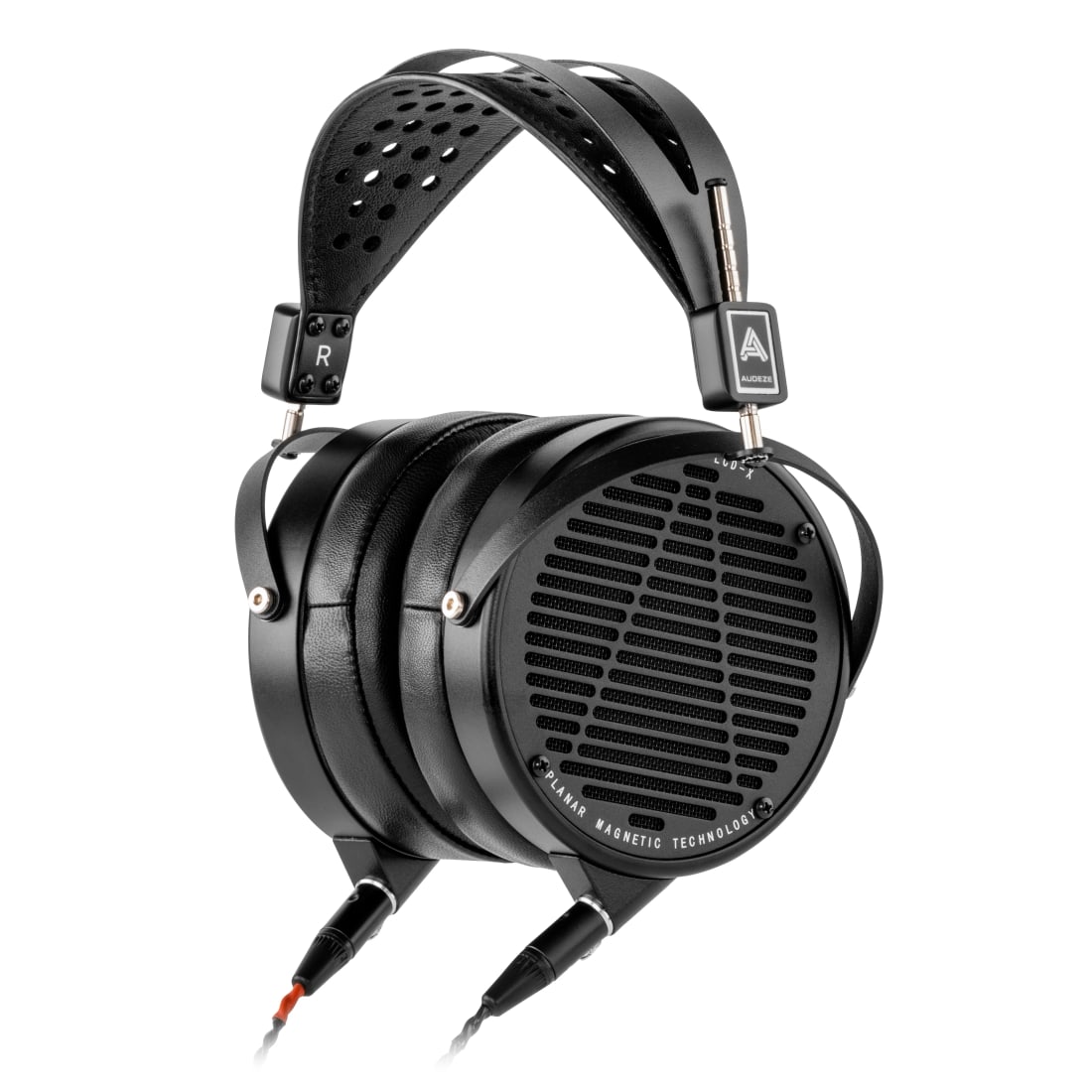
The LCD-X is an open-back planar-magnetic headphone built around a large 106mm driver tuned to a neutral reference profile widely used in professional studios. It suits mixing engineers and audiophiles wanting low distortion and an easy 20-ohm load, at the cost of considerable weight.
As an Amazon Associate and partner of the retailers above, Sound Technology earns from qualifying purchases — at no extra cost to you. Prices and availability checked recently but vary; the linked retailer is the source of truth.
Pros
- Neutral, trustworthy reference tuning
- Very low distortion even at high levels
- Easy 20-ohm load drivable from many amps
- Robust build with user-replaceable parts
Cons
- Heavy at ~600 g for long sessions
- Still wants a capable amp for best dynamics
- Utilitarian looks and large earcups
A working tool that happens to sound extraordinary
Six hundred and twelve grams. That number is the first thing any honest review of the Audeze LCD-X has to reckon with, because it colours everything else about the experience. I've worn these for eight-hour sessions and I've worn them for twenty minutes, and those are genuinely different headphones depending on which it is. But we'll get there.
What the LCD-X is, stripped of the positioning language, is a large-format planar-magnetic headphone tuned to a broadly neutral reference profile and priced at AU$1,899. Audeze builds them in California and they've been through several iterations since the original launch. The version available now runs a 106mm Uniforce diaphragm with Fazor waveguide elements, a 20-ohm impedance and a rated sensitivity of 103 dB per milliwatt. On paper, that combination makes it both unusually easy to drive for a planar and unusually low in distortion — THD sits below 0.1% at 100 dB SPL, which is genuinely good.
The professional audio world has largely made up its mind about these. Walk into a mid-to-upper-tier mixing suite — say, somewhere along the lines of the studios clustered around Sydney's Surry Hills or Melbourne's Collingwood — and you'll find a pair of LCD-X on the desk more often than you might expect. That's not marketing. That's engineers paying their own money because the headphone tells them something useful.
Design and engineering
The driver
Planar magnetic drivers work by suspending a very thin diaphragm (in this case, Audeze's own Uniforce film) between two arrays of magnets. The voice signal runs through a conductive trace printed across the diaphragm, and the whole surface moves rather than a conventional pistonic cone driven from a single point. This matters because it dramatically reduces the mechanical asymmetry that causes distortion at the excursion limits of conventional dynamic drivers. The LCD-X's sub-0.1% THD figure at loud levels isn't marketing; it's a consequence of the physics.
The Uniforce variation specifically addresses a longstanding planar problem: uneven current distribution across the trace means uneven force across the diaphragm, which introduces its own colouration. Audeze's solution is to vary the trace geometry so that force application remains consistent across the membrane surface. It's not the only approach to this problem — other manufacturers use different conductor layouts — but Audeze has been refining theirs for long enough that the implementation is mature.
The Fazor elements are waveguides integrated into the magnet structure. Their purpose is to smooth the interference patterns that the dual-magnet array would otherwise introduce, particularly in the treble. Whether you attribute any perceived smoothness in the top end to Fazor specifically or to the overall tuning is an open question, but the engineering rationale is sound.
Impedance and sensitivity
Twenty ohms is low for a planar. Early Audeze designs were notorious for being punishing loads that exposed the current limitations of all but the beefiest headphone amplifiers. The LCD-X was specifically positioned as the approachable option in the LCD range — the one a studio engineer could run from their interface's headphone output in a pinch. Technically, yes. Practically, it still rewards a proper amp for dynamic headroom. The 103 dB/mW sensitivity means you won't need much voltage, but the impedance is low enough that source output impedance starts to matter. A source with a high output impedance will impose a frequency response interaction. Keep source output impedance below about 2 ohms and you're fine.
Build and materials
The earcups are machined aluminium with a grille that's more industrial than beautiful. The headband is a suspension design — a fabric sling that distributes the clamping load rather than a conventional padded band. This is almost certainly why the LCD-X is as wearable as it is at 612 grams, because that figure would be brutal on a rigid headband. The ear pads are protein leather as standard. Audeze sells alternative pads — perforated leather and fabric options — and these affect the sound meaningfully enough that I'd recommend trying the perforated leather if you find the stock pads warm the low mids too much.
Crucially, nearly everything is user-replaceable. Pads, cables, even the driver assemblies can be swapped. For something at this price, bought as a long-term professional tool, that matters considerably.
The cable supplied is a braided 4-pin XLR terminated affair with a 6.3mm adapter. It's fine. It's not the reason to buy these.
Sound character
I want to be precise about how I'm framing this section. I'm not going to invent a listening session and tell you I heard the opening bars of a specific recording dissolve into a three-dimensional image. What I can tell you is what the known frequency response target, the driver topology, and the consistent reports from engineers and long-term owners tell us to expect — and why those things follow logically from the engineering.
Bass
The LCD-X extends flat to very low frequencies. The specified response starts at 10 Hz, and while that number is optimistic in absolute terms, the more meaningful reality is that the sub-bass is present and controlled without the usual trade-off of mid-bass bloom. Planar drivers don't unload into a backwave the way a dynamic driver does in an open cup — the physics of the diaphragm suspension mean that bass stays tighter. Owners consistently describe the bottom end as present and honest rather than impressive; it tells you what's in the recording rather than adding weight that isn't there. For mixing, that's exactly right. For listeners who want their headphones to flatter bass-heavy material, possibly less so.
Midrange
The midrange is where the LCD-X earns its studio reputation. Vocals, guitars, brass, piano — the frequencies between roughly 250 Hz and 4 kHz are rendered with the kind of low-colouration clarity that makes mix decisions trustworthy. There is a gentle warmth through the upper bass and lower mids that some listeners find musical and others find slightly opaque, and this is the one area where the choice of ear pad makes a genuine difference. The standard pads lean slightly fuller here; the perforated leather opens it up marginally.
Treble
Here's where I'll offer a mild editorial opinion: I reckon the LCD-X treble is one of the more misunderstood aspects of the headphone. It is not a bright headphone. It does not have the forward, etched upper presence that some listeners have come to associate with detail retrieval. Compared to a Beyerdynamic DT 1990 Pro or a Sennheiser HD 800, the LCD-X sounds comparatively relaxed through the presence region. Some people hear this as a lack of air or resolution. I'd argue they're hearing the absence of the 6-8 kHz emphasis that fools our brains into thinking we're getting more information than we are. The actual resolution — the ability to separate fine low-level detail — is excellent. But it presents calmly. Coming from the studio side has made me deeply sceptical of brightness as a proxy for detail, and the LCD-X is a useful corrective.
Dynamics and distortion
The sub-0.1% THD figure translates perceptibly at high playback levels. Headphones that distort at loud levels introduce a kind of smear — transients lose their edge, complex passages become congested. The LCD-X stays composed at levels that would stress lesser drivers. This is particularly relevant for engineers checking mix headroom, but it also means the headphone is simply more pleasant to live with during demanding material. Max SPL is specified above 130 dB, which is well beyond any sane listening level; the relevant point is that the driver has significant headroom above normal use.
Soundstage and imaging
Open-back designs bleed sound both ways — they let environmental noise in and headphone sound out, but they also don't build pressure behind the driver the way a closed cup does. The result for the LCD-X is a soundstage that feels more expansive than most closed headphones without being artificially widened. It's not the cavernous presentation of the HD 800, but positioning is accurate and the stereo image doesn't feel collapsed to a point between your ears. For mixing, imaging is solid and reliable. For pure listening, it's pleasantly unconfined.
Setup and system matching
The LCD-X's 20-ohm impedance makes it drivable from a decent headphone output — a well-specced USB DAC/amp like the RME ADI-2 DAC is an obvious pairing, and one that's common in studios for good reason. The iFi Audio iDSD range also works well. You don't need a high-powered speaker amplifier's headphone tap, but a cheap laptop headphone socket will short-change the dynamics noticeably.
I'd budget at least AU$400-600 for the source and amplification if you're spending AU$1,899 on the headphone. The electronics are not the bottleneck at that point, but they matter. A good DAC matters more than a very expensive cable, and I'll say that plainly because the cable upgrade market around planar headphones sometimes gets silly.
Placement and use context are straightforward — these are open-back, so they require a quiet environment. A noisy open-plan office is not the right home for them. A treated studio, a dedicated listening room, or a quiet home office: yes. The open-back design also means the people around you will hear what you're listening to at moderate volumes, which is occasionally socially awkward anyway.
Living with it
The weight question is real and I won't minimise it. At 612 grams, the LCD-X becomes uncomfortable for most people after two to three hours of continuous wear. The suspension headband does meaningful work here — my own experience with heavy headbands at similar weights is that pressure concentration becomes genuinely painful; the fabric sling distributes load better. But physics is physics. A long mix session requires breaks, and you'd be taking them anyway.
Honestly, I find the weight more manageable at a desk than wandering around, partly because sitting still lets you adjust your head position less, and partly because the suspension does its job better when your head isn't bobbing around. These are not commuting headphones. They are not gym headphones. They are sit-down, serious-listening headphones, and if you use them that way the weight is tolerable, not disqualifying.
Build quality is very good. The machined cups feel substantial. The headband hardware is metal. The connectors are proper mini-XLR. I've seen pairs pass through several years of studio use and come back looking tired cosmetically but functioning perfectly, and the replacement parts availability means a well-maintained pair has an indefinite service life in principle.
In Australia, Audeze is distributed through BusiSoft AV, and support has been responsive in my experience. Warranty is two years for electronics and one year for ear pads and cables, which is fairly standard. Parts availability locally could be better — some pad variants require ordering from Audeze directly — but this is a common friction point with specialist headphone brands in the Australian market rather than an LCD-X-specific failing.
The included travel case is functional and adequately protective. It's not a feature I'd use daily, but for anyone transporting these between studios, it does the job.
How it compares
At AU$1,899, the LCD-X sits in a genuinely competitive tier. The Hifiman Arya Stealth is available for similar money and offers a lighter chassis with arguably more treble air, though its build quality has drawn more criticism over the years and its imaging character is quite different. The Sennheiser HD 800 S comes in around AU$2,000-2,200 and has a larger soundstage and more forward treble, but its bass is lighter and it's notoriously fussy about amplification matching. The Beyerdynamic T1 3rd Generation sits nearby and is a very different sonic character — much brighter, dynamic driver, arguably better for certain genres.
For studio reference specifically, the LCD-X occupies a useful gap: more reliable low-end extension than the HD 800 S, more neutral through the mids than the T1, and lower distortion than most of the competition at this price point. It's not the last word in any single attribute, but it's consistently competent across all of them in a way that suits professional use particularly well.
Who it's for, and who should look elsewhere
The LCD-X makes obvious sense for mixing engineers who want a reliable second opinion beyond their nearfields, for audiophiles who prioritise accuracy over flattery, and for anyone who needs a headphone that stays composed at high levels. The 20-ohm load means it's accessible without a heroic amplifier investment.
Look elsewhere if weight genuinely is a hard limit for you — and it's a legitimate constraint, not a weakness of character. Look elsewhere if you want an expansive, airy presentation with elevated treble sparkle; there are headphones at this price that do that better, and if that's the sound you love, the LCD-X will feel comparatively dull. Look elsewhere if you need closed-back isolation. And look elsewhere if you're hoping to pair these with a phone or a basic laptop output and get the full picture — it will work, technically, but you won't hear what the headphone is actually capable of.
The LCD-X is a serious instrument built for people who use headphones seriously. At AU$1,899, it asks you to commit to both the investment and the ergonomic compromise. For those who meet it on those terms, it repays that commitment with a level of honesty that's genuinely rare at this price. The weight is a real cost. The sound is a real reward. Whether that trade-off works for your specific situation is the only question left to answer.
Common questions
- Can I drive the Audeze LCD-X from a smartphone or laptop headphone output?
- Technically yes — the 20-ohm impedance and 103 dB/mW sensitivity mean most headphone outputs can get the LCD-X to a listenable volume. But the dynamic headroom and low-level detail the driver is capable of will be noticeably constrained by a weak output. A dedicated DAC/amp in the AU$400-600 range is a practical minimum if you want the headphone working as intended.
- How does the weight compare to other planar headphones in this price range?
- At 612 grams, the LCD-X is on the heavier end of open-back planars. The Hifiman Arya, for comparison, is considerably lighter at around 404 grams. Audeze's suspension headband mitigates the weight somewhat compared to a rigid band, but for sessions longer than two to three hours, most users report needing to take breaks.
- Are the ear pads replaceable, and does changing them affect the sound?
- Yes, pads are user-replaceable and Audeze sells several variants. The change in sound is meaningful enough to warrant auditioning if you have the opportunity — the perforated leather pads tend to open up the upper midrange slightly compared to the standard protein leather, while suede-style options typically warm the response. It's not a subtle difference.
- Is the LCD-X suitable for gaming as well as music listening?
- The open-back design gives it a natural, unconfined soundstage that works well for positional audio in games, and the low distortion is pleasant for long sessions. The weight is the real limiting factor — most gaming sessions are long, and 612 grams will become uncomfortable for most people. If gaming is your primary use, a lighter headphone is probably the more practical choice even if it's technically less accurate.
- Where can I buy the Audeze LCD-X in Australia and what does the warranty cover?
- The LCD-X is distributed in Australia through BusiSoft AV, with stock available through authorised specialist retailers. The warranty covers two years on electronic components and one year on consumable parts like ear pads and cables. Some replacement parts and pad variants may need to be ordered directly from Audeze, which means factoring in international shipping times.