Bowers & Wilkins 705 S3
Rating: 4.6 / 5
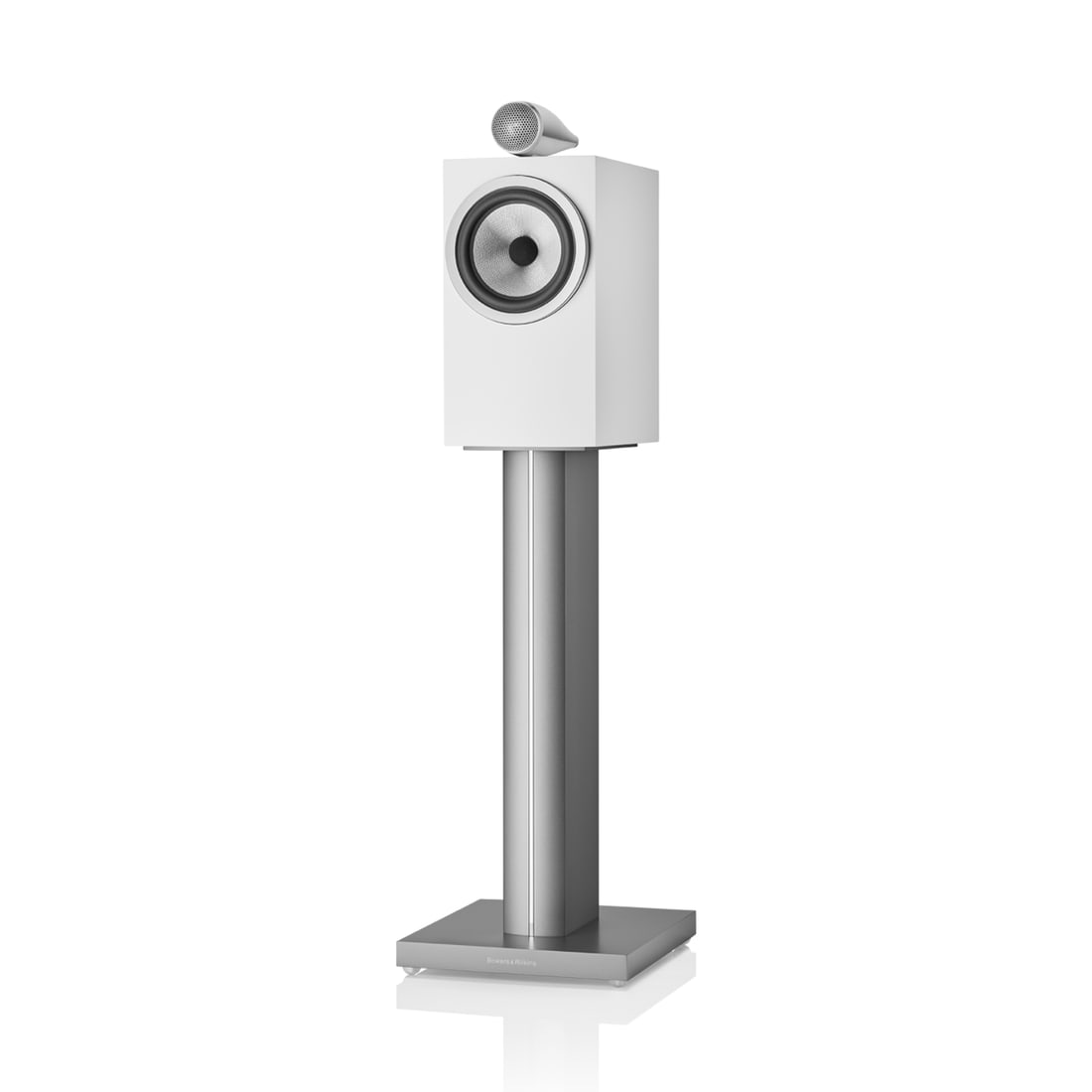
A two-way standmount with a Solid Body Tweeter-on-Top decoupled Carbon Dome and Continuum cone bass/midrange driven by 800-Series trickle-down tech, aimed at discerning hi-fi listeners wanting open, revealing sound from a stand-mounted speaker.
As an Amazon Associate and partner of the retailers above, Sound Technology earns from qualifying purchases — at no extra cost to you. Prices and availability checked recently but vary; the linked retailer is the source of truth.
Pros
- Tweeter-on-top design yields an open, airy, precise treble
- Continuum cone gives a clean, transparent midrange
- Easy 8-ohm load with relatively high 88 dB sensitivity
Cons
- Dedicated FS-700 S3 stands are an extra cost
- Bass extension limited versus larger or three-way rivals
Opening take
Let me be upfront about something: I have complicated feelings about Bowers & Wilkins. On one hand, they are genuinely excellent engineers with a long history of serious acoustic research. On the other, they operate in a market space where their own brand halo can sometimes outshine the actual engineering case for a specific model. The 705 S3, I'm happy to report, mostly earns its keep. At A$4,499 it sits in fiercely competitive territory — this is the price bracket where Australian buyers can also consider the KEF R3 Meta, the Dynaudio Evoke 20, and the Monitor Audio Silver 300 7G. None of those are pushovers. But the 705 S3 comes with a specific and coherent design philosophy rooted in what B&W learned building their flagship 800 Series, and that philosophy is legible in the engineering. That counts for something, and in this case it counts for quite a lot.
This is not a speaker for every room, every system, or every listener. It rewards careful partnering, careful placement, and a degree of patience in setup. But when it clicks, it does something that relatively few standmounts at this price can manage: it gets out of the way of the music with a kind of lucid calm that is genuinely impressive.
Design & engineering
The Solid Body Tweeter-on-Top
The most visually distinctive element of the 705 S3 is, of course, the decoupled tweeter sitting in its own isolated pod above the main cabinet. This isn't styling. It's a deliberate engineering response to a real problem: cabinet resonances, no matter how well-damped, travel through a speaker's structure and reach any drive unit bolted to it. A tweeter mounted on the baffle will inevitably be excited by those residual vibrations, adding a layer of coloration at frequencies where the ear is acutely sensitive — roughly 2 kHz and upward.
By seating the tweeter in a separate 'Solid Body' pod and decoupling it from the main cabinet via a compliant mount, B&W have largely broken that mechanical transmission path. The pod itself is machined aluminium — inert and non-resonant — and the geometry is deliberately rounded to minimise baffle diffraction around the tweeter's radiating surface. The practical result on paper is a cleaner, lower-noise environment for the 25mm Carbon Dome to operate in, with less spurious energy muddying the signal at high frequencies. This is real engineering with a measurable rationale, not a marketing gesture.
The Carbon Dome itself is the same material used in B&W's flagship 800 D4 tweeter, albeit in a more modest implementation. Carbon is stiffer than aluminium and significantly stiffer than fabric, which pushes the tweeter's first break-up mode well above the audible range — B&W cite figures beyond 40 kHz for the material in this application. That stiffness, combined with controlled damping, is what gives the 705 S3 its specified upper-frequency extension to 28 kHz. For listeners who value a sense of air and space in recordings — that fine grain of ambience and overtone decay — the material choice here is purposeful.
The Continuum cone
The 165mm bass/midrange driver uses B&W's proprietary Continuum woven cone material, developed as a replacement for Kevlar in their mid-range units. Kevlar was always a compromise: excellent stiffness but with a characteristic mid-frequency coloration — a slight 'cupped hands' quality that experienced listeners identified over the years. Continuum was designed to deliver comparable stiffness with more neutral damping characteristics, reducing that particular coloration.
In a two-way design like the 705 S3, the bass/midrange unit is doing a lot of heavy lifting — it handles everything from the 50 Hz bass extension up to the crossover point (B&W don't publish the crossover frequency officially, but it's understood to be in the 4 kHz region for this series). That's a broad range that includes the most tonally sensitive octaves of the audio band. The choice of Continuum here is not incidental; it's central to the speaker's intended character of transparency and tonal neutrality through the critical midrange.
The cabinet itself is a conventional vented-box alignment — the rear port tuning contributes meaningfully to the rated 50 Hz lower limit. The internal bracing uses B&W's matrix bracing system, which adds non-parallel internal struts to break up standing waves without adding mass wastefully. The cabinet is relatively compact at 413mm tall (including the tweeter pod) and 192mm wide — these are proper standmounts, not bookshelf speakers in disguise.
Sensitivity and impedance
The 88 dB sensitivity at 2.83V/1m, combined with a nominal 8-ohm impedance, gives the 705 S3 a reasonably tractable load for most amplifiers. The minimum impedance of 3.7 ohms is worth noting — it occurs at a specific frequency and means you'll want an amplifier that can deliver stable current into a modestly reactive load. It's not difficult, but it rules out very low-power valve amplifiers running in single-ended configurations, and it rewards amplifiers with a confident power supply rather than penalising them.
Sound
Bass
Fifty hertz is the honest lower limit here, and I want to be clear-eyed about what that means in practice. In a typical Australian listening room of, say, 25–40 square metres, the 705 S3 will deliver tuneful, well-controlled bass that handles acoustic jazz, chamber music, piano, and even moderately dense orchestral work with genuine composure. It will not pressurise a room. It will not give you the physical weight of a large floorstander or a partnered subwoofer. Owners who primarily listen to electronic music, large-scale orchestral works, or organ will feel the absence of the bottom two octaves on a visceral level.
What the 705 S3 does with the bass it has is admirable on paper. The vented alignment is tuned for speed and definition rather than maximum extension — bass notes are reported consistently by owners as tight and well-defined, with minimal overhang. This suits the speaker's broader character of resolution and transparency rather than warmth or weight.
Midrange
This is where the 705 S3 makes its strongest argument. The Continuum cone, operating in a well-braced, low-resonance cabinet, with a decoupled tweeter relieving it of high-frequency duties at the crossover, is by design in its optimum operating window for much of the critical midband. Vocal reproduction — the test I return to obsessively — is expected to be clean, direct, and free of the colouration that plagued earlier Kevlar-cone B&W designs. Owners consistently describe the midrange as open and revealing without thinness, with a natural weight through the lower-midrange that keeps instruments like cello, male voice, and piano left hand sounding grounded rather than etched.
The caveat, as always with a highly resolving midrange, is that the 705 S3 will tell you precisely what your source and amplification are doing. Flattering of mediocre recordings or upstream gear is not in its character description.
Treble
On paper, the Carbon Dome in its decoupled pod should produce treble that is extended, grain-free, and spatially open. The 28 kHz upper limit gives it comfortable headroom well above the audio band, meaning it's not working anywhere near its mechanical limits within the range we actually hear. Owners and reviewers in other markets describe the treble as airy and precise — cymbals have correct weight and shimmer, massed strings have space between individual instruments, and high-frequency transients like harpsichord plucks or triangle strikes arrive with clarity and appropriate decay.
The Carbon Dome does have a character that's worth naming honestly: it is on the analytical rather than the romantic end of the spectrum. This is not a warm, softly lit treble. Listeners who are accustomed to soft-dome tweeters — particularly fabric domes from the Scandinavian school — may find the 705 S3's top end initially more forward. Whether that reads as 'revealing' or 'bright' will depend partly on room acoustics and partly on partnering gear, and I'll address both below.
Dynamics and soundstaging
The combination of an 88 dB sensitivity and a clean, low-distortion motor system means the 705 S3 should handle dynamic contrasts — the difference between pianissimo and fortissimo in a live recording — with reasonable authority for a two-way standmount. The tweeter-on-top geometry also has a meaningful effect on soundstaging: by removing the tweeter from the baffle plane and allowing it to radiate more freely, B&W have created conditions for better stereo imaging height and a more convincing sense of three-dimensionality in the soundfield. Owners report a notably tall, well-focused image with good depth layering — a characteristic that aligns directly with the engineering intent.
Setup & system matching
Stands and placement
B&W make their own FS-700 S3 dedicated stands, and I'll say directly: you should budget for them. They are not included at the A$4,499 price point and will add to your outlay. Aftermarket alternatives exist — Target, Atacama, and others make solid stands at comparable heights — but the FS-700 S3 stands are engineered to couple to the 705 S3's cabinet in a specific way, and the acoustic case for using them is legitimate, not mere brand upselling.
Placement matters considerably with this speaker. The rear port means distance from the back wall affects bass balance — closer proximity will reinforce bass but risk muddiness; too far out and you lose the port contribution. Start with at least 30–40 cm from the rear wall and adjust by ear. Toe-in affects the treble presentation significantly: more toe-in brings the Carbon Dome's more directional output into the listening position more directly, which can tip the balance towards brightness in a live, reflective room.
Amplification
The 30–120W recommended range is sensible. A quality integrated amplifier in the 50–80W class — Rega Elicit, Naim Nait XS 3, Cambridge Audio EVO 150, or a second-hand Hegel H190 — will partner this speaker very well. The slightly capacitive dip to 3.7 ohms means I'd lean towards amplifiers with a robust power supply and good current delivery. Warm-character amplifiers can help if the room is live and the treble character proves too analytical; lean or bright upstream components will exacerbate that tendency.
Valve amplifiers with an output transformer tapped at 8 ohms — a quality EL34-based push-pull integrated of 30W or more — can work beautifully, providing both the current delivery and a complementary tonal character. Single-ended triode designs below 10W are not suitable partners.
Cabling and sources
I'll say what I always say: don't spend more on speaker cable than you spent on your stands. Competent 16-gauge or 14-gauge copper cable from a reputable manufacturer is the floor; beyond that, improvements are system-dependent and often marginal. The 705 S3 is resolving enough that a genuinely poor source will be exposed, so prioritise your DAC or turntable over exotic wiring.
Living with it
Build quality is excellent in the hand — the cabinet finish on both the White Gloss and Midnight Blue Metallic options is properly executed, and the machined aluminium tweeter pod feels substantial and precise. The grilles attach magnetically, which is clean, and the speaker's compact footprint makes it manageable in typical Australian living spaces that often don't accommodate large floorstanders comfortably.
B&W's Australian distribution through Interdyn is well-established, with authorised dealers in all major cities. Warranty support is reliable. The 705 S3 is not a product you'll struggle to find serviced or supported in Australia, and that matters at this price point.
How it compares
The KEF R3 Meta is the most obvious rival and in some ways the most interesting comparison. The R3 Meta's Uni-Q coincident driver offers a genuinely different approach to imaging and dispersion — some listeners find it more naturally cohesive, others prefer the 705 S3's more explicit spatial layering. The R3 Meta also goes slightly deeper in bass. The 705 S3 counters with what many listeners describe as a more emotionally direct midrange.
The Dynaudio Evoke 20 offers a warmer, softer character — it's more immediately forgiving of bright recordings and a better choice for listeners who prioritise long-term ease of listening over maximum resolution. The 705 S3 is the more revealing and technically precise of the two.
The Monitor Audio Silver 300 7G is larger and more efficient, with deeper bass extension and a warmer tonal balance courtesy of its ribbon tweeter. It's arguably better value for listeners who want a fuller, more room-filling sound. The 705 S3 wins on imaging precision and midrange clarity.
Who it's for — and who should look elsewhere
The 705 S3 is for the listener who values resolution and transparency above all, who has a well-matched amplifier, a controlled room, and the patience to position the speaker carefully. It suits acoustic music, jazz, classical, and well-recorded rock or singer-songwriter material. It partners beautifully with high-quality digital sources and will reward vinyl playback through a competent phono stage.
You should look elsewhere if: your room is acoustically live and bright, your amplifier is lean or analytical, you listen primarily to music with substantial bass content and want physical impact, or your budget is genuinely stretched by the A$4,499 asking price before stands — because this speaker genuinely needs those stands, and that cost is real.
Verdict
The 705 S3 is among the best two-way standmounts available in Australia at this price, with a coherent engineering rationale that justifies most of its asking price. The tweeter-on-top design and Continuum midrange deliver a combination of imaging precision and tonal transparency that is genuinely competitive. It is not universally flattering, and it is not cheap once properly supported. But for the listener who knows what they want from a revealing, precise, musically honest standmount, the 705 S3 makes a compelling and honest case for itself.
Common questions
- Do I need to buy the dedicated B&W FS-700 S3 stands, or will any good stands do?
- The FS-700 S3 stands are purpose-engineered to couple with the 705 S3 cabinet and are genuinely recommended — not just brand upselling. That said, quality aftermarket stands from Atacama, Target, or similar at an appropriate height (approximately 600mm) can work well. Whatever you choose, budget for proper stands; sitting these speakers on a bookshelf does them a serious disservice both acoustically and in terms of imaging performance.
- Will the 705 S3 work with a valve amplifier?
- Yes, with the right one. A quality push-pull valve integrated of 30W or more into 8 ohms — EL34 or KT88 based — can partner the 705 S3 very well, and the tonal warmth of a good valve design complements the speaker's analytical character. Single-ended triode amplifiers below 10W are not suitable partners: the 88 dB sensitivity helps, but the minimum impedance dip to 3.7 ohms demands an amplifier with a confident output transformer and power supply.
- Is 50 Hz bass extension enough for real-world listening?
- For acoustic music, jazz, classical, vocal, and most rock, yes — 50 Hz captures the fundamentals of the vast majority of musical content. Where it becomes limiting is in music with significant sub-bass content: large pipe organ, electronic music, film scores, and anything that relies on the bottom two octaves for physical impact. In those genres, the absence will be felt. Adding a quality subwoofer can address this, though integration requires care.
- The treble is described as analytical. Does that mean it's harsh?
- Not inherently. The Carbon Dome tweeter is extended and detailed rather than harsh — the decoupling system specifically aims to remove the resonance artifacts that can make dome tweeters sound edgy. However, in a highly reflective room or paired with a bright or lean amplifier, the 705 S3's top end can tip towards fatiguing. In a sensibly treated room with well-matched amplification, owners consistently describe the treble as airy and precise rather than aggressive.
- Where can I audition and buy the 705 S3 in Australia, and what does warranty support look like?
- B&W is distributed in Australia by Interdyn, with authorised dealers in Sydney, Melbourne, Brisbane, Adelaide, and Perth. The standard Australian warranty applies (two years parts and labour through authorised service), and Interdyn's long-standing relationship with B&W means spare parts and service support are reliably available. As always, buy from an authorised dealer rather than a grey-market importer if warranty and after-sales support matter to you — and at A$4,499, they should.