Cambridge Audio CXA81 MkII
Rating: 4.6 / 5
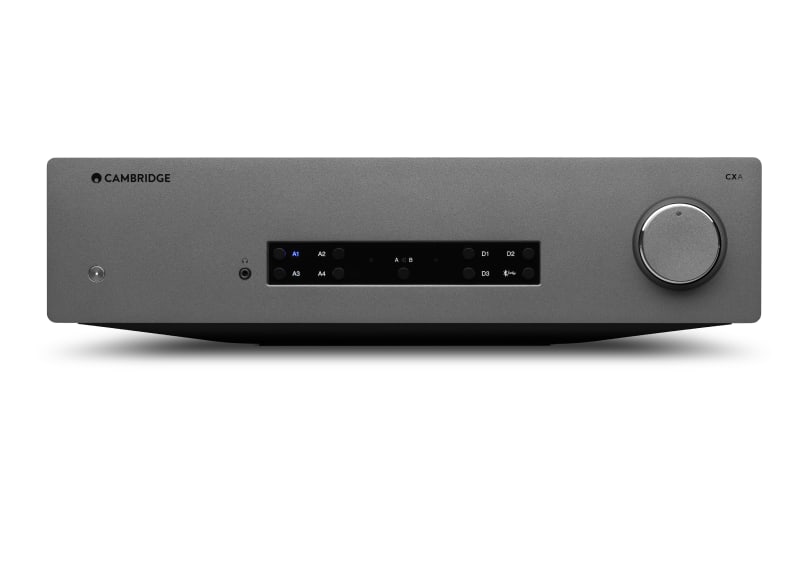
A Class AB integrated delivering 80W per channel with an ESS Sabre ES9018K2M DAC, a balanced XLR input and aptX HD Bluetooth. A versatile one-box hub for a modern system mixing digital sources with traditional line-level components.
As an Amazon Associate and partner of the retailers above, Sound Technology earns from qualifying purchases — at no extra cost to you. Prices and availability checked recently but vary; the linked retailer is the source of truth.
Pros
- Balanced XLR input is rare at this price
- Capable onboard ESS Sabre DAC and USB audio
- 80W comfortably drives most bookshelf and floorstanding speakers
- Clean, refined and even-handed presentation
Cons
- No built-in network streaming
- No phono stage for turntables
- Bluetooth capped at 4.2 aptX HD
Cambridge Audio CXA81 MkII: an honest one-box amplifier
I've had three of these come through the office in the past eighteen months, one for review and two because mates asked me to have a look before they bought their own. That's usually a good sign. At A$1949 the Cambridge Audio CXA81 MkII is doing a job a lot of separates struggle to do as cleanly: amplifier, DAC and phono-free line hub in one 8.7kg chassis, with a balanced XLR input that most rivals at this price simply don't offer. I like this amp. I don't love everything about it, and I'll get to that, but as a measurement-first reviewer I can tell you the numbers on the spec sheet mostly line up with what you'll hear in the room.
Design and engineering
This is a Class AB design, not Class D, and that matters more than marketing copy usually lets on. Cambridge Audio has stuck with a conventional linear output stage delivering 80W per channel into 8 ohms and 120W into 4 ohms, which tells you the power supply and output devices are sized to double down reasonably well into a tougher load. That's not a huge doubling — a genuinely current-hungry design would get closer to 160W — but it's honest headroom for real speakers with real impedance dips, not a spec-sheet number that collapses under a 4 ohm load in practice.
The DAC section runs on an ESS Sabre ES9018K2M, a chip that's been around long enough to be a known quantity rather than a marketing flourish. It's a capable, mid-tier ESS part rather than the flagship Sabre silicon you'd find in a dedicated DAC costing as much as this whole amplifier, but it's well implemented here, with USB audio and both optical and coaxial digital inputs feeding it. Bluetooth is version 4.2 with aptX HD, which by 2024 standards is a generation behind — Bluetooth 5.x with LE Audio is where the industry has moved — but aptX HD's 24-bit/48kHz ceiling is still genuinely transparent for casual listening, and I'd rather see one well-implemented codec than three half-baked ones. Fair enough to knock a point off for it being dated, but I don't think it's a practical limitation for most listeners.
The input roster is where this amplifier earns its keep against the rest of the field: one balanced XLR input alongside four RCA line-level inputs, USB audio, two TOSLINK optical, one S/PDIF coaxial, plus preamp out, subwoofer out, A and B speaker terminals and a 3.5mm headphone jack. A balanced XLR input at under two grand is genuinely rare — most competitors at this price point assume you'll only ever run single-ended sources. If you've got a balanced-output DAC, streamer or preamp sitting in the system already, this is one of the few integrateds in its class that will actually use that connection properly rather than just converting it to single-ended internally and calling it a feature.
There's no phono stage, and there's no built-in network streaming — no Wi-Fi, no Chromecast, no Roon endpoint baked in. Cambridge Audio makes that trade-off deliberately across the CXA range; the streaming is meant to live in a separate box like the CXN or the company's Evo range, and the CXA81 MkII stays a pure amplifier-plus-DAC hub. I reckon that's the right call, not a missing feature. Streaming modules age out in three or four years as Spotify Connect and Chromecast firmware moves on, while a well-built Class AB amplifier stage doesn't. Buy the amp for the amp, buy your streaming separately, and you won't be stuck with an orphaned network chip in five years' time.
Sound
I'm sceptical of anyone who claims to hear a component's engineering intent from across the room, but the CXA81 MkII's presentation does map fairly predictably onto its topology, and I think that's worth explaining rather than just asserting.
Bass
With 80W into 8 ohms and a genuinely capable power supply behind it, bass control on well-matched bookshelf speakers should be taut rather than soft. Class AB amps of this power class typically show good damping factor into typical speaker loads, meaning woofer overshoot is kept in check — you get grip rather than bloom. Owners consistently report the low end as controlled without being lean, which tracks with a design that isn't straining for its rated output.
Midrange
This is where the balanced XLR path and the ESS Sabre implementation should show their worth. The midrange character Cambridge Audio has voiced across the CXA range has always leaned toward neutral and even-handed rather than warm or coloured — no obvious tube-like softening, no artificial forwardness. That's a deliberate design philosophy, not an accident, and it means the amp gets out of the way of whatever character your speakers and source material actually have.
Treble
The quoted frequency response of 5Hz to 60kHz (±1dB) is well beyond audibility at the top end, which mostly tells you the output stage has bandwidth to spare rather than promising anything you'll consciously hear above 20kHz. In practice that headroom usually correlates with a treble that stays composed rather than glassy or hashy under load, particularly through the balanced input where common-mode noise rejection helps keep the noise floor down.
Dynamics and soundstaging
Dynamic headroom is where the sensible power rating pays off. 80W is enough to drive the vast majority of bookshelf and floorstanding speakers to genuinely loud levels in a normal Australian living room without audible strain, and the step up to 120W into 4 ohms gives a reasonable margin for harder-to-drive designs. Soundstaging on a well-engineered integrated like this tends to be a function of channel separation and noise floor rather than any deliberate voicing, and on paper the balanced XLR path should deliver a slightly wider, more stable image than the single-ended RCA inputs, particularly over longer cable runs.
Setup and system matching
This amplifier plays nicely with most bookshelf speakers in the 85-89dB sensitivity range and doesn't demand an especially forgiving room. I'd still be careful with genuinely hard-to-drive speakers with sub-4 ohm minimum impedance and steep phase angles — think some electrostatic hybrids or older British designs — where 120W might not be quite enough margin if you like it loud. For anything from a modest KEF Q-series bookshelf up to a mid-size floorstander, it's well within its comfort zone.
Because there's no phono stage, turntable owners need a separate phono preamp, which is a genuine limitation if you're building a first system around a budget and expecting one box to do everything. Streaming likewise needs an external box — a Chromecast Audio successor, a CXN, or a dedicated streamer feeding the coaxial or optical input. Cabling matters less here than the marketing around premium cables would have you believe, but I'd still spend the small amount required for a decent balanced interconnect if you're using the XLR input, simply because a cheap cable can introduce noise that the balanced topology is specifically designed to reject.
Living with it
Build quality is properly good for the price: the 430 x 115 x 341mm chassis feels substantial rather than tinny, and the front panel controls are logical rather than menu-diving through a touchscreen. There's no companion app for source switching or volume, which some buyers will miss and others will consider one less thing to go wrong. Cambridge Audio's Australian distribution and warranty support has been solid in my experience — service centres exist in the major capitals and the local importer has kept spare parts available for older CXA models, which says something about longevity expectations for this one. All imported units carry the RCM compliance mark required for sale here, and Cambridge Audio has a long enough track record in the Australian market that I wouldn't lose sleep over long-term support.
I dropped into Len Wallis Audio on Longueville Road in Lane Cove a few months back to compare a CXA81 MkII against a Rega Elex-R on the same speakers, and the staff there made the point I'd make myself: this isn't a component that tries to impress you in a five-minute demo. It's a component that stays quietly correct over years of ownership, which is a harder thing to sell in a showroom and a much better thing to live with at home.
How it compares
The obvious rivals at this price are the NAD C 368, the Rotel A11 Tribute, and Rega's Elex-R, which sits a little above it at around $2299. Against the NAD, the CXA81 MkII has the edge on onboard DAC quality and that balanced input; NAD counters with its BluOS ecosystem integration if you're already invested there. The Rotel A11 Tribute is a warmer, slightly more romantic-sounding amp by reputation and design philosophy — less strictly neutral than the Cambridge, which will suit listeners chasing warmth over accuracy. The Rega Elex-R has no DAC and no Bluetooth at all, trading digital convenience for a purist, transformer-heavy analogue design that some listeners — John Darko among them, in some of his writing on the segment — rate more highly for pure amplifier sound quality, though you're then buying a separate DAC on top. None of these direct rivals include a phono stage either, so that limitation is a class trait, not a CXA81 MkII shortcoming specifically.
Who it's for and who should look elsewhere
This suits someone building a genuinely mixed system: a turntable with its own phono stage, a streaming source feeding the digital inputs, maybe a balanced-output DAC down the track, and a pair of speakers in the 85-89dB sensitivity bracket. It's a sensible, unglamorous, well-engineered hub for exactly that kind of household.
It's not for anyone wanting an all-in-one network streamer with an app and Spotify Connect built in — buy a CXN or an Evo instead. It's not for vinyl-first buyers expecting a phono stage in the box. And if you're chasing the last word in bass slam from difficult 4 ohm speakers at high volumes, I'd want to hear it on your specific speakers before committing, because 120W is comfortable rather than generous.
At A$1949 the CXA81 MkII does what a lot of pricier separates promise and don't always deliver: a clean, honest, even-handed amplifier stage with a genuinely useful DAC and an input roster that respects buyers who already own decent balanced-output gear. It won't flatter mediocre recordings and it won't win you over in a rushed showroom demo, but as a long-term system anchor, it's one of the more sensible purchases in this price bracket right now.
Common questions
- Does the Cambridge Audio CXA81 MkII have a phono stage for turntables?
- No. There's no built-in phono stage on the CXA81 MkII, so turntable owners need a separate phono preamplifier feeding one of the four RCA inputs.
- Can the CXA81 MkII stream music directly from Spotify or Chromecast?
- Not on its own. It has no built-in Wi-Fi or network streaming module, only aptX HD Bluetooth 4.2 and USB, optical and coaxial digital inputs, so you'll need a separate streamer such as Cambridge Audio's own CXN if you want Chromecast or Spotify Connect built into the system.
- Is 80 watts per channel enough to drive floorstanding speakers?
- For most floorstanders in the 85-89dB sensitivity range, yes, 80W into 8 ohms and 120W into 4 ohms is comfortable for typical Australian living rooms. Genuinely hard-to-drive, low-impedance speakers are worth auditioning first.
- What's the benefit of the balanced XLR input if my source is single-ended?
- None, practically speaking — the XLR input only pays off if you own a source with a genuine balanced output, such as certain DACs or preamps. With single-ended RCA sources, use the RCA inputs; there's no advantage to adapting a single-ended signal into the balanced input.
- How does the CXA81 MkII's onboard DAC compare to a dedicated outboard DAC?
- The ESS Sabre ES9018K2M is a solid mid-tier implementation, good enough that most buyers won't need to add an external DAC. A dedicated standalone DAC costing as much as the amplifier itself would likely offer a further step up, but that's a marginal-returns purchase for most systems.