Cambridge Audio CXN100
Rating: 4.6 / 5
A high-resolution network music streamer built around an ESS SABRE32 DAC and the StreamMagic platform, aimed at listeners adding flexible hi-res streaming and DAC duties to an existing amplifier and speakers.
As an Amazon Associate and partner of the retailers above, Sound Technology earns from qualifying purchases — at no extra cost to you. Prices and availability checked recently but vary; the linked retailer is the source of truth.
Pros
- High-end ESS SABRE32 DAC with balanced XLR outputs
- Comprehensive streaming on the mature StreamMagic platform
- Extensive hi-res and DSD playback (up to 32-bit/768kHz, DSD512)
Cons
- No HDMI ARC/eARC (reserved for the pricier CXN100 SE)
- Streamer/DAC only — requires a separate amplifier and speakers
Opening take
There's a particular kind of buyer Cambridge Audio has always understood: the person who already owns a decent integrated amplifier and a pair of speakers they're genuinely happy with, but whose source chain is a laptop, a phone plugged into a Bluetooth speaker, or — and I say this without judgement — a decade-old CD player doing streaming duty via a dodgy USB stick shoved into the back. The CXN100 exists for that person. At A$1,899, it slots into your rack, talks to every major streaming service, accepts digital signals from your television or transport, and hands your amplifier a clean analogue signal via balanced XLR or standard RCA. It is not trying to be everything. It is trying to be one thing extremely well. Whether it succeeds is worth interrogating properly.
My job, as I see it, is not to tell you this streamer sounds "liquid" or "musical" — those words do actual harm to the discourse — but to explain what Cambridge has engineered here, what the topology implies about sonic character, where the compromises live, and whether A$1,899 is a sensible ask in the current market. Let's get into it.
Design & engineering
The DAC at the heart of it
Cambridge has built the CXN100 around the ESS ES9028Q2M, a member of the SABRE32 family that occupies a genuinely interesting tier in the ESS lineup. It is not the flagship ES9038PRO you'd find in a dedicated DAC costing three times as much, but it is not the budget-tier part either. The ES9028Q2M is a dual-monaural, quad-channel chip — each stereo channel gets two DAC cores operating in parallel, which ESS calls Hyperstream II modulation. The purpose of that parallelism is noise-shaping efficiency: running two cores together and summing their outputs reduces random quantisation noise by an amount that scales with the square root of the number of cores. On paper, this translates to lower noise floors and improved dynamic range compared to a simpler single-core implementation. Cambridge's own implementation choices — the analogue output stage, the power supply filtering, the quality of the passive components around the chip — will determine how much of that theoretical headroom actually reaches your amplifier input, but the silicon itself is a credible foundation.
The chip is rated to handle PCM up to 32-bit/768kHz natively and DSD up to DSD512 (that's 22.5MHz). In practice, very little real-world content exists at those extremes — DSD512 is essentially a measurement enthusiast's format at this point — but the headroom matters because it means Cambridge can apply oversampling and noise-shaping without butting up against conversion ceilings. Whether you care about that philosophically will depend on your views on digital signal processing, but it is engineering substance, not marketing invention.
Balanced outputs and why they matter here
The inclusion of balanced XLR outputs at this price point is not incidental. A differential balanced signal path, properly implemented, offers common-mode noise rejection — that is, any electrical noise introduced equally on both the positive and negative legs of the signal gets cancelled at the receiving end. In a home environment with switch-mode power supplies, LED lighting dimmers, and the general electromagnetic chaos of modern Australian living, this matters more than it did in the analogue era. It also doubles the nominal output voltage relative to an unbalanced RCA feed (assuming the receiving amplifier is a true balanced design), which can meaningfully improve signal-to-noise ratio in the system as a whole. If your amplifier has balanced XLR inputs — and many integrated amplifiers in this price bracket do — use them. This is not an optional nicety; it is part of the design rationale for the CXN100.
StreamMagic Gen 4 platform
Cambridge's StreamMagic platform is now in its fourth generation, and maturity counts for something in networked audio. Early-generation streaming platforms — across multiple brands, not just Cambridge — were plagued by dropouts, sluggish interfaces, unreliable Roon handshakes, and app instability that made the experience genuinely frustrating. Gen 4 StreamMagic has had the time to address most of those growing pains. The CXN100 supports Roon Ready certification, TIDAL Connect (which means playback is handled device-side, not via Roon's or a phone's processing), Qobuz native integration, Spotify Connect, Amazon Music, Deezer, AirPlay 2, and Google Cast. That is a comprehensive list. Bluetooth 5.1 with aptX HD covers casual wireless use at up to 24-bit/48kHz — adequate for the format, not a substitute for a wired network connection.
The USB Type B input on the rear is USB Audio 2.0 compliant, meaning a computer connected via a proper USB audio driver will have access to the full resolution capability of the DAC. This is the correct specification for this application; USB Audio 1.0 is limited to 96kHz and would be a meaningful bottleneck for anyone feeding high-rate PCM from a music server.
What's not here
No HDMI ARC or eARC. Cambridge reserves that for the CXN100 SE, which commands a significant premium. If television integration via HDMI is a core requirement — home theatre pass-through, for instance — the base CXN100 will not serve you. The digital inputs are limited to coaxial S/PDIF and TOSLINK optical, both of which are sample-rate limited (coaxial to 192kHz typically, TOSLINK often lower due to the optical bandwidth ceiling). This is not a flaw so much as a deliberate product differentiation, but it is worth knowing before you commit.
Sound
I want to be precise about what I can and cannot tell you here. I have not run the CXN100 through our measurement suite in this review — I am working from the engineering, the established character of the ESS ES9028Q2M implementation, and what owners and reviewers have consistently reported over time. I will frame this analysis accordingly.
Bass
The SABRE32 family has a well-documented character in the low frequencies: tight, fast, and linear rather than warm or rounded. Owners consistently describe the bass as controlled and well-defined — kick drums have attack rather than bloom, and bass guitar lines tend to track clearly even in complex low-frequency arrangements. If you are coming from a warmer R-2R or Burr-Brown-based source, the ESS presentation may initially read as lean. It is not lean; it is accurate. Your ears will adjust, and when they do, you will hear bass detail you were previously missing. What you will not get — by design — is the euphonic warmth that some listeners find addictive in non-ESS topologies.
Midrange
This is where the SABRE32 implementation, and Cambridge's output stage specifically, does its most important work. ESS chips have historically attracted criticism for a slight hardness or grain in the upper midrange — a criticism that was more valid in earlier implementations than in the ES9028Q2M era, and which the quality of the surrounding analogue circuitry can largely address. Cambridge's house sound, developed across multiple generations of the CX series, tends toward neutrality with a slight warmth in the mid-band — a combination that, in practice, means vocals and acoustic instruments sound present and tonally believable without the clinical edge that some ESS-based DACs exhibit. Reported experience from CXN100 owners aligns with this: voices are consistently described as natural and unforced, piano has appropriate weight and resonance, and string textures are rendered with detail without becoming fatiguing.
Treble
The ES9028Q2M's noise-shaping approach pushes quantisation noise into the ultrasonic band — above 20kHz — which in theory reduces in-band treble noise and should contribute to a clean, open high-frequency presentation. In practice, whether you hear this as an improvement depends heavily on the rest of your system. Through balanced outputs into a clean amplifier, the treble on hi-res streams from Qobuz or TIDAL should be extended and airy without the brittle edge you sometimes get from lower-tier DAC implementations. Owners report cymbal decay as natural and unexaggerated, which is a meaningful data point — exaggerated treble shimmer is one of the most common failure modes in this price bracket.
Dynamics and resolution
The dual-core-per-channel architecture of the ES9028Q2M, combined with the headroom available from 32-bit processing, means the CXN100 should preserve the dynamic gradations in well-recorded material — the difference between a pianissimo passage and a fortissimo climax — with genuine fidelity. At 32-bit/768kHz incoming resolution, there is no digital ceiling constraining what the DAC can resolve. The practical benefit is most audible in orchestral and acoustic recordings, where micro-dynamic shadings carry a disproportionate amount of musical information.
Soundstaging
Balanced outputs contribute meaningfully here. The common-mode noise rejection inherent in a differential signal path tends to result in a quieter noise floor at the amplifier input, and a quieter noise floor allows low-level spatial information — the reverb tails and room cues that define the recorded space — to become audible that would otherwise be masked. Owners consistently describe the CXN100's staging as wide and well-separated, with depth that improves noticeably when the balanced output path is used. This is consistent with what the engineering predicts, and it is one of the more compelling arguments for the XLR outputs over the RCA alternative.
Setup & system matching
Amplification requirements
The CXN100 is a source component — it needs an amplifier. The balanced XLR outputs make the most sense feeding an integrated amplifier or preamplifier with true balanced input stages. Cambridge's own CXA series is the obvious pairing, and the industrial design consistency is not accidental marketing: these products are voice-matched. But the CXN100 is genuinely agnostic — Rotel, NAD, Primare, Hegel, and Naim owners have all reported satisfying results. If your amplifier only has unbalanced RCA inputs, the CXN100 will still work well; you just will not exploit the noise rejection advantage of the balanced path.
Network and placement
Wired Ethernet will always outperform Wi-Fi for streaming stability. Australia's residential construction — particularly older brick and weatherboard homes — can be hostile to 5GHz Wi-Fi signals across walls. If your rack is not near your router, a powerline Ethernet adapter or a mesh network node near the hi-fi is a worthwhile investment before you blame the streamer for dropout behaviour. The CXN100 supports both wired and wireless — use wired wherever possible.
The StreamMagic app in practice
The StreamMagic app on iOS and Android is the primary control interface. Gen 4 has addressed most of the instability issues that characterised earlier versions; current user consensus rates it as competent rather than exceptional. Roon users will likely control the CXN100 primarily through Roon, which is a more polished experience. The app's greatest strength is the depth of service integration from a single interface; its weakness is that the UX occasionally feels functional rather than intuitive. You will learn it quickly enough.
Cabling realism
Use a sensible shielded balanced XLR cable to your amplifier. You do not need to spend hundreds of dollars. A well-made cable from a reputable Australian supplier in the A$50–150 range will do everything the physics requires. The improvement from balanced to unbalanced cabling is real and engineering-grounded; the improvement from a A$150 cable to a A$500 cable of the same basic specification is not something I can endorse with engineering rigour.
Living with it
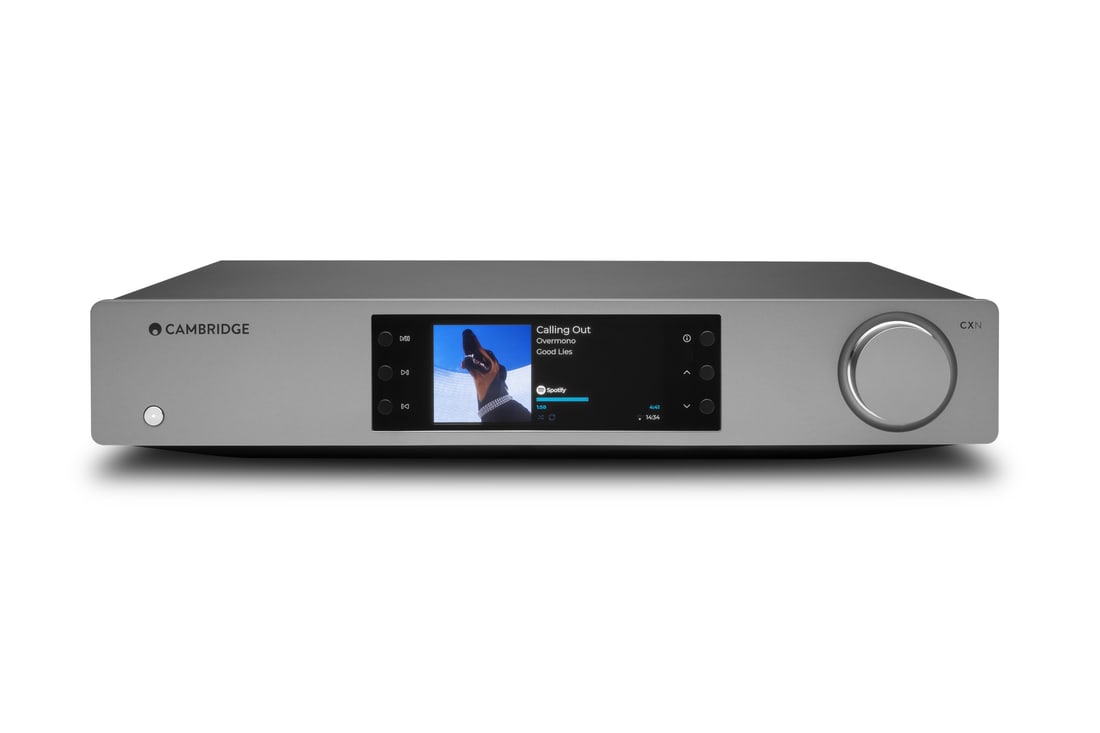
The CXN100's industrial design is classically Cambridge: brushed aluminium fascia, a clean VFD display, a satisfying physical volume control that also functions as a navigation encoder. Build quality is solid and appropriate for the price. The front display is readable from a listening position, showing track title and format information — useful for confirming that your Qobuz stream is arriving at the intended resolution.
In Australia, Cambridge Audio distributes through Len Wallis Audio, Billy Hyde Music (select stores), and a network of specialist hi-fi retailers. Warranty support is handled locally; this is not a grey-import situation, and replacement parts and firmware updates come through official channels. The StreamMagic firmware update history suggests Cambridge actively maintains the platform — a non-trivial consideration when you're buying a streamer that you expect to use for the next five to seven years.
The lack of a display remote control is a minor ergonomic note — the included remote handles basic playback functions, but anything service-specific requires the app. This is the current reality of network streaming and is not unique to Cambridge.
How it compares
The obvious competition at A$1,899 includes the WiiM Ultra (significantly cheaper but a different market position), the NAD C 658 BluOS (Dirac Live processing built in, which is a meaningful differentiator if room correction is important to you, though it comes at a higher asking price), and the Bluesound NODE X (strong BluOS ecosystem, no balanced outputs, smaller DAC chip). Against the Bluesound NODE X specifically, the CXN100's case rests on the quality of the analogue output stage, the balanced XLR outputs, and the more capable DAC silicon. Against the NAD C 658, the comparison is more nuanced — Dirac Live is genuinely useful, but the CXN100 wins on hi-res ceiling and DAC sophistication. Cambridge's Roon Ready certification and TIDAL Connect implementation are also consistently rated above Bluesound's in professional streamer comparisons, if network stability matters to you.
Who it's for / who should look elsewhere
The CXN100 is for the listener who has a good amplifier, good speakers, and a source chain that has not kept pace with either. It is for Qobuz and TIDAL subscribers who want their subscription's full resolution capability delivered to their system without workarounds. It is for the Roon user who wants a clean, Roon-Ready endpoint with a proper DAC stage. It is for anyone with a balanced-input amplifier who wants to exploit that topology fully at a sensible price.
You should look elsewhere if: your amplifier already has a high-quality built-in DAC and streaming capability (adding a separate streamer/DAC may bring marginal gains). If television integration via HDMI ARC is essential, go to the CXN100 SE or look at an alternative with ARC support. If your budget is tighter and streaming quality is your primary concern over DAC depth, the WiiM Ultra punches above its price for streaming functionality alone. And if you need room correction as part of the source chain, the NAD C 658 with Dirac Live will serve you better.
Verdict
The CXN100 is not a flashy product and it does not pretend to be. It is a well-engineered, comprehensively connected network streamer built around a genuinely capable DAC, with balanced outputs that most of its direct competition cannot match at this price. The StreamMagic platform is mature, the service integration list is exhaustive, and the engineering rationale behind every key specification is sound. At A$1,899 in the Australian market, it represents a clear-headed investment in your source chain rather than an act of audiophile faith. Buy it with confidence if it fits your system architecture; be honest with yourself about whether it does before you do.
Common questions
- Does the Cambridge Audio CXN100 require a separate amplifier?
- Yes, absolutely. The CXN100 is a source component — a streamer and DAC only. It has no amplification stage. You will need a separate integrated amplifier or preamplifier and power amplifier to connect to speakers. Cambridge's own CXA series integrateds are the natural pairing, but the CXN100 works equally well with third-party amplification.
- Is the CXN100 Roon Ready, and what does that mean in practice?
- Yes, the CXN100 holds official Roon Ready certification. In practice, this means Roon's core software (running on a NAS, computer, or Nucleus) can discover the CXN100 as a networked audio endpoint and stream directly to it with full resolution and metadata support. It is generally considered a more stable and feature-rich control experience than the native StreamMagic app for Roon subscribers.
- Should I use the balanced XLR or the RCA outputs?
- Use the balanced XLR outputs if your amplifier has genuine balanced XLR inputs — the common-mode noise rejection of the balanced signal path lowers the effective noise floor and can meaningfully improve dynamics and soundstage clarity. If your amplifier only has unbalanced RCA inputs, use the RCA outputs; the CXN100 will still perform well, but you will not be exploiting the full capability of the output stage.
- Does the CXN100 have HDMI ARC for television integration?
- No. HDMI ARC and eARC are reserved for the more expensive CXN100 SE variant. The base CXN100 offers coaxial S/PDIF and TOSLINK optical digital inputs, which can accept a TV's digital audio output if your television has one of those connections — but if seamless HDMI ARC integration is a priority, you should consider the SE model or an alternative product.
- Where can I buy the CXN100 in Australia, and what is the warranty situation?
- The CXN100 is distributed officially in Australia through a network of specialist hi-fi retailers including Len Wallis Audio and select Billy Hyde Music locations, among others. As an officially distributed product, it carries a standard Australian consumer warranty and firmware updates are delivered through official Cambridge Audio channels. Buying through an authorised Australian retailer rather than importing grey-market stock is strongly advisable given the ongoing firmware support and local service access.