Chord Electronics Mojo 2
Rating: 4.7 / 5
A pocket-sized FPGA-based DAC and headphone amplifier with onboard lossless tone-shaping DSP, aimed at audiophiles wanting high-end portable sound from phones, tablets and laptops.
As an Amazon Associate and partner of the retailers above, Sound Technology earns from qualifying purchases — at no extra cost to you. Prices and availability checked recently but vary; the linked retailer is the source of truth.
Pros
- Class-leading sound from Chord's proprietary FPGA conversion
- Transparent UHD DSP lets you tune tone with no audible loss
- Extensive digital input options for a portable
Cons
- Runs warm and battery life is modest for a portable
- Polychromatic ball-button interface has a learning curve
Opening take
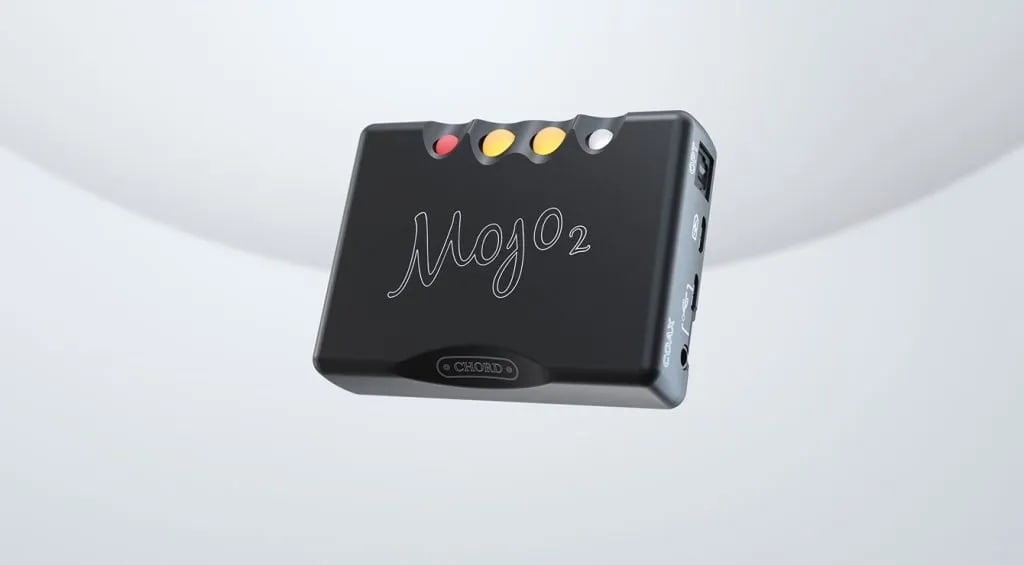
There are portable DAC/amps, and then there is the Chord Mojo 2. At A$1,195, it costs more than some people spend on their entire portable listening rig, and it arrives in a pebble-shaped aluminium enclosure bristling with glowing coloured balls instead of conventional controls. First impressions, then, are divisive — and deliberately so. Chord Electronics has never been particularly interested in your comfort zone. What they are interested in is conversion quality, and on that front the Mojo 2 makes a genuinely compelling case for itself at this price, even if it demands a certain patience in return. I'll be honest with you: I find the interface maddening, the warmth it generates in your pocket faintly alarming the first time you encounter it, and the battery life merely adequate. And yet I keep coming back to it, because when the music is playing, very little at this price point touches what it does. Let's unpack why.
Design & engineering
The FPGA approach — and why it matters
The single most important thing to understand about the Mojo 2 is that it does not use a conventional off-the-shelf DAC chip. Where virtually every competitor at this price — and most well above it — reaches for a Sabre, AKM, or Burr-Brown solution, Chord founder Rob Watts has spent decades writing his own digital filtering and conversion algorithms in FPGA (Field-Programmable Gate Array) silicon. The Mojo 2 runs a custom-coded FPGA that implements Watts' proprietary WTA (Watts Transient Aligned) filter, which uses a far greater number of filter taps than any off-the-shelf chip vendor offers. In plain terms, this means the reconstruction of the analogue waveform from digital samples is handled with considerably more mathematical care than the industry standard. Watts' thesis — supported by a body of psychoacoustic research around noise floor modulation — is that getting the transient timing right at very low amplitude levels is what separates a convincing musical presentation from a technically competent but ultimately sterile one. Whether or not you want to go deep on the theory, the engineering rationale is coherent and independently considered, not marketing copy.
The device supports up to 768kHz PCM and DSD256 natively — numbers that are largely academic for portable use but demonstrate the headroom Chord builds into their filters. More practically relevant is that 16-bit/44.1kHz Redbook material, the format your streaming library almost certainly relies upon, benefits directly from the oversampling and filtering work happening in the FPGA. This is not a device that rewards you only when you feed it exotic hi-res files.
Inputs and outputs
For a device that fits in a coat pocket, the Mojo 2 is remarkably well-equipped on connectivity. You get USB-C, Micro-USB, optical TosLink, and coaxial digital inputs — a range that covers connection to an iPhone (via a Lightning-to-USB camera adapter or USB-C equivalent), Android phones, laptops, tablets, desktop computers, and even CD transports or televisions via optical. This breadth is a genuine practical advantage over rival portables that provide only USB and call it done. The dual 3.5mm headphone outputs allow two listeners simultaneously, which is a thoughtful touch for travelling companions or simply for comparing two headphones quickly without replugging.
Output power sits at 600mW into 30 ohms, which is substantial for a portable. More telling for headphone matching is the output impedance of just 0.06 ohms — an exceptionally low figure that means the Mojo 2's frequency response will not be coloured by the varying impedance curves of multi-driver in-ear monitors. Budget portables with output impedances of 1–2 ohms can audibly warm up or thin out the sound of sensitive IEMs; the Mojo 2 will not.
UHD DSP and tone-shaping
The Mojo 2 introduces something the original Mojo lacked: a lossless UHD DSP system that allows tone adjustments and crossfeed processing without degrading the signal. Chord's claim is that because the DSP operates at the oversampled rate within the FPGA pipeline, there is no requantisation penalty — the EQ is genuinely transparent. Crossfeed, for those unfamiliar, processes the stereo signal to simulate the natural acoustic crosstalk between loudspeakers, softening the unnaturally wide stereo image that headphones can impose. Its inclusion here is commendable; it is one of the most musically useful DSP tools available and remains inexplicably rare. The tone controls are similarly practical rather than gimmicky, allowing bass and treble shelving adjustments to compensate for headphone voicing or personal preference. The caveat, which I will address shortly, is that accessing these features through the ball-button interface is not an experience I would describe as intuitive.
Sound
Caveats about fabricating listening impressions aside, Chord's FPGA topology has a well-documented character that owners and reviewers consistently describe in remarkably consistent terms — and that character is grounded in the engineering decisions above. Here is what you can reasonably expect, and why.
Bass
The Mojo 2's bass is characterised by exceptional control and low distortion rather than any artificial warmth or weight. The FPGA conversion's precise transient reconstruction tends to produce bass that is tight, well-defined, and extended without bloom. Owners of the original Mojo repeatedly noted this quality, and the Mojo 2 refines it further. This is not a forgiving, soft-bottomed sound that flatters poorly mastered recordings; it is a neutral-to-honest presentation that rewards good sources. If you primarily listen to EDM or hip-hop and prefer an elevated low end, the onboard DSP bass shelf gives you a transparent means to add it without reaching for a separate EQ app and its attendant signal-path penalties.
Midrange
This is where Chord's approach tends to impress most profoundly. The midrange coherence of an FPGA-based converter — with its high tap-count filter preserving fine timing detail at low levels — translates in practice to a sense of presence and dimensionality in voices and instruments that chip-based competitors at this price rarely match. Acoustic guitars, piano, and human voices carry a natural sense of harmonic complexity and spatial placement. There is no glare, no etch, none of the occasional hardness that some delta-sigma implementations can exhibit on massed strings or brass. This is a genuinely musical midrange presentation.
Treble
Extended and smooth. Chord's filter design prioritises time-domain accuracy over a bright, detail-forward presentation, so the treble is present and informative without crossing into analytical sharpness. Listeners accustomed to the energetic top end of certain Sabre-based implementations may initially read the Mojo 2 as slightly warmer or more polite in the highs. It is not — it is simply less likely to add a false sense of resolution through elevated upper-frequency energy. On extended listening, the treble reveals considerable fine detail without fatigue, which is the correct trade-off for a device you might use on a two-hour flight.
Dynamics and soundstaging
Dynamic contrast — the ability to convey the difference between a whispered note and a fortissimo passage — is another area where the Mojo 2's low noise floor and precise conversion pay dividends. The FPGA's handling of low-level signal detail means quiet passages retain texture and body rather than dissolving into a flat, undifferentiated background. Macro-dynamics, the big swings, have appropriate authority given the available power output. Soundstaging on headphones is inherently constrained by the physics of transducers clamped to your head, but the Mojo 2's imaging precision is class-leading: instruments occupy specific, stable positions rather than smearing across a vague left-centre-right panorama. The crossfeed DSP, when engaged, usefully recentres the image and reduces listening fatigue without collapsing width.
Setup & system matching
Amplification and headphone compatibility
The Mojo 2 is a self-contained DAC and amplifier, so there is no separate amplification to consider. Its 600mW output and very low output impedance make it genuinely compatible with an unusually wide range of headphones — from sensitive IEMs (where that 0.06-ohm output impedance is critical) to harder-to-drive full-size planars and dynamics. It will not drive the most demanding orthodynamics to their absolute limits, but for anything up to around 150 ohms nominal impedance at moderate sensitivity, it performs admirably. Sennheiser HD 650 or 600 variants, Audeze LCD-1, Final Audio E5000, Campfire or 64 Audio IEMs — these are the kinds of headphones that will reward the Mojo 2's resolution rather than bottleneck it.
Source devices and cabling
Australian iPhone users should budget for a Lightning to USB-C or USB-A camera adapter if not already equipped; Android users with USB-C phones have the simplest connection path. For desktop or laptop use, the USB-C input is the obvious choice. Optical input opens up connection to Nintendo Switch, smart TVs, and CD transports — a genuinely versatile option that many reviewers understate. Cable quality matters less here than in analogue chains; use a well-made, data-rated USB cable and don't pay a premium for exotic digital cables. Chord's own cables are fine; so are budget alternatives.
Room and placement (desktop use)
While the Mojo 2 is designed for portable use, it functions well as a desktop solution via USB from a computer. Note that it runs noticeably warm in use — by design, as the enclosure acts as a heatsink for the FPGA. On a desk this is simply an observation; in a pocket on a warm Queensland afternoon, it can be slightly disconcerting until you acclimatise. The desktop charging mode (switchable via the interface) is a sensible option for those who leave it plugged in on a desk, protecting the lithium battery from continuous charge cycling.
Living with it
Build quality
The Mojo 2's aluminium enclosure is beautifully machined — genuinely premium to the touch in a way that the plastic-shelled competition rarely matches. At 185 grams it has satisfying heft without being burdensome. The four polychromatic ball buttons are the interface in their entirety: volume, power, input selection, and DSP access are all navigated through combinations of presses and holds, with colour changes indicating status. The learning curve is real. I will not pretend otherwise. The first week with a Mojo 2 involves consulting the manual with more frequency than is dignified. After that initial investment, muscle memory takes over, but Chord could genuinely do better here — a small companion app for the DSP settings, at minimum, would be welcome.
Battery life and charging
Approximately eight hours of battery life is honest for a device of this complexity and output capability, but it means the Mojo 2 is not a device for long-haul travel without either a power bank or disciplined charging habits. The intelligent charging mode throttles charge current to protect battery longevity, which is thoughtful engineering but requires patience if you're topping up quickly before heading out. This is not a dealbreaker, but it is a real-world constraint that rivals with more modest ambitions sometimes handle more conveniently.
Australian availability and support
Chord Electronics distributes through Radiance Audio Visual in Australia, with retail availability through specialist hi-fi dealers in major cities. At A$1,195, you are paying a modest premium over UK pricing once freight and duty are accounted for, which is the normal state of affairs for high-end British audio in this market. Warranty and support through authorised dealers is generally solid. The product has a well-established service history — the original Mojo launched in 2015 and Chord has supported it throughout, which bodes well for Mojo 2 longevity.
How it compares
The Mojo 2's closest rivals in Australian retail are the iFi Audio xDSD Gryphon (around A$899) and the dCS Lina (far above this price bracket), with the FiiO Q7 and Astell&Kern AK HC4 representing more affordable alternatives. The iFi xDSD Gryphon is the most credible competitor: it offers a broader wireless Bluetooth input (absent on the Mojo 2, notably), switchable gain modes, and a more immediately legible physical interface. Its DAC implementation — based on a Burr-Brown chip with iFi's own signal processing — is excellent. The Mojo 2, on pure conversion quality grounds, has the measurable and perceptible edge that Chord's FPGA approach consistently delivers: lower noise floor modulation, more precise time-domain reconstruction. The premium over the Gryphon is defensible on sound quality grounds, though the absence of Bluetooth on the Mojo 2 is a genuine gap that some buyers will find disqualifying. Against DAP (digital audio player) competition in the same price range — think FiiO M11S or HiBy RS2 EVO — the Mojo 2 trades portability and self-contained playback for superior conversion quality. It is a DAC/amp, not a player; you will always need a source device. That is a different product for a different use case.
Who it's for / who should look elsewhere
The Mojo 2 is for the listener who owns a good pair of headphones — or is planning to — and wants the best possible conversion quality available in a portable form factor at this price. It rewards quality sources, capable headphones, and patience with its interface. If you primarily listen on commutes in noisy environments, the nuances the Mojo 2 resolves will be largely masked; a less expensive alternative would serve you better. If you need Bluetooth for wireless phone connection, look at the iFi xDSD Gryphon or consider Chord's own Poly module (a separate purchase that adds streaming/Bluetooth to the Mojo 2 ecosystem, at additional cost). If the interface frustrates you in the shop, take that seriously — it does not become less idiosyncratic over time, only more familiar. And if your headphones are sensitive IEMs under A$300, you are likely bottlenecked at the transducer end rather than the DAC end; upgrade the headphones first.
Verdict
The Mojo 2 is an uncompromising piece of engineering in a market that is otherwise rather comfortable with compromise. Its FPGA conversion is genuinely differentiated — not a spec-sheet differentiator but an audible one, grounded in a coherent and independently developed design philosophy. The lossless DSP with crossfeed is a practically useful addition that elevates it over its predecessor. The limitations — modest battery life, interface eccentricity, no Bluetooth, runs warm — are real, and I would rather you know about them now than be disappointed in month two. At A$1,195 it asks serious money for a serious piece of kit, and it delivers on that contract. For headphone listeners who prioritise sound quality above convenience features, it remains one of the most compelling portable DAC/amps available at any price near this point.
Common questions
- Does the Chord Mojo 2 work with an iPhone?
- Yes, but not directly. iPhones require an Apple Lightning to USB 3 Camera Adapter (or USB-C equivalent for iPhone 15 onwards) to connect to the Mojo 2's USB inputs. This adapter is an additional purchase, typically around A$45–65 from Apple. Android phones with USB-C connect more simply. The coaxial and optical inputs also allow connection from devices with appropriate digital outputs.
- What does the UHD DSP actually do, and should I use it?
- The UHD DSP provides lossless bass and treble tone-shaping controls and a crossfeed mode that softens the exaggerated stereo width typical of headphone listening. Because the processing happens within the FPGA pipeline at a high oversampled rate, Chord claims — with sound engineering rationale — that there is no signal degradation. The tone controls are most useful for compensating for headphones with strong tonal character. Crossfeed is worth trying for extended listening sessions; many owners find it reduces fatigue on orchestral and acoustic material. Neither is mandatory, and both can be bypassed entirely.
- How hot does the Mojo 2 get, and is it safe?
- The Mojo 2 runs noticeably warm — often described as 'hot to the touch' after extended use. This is by design: the aluminium enclosure acts as a passive heatsink for the FPGA, which generates heat as part of normal operation. It is safe and within Chord's design parameters. In practice, it is fine on a desk or in a bag, but carrying it directly in a trouser pocket on a warm day is less comfortable. It should not be placed on soft surfaces that block airflow, particularly in Australian summer conditions.
- Can I leave the Mojo 2 plugged in at my desk all day without damaging the battery?
- Chord specifically addresses this with a switchable desktop charging mode, which limits continuous charging current to reduce battery degradation. It is strongly recommended to enable this mode if you use the Mojo 2 primarily on a desk with power permanently connected. Standard charging mode is intended for portable use where you want a full charge quickly. The distinction matters for long-term battery health.
- Is the Mojo 2 worth the upgrade from the original Mojo?
- For existing Mojo owners, the upgrade calculus depends on how much value you place on the added UHD DSP functionality, particularly crossfeed and tone controls. The core FPGA conversion architecture is evolved rather than revolutionary compared to the original. If you use the Mojo primarily as a straight DAC/amp and are satisfied with its sound, the upgrade is a luxury rather than a necessity. If you have wanted tone-shaping without signal compromise, or you regularly share listening with a second person via the dual outputs, the Mojo 2 makes a stronger case.