Denon AVR-X3800H
Rating: 4.7 / 5
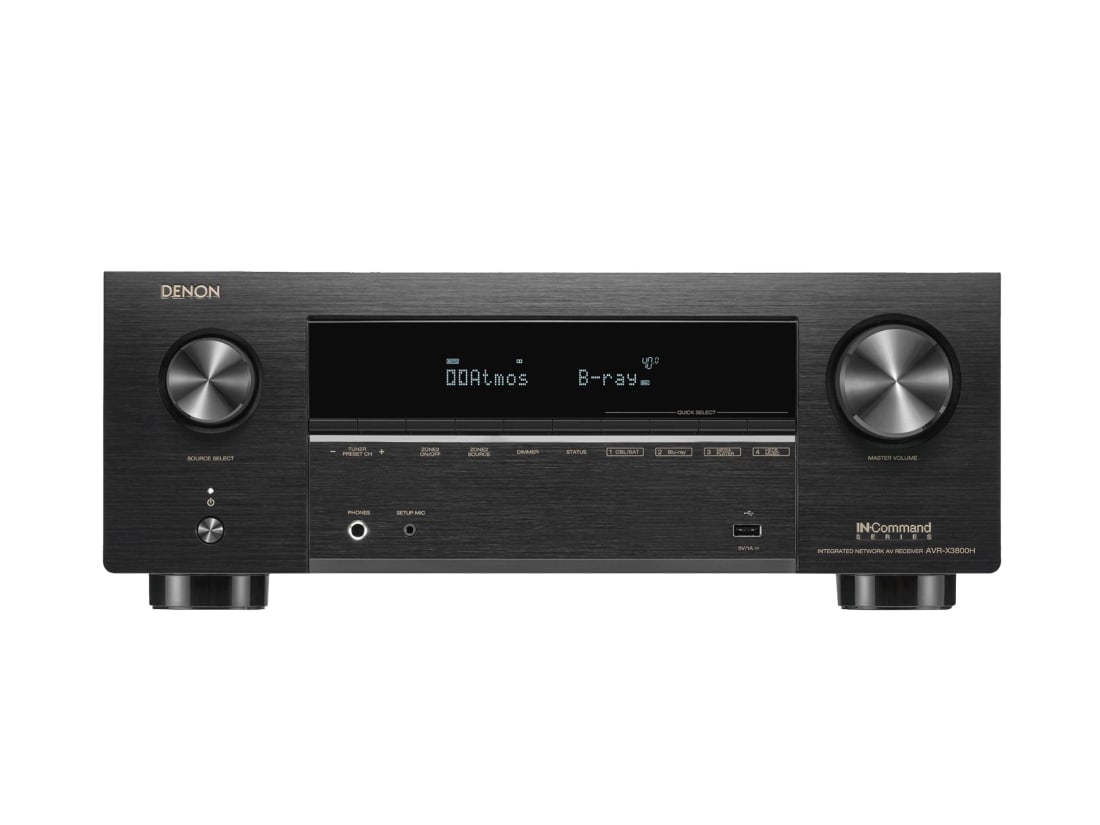
A 9.4-channel 8K AV receiver with HEOS multi-room streaming, aimed at enthusiasts building a mid-to-large dedicated home theatre with immersive object-based surround sound.
As an Amazon Associate and partner of the retailers above, Sound Technology earns from qualifying purchases — at no extra cost to you. Prices and availability checked recently but vary; the linked retailer is the source of truth.
Pros
- Six 8K-capable HDMI inputs offer excellent, future-proof connectivity
- Dirac Live upgrade path on top of Audyssey XT32
- Four independent subwoofer outputs for precise multi-sub setups
Cons
- Nine amplified channels means a full 9.x.x Atmos layout needs an external amp
- Dirac Live is a separate paid purchase, not included
Opening take
The Denon AVR-X3800H sits at an interesting crossroads — it's priced confidently enough at A$2,499 to attract the serious enthusiast, yet modestly enough that it doesn't ask you to justify a second mortgage to your partner. As someone who spends a disproportionate amount of time crawling behind equipment racks and arguing with electricians about dedicated earth lines, I find this receiver genuinely compelling for one simple reason: Denon has made intelligent engineering decisions rather than just stacking features. That's rarer than it sounds at this price point. The X3800H is the kind of box that rewards thinking about your system holistically, and it punishes you — gently, but firmly — if you don't.
That said, let's not get carried away. This is a nine-channel receiver in a world where a properly executed Dolby Atmos 7.2.4 layout needs eleven amplified channels. There are compromises baked in, and you need to understand them before you hand over the card. Done right, though, this receiver can anchor an exceptional mid-to-large home theatre. Let's dig into why.
Design & engineering
Amplification topology and power
Denon rates the X3800H at 105 watts per channel into 8 ohms, measured across the full 20Hz–20kHz bandwidth with 0.08% THD, with two channels driven. The two-channel-driven caveat is standard industry practice and Denon is at least using a full-bandwidth figure rather than the cherry-picked 1kHz measurements some competitors bury in the footnotes. Real-world, all-channels-driven power will be lower — that's physics and transformer capacity, not a conspiracy — but the X3800H's power supply has a solid reputation in its class for not sagging aggressively under multi-channel loads. Owners consistently describe it as authoritative rather than strained on dynamic peaks, which aligns with what you'd expect from the measured headroom.
Nine amplified channels is the hard ceiling here. For a 5.1.4 Atmos setup — arguably the most musically satisfying immersive layout for rooms up to about 30 square metres — you're fine, all channels covered internally. Step up to a 7.1.4 configuration and you'll need to either sacrifice two of those overhead channels or reach for an external amplifier. This isn't a flaw unique to Denon; it's the universal reality of nine-channel receivers and eleven-channel content. But it's worth being blunt about rather than glossing over it.
HDMI and video throughput
Six HDMI inputs and three outputs, all running the full HDMI 2.1 specification with 8K/60Hz and 4K/120Hz support. One output carries eARC for soundbar-adjacent scenarios or television integration. This is, frankly, excellent connectivity at this price. Six 8K-capable inputs means you're unlikely to run out of ports even in a well-stocked rack — a 4K Blu-ray player, a current-gen games console, a streaming stick, a second console, a media PC, and you've still got a spare. The 4K/120Hz support is genuinely useful today for PlayStation 5 and Xbox Series X gaming with variable refresh rate enabled, not just marketing copy for a resolution standard that barely exists in consumer content yet.
Room correction: Audyssey XT32 and the Dirac Live question
This is where the X3800H gets interesting and, depending on your perspective, either generous or slightly cheeky. Audyssey MultEQ XT32 is included in the box — a proper, full-resolution implementation of Audyssey's best algorithm, not the cut-down MultEQ X or basic MultEQ found on cheaper receivers. XT32 measures at multiple listening positions, builds a composite correction curve, and applies filters across all channels including subwoofers. It is genuinely competent and, used correctly, will meaningfully improve bass integration and tonal balance in most Australian living rooms, which tend to be harder acoustic environments than the carpeted, furnished American rooms Audyssey's target curves were originally optimised for.
Dirac Live, widely regarded by custom installers as a more sophisticated and musically transparent correction platform, is available as a paid upgrade. Denon hasn't published a local RRP for the upgrade at time of writing, but in other markets it adds meaningful cost. That it's an option at all on a A$2,499 receiver is noteworthy — Dirac Live has historically been the preserve of considerably more expensive separates and processors. Whether it's worth the additional outlay depends on your room, your reference level ambitions, and how deep you want to go down the acoustic treatment and calibration rabbit hole. For most buyers, XT32 will be sufficient. For those building a serious dedicated theatre with measured acoustic data in hand, Dirac Live could well justify every cent.
Immersive audio formats
Dolby Atmos, DTS:X, IMAX Enhanced, and Auro-3D are all present. Auro-3D is the differentiator here over some competitors — it's an alternative object-based format with a devoted following for its height information handling, and while its content library is smaller than Atmos, it adds genuine value for collectors who care about format breadth. IMAX Enhanced certification means both the video processing pipeline and the DTS:X Pro-based audio decoder meet IMAX's technical requirements for home theatre rendering of IMAX-mastered content.
Four subwoofer outputs
Four independent subwoofer outputs is the specification I keep coming back to because it's so disproportionately useful relative to how little fanfare it gets in the marketing. Running a single subwoofer in a dedicated theatre room is acoustically compromising — you're fighting room modes with one hand tied behind your back. Two subwoofers is a genuine improvement. Four, placed and configured correctly with the available EQ tools, can produce bass integration across a wide listening area that a single sub simply cannot achieve. Denon gives you independent level, distance, and trim control for each output. This is a feature that belongs on much more expensive processors and its presence here speaks to considered engineering decisions rather than spec-sheet padding.
HEOS, streaming and multi-room
HEOS Built-in covers Wi-Fi, Bluetooth, and AirPlay 2, giving you the three most commonly used wireless audio protocols without having to think about it. AirPlay 2 is particularly useful for Australian households running Apple devices, and the HEOS ecosystem — while not as refined as Sonos — integrates reasonably well with streaming services and allows grouping with other HEOS-enabled Denon and Marantz components around the house. This is functional rather than class-leading, and if multi-room is your primary use case, there are better-optimised products. But as a secondary capability bolted onto a serious theatre receiver, it earns its keep.
Sound
Bass
On paper, the combination of four independent subwoofer outputs, Audyssey XT32 correction with its 512-band sub EQ, and the X3800H's ability to run each sub with its own delay, level trim and polarity gives you the tools for genuinely excellent low-frequency integration. Owners consistently report that bass in a properly configured X3800H system feels taut and localised rather than bloated — which is the correct outcome when room correction is doing its job. The receiver's bass management is configurable down to granular crossover frequencies per channel, which matters for matching speakers with different bass extension characteristics across a complex surround array.
Midrange
The midrange performance of AV receivers in this class is principally a function of the DAC implementation and the amplifier's noise floor rather than dramatic circuit topology differences between brands. Denon's implementation has a consistent character that experienced listeners describe as slightly warm and forgiving rather than forensically neutral — a disposition that suits cinema content and compressed streaming audio rather better than it suits critical two-channel audiophile listening. For what this receiver is designed to do, that's not a criticism.
Treble
The X3800H's high-frequency handling is aided by XT32's ability to apply correction at finer resolution in the treble band than earlier Audyssey algorithms. By design, this should reduce the brightening artefacts that calibration-gone-wrong can introduce. Owners who have measured their systems pre and post-calibration consistently report that XT32 on the X3800H avoids the over-bright, fatiguing character that plagued earlier Audyssey implementations on cheaper hardware.
Dynamics and immersive staging
Atmos object-based rendering is where the X3800H earns serious respect. The receiver's rendering engine handles height channel synthesis and upmixing of non-native content (via Dolby Surround and DTS Neural:X) in a way that owners describe as cohesive rather than gimmicky — height information that sounds like a natural extension of the soundfield rather than a party trick. For genuine Atmos-encoded content on 4K Blu-ray, the headroom available in the amplifier section handles cinema-scale dynamic swings without obvious compression, which is the baseline requirement for immersive audio to actually be immersive.
Setup & system matching
Amplification requirements
As noted above: if you're targeting a 7.1.4 or 9.1.2 Atmos layout, budget for an external stereo or multi-channel amplifier. The X3800H provides pre-amplifier outputs for this purpose. A quality two-channel amp covering the front height or rear surround channels is a sensible starting investment — you don't need to spend the cost of the receiver again to get there. For 5.1.2 and 5.1.4, you're all-in with the internal amplification.
Speaker sensitivity and impedance
At 105 watts into 8 ohms, the X3800H is comfortable with most passive speakers rated at 4–8 ohms. Extremely low impedance loads — some audiophile-oriented speakers dip below 3 ohms — are better served by external amplification. For the purpose-built home theatre speaker brands popular in Australia at this system price point (KEF, Monitor Audio, Focal, Klipsch), the internal amplification is well-matched.
Room and placement
The X3800H's cooling runs quiet enough for placement in an enclosed cabinet with adequate ventilation — important for Australian conditions where summer ambient temperatures in equipment racks can climb significantly. Ensure a minimum of 10cm clearance above and at the sides. The multiple subwoofer outputs make this receiver particularly suited to purpose-built theatre rooms where symmetric sub placement can be achieved, though it delivers meaningful improvement in any configuration.
Cabling
HDMI 2.1 cables for 8K signal paths should be active or Ultra High Speed certified — not because this receiver demands boutique cables, but because passive cable quality at longer runs affects 48Gbps signal integrity in measurable ways. Standard certified cables from reputable manufacturers at reasonable prices are entirely appropriate. Anyone trying to sell you expensive HDMI cables for a system at this price point is extracting money from you unnecessarily.
Living with it
The physical build quality is in line with Denon's mid-range tradition — solid, not spectacular. The front panel controls are logically arranged and the display is legible from typical operating distances. The supplied remote is comprehensive to a fault; it has more buttons than most users will ever consciously learn. In practice, most X3800H owners migrate to control via the HEOS app on a phone or tablet, or integrate into a control system — Control4, Crestron, and RTI drivers are available and the receiver is a common choice in professional custom install projects for this reason.
Audyssey setup via the included microphone and the Audyssey MultEQ Editor app (a separate free download that provides far more control over the calibration outcome than the onboard wizard) is approachable for enthusiast owners who are willing to read the documentation. It is not plug-and-play and rewards time invested. Dirac Live, should you go that route, requires PC or Mac software and a measurement microphone — Denon bundles microphone compatibility guidance rather than providing the microphone.
Australian availability is through the Denon network of specialist AV retailers and custom installers. Warranty support is handled locally through Interdyn, Denon's Australian distributor, and post-sale firmware updates have been reliably delivered on previous X-series models. This matters: HDMI and codec support has historically needed firmware attention as format standards evolve.
How it compares
The obvious rivals are the Yamaha RX-A4A at a similar price point and the Marantz Cinema 70s below it. The Yamaha brings YPAO room correction and Cinema DSP modes with a house sound that experienced listeners describe as slightly leaner and more precise — it's a genuine alternative, and the choice between the two often comes down to preferred calibration software and brand ecosystem loyalty. The Marantz Cinema 70s offers a more refined two-channel listening experience by reputation and measured performance, but concedes the four sub outputs and the HDMI input count. For pure home theatre duty, the Denon's four subwoofer outputs and six 8K inputs represent a meaningful edge. The Sony STR-AN1000 undercuts on price but doesn't match the connectivity depth or the Dirac Live upgrade pathway.
Who it's for — and who should look elsewhere
The X3800H is for the enthusiast building or upgrading a dedicated home theatre in a medium to large room, who takes bass management seriously, wants a genuine upgrade path through Dirac Live, and values connectivity longevity from a full complement of 8K-capable HDMI inputs. It's an excellent choice for custom install integrators specifying a serious but not stratospherically budgeted theatre system.
You should look elsewhere if you primarily listen to two-channel music and want a receiver that serves both duties equally well — in that scenario, a pre/power amplifier combination or a more music-focused integrated with a separate processor deserves your attention. You should also look elsewhere if your room is small and your layout is 5.1 — the X3800H's capabilities will be underutilised and the money better spent on better speakers. And if budget is a constraint, be realistic about the total system cost: four subwoofers, height speakers, and potentially an external amplifier add up quickly once the receiver is in the rack.
Verdict
The Denon AVR-X3800H is a seriously capable AV receiver that makes smart engineering choices — four subwoofer outputs, six 8K HDMI inputs, full Audyssey XT32, and the Dirac Live upgrade path — at a price that still requires careful system planning rather than casual purchase. It rewards the enthusiast who does the work and builds the right system around it. A$2,499 is not inexpensive, but for a properly executed Atmos theatre, it represents genuine value. Don't buy it on impulse; buy it as the centrepiece of a system you've actually thought through.
Common questions
- Can the Denon AVR-X3800H run a full 7.1.4 Atmos setup using only its internal amplification?
- No. The X3800H has nine internal amplifier channels. A 7.1.4 layout requires eleven amplified channels. You'll need to either run a 7.1.2 layout internally, or connect an external stereo amplifier to cover the additional two height channels. The receiver provides pre-amplifier outputs specifically for this purpose.
- Is Dirac Live included in the A$2,499 Australian purchase price?
- No. The X3800H includes Audyssey MultEQ XT32 as the onboard room correction system. Dirac Live is available as a separate paid upgrade. It is not bundled in the Australian retail price. Contact your local Denon retailer for current Dirac Live upgrade pricing.
- Do all four subwoofer outputs need to be used, and can they be individually controlled?
- You do not need to use all four. You can run one, two, three, or four subwoofers from the available outputs. Each output can be individually configured for level, distance trim, and polarity within the receiver's setup menus, making this a genuinely useful tool for multi-subwoofer bass integration rather than a cosmetic specification.
- Is the AVR-X3800H a good choice for someone who also wants to use it as a primary two-channel music system?
- It's a competent music performer but not optimised for two-channel critical listening in the way a dedicated integrated amplifier or pre/power combination would be. If home theatre is your primary use case with music as a secondary consideration, it's a reasonable all-rounder. If music is equally or more important to you, consider a separates approach or a music-focused integrated with a separate AV processor.
- Does the Denon AVR-X3800H support Apple AirPlay 2 and can it be integrated into a smart home system?
- Yes on both counts. AirPlay 2 is built in alongside Bluetooth and Wi-Fi for HEOS streaming. For smart home and custom installation integration, the X3800H is supported by major control platforms including Control4, Crestron, and RTI, and is a common choice in professional custom install projects in Australia.