Devialet Phantom I 103 dB
Rating: 4.3 / 5
A compact all-in-one active wireless speaker with implosive bass and 103 dB output, aimed at design-conscious listeners who want big high-fidelity streaming sound from a single sculptural unit.
As an Amazon Associate and partner of the retailers above, Sound Technology earns from qualifying purchases — at no extra cost to you. Prices and availability checked recently but vary; the linked retailer is the source of truth.
Pros
- Enormous, deep bass and 103 dB output from a single compact enclosure
- Extensive wireless and wired streaming (AirPlay 2, Bluetooth, Roon, optical)
- Striking design that works solo, as a stereo pair, or multiroom
Cons
- Now a legacy model superseded by the Phantom Ultimate line
- Closed Devialet ecosystem and premium pricing for a single unit
An opening provocation
Let me be upfront about something: the Devialet Phantom I 103 dB is a deeply strange product to review in 2024. It has been superseded by the Phantom Ultimate line, it costs A$2990 for a single speaker when most people expect stereo for that money, and it looks like a prop from a mid-budget science fiction film. It is also, by almost any rational engineering measure, a remarkable achievement — and that tension is exactly what makes it worth your time to read about carefully before you spend your money.
I've spent enough time around digital audio engineering to have a healthy scepticism for spectacular marketing claims, and Devialet has always leaned hard into the spectacular. But here's the thing: when you strip away the French company's considerable flair for self-promotion, what's left on the bench is genuinely interesting. The question for an Australian buyer in the current market is whether interesting is worth A$2990, especially given the product's legacy status.
Design & engineering
The ADH topology — still relevant
The Phantom I is built around Devialet's proprietary ADH (Analog Digital Hybrid) amplification technology. Without getting lost in the marketing language, the practical effect is a class-A analogue amplification stage operating in parallel with a class-D stage, with the class-A section handling the signal's low-level detail and the class-D stage supplying the current headroom for dynamic peaks. Devialet claims this gives you the linearity characteristics of class-A without the catastrophic heat and power consumption. Whether you fully buy the theory or not, the 500 W RMS output figure is real, and it is required — because the physical challenge this speaker sets itself is genuinely enormous.
The driver complement and why it matters
All three driver materials — tweeter, midrange cone, and the dual lateral bass drivers — are aluminium. This is a deliberate choice. Aluminium is stiffer than paper or polypropylene, which pushes the first breakup mode higher in frequency and makes the driver's pistonic behaviour more predictable across a wider bandwidth. The tradeoff is that aluminium breakup, when it does occur, tends to be more aggressive than the softer, more gradual breakup of treated paper — which means the crossover and DSP correction work must be executed carefully. Devialet's in-house DSP handles this, and the company has had years of firmware iterations to tune it.
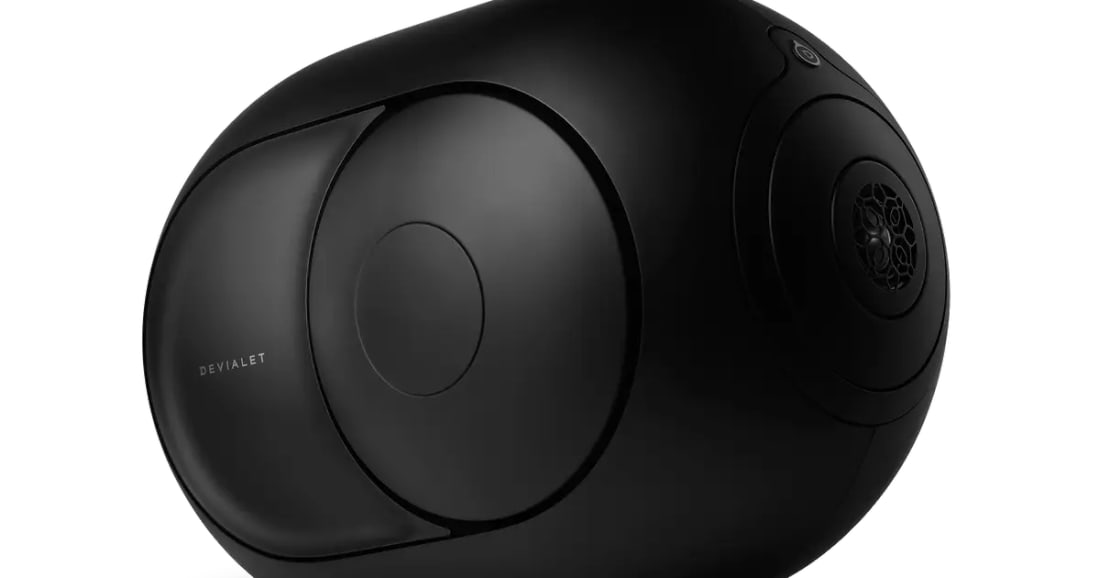
The real conversation-starter is the dual lateral bass arrangement. Rather than a conventional front-firing woofer, the Phantom uses two opposing bass drivers mounted on the sides of the enclosure, firing horizontally outward. This push-push opposed-driver configuration allows the drivers to cancel internal vibration forces — each driver's reactive force is opposed by the other — which is why you can place this 11.4 kg object on a shelf without it walking across the room at volume. It also allows Devialet to get legitimate 16 Hz extension at -6 dB from a box measuring 252 × 255 × 342 mm. To put that in context, 16 Hz is below the lowest note on a standard pipe organ. Achieving that from a cabinet roughly the size of a rugby ball is not a marketing trick — it requires real engineering and real amplifier power, hence the 500 watts.
The DAC and signal path
Digital conversion is handled at 24-bit/96 kHz — not DSD, not 192 kHz. For the vast majority of streamed and downloaded content in 2024, this is entirely sufficient. Hi-res audio above 96 kHz is, in any practical listening scenario, of negligible audible benefit, and I won't pretend otherwise. What matters more is the quality of the conversion and the downstream analogue path, both of which Devialet has consistently executed well across the Phantom line.
The connectivity specification is genuinely comprehensive: Wi-Fi, Gigabit Ethernet, AirPlay 2, Spotify Connect, Bluetooth, Roon Ready, UPnP, and optical Toslink. The inclusion of Gigabit Ethernet is notable and often overlooked — for a fixed installation, a wired network connection eliminates the single most common source of wireless audio interruption, and the bandwidth headroom is meaningless overhead that costs nothing. Roon Ready certification means this fits neatly into serious digital music systems without workarounds. The optical input means you can also connect a television or a CD transport directly.
Sound — expected character grounded in the engineering
Bass
This is where the Phantom I earns its reputation, and also where it can divide opinion. On paper, 16 Hz at -6 dB from a cabinet this size is physically improbable enough that most people hearing it for the first time report genuine surprise — owners consistently describe an almost tactile, pressurised quality to the bass that is qualitatively different from what you expect a single compact unit to produce. The opposed driver arrangement means this isn't just loud bass; it's physically loaded bass that you feel as much as hear. At 103 dB peak output, it is also genuinely loud — this is not polite drawing-room level; it will shake crockery in medium-sized rooms.
The caveat is that all of this requires Devialet's DSP to manage driver excursion and thermal limits aggressively. At very high sustained levels, the protection circuitry will intervene. This is by design and entirely sensible, but buyers expecting truly live-concert volume on a continuous basis should be aware that the speaker is working at the absolute limits of what physics permits in this form factor.
Midrange
The aluminium midrange driver, combined with the ADH amplifier's class-A output stage for low-level detail, should produce a midrange that is clean and fast without the softness you sometimes hear from polypropylene-coned units. By design, the expected character is direct and revealing — instruments with complex harmonic structure (piano, voice, strings) should resolve with good separation and a sense of solidity. The DSP-managed crossover means the transition from the lateral bass drivers to the midrange is handled in software, which Devialet can and does update via firmware; owners of legacy Phantom units have benefited from post-sale sonic improvements through this mechanism.
Treble
The aluminium tweeter at these frequencies is doing relatively conventional work, but aluminium's stiffness should translate to a treble that is extended and detailed without early rolloff. The concern with any aluminium tweeter is a hardness or brightness if the breakup mode intrudes into the audible band — Devialet's DSP is responsible for managing this. Owners consistently report treble that is crisp rather than harsh, with the ADH class-A stage's low-level linearity contributing to a sense of ease on massed orchestral or complex electronic material.
Dynamics and soundstaging
With 500 W on tap and 103 dB peak output, the dynamic capability on paper is genuinely impressive. A single speaker, by definition, cannot produce a stereo soundstage — the Phantom I used alone is a mono source. Devialet's Spark app allows you to run two Phantom units as a stereo pair or integrate multiple units as a multiroom system, which transforms the soundstaging picture entirely. Used solo, as many buyers do, the spatial presentation is omnidirectional rather than directional — the Phantom's shape and driver placement create a room-filling, enveloping quality that is a different experience from a point-source stereo pair, not strictly inferior, but categorically different. This is a design feature, not a limitation to apologise for.
Setup & system matching
One of the genuine practical advantages of the Phantom I is the absence of amplifier matching decisions. There is no amplifier to choose, no speaker cable to agonise over, no impedance curve to worry about. You power it from the mains — and Australian buyers should note that Devialet ships with correct 230V/50Hz power handling, so no voltage concerns — connect it to your network via Wi-Fi or the Gigabit Ethernet port, configure it through the Spark app, and you are done.
Placement deserves real thought. The lateral bass driver arrangement means the speaker loads the room differently from a conventional design. Devialet recommends at least 20–30 cm of clearance from side walls for the drivers to breathe, and the unit works better on a solid, decoupled surface — a quality isolation platform will extract more from it than the same money spent on cables. In a typical Australian brick-veneer or hardwood-floored room, the deep bass will couple strongly with the floor and room boundaries; some low-frequency room gain is likely, which can accentuate the already substantial bass output. A quick level adjustment in the Spark app's EQ settings addresses this.
The optical Toslink input is worth flagging for buyers who want to use this with a television as a primary audio output — the quality uplift from a modern OLED or QLED's internal speakers is substantial, and the single-box convenience argument becomes even stronger in that use case.
Living with it
Build quality is European industrial premium — the casing feels dense and well-finished, which you'd expect given the 11.4 kg weight. The Phantom is not a product you service yourself or swap drivers in; it is a sealed, integrated unit designed to be managed entirely through Devialet's software ecosystem.
That ecosystem is the chief practical concern for Australian buyers. Devialet's Spark app handles configuration, volume, input selection, EQ adjustments, and multiroom grouping. The app has historically had mixed reviews for stability — it has improved significantly over successive updates, but you are committing to a proprietary software layer that Devialet controls. Given the Phantom I is now a legacy product superseded by the Phantom Ultimate line, the question of how long firmware updates and app support continue is legitimate and unanswered. Devialet has not announced an end-of-life date for Phantom I support, but buyers should factor this into a five-to-ten-year ownership expectation.
Australian distribution is handled through authorised resellers and Devialet's own online store, with warranty support available locally. At A$2990, you are in warranty-service territory where you expect proper support, not a grey-market postal lottery. Verify your point of purchase is an authorised AU dealer.
How it compares
At A$2990 for a single unit, the competitive landscape requires honest framing. A Sonos Era 300 is a fraction of the price and offers Dolby Atmos spatial audio processing — it does not compete sonically on bass output or dynamic headroom, but it represents far lower financial commitment and ecosystem risk. A KEF LSX II pair at a similar total outlay gives you true stereo from a proven British manufacturer with an active speaker pedigree and better long-term parts support. The Naim Mu-so 2 occupies similar territory — a premium single-unit all-in-one — but without the Phantom's bass extension or output levels, trading those for what many consider a more musically organic character.
Where the Phantom I has no direct rival is in its combination of genuine infrasonic extension, 103 dB output, and single-box form factor. If those specific attributes matter to you, nothing else at this price does it. If they don't, better-value alternatives exist.
Who it's for — and who should look elsewhere
The Phantom I 103 dB makes compelling sense for: design-conscious buyers in smaller apartments where a full separates system is impractical; listeners who prioritise deep, physical bass reproduction above all other characteristics; Roon users wanting a multiroom endpoint with genuine sonic credibility; and anyone who needs a genuinely capable optical input to elevate a television's audio without a separate amplifier and speakers.
Look elsewhere if: you value long-term ecosystem independence and the ability to service or upgrade components; you want true stereo from a single purchase at this price; you listen primarily to acoustic music where midrange transparency and spatial imaging matter more than bass impact; or if the idea of a French company's continued software support for a superseded product introduces more anxiety than the sound quality resolves.
Verdict
The Devialet Phantom I 103 dB is an engineering achievement that time has made complicated to recommend cleanly. Its bass output and extension from this cabinet volume remain genuinely extraordinary — not hyperbole, actual physics that took serious effort to achieve. The ADH amplification, comprehensive streaming connectivity including Roon Ready and optical, and the opposed-driver architecture make for a coherent, thoughtful design. But A$2990 for a legacy single-speaker unit in a proprietary ecosystem, at a moment when the manufacturer's own successor line has superseded it, is a purchase that requires eyes open. If you audition it and the bass physics hit you the way they hit most people, you'll understand the appeal immediately. Just make sure you're buying with long-term ecosystem realism, not just the showroom moment.
Common questions
- Do I need to buy two Phantom I units to get stereo sound?
- Yes — a single Phantom I is a mono source. Devialet's Spark app supports pairing two Phantom units as a stereo pair, or configuring multiple units as a multiroom system. If stereo imaging from a single purchase is important to you, this is a genuine limitation to factor into the A$2990 entry price.
- Is the Phantom I 103 dB still supported by Devialet with firmware and app updates?
- As of writing, Devialet continues to provide Spark app support for the Phantom I line, and it remains Roon Ready certified. However, it is a legacy product superseded by the Phantom Ultimate range. Devialet has not published an end-of-life support date, but buyers planning a five-to-ten year ownership horizon should factor in the possibility that software support eventually lags behind current models.
- Can I connect the Phantom I to a television directly?
- Yes — the Phantom I includes an optical Toslink input, which accepts the digital audio output from most modern televisions. This makes it a practical single-box upgrade for TV audio without requiring a separate amplifier. Just confirm your television has an optical output (most do) and use a standard Toslink cable.
- How loud is 103 dB really, and will it suit a typical Australian apartment or house?
- 103 dB at one metre is genuinely loud — roughly equivalent to a live rock concert at medium distance. In a typical medium-sized Australian room (25–40 square metres), the Phantom I has considerably more dynamic headroom than most listeners will use. For small apartments with shared walls, the deep bass extension to 16 Hz may create as many neighbourly complications as it solves acoustic ones. The Spark app's EQ allows you to trim bass output if needed.
- Does the Phantom I work with Roon, and does it need a Roon Core to function?
- The Phantom I is Roon Ready certified, meaning it acts as a Roon endpoint (zone) and receives audio directly from a Roon Core over the network. You do need a separately running Roon Core — on a NAS, a dedicated Nucleus, or a computer — for Roon functionality. Without Roon, the speaker operates fully via Devialet's Spark app, AirPlay 2, Spotify Connect, Bluetooth, and UPnP independently.