Focal Clear MG
Rating: 4.7 / 5
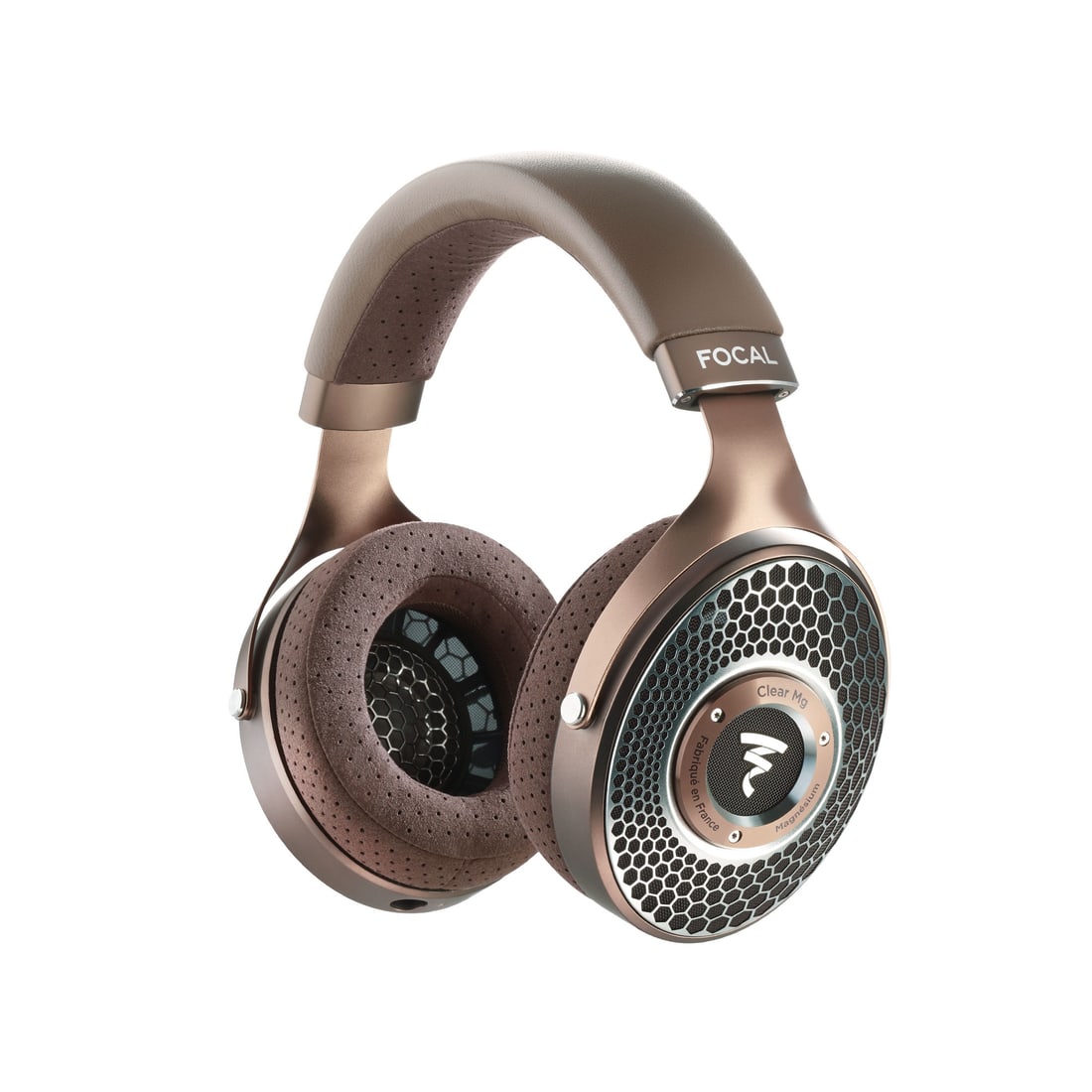
The Clear MG is Focal's open-back dynamic flagship using an 'M'-shaped magnesium dome driver for wide bandwidth and low distortion. It targets audiophiles wanting a fast, detailed and easy-to-drive full-size headphone made in France.
As an Amazon Associate and partner of the retailers above, Sound Technology earns from qualifying purchases — at no extra cost to you. Prices and availability checked recently but vary; the linked retailer is the source of truth.
Pros
- Fast, dynamic and highly detailed presentation
- Easy 55-ohm load drives well from modest amps
- Superb build with solid aluminium yokes
- Wide, even frequency response
Cons
- Heavy at 450 g over long sessions
- Treble can read as forward/energetic for some
- Premium price for a dynamic headphone
The short version is: this is a headphone that earns its price, mostly
Four hundred and fifty grams. That number sits at the back of my mind every time I pick up the Focal Clear MG, because weight is the thing nobody talks about honestly in headphone reviews. We say 'premium build' and 'substantial feel' and quietly ignore the neck ache that starts around the two-hour mark. But I'm getting ahead of myself.
The Clear MG is Focal's current open-back dynamic flagship, sitting above the original Clear in the line and below the Utopia in price. It's built in Saint-Étienne, France, and priced in Australia at A$2,199. At that number you're in serious company, and Focal knows it. The engineering brief here is precise: a fast, wide-bandwidth dynamic driver with low distortion, in a chassis that doesn't embarrass itself on a desk next to a component stack. On paper, they've mostly delivered.
Design and engineering
The 'M'-dome driver
The centrepiece is a 40mm dynamic driver with what Focal calls an 'M'-shaped magnesium dome. This is not a marketing flourish — the geometry is structural. The M-profile distributes energy across the diaphragm differently to a conventional inverted dome, reducing the pistonic breakup modes that cause colouration in the upper midrange and lower treble. Magnesium itself is chosen for its stiffness-to-mass ratio: it's lighter than aluminium and stiffer than most polymer composites used at this price. The practical upshot is a driver that Focal claims can maintain controlled excursion over a very wide bandwidth, 5 Hz to 28 kHz per the spec sheet, without the kind of resonance spikes you'd normally have to equalise around.
THD is specified at below 0.25% at 1 kHz and 100 dB SPL. That's a conservative figure at a comfortable listening level; the number drops further at more typical domestic SPLs. For context, many planar magnetic headphones in this price bracket market low distortion as a primary differentiator — the Clear MG's measured performance means Focal can legitimately compete on that axis with a dynamic driver, which is the more difficult engineering ask.
Sensitivity, impedance, and what that means for Australian buyers
At 55 ohms and 104 dB/mW, the Clear MG sits in a genuinely useful sweet spot. It's sensitive enough to drive adequately from a quality portable source or a laptop headphone output, but it scales — meaning a dedicated amplifier will extract more from it. This matters because a lot of A$2,000-plus headphones either need a proper desktop amplifier to reach their potential, or are so easy to drive that a dedicated amp adds nothing. The Clear MG rewards a good amp without punishing you for using a middling one. For anyone buying through Australian specialist retailers like Addicted to Audio or Audio Connection, that's a useful conversation to have with the staff before committing to ancillary gear.
Materials and construction
The yokes are machined aluminium, and they feel it — there's a precision to the way the cups articulate that you don't get from the polymer gimbals on mid-tier headphones. The headband is leather, stitched, and padded, with a metal inner spine. Ear pads are perforated microfibre over memory foam; they're comfortable initially and breathe reasonably well by the standards of closed-cell foam. The cable situation is genuinely generous: a 1.2-metre terminated 3.5mm cable for portable use, a 3-metre 4-pin XLR for desktop, plus adapters, all in a hard case that's actually shaped to the headphone rather than being a generic rectangle.
One aside: I keep a small whiteboard on the wall of my listening space with the specs of whatever I'm reviewing, which I stole as a habit from a session engineer I worked under years ago at a facility near King Street in Newtown. He swore it stopped him reaching for the EQ before he'd actually heard something properly. With the Clear MG, I found myself checking it more than once, because the driver spec and the listening experience align more closely than they usually do at this price.
Sound
Bass
The low end is taut and well-defined without being lean. Extension to 5 Hz is, in practice, more about headroom than audible bass — what it means subjectively is that the midbass isn't compensating for a shelf-off below 40 Hz. You get kick drums with genuine body, not the papery quality that afflicts some fast-but-thin open-backs. Bass lines on recorded acoustic material track cleanly without the smear that tends to reveal itself on complex double-bass passages. It's not the warmest presentation in the class, but it's an accurate one, and I'd rather have that at this price.
Midrange
This is where the M-dome engineering pays off most clearly. The midrange is detailed and textured in a way that feels earned rather than achieved through a forward tilt. Vocals sit correctly — present, but not pushed in front of the mix in that slightly fatiguing way some detail-forward headphones achieve by lifting 3-5 kHz. String tone has appropriate body. Acoustic guitar has bite without glare. Owners across various forum discussions consistently note that the Clear MG retrieves low-level detail in complex mixes without making that detail feel aggressive. I'd agree, based on the engineering: the low-distortion driver and wide bandwidth mean you're hearing the recording rather than a colourations artefact being mistaken for resolution.
Treble
Here's where you need to be honest with yourself as a potential buyer. The Clear MG's treble is forward. Not harsh — the distortion figure keeps it clean — but the upper registers have presence and energy that some listeners will read as bright and others will read as accurate. I've spent enough time on both sides of studio glass to be cautious about conflating brightness with detail, and the Clear MG largely holds up under that scrutiny. Extended listening on material with hot high hats or forward-mixed cymbals can accumulate, though. If you're treble-sensitive, this is not the headphone you listen to for four hours straight. An hour and a half is more realistic before the ears need a rest, and not all of that is the weight.
Dynamics and transients
This is genuinely impressive. The M-dome's stiffness-to-mass advantage shows itself in transient speed — leading edges on percussion are fast and clean, and dynamic swings between quiet and loud passages have authority. The Clear MG doesn't compress macro-dynamics in the way some planar headphones can at their price points, and the micro-dynamic resolution is high enough that low-level detail in quiet passages registers properly. For any listener who works with recorded music professionally, that last quality is particularly useful.
Soundstaging and imaging
Open-back designs have a structural advantage in soundstage width, and the Clear MG uses it. The image extends naturally beyond the headphone cup width, with reasonable depth layering. It's not the most holographic presentation in the class — the Sennheiser HD 800 S remains the reference for sheer spatial scale at a higher price — but for an open-back dynamic at A$2,199, the stage is wide, the imaging is precise, and instruments in complex mixes maintain separation under pressure. Binaural recordings and well-produced orchestral material in particular show the headphone at its most convincing.
Setup and system matching
The 55-ohm impedance and 104 dB sensitivity mean you have real flexibility here. A quality portable digital audio player — a Astell&Kern SR25, a FiiO M11 Plus, something in that bracket — will drive the Clear MG to satisfying levels with good control. A mid-tier desktop headphone amplifier, something like the Schiit Magni or the iFi Zen CAN, will improve authority in the bass and sharpen the transient performance noticeably. You don't need to spend A$3,000 on an amplifier to enjoy this headphone, which is not something you can say about all flagship dynamics.
On the DAC side, the forward treble means you want to avoid pairings that add their own upper-frequency brightness. Warmer-voiced DACs, or those with natural upper-frequency rolloff, balance the presentation usefully. Neutral-measuring DACs work well too. Avoid anything described by its manufacturer as 'analytical' or 'extended' — you'll compound the treble energy and the accumulated fatigue will arrive earlier.
Placement matters too: these are open-back, so background noise bleeds in and music leaks out. They're not suitable for shared offices, libraries, or anywhere you'd impose on others. At home, at a desk, in a listening room — that's their environment, and that's fine.
Living with it
The build is excellent and the finish is cohesive in a way that matters when you're spending A$2,199. The aluminium yokes feel precise without feeling over-engineered. The leather headband wears well. The hard case is genuinely useful for travel or storage.
The 450-gram weight is the practical limitation that deserves plain language: these are heavy headphones. At one hour they're fine; at two hours you'll have adjusted your sitting position multiple times; at three hours the weight is a real factor. People with smaller heads or lighter headphones in their reference may adapt faster, or not at all. I'd strongly suggest a physical trial if you can arrange it — Addicted to Audio's Melbourne store and Audio Connection in Sydney both typically stock Focal's range for audition. Comfort is not universal, and 450 grams will end a session for some listeners before the music does.
There's no app, no wireless, no active noise cancellation. The Clear MG is a passive, wired, open-back dynamic headphone. That's it. If that reads as a limitation, this isn't your product. If it reads as a relief, welcome.
Australian warranty and support runs through the local distributor. Parts availability for Focal's pad ecosystem has been reasonably reliable historically, which matters at this price point — you want to know replacement pads exist in three years.
How it compares
At A$2,199, the Clear MG's primary competition is the Sennheiser HD 800 S (roughly A$2,499), the Audeze LCD-X (around A$2,200 depending on configuration), and Beyerdynamic's T1 (discontinued but still in circulation at similar prices). The HD 800 S offers more soundstage scale and a more neutral tonal balance but has its own notorious 6 kHz peak and is harder to drive well. The LCD-X is planar, heavier still, with a warmer and darker tonal character — a fundamentally different presentation that suits some material better and others worse. Against those rivals, the Clear MG's advantages are driver speed, dynamic expression, and the ease-of-driving spec that the Audeze in particular can't match.
Honestly, I think A$2,199 is a fair price rather than an aggressive one. Focal isn't giving ground here — the competition at this bracket is credible. But the engineering rationale is sound, the build is genuinely premium, and the French manufacturing origin is verifiable, not aspirational spruiking.
Who it's for, and who should look elsewhere
The Clear MG suits: listeners who want a fast, detailed open-back they can drive from a quality portable or modest desktop amp; people who come from a music production or monitoring background and want the detail retrieval without sacrificing dynamic authenticity; buyers who value real build quality and a coherent package over feature lists.
- Look elsewhere if you are treble-sensitive and have found other 'detailed' headphones fatiguing on extended sessions — the Clear MG's forward top end will compound that.
- Look elsewhere if you need a headphone for shared or public spaces — open-back is non-negotiable in that reading.
- Look elsewhere if weight and long-session comfort is your primary concern. At 450 g, this is a real trade-off, and there are lighter options at slightly lower prices.
- Look elsewhere if you want a warm, lush, forgiving presentation. The Clear MG is detailed and somewhat demanding of the material you feed it.
But if you're a critical listener who wants a dynamic headphone that competes seriously with the planar field on distortion and detail, that doesn't require a four-figure amplifier to perform, and that's built with the kind of care that justifies the price tag — the Clear MG makes a genuine case for itself. I'd just make sure you've physically tried it for at least an hour before the credit card comes out.
— Eleanor Shaw, Headphones & Personal Audio Editor
Common questions
- Does the Focal Clear MG need an expensive amplifier to sound its best?
- Not by the standards of its class. At 55 ohms and 104 dB sensitivity, the Clear MG drives adequately from a quality portable DAP or even a good laptop headphone output. A dedicated desktop amplifier in the A$300–700 range will improve bass authority and transient precision noticeably, but you're not obligated to spend four figures on amplification the way you would be with harder-to-drive open-backs like the Audeze LCD-X.
- Is the treble on the Clear MG harsh or fatiguing?
- Forward rather than harsh is the more accurate description. The THD figure below 0.25% keeps the upper frequencies clean, but the presentation has energy and presence in the top end that sensitive listeners will find accumulates over long sessions. If you've found headphones in Beyerdynamic's brighter lines or the AKG K812 tiring, approach the Clear MG with a physical trial first.
- How does the Clear MG compare to the Focal Clear (original)?
- The Clear MG replaces the original Clear with the updated magnesium M-dome driver in place of the original aluminium dome. The design rationale is improved stiffness-to-mass ratio and reduced resonance modes. Sound character is broadly similar in presentation — fast, detailed, dynamic — with the MG iteration generally regarded as more refined in the upper midrange region where the original could occasionally show driver colouration.
- Where can Australian buyers audition and purchase the Focal Clear MG?
- The Clear MG is stocked by specialist Australian retailers including Addicted to Audio (Melbourne and Sydney locations) and Audio Connection in Sydney. Focal's Australian distribution is handled through local channels, which supports warranty and parts availability. Given the weight and treble character are personal-fit issues, a physical audition is strongly recommended before purchase.
- Are the ear pads replaceable, and how long do they last?
- Yes. Focal's pad ecosystem for the Clear line uses a proprietary attachment that is specific to the headphone, so generic replacements won't fit. Focal-branded replacement pads have been available through Australian retailers historically, though lead times can vary. The original perforated microfibre pads typically show wear at the contact edges after 12–24 months of regular use, so factor replacement cost into long-term ownership planning.