Focal Kanta No.2
Rating: 4.6 / 5
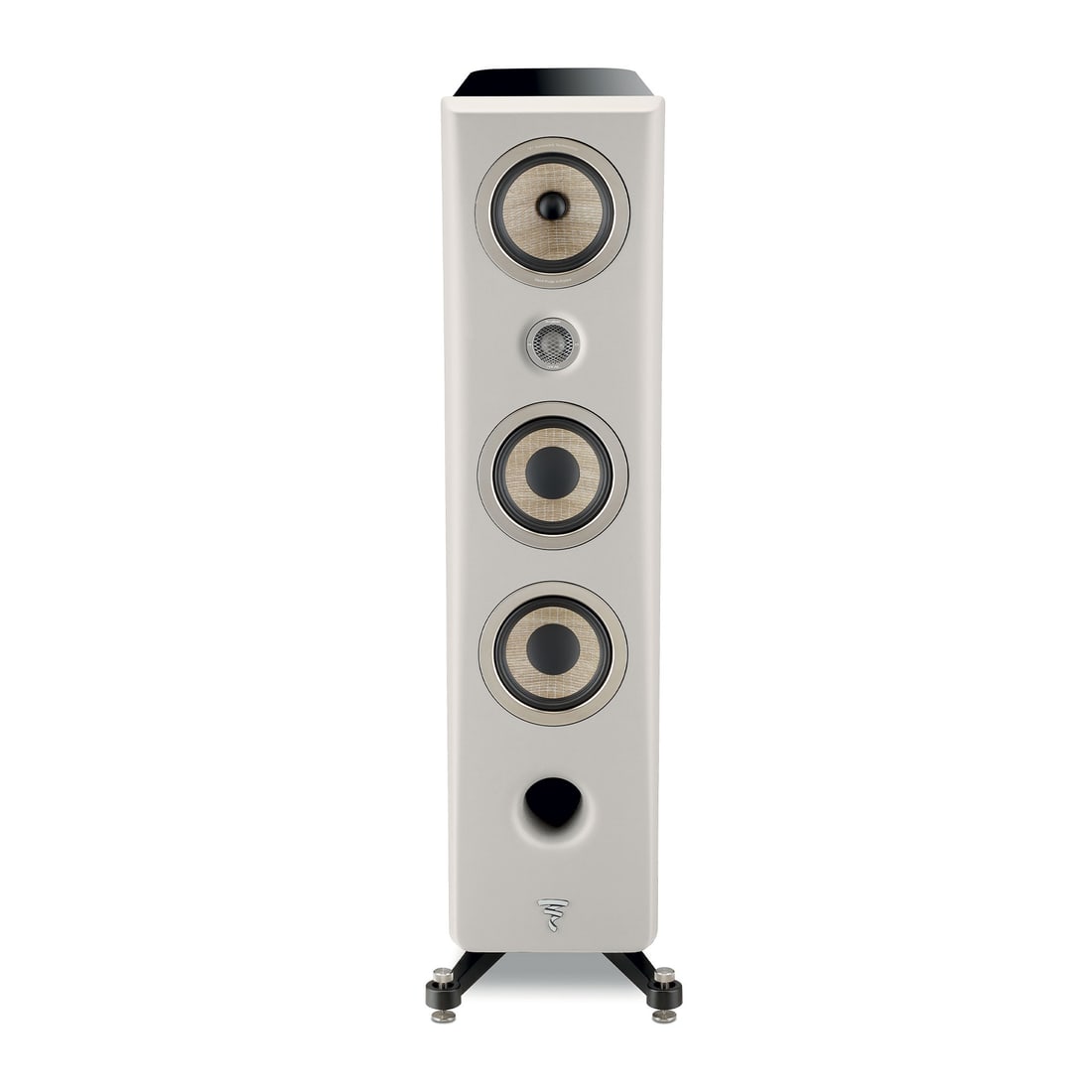
A three-way bass-reflex floorstanding loudspeaker built around Focal's Flax-cone drivers and Beryllium tweeter, aimed at high-end home hi-fi listeners wanting reference-grade French audiophile sound in a stylish package.
As an Amazon Associate and partner of the retailers above, Sound Technology earns from qualifying purchases — at no extra cost to you. Prices and availability checked recently but vary; the linked retailer is the source of truth.
Pros
- Beryllium tweeter and Flax-sandwich cones deliver fast, detailed, neutral sound
- Easy-to-drive 91 dB sensitivity works with a wide range of amplifiers
- Distinctive, well-finished cabinet with multiple colour options
Cons
- Premium price for a mid-sized floorstander
- Beryllium tweeter can sound forward/bright in untreated rooms
An opening take
Focal has always occupied a peculiar and somewhat enviable position in the high-end speaker market: too French to be politely ignored, too technically rigorous to be dismissed as mere style. The Kanta No.2 sits at the upper end of the brand's mid-tier — if you'll permit that phrase for a speaker asking A$19,500 — and it arrives carrying the most consequential technology Focal makes: a pure Beryllium inverted-dome tweeter borrowed directly from their Utopia lineage, paired with their proprietary Flax-sandwich cone drivers throughout. On paper, this is a speaker that should terrify rivals at twice the price. In practice, the picture is more nuanced, and I think it deserves a more honest assessment than the breathless praise it typically receives in the European press.
I'll say this upfront: I find Focal's engineering philosophy genuinely admirable. They own their own driver production. They invented the inverted-dome tweeter. They develop materials — Beryllium, Flax, W-composite — with real acoustic rationale behind them. The Kanta No.2 is not a parts-bin speaker. But A$19,500 is real money in this country, the competition at that price point is fierce, and a Beryllium tweeter in the wrong room can make you regret every dollar. Let's be precise about what you're actually buying.
Design & Engineering
The Flax cone: why it matters
The defining design decision in the Kanta No.2 — even more than the Beryllium tweeter, which gets all the press — is the consistent use of Flax-sandwich cone drivers across both the woofer and midrange. Focal's Flax material is a woven flax-fibre core sandwiched between two layers of glass-fibre. The rationale is straightforward and legitimate: you want a cone that is simultaneously light (low moving mass, fast transient response), rigid (high stiffness-to-weight ratio, minimal cone breakup), and well-damped (internal damping that suppresses resonance without needing to add mass). Traditional paper cones offer good damping but limited stiffness. Aluminium and other metals offer stiffness but poor internal damping — they ring. Carbon fibre composites offer rigidity but can be expensive and hard to tune. Flax is Focal's answer to this triangle, and the acoustic argument holds up: natural plant fibres have exceptional internal damping characteristics while the sandwich construction provides bending stiffness. The result, by design, should be a cone that moves quickly, stops cleanly, and introduces minimal colouration of its own.
The two 6.5-inch woofers operate in a bass-reflex cabinet tuned via a rear-firing port, and they feature Focal's NIC (Neutral Inductance Circuit) motor system. NIC uses a copper ring integrated into the motor structure to linearise inductance variation as the voice coil moves through its excursion range. This is genuine engineering: non-linear inductance is one of the primary sources of bass distortion in dynamic drivers, and addressing it at the motor level rather than through crossover compensation is the more direct solution. The midrange driver — also a 6.5-inch Flax unit — adds TMD (Tuned Mass Damper) suspension, which introduces a secondary mechanical resonance tuned to counteract the primary surround resonance. Again, this is not marketing nomenclature for nothing; TMD is a technique borrowed from structural engineering and it does measurably reduce distortion artefacts at the crossover transition frequencies.
The Beryllium tweeter
The 27mm inverted-dome Beryllium tweeter is the headline act, and it warrants both enthusiasm and a word of caution. Beryllium is extraordinary as a tweeter diaphragm material: its stiffness-to-weight ratio exceeds even diamond on a practical basis for dome geometries, its first breakup mode is pushed well beyond 40 kHz (consistent with the specified 40 kHz upper response limit), and the result is a tweeter that should reproduce everything in the audible band — and considerably above it — with vanishingly low colouration from modal behaviour. This is not aspirational: it is confirmed by both the physics and Focal's decades of Beryllium tweeter development, which dates back to their Utopia line. The inverted-dome geometry also provides a specific radiation pattern benefit: wider horizontal dispersion at high frequencies compared to a conventional dome, contributing to a more spacious, less beamy treble presentation.
The caution: Beryllium is genuinely toxic in raw form, which is why Focal vapour-deposits it in controlled facilities and why you should never, under any circumstances, attempt to touch or damage a tweeter diaphragm. The finished driver is safe in normal use. But this is also a very resolving, very fast tweeter, and in a room with hard reflective surfaces — bare floorboards, plaster walls, low-absorption furnishings — that precision can translate to a forward, bright presentation. This is not a flaw in the tweeter; it is a room-matching and placement issue. But it is a real-world consideration for Australian buyers, many of whom live in homes with exactly those acoustic characteristics.
Cabinet and crossover
The Kanta No.2's cabinet is narrow-baffle by floorstander standards at 321mm wide, which reduces diffraction effects and contributes to precise imaging. At 35kg per speaker, there is clearly substantial internal bracing. The sculpted, curved rear panel is not purely aesthetic — curved surfaces resist cabinet resonance more effectively than flat panels under equal-area loading. The multi-colour finish options (several lacquer combinations across the cabinet and plinth) reflect Focal's positioning of the Kanta line as a design-forward product, and the execution is genuinely good by any standard. Nominal impedance is 8 ohms with a minimum of 3.1 ohms. That minimum is not trivial — it will influence amplifier selection — but at 91dB sensitivity the speaker remains manageable for a wide range of equipment.
Sound
Bass
The specified -6dB point of 29Hz is credible for this cabinet volume with dual 6.5-inch woofers and a rear port, and it positions the Kanta No.2 as genuinely full-range for most music. The NIC motor system and Flax cone combination should, by design, produce bass that is defined and textured rather than bloated or slow. Owners consistently describe the low end as taut and controlled — not the big, warm, room-filling bass of a larger cabinet or a transmission-line design, but a faster, more pitch-accurate presentation that serves acoustic bass, kick drum attack, and orchestral bass sections with distinction. The trade-off, as always with a compact-for-its-bandwidth bass alignment, is that deep bass extension below 40Hz requires room reinforcement from boundary placement to reach full impact. Pulling the speakers more than a metre from the rear wall — as precision imaging might otherwise suggest — can make the bass feel lean in larger rooms.
Midrange
This is where the Flax midrange driver's TMD suspension and the overall engineering coherence of the design should tell most clearly, and by all well-established accounts, it does. The midrange is where Focal's philosophy diverges from British house sound: this is not a warm, euphonic, forgiving presentation. Voices and instruments are presented with transparency and presence, with a sense of immediacy that some listeners find revelatory and others find slightly relentless. The Flax cone's intrinsic damping means that this presence is not accompanied by the glare or hardness associated with metal-cone midrange drivers — it is clean and composed — but it is not a soft or recessed midrange. Listeners who have spent years with British stand-mount speakers may need an adjustment period.
Treble
The Beryllium tweeter is the most discussed element of the Kanta No.2's sound, and for good reason. Extension to 40kHz means it reproduces ultrasonic content from DSD and high-rate PCM formats without compression, and its low distortion means that detail retrieval at the upper register is exceptional. Cymbal decay, breath in woodwind recordings, the leading edge of plucked strings — all arrive with a clarity that can genuinely recontextualise recordings you thought you knew well. The forward characteristic I noted earlier in room-matching terms is real: this is not a laid-back, smooth treble in the tradition of soft-dome designs. It is precise, extended, and honest. In a well-treated room with warm amplification, this is a profound strength. In a live, reverberant room, it can fatigue.
Dynamics and soundstaging
Sensitivity of 91dB at 2.83V/1m is genuinely useful — not in the horn-speaker league, but meaningfully more efficient than the 86-88dB floorstanders that populate much of the competition at this price. This translates to better dynamic contrast at realistic listening levels, better micro-dynamic resolution, and a sense of effortless headroom that lower-sensitivity designs sometimes lack. The soundstage is wide and well-defined, benefiting from the narrow baffle and the Beryllium tweeter's dispersion characteristics. Imaging is precise without being clinical — instruments are located rather than smeared — and depth layering is a consistent strength noted by owners who have placed the speakers carefully.
Setup & System Matching
Amplification
The 40–300W recommendation from Focal is honest, and the 91dB sensitivity means that even a quality 50W integrated will drive these speakers to satisfying levels in a typical Australian living room. However, the 3.1-ohm minimum impedance demands respect. This is not a dangerous load, but it is a reactive one, and budget class-D amplifiers or vintage receivers with poor current delivery will struggle with dynamic peaks. I would prioritise current capability over raw wattage in amplifier selection. A well-specified 80W integrated with a proper power supply will outperform a poorly designed 200W receiver here. Valve amplifiers with robust output transformers — the speaker's nominal 8 ohms is workable — can pair beautifully, provided they have genuine current reserve. Tube amplifiers under 30W are a risk I would not take without a home demonstration.
Room and placement
I'll be direct: if your listening room has significant hard surface reflection — polished concrete floors, bare plaster, large glass surfaces — the Kanta No.2's Beryllium tweeter deserves serious consideration before purchase. Some acoustic treatment, even modest rugs, curtains, or a bookshelf wall behind the listening position, can transform the experience. These speakers also need space from the rear wall for the rear port to breathe and for the bass to integrate properly — 50-80cm minimum as a starting point. Toe-in experimentation is essential; the narrow baffle means imaging sharpens considerably with careful aiming.
Partnering gear
These are revealing enough speakers that the source chain matters. A mediocre streaming DAC will be exposed. This is not a bug — it is the correct behaviour for a reference-grade transducer — but buyers should budget accordingly. At A$19,500 for the speakers, a source and amplification budget of equivalent scale is not excessive; it is appropriate.
Living with It
Build quality is excellent in all the ways that matter at this price: the cabinet finish is robust and beautifully executed, the driver surrounds are properly protected, and the binding posts are solid and accept spades, bananas, or bare wire without drama. Multiple finish combinations allow genuine personalisation, which is rare at this price point. Focal is distributed in Australia through a well-established network with service support — not a grey import situation — and the brand's longevity in the Australian market gives reasonable confidence in long-term parts availability. The speakers are heavy at 35kg each but not unwieldy for two people; the spike system on the plinth is conventional and effective on both carpet and hard floors with appropriate floor-protector cups.
How It Compares
At A$19,500, the Kanta No.2 competes directly with the Dynaudio Confidence 20 (stand-mount, different proposition), the Sonus Faber Sonetto VIII, the KEF Reference 3 at slightly above, and — critically — Focal's own Sopra No.2 which sits above it in the range. The Sopra No.2 uses a W-composite midrange rather than Flax and a different cabinet geometry, and it commands a significant price premium. Whether that delta is justified is a legitimate question for a home demonstration. Versus the KEF Reference 3, the Kanta offers warmer tonality on paper but arguably more conventional driver technology; the Uni-Q approach is fundamentally different in imaging philosophy. The Sonus Faber Sonetto VIII is warmer, more forgiving, and arguably more beautiful; it will suit listeners who value musicality-as-warmth over resolution. The Kanta No.2 is the more analytically honest design of the two.
Who It's For / Who Should Look Elsewhere
The Kanta No.2 is for the listener who wants genuinely reference-grade transducer technology — Beryllium tweeter, coherent Flax cone architecture throughout — in a package that works with a wide amplifier range and doesn't require a dedicated listening room to function. It rewards careful setup and honest associated equipment. It is well suited to acoustic music, jazz, classical, and any genre where texture, timing, and treble resolution are primary values.
You should look elsewhere if: your room is acoustically live and untreated and you are unwilling to address that; if you prioritise warmth and forgiveness over transparency; if your amplifier budget is under approximately A$3,000–4,000 (the speakers will simply reveal its limitations); or if you need room-filling bass from a speaker in a space larger than roughly 35 square metres without adding a subwoofer. There is also an honest question of value: A$19,500 is not a casual purchase, and some buyers will find that the Focal Aria 936 or a carefully chosen secondhand Sopra No.2 serve them better within or close to that budget. This is not a speaker that flatters poor decisions; it illuminates them.
Verdict
The Focal Kanta No.2 is one of the most technically coherent floorstanders available in Australia at its price point — a speaker built around genuine engineering decisions rather than parts-bin assembly, with a Beryllium tweeter that remains among the finest high-frequency transducers available outside of the six-figure speaker market. Its honest, transparent presentation is a virtue for the right listener in the right room, and its 91dB sensitivity makes it genuinely accessible to quality amplification across a wide power range. But it is not a speaker that forgives an untreated room or indifferent source equipment, and at A$19,500 it demands — and deserves — to be heard in your own space before the purchase is committed. Take the home demonstration if your dealer offers it. In the right system, this is a speaker you will keep for a decade.
Common questions
- Does the Focal Kanta No.2 need a powerful amplifier to perform well?
- Not necessarily powerful in raw wattage terms — the 91dB sensitivity means a quality 50–80W integrated will drive them to realistic levels without strain. What matters more is current delivery and a well-specified power supply, because the 3.1-ohm minimum impedance places real demands on an amplifier's ability to maintain voltage swing under dynamic loads. Prioritise amplifier quality and current capability over headline wattage figures.
- Is the Beryllium tweeter actually dangerous?
- Beryllium in its raw elemental form is a toxic material, but the finished vapour-deposited tweeter diaphragm in the Kanta No.2 is safe under all normal listening and handling conditions. The risk arises only if the diaphragm is physically damaged or machined — something you should never attempt. In normal use, treat it as you would any precision tweeter: don't touch the dome, keep children and pets away from the drivers, and you will have no issues.
- How much room do the Kanta No.2s need to sound their best?
- These are medium-to-large room speakers that benefit from at least 50–80cm of clearance from the rear wall to allow the rear-firing port to function correctly and for the bass to integrate. A listening room of roughly 20–40 square metres is the sweet spot. Very large rooms may find the bass presentation lean without boundary reinforcement or subwoofer support; very small rooms may struggle with low-frequency room modes given the speaker's extension to 29Hz.
- Where can I buy the Focal Kanta No.2 in Australia, and is warranty support reliable?
- Focal is officially distributed in Australia through an established local network of specialist audio retailers, which means you are buying a properly warranted product with local service support — not a parallel import. Retailer presence is strongest in Sydney, Melbourne, and Brisbane, with some representation in other capitals. The brand has maintained continuous Australian distribution for many years, giving reasonable confidence in long-term support and parts availability.
- How does the Kanta No.2 compare to the Focal Sopra No.2 — is the upgrade worth it?
- The Sopra No.2 sits above the Kanta in Focal's range and uses a W-composite sandwich midrange cone rather than Flax, along with a revised cabinet geometry and crossover. The performance difference is real but incremental rather than transformative — both speakers share the same Beryllium tweeter lineage and the same core design philosophy. Whether the price premium for the Sopra No.2 is justified depends heavily on your system context and listening priorities. If budget allows, a comparative home demonstration is strongly recommended before committing either way.