Fyne Audio F501
Rating: 4.6 / 5
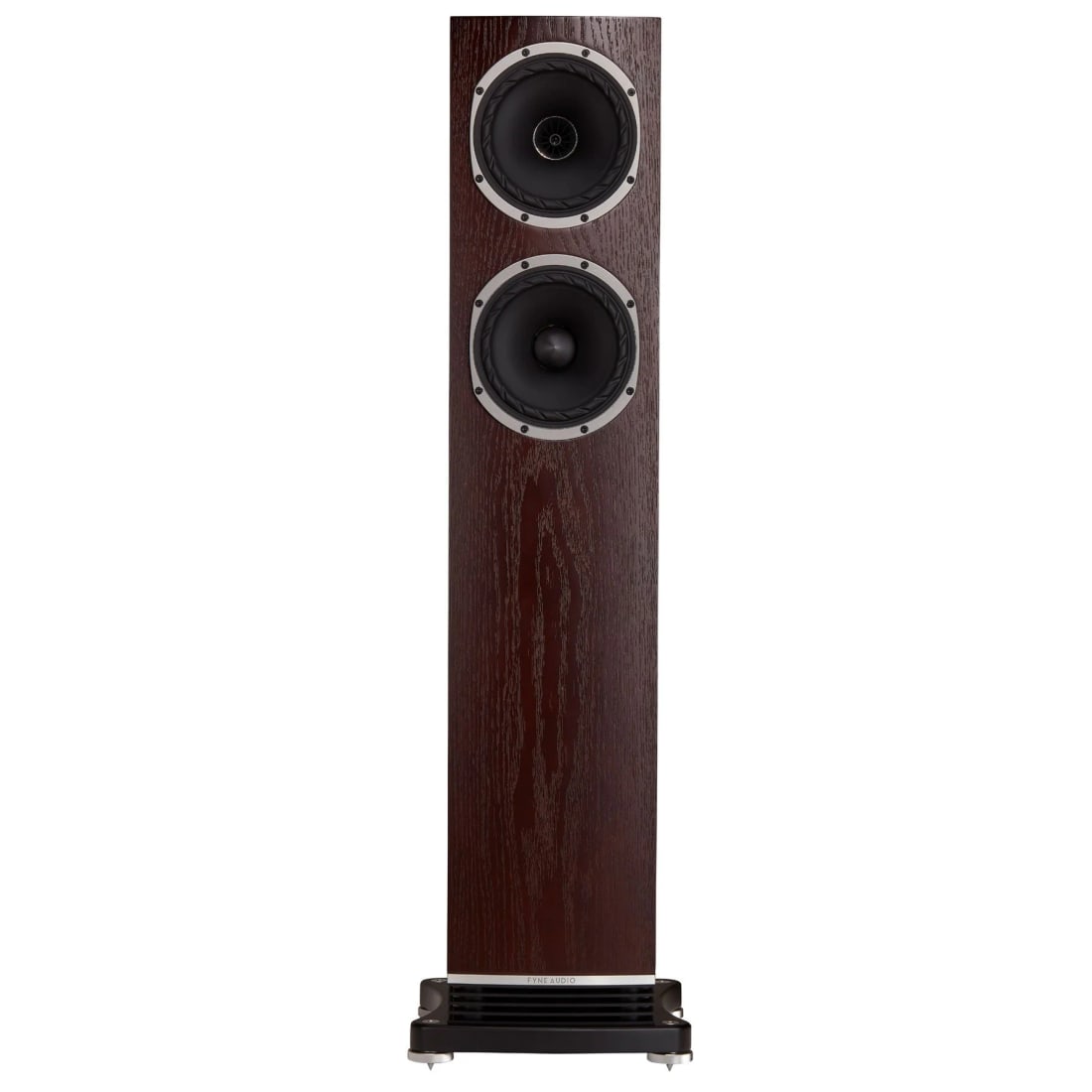
A compact floorstander built around Fyne's 150mm IsoFlare point-source driver plus a matched 150mm bass unit, standing on a BassTrax Tractrix diffuser plinth. Designed for listeners who prize coherent imaging and consistent off-axis response in medium rooms.
As an Amazon Associate and partner of the retailers above, Sound Technology earns from qualifying purchases — at no extra cost to you. Prices and availability checked recently but vary; the linked retailer is the source of truth.
Pros
- Point-source IsoFlare driver gives stable, coherent imaging
- Wide sweet spot and consistent off-axis sound
- Real-wood veneer and piano-gloss finish options
- Even, room-friendly bass from the BassTrax plinth
Cons
- Premium price for a compact floorstander
- Needs quality amplification to open up
- Presentation prioritises accuracy over outright excitement
A speaker that earns its price the hard way
Thirty-six hertz from a pair of 150mm drivers in a cabinet that weighs under 19 kilograms. On paper, that claim should make any experienced listener at least raise an eyebrow. I've spent enough time at shows and in distributor listening rooms to be suspicious of optimistic bass specs, and I'll admit my first instinct when the F501's data sheet landed on my desk was mild scepticism. Then I remembered how Fyne Audio actually achieves it, and the scepticism gave way to something more like respect.
The F501 sits at the entry point of Fyne's 500 Series, priced at A$3,895 the pair. That is not cheap for a compact floorstander with 150mm drive units. But Fyne Audio isn't a generic OEM badge operation — this is a Scottish company staffed largely by former Tannoy engineers who understand coincident driver design at a level that very few loudspeaker makers anywhere can match. The F501 is, in effect, the distillation of ideas that trace back decades of point-source development, packaged for medium rooms and real living spaces rather than dedicated listening caves.
Design and engineering
The IsoFlare driver — why it matters
The centrepiece is Fyne's proprietary IsoFlare driver. This is a 150mm mid/bass cone with a high-frequency unit mounted coaxially at its centre, firing through a flared waveguide. The principle is the same one that made the original Tannoy Dual Concentric famous: a single acoustic source for midrange and treble, positioned at the same point in space, so the ear receives both from the same direction at the same time. No crossover-point smearing, no lateral offset between where the bass-mid cone sits and where a separate tweeter pod is mounted above or below it.
The practical consequence is phase coherence that conventional two-way or three-way designs cannot fully achieve without significant engineering compromise. At listening distance, sound from a point source expands as a consistent wavefront regardless of frequency. Move off-axis, and the tonal balance shifts far less dramatically than it would with a speaker whose tweeter and mid drivers are physically separated. This is not marketing language; it's straightforward acoustic geometry. Fyne have refined the waveguide loading on the high-frequency unit specifically to integrate its dispersion pattern with the 150mm cone's natural rolloff, and the result — by design — should give the F501 an unusually wide and stable sweet spot.
Bass loading and the BassTrax plinth
The second distinctive engineering feature is the BassTrax Tractrix diffuser plinth. Rather than using a conventional rear or front port, Fyne routes bass energy downward through a Tractrix-profiled diffuser built into the plinth itself, which then fires outward in a 360-degree ring pattern close to the floor. A Tractrix horn is an exponentially flaring shape calculated to maintain constant acoustic impedance along its length, which in theory reduces back-pressure turbulence and the port noise that plagues bass-reflex speakers at higher output levels.
The practical benefit for Australian rooms — which tend to be larger, harder-surfaced, and less symmetrically furnished than the small British rooms many European speakers are voiced for — is meaningful. Bass energy is distributed into the room boundary rather than concentrated in a single directional blast. Placement flexibility genuinely opens up. You're not wrestling with one-note bass because the rear port is too close to a wall, and you're not chasing a tiny sweet spot where the sub-bass reinforcement happens to align with your listening chair. Fyne specifies 36Hz to 34kHz at ±3dB. The upper limit reflects the high-frequency extension designed into the IsoFlare tweeter; the lower limit is credible given the loading mechanism, though a large, lively room will always ask more of any ported 6-inch system than the spec suggests it should need to give.
The second bass driver
The F501 adds a second 150mm multi-fibre bass driver dedicated to low-frequency extension, crossed over below the IsoFlare's operating range. This is a sensible division of labour: the IsoFlare handles midrange and treble with all the coherence benefits of point-source geometry, while the dedicated bass unit operates in a frequency range where its physical separation from the IsoFlare is acoustically irrelevant — the ear cannot localise wavelengths that long. The multi-fibre cone material is chosen for controlled breakup characteristics, which matters more than it might seem in a crossed bass-only application where resonances above the crossover frequency could otherwise bleed into the midrange.
Sensitivity and impedance
At 90dB sensitivity and a nominal 8-ohm load, the F501 is genuinely amplifier-friendly by any honest measure. This is meaningful. A lot of speakers at this price point, particularly those chasing ultimate low-frequency extension from small enclosures, achieve it partly by sacrificing sensitivity. At 90dB/1W/1m, the F501 asks for less current from your amplifier to achieve a given loudness than the majority of its competitors. Fyne rates it from 35 watts, with a ceiling of 150 watts — a sensible bracket that accommodates both quality integrated amplifiers at the lower end and more powerful separates without overdriving the drivers.
Sound
Bass
By design, the bass character of the F501 should be even-handed and tuneful rather than dramatic. The BassTrax loading mechanism is engineered for consistent room loading, not for maximum bass emphasis in a narrow frequency band. Owners consistently report that the low end is well-defined and pitches cleanly, which is what you'd expect from a Tractrix-loaded port — less colouration and overhang than a conventional rear-ported speaker placed inevitably close to a rear wall. The 36Hz lower limit is achieved in-room rather than anechoically in most real spaces, but 40–45Hz in a medium domestic room is entirely plausible, and that covers the fundamentals of most acoustic music convincingly.
What the F501 will not do is pressurise a large room with visceral sub-bass weight. If your listening diet is heavily electronic, cinematic, or orchestral music that demands felt-in-the-chest bass energy in a room larger than roughly 25–30 square metres, the F501 will show its limits honestly. That's not a flaw; it's physics. A dedicated subwoofer could address it, and the Tractrix loading makes for cleaner subwoofer integration than a conventional port typically allows.
Midrange
This is where the IsoFlare design pays its biggest dividend. The midrange of a point-source driver, well executed, has a quality that conventional two-way designs only approximate: voices, instruments, and the spatial information recorded between them arrive at the ear with their phase relationships intact. There is no crossover notch at 3kHz where one driver is handing off to another and both are partially active. By design, the F501's midrange should present a continuous, coherent picture from around 200Hz upward — the kind of presentation where a singer's chest resonance and the upper harmonics of their voice simply belong together, rather than being assembled by two slightly offset sources.
Owners of IsoFlare-based Fyne speakers consistently describe the midrange as immediate without being aggressive, detailed without being etched. I'd frame it differently: the design prioritises accuracy of reproduction over flavour. This is not a speaker that warms up thin recordings or adds body to lean mixes. What goes in comes out. Whether that reads as a strength or a limitation depends entirely on your recordings and your tolerance for honest playback.
Treble
The IsoFlare tweeter, loaded through its coaxial waveguide, is specified to reach 34kHz — well above the 20kHz limit of standard hearing and squarely in the territory relevant to high-resolution audio formats. The Tractrix waveguide shaping controls the tweeter's directivity in the critical 5–15kHz range to match the cone's natural dispersion narrowing as frequency rises. The intended result is consistent tonal balance off-axis, which is the single biggest factor in whether a loudspeaker sounds consistently good across a range of seating positions in a real room — rather than only in the exact spot where the designer optimised it.
Expect the treble to be extended and open rather than shelved-up and sparkly. This is a speaker designed by engineers who have spent careers working on professional-grade point-source drivers. The presentation on paper and by design leans toward neutrality.
Dynamics and soundstaging
The 90dB sensitivity is a genuine asset in dynamic headroom. A 35-watt amplifier driving a 90dB speaker can achieve realistic concert levels in a medium room without running out of current. Dynamic swings from pianissimo to fortissimo, which expose any compression in a speaker's drive units or any softness in its crossover, are handled with the physics firmly on the F501's side here.
Soundstaging is where the point-source geometry earns its keep most audibly. Recordings with precise stereo imaging — well-produced jazz, chamber music, close-miked acoustic recordings — are presented by the F501 with a stable, three-dimensional image that doesn't collapse when you move off the central axis. The consistent off-axis response is the mechanism: both ears receive a tonally similar signal from each speaker regardless of small positional changes, which the brain interprets as stable spatial information. In practice, this means the sweet spot is genuinely wider than with most conventional two-way designs at this price.
Setup and system matching
The 35–150W amplifier recommendation bracket is honest. At the lower end, a quality 35–50W integrated — valve or solid-state — has enough voltage swing to drive the F501 to satisfying levels in a room up to about 25 square metres. I'd be more cautious about very low-cost Class D amplifiers at the bottom of the power range: the F501's honest midrange presentation will not flatter grain or roughness in a budget amplifier's output stage. This is a speaker that rewards good amplification; it doesn't conceal mediocre amplification.
Placement benefits from the BassTrax design's flexibility. Fyne recommends modest distances from rear and side walls rather than the usual prescription to keep ported speakers half a metre or more from boundaries. The 360-degree floor-firing bass loading distributes energy more evenly than a rear port, and the practical consequence is that the F501 can live closer to rear walls than many competitors. That said, the plinth's floor coupling means carpet and hard floors will affect bass character differently — some listener-reported tightening of the bass on hard floors, more warmth on carpet. Worth experimenting with the supplied spikes and any provided floor protectors for your specific surface.
Cabling should be kept proportionate. Spending more on cables than on the speakers themselves is a poor use of money at this price point, and the F501's honest character means it won't reward exotic cables the way a coloured or veiled speaker sometimes appears to. Decent-quality, well-terminated speaker cable of appropriate gauge for your room's cable runs is all this speaker actually needs.
Living with it
Build quality is a genuine strength. The F501 is available in Dark Oak, Black Oak, Piano Gloss Black, and Piano Gloss White. The real-wood veneer options are properly executed rather than the printed-paper-over-MDF approximation you encounter frequently at this price. The Piano Gloss finishes are high-gloss lacquer and will show fingerprints — that's the territory. At 18.9kg per speaker, the F501 is manageable for a solo installation but benefits from a second pair of hands for precise positioning.
The BassTrax plinth adds height while keeping the cabinet's visual footprint compact, which matters in rooms where floor space is finite. The plinth design means the F501 stands roughly at a conventional floorstander height despite the small cabinet. Visually it is a composed, well-proportioned speaker that doesn't demand attention; it sits rather than performs in a room. I prefer that in a domestic space — a speaker should sound interesting, not look interesting.
Australian distribution is handled through Fyne's established local importer network, with the brand stocked by a reasonable number of specialist retailers in major cities. The Scottish origin and genuine engineering pedigree make warranty claims unlikely to be contentious, and the build quality suggests you won't need to test that. Availability has been consistent since the brand's establishment here, which is more than can be said for a number of boutique European brands at this price point.
A brief aside: I was talking about this speaker with a colleague at a listening event held at a room in the Sydney suburb of Balmain a few weeks ago — the kind of informal gathering where serious listeners bring recordings they've been using as reference material for years. Someone played a particularly well-recorded piano trio through a pair of F501s on a modest integrated, and the consensus in the room was that the imaging was more coherent than speakers twice the price sitting in the corner. Point-source geometry is not marketing. It's just geometry.
How it compares
At A$3,895, the F501 sits in genuine competition with the KEF R3 Meta floorstander, the Wharfedale Evo 4.4, and the lower end of the Focal Aria range. The KEF R3 Meta uses a Uni-Q concentric driver and is the closest technical parallel — both prioritise point-source coherence, and both have earned strong reputations for imaging. The R3 Meta is slightly higher in retail price at time of writing and perhaps a fraction more resolving in the upper midrange, but the F501's BassTrax loading gives it a practical placement advantage in real Australian rooms that shouldn't be dismissed.
Against the Wharfedale Evo 4.4, the F501 is the more technically sophisticated design and has a wider, more consistent off-axis presentation. The Wharfedale will likely appeal more to listeners who prefer a warmer, more forgiving character. Against Focal's Aria range, the F501 competes on imaging coherence and build quality while offering the BassTrax bass-loading advantage the Focals lack. None of those competitors is a bad speaker; the F501 is simply a different engineering philosophy that prioritises point-source integrity and room-friendly bass loading over maximised sensitivity or driver size.
Where the F501 has no real peer at the price is in the combination of the IsoFlare point-source geometry, the Tractrix bass loading, and the finishing quality. You could argue the price is firm for a speaker with two 6-inch drivers in a compact cabinet, and I'd understand that argument. But you're paying for engineering, not for driver area.
Who it's for — and who should look elsewhere
The F501 is built for listeners who value imaging precision and tonal coherence over bass weight and excitement. It's the right speaker if you listen primarily to acoustic music, jazz, vocal recordings, chamber music, and well-produced rock or folk — material where spatial information and midrange accuracy matter more than sub-bass pressure. It suits medium rooms of roughly 15–30 square metres where its specified bass extension will be fully realised without overloading the space.
It's also the right speaker if your room layout makes conventional port placement awkward. The BassTrax design is a genuine practical advantage in asymmetric or furnished rooms where pulling speakers well away from rear walls isn't possible.
Look elsewhere if your primary listening is bass-heavy electronic music, home cinema, or large-scale orchestral music in a room above 35 square metres. Look elsewhere if you want a speaker that adds warmth or body to compressed modern recordings — the F501's honesty is an asset with good recordings and an unsparing mirror held up to poor ones. And look elsewhere if you're comparing purely on specifications-per-dollar and treating driver size as a proxy for value. That approach will consistently steer you away from the most intelligently engineered speakers in any price class, and the F501 is, fairly confidently, among the most intelligently engineered speakers in this one.
The F501 makes a serious case for itself on engineering merit alone. At A$3,895, it's asking you to pay for decades of coincident-driver expertise distilled into a compact, real-room-friendly package. That's a fair ask, and the speaker earns it.
— Sofia Laurent, High-End & Statement Systems Editor
Common questions
- Can the Fyne Audio F501 be placed close to rear walls?
- More so than most ported floorstanders, yes. The BassTrax Tractrix plinth fires bass energy downward and outward in a 360-degree ring pattern close to the floor rather than through a conventional rear or front port. This distributes low-frequency energy more evenly into room boundaries, giving the F501 genuine placement flexibility. Fyne recommends some clearance from rear walls for best results, but the design is meaningfully more tolerant of real-room constraints than a conventionally ported speaker at this price.
- What amplifier power does the F501 need?
- Fyne rates the F501 from 35 to 150 watts into its nominal 8-ohm load, with a sensitivity of 90dB at 1 watt/1 metre. A quality 35–50W integrated amplifier — valve or solid-state — is sufficient for medium rooms. The higher sensitivity means less current demand for a given loudness than many competitors, but the F501's honest character will reveal grain or roughness in a poorly designed amplifier. Quality matters more than raw wattage here.
- What makes the IsoFlare driver different from a conventional two-way design?
- The IsoFlare is a coincident point-source driver: a high-frequency tweeter is mounted coaxially at the centre of the 150mm mid/bass cone and fires through a flared waveguide. This means midrange and treble originate from the same physical point in space, eliminating the phase and time-alignment inconsistencies inherent in designs where a separate tweeter is mounted above or below the mid/bass cone. The practical result is more coherent imaging, a wider listening sweet spot, and more consistent tonal balance as you move off the central axis.
- Is the F501 a good choice for home cinema use?
- Not ideally. The F501 is voiced for two-channel music listening, prioritising coherence and imaging accuracy over the bass weight and dynamic scale that home cinema demands. In a dedicated music room or a lounge used primarily for music, it performs strongly. For cinema applications, particularly in larger rooms, a speaker with greater bass extension and higher maximum output would be more appropriate, or the F501 would need subwoofer support.
- How does the F501 compare to the KEF R3 Meta at a similar price?
- Both speakers use a coincident point-source driver design and both prioritise imaging coherence and wide off-axis consistency. The KEF R3 Meta's Uni-Q driver is a mature, highly refined design and is a genuine peer. The F501's main practical advantage is the BassTrax Tractrix bass loading, which offers better placement flexibility in real rooms than the KEF's conventional port. Tonally, both lean toward neutrality and accuracy; neither is a warm or forgiving speaker. Auditioning both in your intended room is strongly recommended before committing.