Grado RS2x
Rating: 4.4 / 5
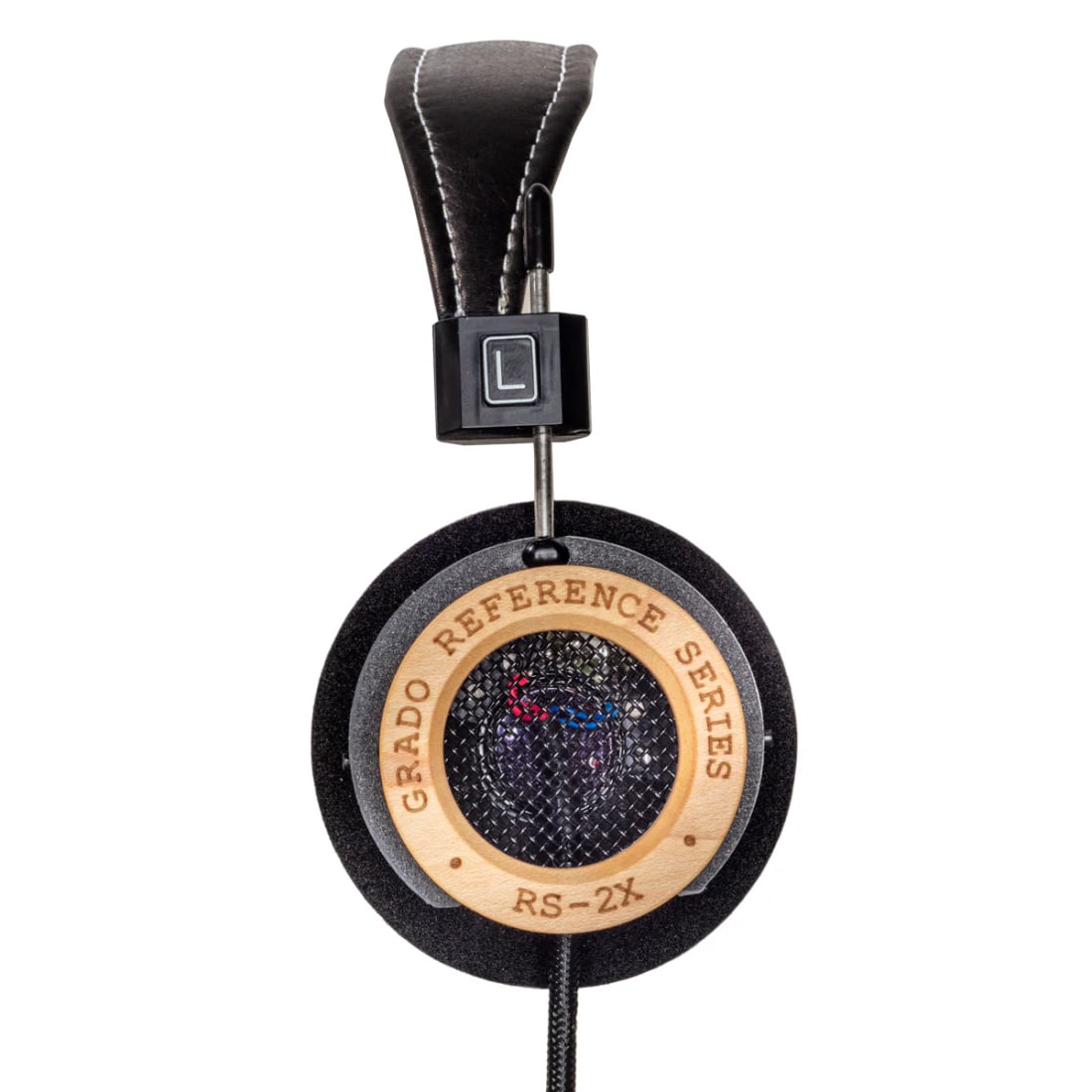
The RS2x is a hand-built open-back on-ear from Grado's Reference Series, pairing a maple-and-hemp housing with their 4th-generation X driver. It suits listeners who want a lively, forward and engaging sound for rock and acoustic material and don't mind an on-ear fit.
As an Amazon Associate and partner of the retailers above, Sound Technology earns from qualifying purchases — at no extra cost to you. Prices and availability checked recently but vary; the linked retailer is the source of truth.
Pros
- Lively, engaging midrange ideal for rock and acoustic
- Lightweight and easy to drive from most sources
- Distinctive hand-made maple/hemp wood build
- Strong value within Grado's Reference line
Cons
- On-ear foam pads and minimal isolation won't suit everyone
- Fixed, non-detachable cable
- Very sparse accessories
The short version
Thirty-eight ohms and 99.8 dB sensitivity. On paper, almost anything will drive the Grado RS2x — your phone, your interface, your grandmother's portable CD player. That's partly the point. Grado built these to be used, not babied. At A$795 they sit in the middle of the Reference line, and they wear that position honestly: better than the RS1x in certain areas is a conversation for another day, but the RS2x is a coherent, hand-built object with a genuine sonic identity. Whether that identity suits you depends almost entirely on what you listen to and how long you can tolerate foam on your ears.
Design and engineering
The maple and hemp housing
Grado's use of wood in housing construction isn't decoration. The material choice affects resonance behaviour — hard synthetic cups tend to ring in ways that can add a glassy edge to the upper midrange, while wood damps those resonances differently, contributing to what listeners consistently describe as a more natural, less fatiguing character. The RS2x pairs a maple sleeve with a hemp core, a combination Grado introduced to bring additional internal damping without adding mass. Hemp, for what it's worth, has a fibre structure that absorbs certain vibration frequencies particularly well; it's not marketing whimsy, even if it sounds like it might be.
The result is a housing that weighs almost nothing. Grado's on-ear designs have always been light, and the RS2x continues that tradition. Coming from a studio background I've worn headphones for six, eight, ten-hour stretches, and weight matters in ways that only become obvious around hour four. The RS2x won't cause neck fatigue. The foam pads are another story, which I'll get to.
The 4th-generation X driver
The 44mm dynamic driver here is Grado's fourth-generation 'X' unit, hand-built in their Brooklyn facility. Grado has been making drivers in-house for decades and the X series represents their current best thinking on diaphragm geometry and voice-coil topology. The frequency response specification runs 14 to 28,000 Hz, which is a wide window, though how flat that response is across the range isn't disclosed. Grado's house sound leans toward the upper midrange and lower treble — by design, not by accident — and the driver geometry is tuned to support that character.
The cable is an 8-conductor super-annealed copper design, fixed and non-detachable, terminating in a 6.3mm plug. Super-annealed copper is a real thing: the annealing process relieves work-hardening in the wire, improving flexibility and theoretical conductivity. Whether that translates to audible differences versus standard OFC is a claim I'd ask you to hold loosely. What I can say is the cable is softer and less microphonic than many — it doesn't crinkle and transmit handling noise the way a cheap cable does. The fixed termination is a legitimate inconvenience if you prefer balanced connections or simply want to swap cables, and at A$795 I'd rather Grado offered a detachable option. That's my honest gripe with the design.
Sound
Bass
The low end is present but not prioritised. Sub-bass extension is modest — the open-back, on-ear form factor simply can't pressurise the ear the way a closed, circumaural design can, and the RS2x makes no attempt to compensate with artificial bass boost. What you get instead is bass that's tight and reasonably textured. Kick drums hit with good transient definition; upright bass on acoustic recordings has body without bloom. Owners consistently report that the low end suits jazz, folk and classic rock rather than electronic music where sub-bass weight matters. That's an accurate characterisation by design: the driver isn't voiced for rumble.
Midrange
This is where the RS2x earns its keep. The midrange is forward, present, almost confrontationally immediate — voices sit right in your face, guitars have texture and bite, piano has real strike to it. I've spent enough time with reference-grade headphones to know the difference between genuine midrange clarity and upper-midrange brightness doing an impression of clarity, and the RS2x sits closer to the former than many open-backs at this price. The hemp and maple housing does appear to contribute something here; the character is warm without being veiled, which is a harder balance to strike than it sounds.
For rock listeners this is the central argument for the RS2x. Put on anything from Neil Young's Harvest to Led Zeppelin II to Radiohead and the presentation is engaging in a way that pulls you into the mix rather than placing you at a clinical distance from it. Acoustic guitar particularly benefits: fingerpicking has edge and air, strumming has dynamics. Owners who came to Grado from other reference headphones almost universally note the midrange as the product's defining quality.
Treble
Extended but not razor-sharp. The RS2x reaches a specified 28,000 Hz, and the high frequencies are present and detailed without crossing into the kind of sibilance that makes hi-hat or vocal esses fatiguing over time. I'd call the treble character lively rather than bright — there's enough energy to resolve cymbal decay and string overtones, but not so much that the headphone becomes tiring after thirty minutes. That said, listeners who are genuinely treble-sensitive should audition before buying. The RS2x is not a dark or forgiving headphone; it doesn't paper over upper-frequency content.
Dynamics and imaging
Dynamic headroom is a genuine strength. The X driver tracks transients well, and the result is an engaging sense of punch on percussive material. Live recordings and albums with wide dynamic range benefit noticeably. Soundstaging, by contrast, is moderate. Open-back headphones in general produce a wider stage than closed designs, and the RS2x gives you a believable sense of space, but the presentation is more intimate than expansive — instruments are well separated but not placed at vast distances. For rock and acoustic this is appropriate. For orchestral or large-scale choral work where a sense of scale matters, you might find the RS2x's presentation a little close.
Setup and system matching
At 38 ohms and 99.8 dB sensitivity, the RS2x will play loud from almost any source. A smartphone will drive it. A DAC/amplifier headphone output will drive it easily. You don't need a separate headphone amplifier to get the RS2x working, and that's a genuine advantage: the total system cost doesn't balloon the way it might with a 300-ohm planar.
That said, the RS2x does respond to source quality. Because the midrange presentation is so immediate and forward, a bright or grainy DAC will be exposed. Grado's house sound already leans toward the upper registers; if your DAC also leans bright, the combination can tip from lively to edgy. Warmer sources — or a quality desktop DAC/amp with a neutral-to-slightly-warm character — suit the RS2x well. The iFi Zen DAC and the Schiit Heresy are both available locally (both under A$300) and both work well with the RS2x without adding brightness.
Cabling is fixed at 6.3mm, so you'll need an adaptor for 3.5mm headphone jacks. Grado includes one, but it's one of the sparse accessories. Don't lose it.
Placement: these are open-back on-ears, which means they leak sound in both directions freely. They're not suitable for open-plan offices, commuting, or any situation where ambient noise matters or where you'd rather not share your music with the room. That's not a criticism — it's physics — but Australian buyers thinking about whether they can use these at work should factor it in. I'll be blunt: they can't.
Living with it
Build quality is genuinely impressive for the price. The maple and hemp housing has a warm, tactile quality — these feel like a crafted object, not a manufactured one. The Brooklyn assembly is evident in the fit and finish. I've had Grado headphones on my head in studios around Sydney's inner west and the build has never given me reason for concern.
The comfort conversation is more complicated. The foam pads are Grado's standard on-ear design — circular, minimal, and they sit directly on the outer ear. For some listeners this is fine indefinitely. For me, and I'll admit this freely, it's one of the things I watch closely in any on-ear design: the foam compresses and the earphone sits harder against the ear over time. Owners consistently report that two to three hours is the comfortable limit before needing to take the RS2x off. Some swap aftermarket pads (Grado's L-cushion or third-party alternatives) for improved comfort, which is worth knowing before you buy.
Accessories are genuinely sparse. You get a 6.3mm-to-3.5mm adaptor and a basic cable. No carry case, no balanced cable option, no extra pads. At A$795 that's acceptable but not generous. Grado's Australian distribution is handled through a handful of specialist retailers — Audio Connection in Melbourne is one of the established stockists — and service support for a product hand-built in Brooklyn is generally done through the importer. Worth confirming warranty terms at point of purchase.
How it compares
The obvious Australian comparison at this price point is the Beyerdynamic DT 900 Pro X (around A$500) and the Sennheiser HD 560S (around A$280). Both are open-back, both are over-ear rather than on-ear, and both offer considerably more long-wear comfort. The Sennheiser in particular is almost absurdly comfortable by comparison. What you give up with both is the RS2x's midrange character and the sense that you're listening to something handmade with a genuine point of view. The Beyerdynamic is technically more neutral and arguably more versatile across genres. The Grado is more engaging for the specific music it does best.
Within Grado's own line, the step down to the SR325x (around A$550 AU) gives up the hemp-and-maple housing for a metal cup, and owners report a slightly harder, more forward character. The RS2x is genuinely the more refined option. The RS1x above it (around A$1,400 AU) represents a meaningful step up in detail and extension, but the RS2x is the sweet spot in the Reference line for most listeners who don't want to spend that far into four figures.
Who it's for, and who should look elsewhere
Buy the RS2x if you listen to rock, acoustic, jazz or folk; if you want a handmade, sonically distinct headphone that rewards the material it's built for; if you listen at home and don't need isolation; and if the on-ear fit is something you're prepared to work with, either through short sessions or aftermarket pads. The easy driveability is a real bonus for anyone who doesn't want to invest in amplification.
Look elsewhere if you primarily listen to electronic music, hip-hop or anything that relies on sub-bass weight and impact — the RS2x simply isn't voiced for that. Look elsewhere if you need a headphone for commuting or the office. Look elsewhere if cable replaceability matters to you, or if long uninterrupted listening sessions are your primary use case and on-ear discomfort is a dealbreaker. The Audio-Technica ATH-R70x (around A$530 AU) is worth a look in that scenario.
The RS2x is an honest, characterful, beautifully built headphone that knows exactly what it is. A$795 is not a casual purchase, but for the listener it's aimed at — and that listener will know who they are by now — it delivers something that sounds genuinely alive in a market full of technically correct but emotionally inert options. Not perfect. Not for everyone. But for the right listener in the right room, pretty hard to argue with.
— Eleanor Shaw, Headphones & Personal Audio Editor
Common questions
- Do I need a dedicated headphone amplifier to drive the Grado RS2x?
- No. At 38 ohms impedance and 99.8 dB sensitivity, the RS2x will reach comfortable listening volumes from a smartphone, laptop headphone jack, or portable DAC without a separate amplifier. That said, the forward midrange presentation means it will reveal source quality differences — a cleaner, warmer source will sound noticeably better than a cheap or bright one, even if volume isn't the issue.
- Are the ear pads replaceable on the Grado RS2x?
- Yes. Grado uses a simple friction-fit pad system that makes replacement straightforward. The stock foam pads are Grado's standard S-cushion design. Many owners eventually move to Grado's L-cushion or G-cushion pads, or third-party alternatives, to improve long-wear comfort. Pad condition also affects the sound, so it's worth replacing them when they've compressed significantly.
- How does the RS2x handle isolation — can I use it in a shared space?
- The RS2x is an open-back design and offers virtually no passive isolation. External noise comes through clearly, and your music leaks out equally clearly. These are home-listening headphones, full stop. Using them in an open-plan office, on public transport, or anywhere that requires either personal quiet or consideration of others nearby isn't practical.
- The cable is fixed at 6.3mm — what do I need for a regular headphone jack?
- Grado includes a 6.3mm-to-3.5mm screw-on adaptor in the box. It's the primary adapter for connecting to phones, laptops, and portable players. The box is otherwise quite sparse on accessories, so keep track of the adaptor — replacements are available but it's an unnecessary hassle. There's no balanced cable option given the fixed, non-detachable cable design.
- Is the Grado RS2x worth the price over the SR325x sitting below it in the range?
- For most listeners, yes. The RS2x's maple and hemp housing isn't just cosmetic — the material combination contributes a measurably different resonance character compared to the SR325x's metal cup, and the sonic presentation is generally reported as more refined and less edgy in the upper midrange. The price gap (roughly A$245 at current pricing) is meaningful, but if the Reference line is your target and you're going to live with these for several years, the RS2x is the more satisfying long-term choice.