iFi Audio ZEN DAC 3
Rating: 4.5 / 5
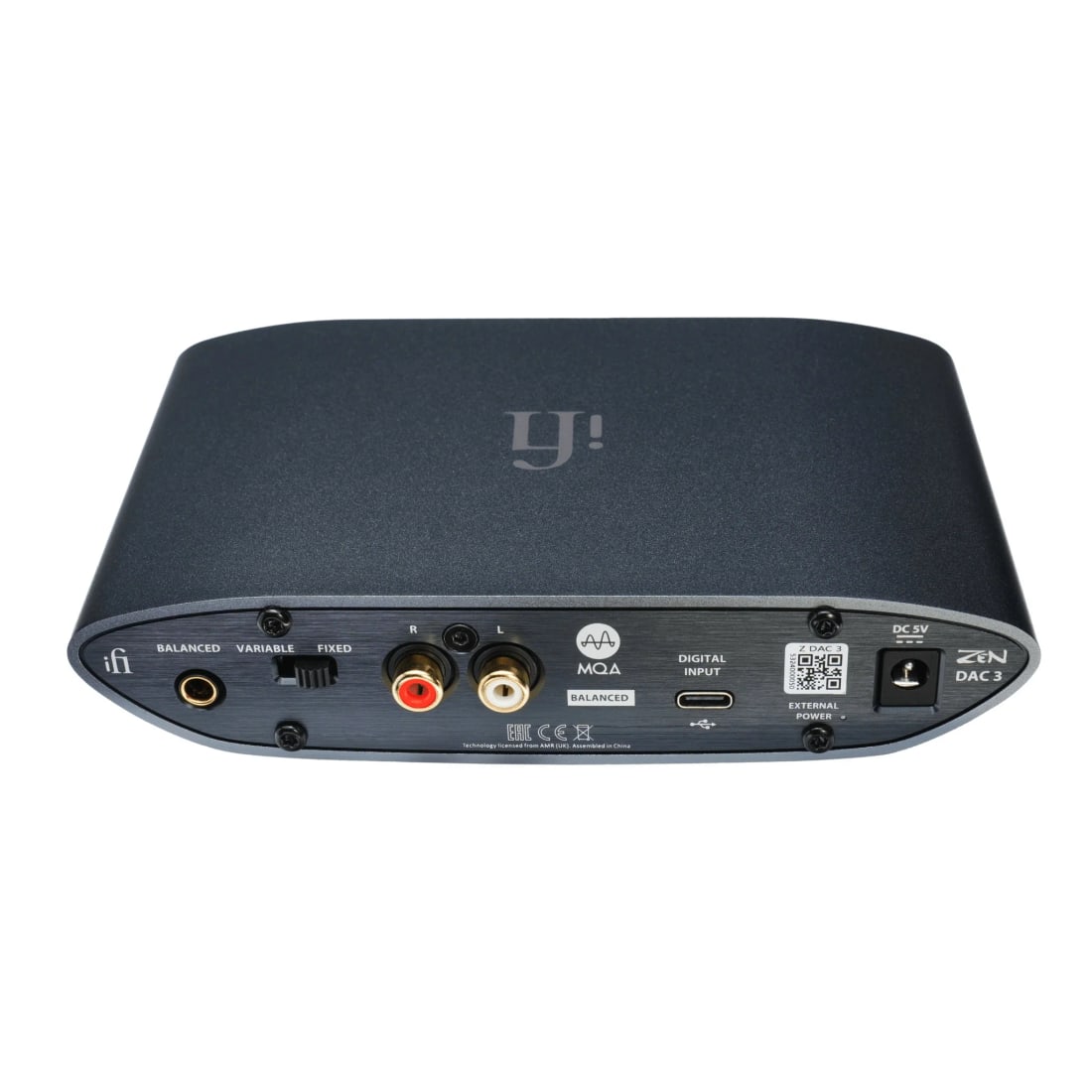
The ZEN DAC 3 is a desktop USB DAC and headphone amplifier with balanced 4.4mm and single-ended 6.3mm outputs plus iFi's analogue XBass+ and PowerMatch controls. It targets desktop users wanting a feature-rich, affordable balanced source for headphones or active speakers.
As an Amazon Associate and partner of the retailers above, Sound Technology earns from qualifying purchases — at no extra cost to you. Prices and availability checked recently but vary; the linked retailer is the source of truth.
Pros
- Balanced 4.4mm output at a low price
- Analogue XBass+ bass boost done well
- Ample power for most headphones
- Works as fixed or variable pre-out
Cons
- Best results need a decent USB/iPower supply
- No Bluetooth or network streaming
- MQA support is of limited value now
The short version is: a lot of DAC for $399
Three hundred and ninety-nine Australian dollars. That used to buy you a decent single-ended DAC with a mediocre op-amp output stage and a USB input that choked on anything above 192kHz. The ZEN DAC 3 arrives at the same price point offering a Burr-Brown DAC, native DSD512, balanced 4.4mm headphone output, and enough output power to drive most planars you'd realistically own at this budget. On paper that sounds like iFi overpromising. In practice, the engineering behind most of those claims is sound.
I'll be upfront: I spend a lot of time arguing about USB audio on forums (yes, I know how that sounds). The ZEN DAC 3 is exactly the kind of product those arguments are about — affordable, well-specced, with a few marketing additions that deserve honest scrutiny alongside the genuinely good engineering. Let's work through it properly.
Design and engineering
The DAC chip and topology
iFi has stayed with a Burr-Brown DAC implementation, and that's not an accident. The Texas Instruments Burr-Brown family — historically associated with PCM1792, PCM1795, and related silicon — has a reputation among designers for a warmer, fuller tonal character compared to the ESS Sabre line. ESS chips measure flatter on a bench but can exhibit a certain analytical quality that some listeners and reviewers find fatiguing over long sessions. Burr-Brown doesn't win every measurement war, but the presentation tends to be more forgiving on imperfect source material, which is probably most of your library.
The USB input handles PCM up to 768kHz and DSD512 natively. Bit-perfect operation — meaning the DAC receives the data stream unmodified by the operating system's sample rate conversion — depends on driver behaviour and host configuration, not just the hardware. On macOS this is generally straightforward in exclusive mode. Windows users will want the ASIO driver or WASAPI exclusive mode. Linux is fine with UAC2. So: the hardware supports bit-perfect delivery; your OS and software chain determines whether you actually get it.
Balanced output at this price
The 4.4mm Pentaconn balanced headphone output is the headline feature, and it's genuinely unusual at $399. Balanced drive means the DAC's differential output stage is preserved all the way to the headphone driver, with separate positive and negative drive for each channel rather than a common ground return. The result is better channel separation and, at a given supply voltage, double the voltage swing versus single-ended. iFi rates balanced power at greater than 390 mW into 64 ohms; the single-ended 6.3mm output does greater than 210 mW into 32 ohms. Those figures aren't staggering in absolute terms — a dedicated headphone amplifier will do multiples of that — but they're more than enough for most planar-magnetic headphones in this class. Audeze LCD-2s at 70 ohms, HiFiMan Arya at 35 ohms, Meze 99 Classics at 32 ohms: all manageable.
XBass+ and PowerMatch
XBass+ is iFi's analogue bass boost, applied at the output stage rather than in the digital domain. The distinction matters. A digital bass boost increases the level of low-frequency bins before the DAC, which can push the DAC into clipping if your source files are already near 0 dBFS. An analogue boost after the DAC avoids that risk and introduces no additional digital processing artefacts. Whether you actually want a bass boost is a matter of taste and headphone choice. With open-back headphones in a quiet room, bass extension is usually fine unaided. With closed-back phones in a noisy environment where low-frequency isolation competes with ambient noise — honestly, XBass+ is more useful than I expected it to be.
PowerMatch switches gain between two settings. Low gain for sensitive IEMs (where you need fine volume control at quiet listening levels); high gain for power-hungry planars. This is a genuinely practical feature, not window dressing.
Line outputs and pre-amp mode
The ZEN DAC 3 provides both 4.4mm balanced line outputs and standard RCA outputs. Both can operate in fixed or variable mode, making the unit viable as a preamp feeding active monitors or a power amplifier. Variable balanced line output at a desktop for $399 is not something many competitors offer in this category.
MQA: honest accounting
Full MQA decode is supported. I'll be direct about this: MQA as a format is in genuine decline following the collapse of MQA Ltd in 2023 and the shift by Tidal — its primary delivery vehicle — toward FLAC-based delivery. The decode hardware is present, and if you have MQA files it will render them correctly. But I wouldn't pay extra for it, and I wouldn't base a purchasing decision on it. It's there; it works; its long-term relevance is limited.
Expected sonic character
Bass
By design, Burr-Brown implementations tend to present bass with a touch more weight and body than hyper-linear delta-sigma alternatives. XBass+ aside, the ZEN DAC 3's bass output should be full and well-textured rather than analytical. Owners consistently report that kick drums land with real presence and that bass guitars have body rather than the lean, etched quality of some ESS-based competitors. The caveat is that XBass+ should be used deliberately — engaged for specific headphone pairings, not left on as a default.
Midrange
The Burr-Brown house character extends into the midrange. Vocals tend to sit with natural density; strings don't have the tendency toward sibilance that some ESS implementations exhibit. For a desktop DAC used across varied programme material — jazz, voice, film, whatever your actual listening is — this is a sympathetic tuning. It rewards longer listening sessions rather than impressing in a five-minute demo and fatiguing by the half-hour mark.
Treble
Treble is extended but not analytical. The ZEN DAC 3 is unlikely to embarrass itself on complex material, and the balanced output's improved channel separation gives orchestral and spatial recordings a bit more air than single-ended equivalents at this price. Owners of bright-leaning headphones — certain Beyerdynamic models, some early AKG designs — report the ZEN DAC 3 is a genuinely comfortable pairing that doesn't exacerbate treble hardness.
Dynamics and soundstaging
Dynamic headroom is adequate for the output power on offer. The balanced output's extra drive into higher-impedance loads gives transients a cleaner leading edge — snare hits, piano attacks, brass entries. Soundstaging from balanced headphone outputs generally benefits from the improved channel separation: centre images are more precisely anchored and left-right positioning is more distinct. These are structural benefits of the balanced topology, not audiophile mythology.
Setup and system matching
USB power and the iPower question
Here's the uncomfortable truth: the ZEN DAC 3 is a USB-powered device, and the quality of your USB bus power directly affects its performance. A noisy USB port on a cheap motherboard or a powered hub with a switching supply will introduce ground noise that can raise the noise floor. iFi sells its iPower series supplies and a USB-cleaning product called the iPurifier; both are real solutions to a real problem, not upselling for its own sake. If your desktop machine has a clean USB implementation — most modern Apple Silicon Macs do, as do many recent AMD-platform motherboards — you'll be fine out of the box. If you're running an older Windows desktop with a generic USB controller, a $79 iPower 5V supply is a worthwhile addition. Budget accordingly.
Headphone matching
The ZEN DAC 3 is best matched to headphones in the 16 to 150 ohm range. For very sensitive IEMs (anything above 100 dB/mW), low gain mode is essential; some listeners still report a faint background hiss with highly sensitive custom IEMs, which is a known limitation of single-box desktop units. For full-size over-ear headphones — the most natural pairing — the power is generally adequate. I wouldn't push it hard against something like the HiFiMan Susvara (which needs several watts and a dedicated amp) but that's not the ZEN DAC 3's audience.
As a desktop preamp
The variable output into active monitors is one of the ZEN DAC 3's underrated uses. A pair of Yamaha HS5s or Adam Audio T5Vs driven from the balanced 4.4mm outputs via a suitable cable gives you a genuinely clean desktop monitor chain without a dedicated preamp. For a home studio or a serious listening desk, this is a practical and well-priced solution.
Cabling reality
You'll need a USB-C cable — iFi supplies one, and it's adequate. Balanced headphone cables terminating in 4.4mm Pentaconn are more common than they were two years ago; most major headphone manufacturers now offer them as accessories or aftermarket. Budget $40 to $80 for a decent balanced cable if your headphones ship with only a 3.5mm or 6.3mm termination.
Living with it
Build and ergonomics
The ZEN DAC 3 sits in iFi's familiar compact footprint: roughly the size of a thick paperback, aluminium shell, the volume pot at the front right. The knob action is smooth without being loose. Front-panel switches for XBass+ and PowerMatch are positive and clearly labelled. The unit doesn't shift around on a desk under normal use, which sounds basic but wasn't always true of earlier ZEN models with their lighter chassis.
Heat is minimal under normal use. No fan, no thermal concerns in an Australian summer — I spent a bit of time in the middle of a Melbourne heatwave checking in with this class of device generally, and passively cooled desktop electronics at this power level rarely have issues.
No Bluetooth, no network
Worth stating plainly: the ZEN DAC 3 is a USB DAC. It doesn't stream from your network, it has no Bluetooth, it doesn't run Roon Ready, it doesn't talk to a NAS. If your source is a computer or phone via USB-C, that's fine. If you want a streamer-DAC combination, this isn't it — you'd need to add a dedicated streamer (iFi's own ZEN Stream, or something like an ultraRendu, or a Raspberry Pi running Ropieee) upstream.
Australian availability and support
iFi Audio is distributed in Australia through a network of retailers including Addicted to Audio, who stock the ZEN range nationally. Warranty support is handled through the Australian distributor rather than direct from the UK, which means warranty claims don't require international shipping. At $399 the ZEN DAC 3 is competitively priced against its US and UK RRP when converted — iFi has generally maintained reasonable parity in the Australian market for this product line.
How it compares
The obvious competitor at this price is the Schiit Magni/Modi stack, which costs similar money split across two boxes, offers more raw headphone power from the Magni, but lacks balanced outputs and requires mains power rather than USB bus power. The Topping DX3 Pro+ sits at a similar price and uses an ESS chip with Bluetooth added, but has no balanced headphone output. The iFi hip-dac 3 is the portable sibling — less power, no line outputs, more portable.
The only balanced headphone output competitor I'm aware of at or near $399 in the Australian market is the Fiio K9 AKM (significantly more expensive at around $700+) and the FX-Audio DAC-X6 MKII (balanced but dramatically less refined). The ZEN DAC 3's 4.4mm balanced headphone output at $399 is genuinely unusual in this regard, and it's where the value argument is strongest.
Honestly, the Schiit stack will outmuscle the ZEN DAC 3 on raw headphone amplification if you have genuinely power-hungry headphones. But for the majority of desktop listeners who don't own Susvara-class planars, the ZEN DAC 3's integrated solution at $399 with balanced output is the more complete package.
Who it's for and who should look elsewhere
The ZEN DAC 3 is well suited to desktop listeners with full-size headphones in the 16 to 150 ohm range who want a balanced 4.4mm output, more output options than most similarly priced competitors, and a reasonably complete desktop hub — including variable preamp outputs for active monitors. It's a good match for someone stepping up from a motherboard or dongle DAC who isn't ready to spend $700 to $1,000 on separates.
Look elsewhere if you need a network streamer, Bluetooth, or significantly more headphone amplifier headroom than 390 mW balanced can provide. If you're driving Audeze LCD-4s or HiFiMan HE6se, you need a dedicated amplifier regardless of your DAC budget. And if you have genuinely sensitive IEMs as your primary transducer, a dedicated IEM-optimised source with ultra-low noise floor might serve you better.
One mild caveat I'll add: the MQA feature should not influence your decision in either direction in 2025. Don't buy the ZEN DAC 3 because it decodes MQA; don't avoid it for the same reason. It's there, it works, and in a year or two it's likely to be completely irrelevant.
At $399 in Australia, the ZEN DAC 3 does something that actually matters: it brings a measured, technically honest balanced headphone output to a price point where it hasn't reliably existed before. The Burr-Brown implementation should reward longer listening sessions rather than impressing briefly in a showroom. Get your USB power source right, match it to appropriate headphones, and it'll be one of those components you stop thinking about — which is, I'd argue, the best thing a DAC can be.
— Theo Mensah, Digital, DACs & Streaming Editor
Common questions
- Does the iFi ZEN DAC 3 work with iPhone or Android via USB-C?
- The ZEN DAC 3 uses USB-C and is compatible with Android phones that support USB Audio Class 2 over USB-C. For iPhone users with a Lightning port, you'll need Apple's Camera Adapter and a USB-C cable; for USB-C iPhones (iPhone 15 onwards), connection is more direct but iOS imposes a 48kHz ceiling on USB audio output regardless of the DAC's capability. The unit's high-resolution support only becomes relevant when the source device passes the full data stream — which, with computers running appropriate software, it will.
- Is 390 mW balanced enough for planar-magnetic headphones?
- For most planars in the mainstream market — HiFiMan Arya, Audeze LCD-2, Meze Empyrean — yes, 390 mW balanced into 64 ohms is workable, particularly at moderate to high listening levels. For genuinely demanding planars like the HiFiMan Susvara or Audeze LCD-4, which benefit from several watts of drive, the ZEN DAC 3 is not the right amplifier. Match the tool to the load.
- Do I need to buy the iFi iPower supply separately?
- Not necessarily. The ZEN DAC 3 runs from USB bus power and performs well from clean USB implementations — modern Apple Silicon Macs and many recent AMD-platform motherboards included. If your computer has a noisy USB supply (common on older or budget motherboards), an iFi iPower 5V supply is a genuine performance upgrade rather than upselling. Try it from your computer first; add the supply if you notice background noise or want to extract the last bit of performance.
- Can the ZEN DAC 3 drive a power amplifier or active monitors directly?
- Yes. The RCA and balanced 4.4mm line outputs both support variable output mode, making the ZEN DAC 3 a functional preamplifier for active monitors or a power amplifier. The balanced line output into a pair of studio monitors — Adam Audio, Yamaha HS series, etc. — is a practical and well-priced desktop monitor solution. You'll need the appropriate 4.4mm Pentaconn to XLR cable, which isn't included.
- Is MQA support worth factoring into the purchase decision?
- In 2025, no. MQA Ltd entered administration in 2023, and Tidal — the format's primary delivery platform — has been transitioning to standard FLAC delivery. Full MQA decode is present and functional on the ZEN DAC 3, so if you have an existing MQA library it will be rendered correctly. But the format's future is uncertain enough that it should neither attract you to nor put you off this product.