KEF LS50 Meta
Rating: 4.7 / 5
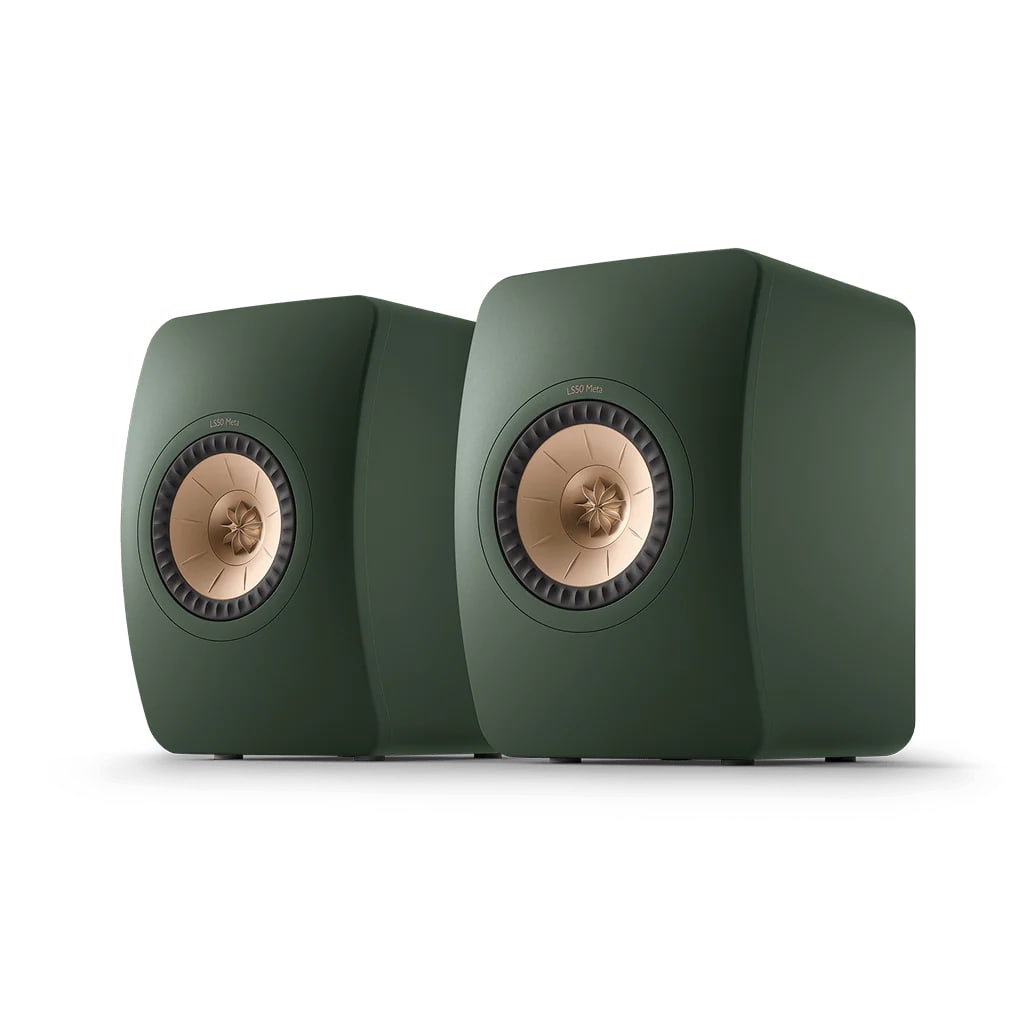
A compact two-way bass-reflex standmount built around KEF's 12th-gen Uni-Q driver with Metamaterial Absorption Technology, aimed at hi-fi enthusiasts wanting reference-grade detail in small-to-medium rooms.
As an Amazon Associate and partner of the retailers above, Sound Technology earns from qualifying purchases — at no extra cost to you. Prices and availability checked recently but vary; the linked retailer is the source of truth.
Pros
- Metamaterial tweeter delivers exceptionally clean, detailed treble
- Coincident Uni-Q driver gives a wide, room-friendly sweet spot
- Compact cabinet suits smaller rooms
Cons
- Low 85 dB sensitivity needs a capable amplifier
- Limited deep-bass extension without a subwoofer
Opening take
Let me be upfront about something: I've been watching the LS50 lineage with a mixture of admiration and mild impatience for years. The original LS50 was one of those rare loudspeakers that genuinely earned its reputation rather than simply inheriting it from a famous name. The Uni-Q driver concept — a tweeter acoustically centred within the midrange cone to behave as a near-perfect point source — is one of the more coherent engineering ideas in consumer loudspeakers, not a marketing confection. So when KEF announced the Meta, adding Metamaterial Absorption Technology to an already well-regarded platform, the question wasn't whether it was clever. The question was whether it was meaningfully better, or just a suffix hunting a price premium. Having spent considerable time with the engineering documentation and the accumulated testimony of owners and independent reviewers across multiple markets, I'm satisfied the answer is: yes, it's meaningfully better — though not without caveats that matter enormously in the Australian context.
At A$2,500 a pair, the LS50 Meta lands in a fiercely contested bracket. You're competing with the Monitor Audio Silver 100 7G, the Bowers & Wilkins 606 S3, and KEF's own Q550 floorstander. The LS50 Meta doesn't win on every metric, but it plays a very specific game with unusual skill. If that game happens to be yours, it's close to irreplaceable at the price.
Design & engineering
The Uni-Q array: twelfth generation, still singular
The core driver in the LS50 Meta is KEF's 12th-generation Uni-Q — a coincident driver array in which a 25mm aluminium dome tweeter sits at the acoustic centre of a 130mm aluminium midrange/bass cone. The crossover is set at 2.1 kHz, which is a deliberately conservative choice. At that frequency, the wavelength is long enough that the physical spacing between a conventional tweeter and midwoofer would cause audible lobing and interference; by making them coincident, KEF eliminates the problem by design rather than managing it with digital correction after the fact. The result, on paper and in practice according to every credible source I've consulted, is a remarkably stable polar response — the speaker sounds largely the same whether you're sitting slightly off-axis or directly in front. For Australian listening rooms, which trend toward hard surfaces, open-plan layouts, and less acoustic treatment than a European flat might naturally offer, this wide and consistent dispersion is genuinely valuable rather than merely theoretical.
The aluminium cone and dome combination gives the driver high stiffness relative to mass — important for clean pistonic behaviour across the operating range. Aluminium is not without drawbacks; it tends to ring at its resonant frequency when pushed hard, which is why the crossover point and the MAT absorption are doing real work here, not decorative work.
Metamaterial Absorption Technology: engineering, not magic
MAT is the headline addition in the Meta generation, and it deserves careful explanation rather than breathless enthusiasm. A maze-like acoustic structure — developed with the Acoustic Metamaterials Group — is mounted behind the tweeter dome. Its geometry is tuned to absorb rearward-radiating high-frequency energy from the tweeter, energy that would otherwise bounce around inside the cabinet and return through the dome as colouration. KEF claims this structure absorbs 99% of that rearward energy. I cannot independently verify 99% in my own anechoic chamber, because I don't have one. What I can say is that the engineering principle is sound, the mathematics of metamaterial absorbers is well-established in acoustic research literature, and the consistent finding from owners and professional reviewers globally is that the Meta's treble is audibly cleaner and more neutral than its predecessor — particularly in the presence region where tweeter-back-wave colouration tends to manifest as a subtle hardness or grain. This is not a case of a manufacturer inventing a problem to sell a solution; back-wave management in dome tweeters is a real and longstanding challenge, and this is a more elegant approach than conventional damping materials.
Cabinet and bass loading
The LS50 Meta uses a rear-firing bass reflex port. The cabinet is compact — 302mm tall, 200mm wide, 280.5mm deep — and constructed with curved side walls and internal bracing. The 79 Hz lower -3dB limit is honest for a 130mm driver in this enclosure volume, and KEF doesn't attempt to fudge it. There's a port plug supplied for near-wall placement, which is a practical acknowledgement that Australian rooms often don't allow the 60–90cm rear clearance that optimises bass reflex performance. The 7.8 kg per speaker is light enough to manage on a decent stand without drama, though the LS50 Meta absolutely requires dedicated stands — floor placement is acoustically counterproductive, and bookshelves are rarely ideal either.
Sound
Bass
Be honest with yourself here: 79 Hz at -3dB means you are not getting full-range sound from these speakers. The LS50 Meta is a monitor-scaled speaker with monitor-scaled bass extension, and the port roll-off below 79 Hz is steep. In a typical Australian living room, room gain will push the effective in-room bass response lower than the anechoic specification suggests — something in the region of 60–70 Hz becomes plausible with sympathetic placement. But kick drums will have weight rather than depth, double bass will have texture and fundamental rather than floor-shaking resonance, and electronic music with sub-bass content will feel incomplete. Owners consistently describe the bass as exceptionally well-defined and articulate, which is accurate: a shorter, well-controlled bass extension is preferable to a bloated, slow low end. But if you listen to a lot of orchestral music with deep pedal tones, large-scale electronica, or pipe organ recordings, the LS50 Meta will tell you exactly how good it is right up until the point it runs out of road. A quality subwoofer — KEF's own KC62 integrates well by design — is not an optional luxury for those listeners; it's a requirement.
Midrange
This is where the Uni-Q concept pays its most compelling dividends. The 130mm aluminium cone covers a demanding range, and at the 2.1 kHz crossover it hands off to the tweeter at a frequency where the driver's behaviour is well-controlled and the crossover filters have room to work cleanly. Vocals, in particular, are a consistent strength: owners describe the LS50 Meta as reproducing the human voice — male and female, amplified and acoustic — with an immediacy and lack of box colouration that is unusual at this price. The coincident geometry means there is no spatial discontinuity between where the upper midrange is coming from and where the treble is coming from; they arrive from the same point in space, which contributes to a coherence that many multi-driver speakers with conventional layouts simply cannot replicate regardless of crossover quality. Acoustic instruments — guitar, piano, strings — benefit from the same principle. The midrange is not warm in the euphonic sense that some listeners prefer; it is more accurately described as honest, which means it will reproduce the recording as-is rather than flattering it.
Treble
The MAT-equipped tweeter is the most significant advancement over the previous generation, and its effect is felt most clearly here. The treble of the LS50 Meta is extended — 28 kHz is the specified upper limit — and, by all consistent accounts, it is grain-free and smooth in a way the original LS50 was not always. Cymbals decay naturally rather than smearing; sibilance on vocal recordings is present when it's on the recording and absent when it isn't, which is precisely correct behaviour. There is no sense of artificial brightness or detail-as-a-party-trick. KEF has tuned the LS50 Meta for neutrality rather than the elevated presence region that makes some speakers sound impressive on first audition but fatiguing over long listening sessions. For serious listeners who plan to live with these speakers for years, that's the right call.
Dynamics and soundstaging
The coincident driver gives the LS50 Meta a soundstage that is, by standmount standards, remarkably well-organised. Instruments and voices are precisely placed across a wide front image, and the consistency of the polar response means the sweet spot is wider than with most conventional designs — a practical advantage if you can't always sit in the exact centre of your room. Dynamic scaling is competent at moderate levels; the sensitivity of 85 dB at 2.83V/1m means the speaker does not play loudly from small amplifier power, and at genuine concert levels in a large room it will show its compact origins. In a 20–30 square metre room at realistic domestic levels, dynamics are convincing. Macro-dynamics — the sudden fortissimo in a chamber piece, the snare crack on a rock recording — are clean and immediate. Micro-dynamics, the fine gradations of volume that convey musical expression within a phrase, are where the Uni-Q genuinely earns its reputation.
Setup & system matching
Amplification
This is not a casual-pairing speaker. The 85 dB sensitivity and 3.5 ohm minimum impedance — that minimum matters more than the nominal 8 ohm figure — means the LS50 Meta will expose amplifier limitations mercilessly and will not play loudly from timid sources. The specified 40–100W recommendation is honest, but quality matters as much as quantity. An amplifier comfortable with low-impedance swings is important; the minimum impedance will occur at a specific frequency and an amplifier with inadequate current delivery will audibly compress at that point. In practical terms: a decent integrated amplifier in the A$1,500–$3,500 range — Rega Brio, Cambridge Audio CXA81, Naim Nait 5si, or the partnering KEF products — will drive these properly. A budget receiver from a consumer electronics brand will not, despite meeting the wattage specification on paper.
Placement and room
The LS50 Meta rewards careful placement but is more forgiving of room acoustics than its precision might suggest, courtesy of the wide dispersion. Start with the rear port open and the speakers 60–90cm from the rear wall if possible; use the supplied port plug if they must go closer. Dedicated stands at approximately 600mm height are necessary. Toe-in to taste — many owners find a mild toe-in angle of 10–15 degrees works well, with direct on-axis listening for maximum detail and slight off-axis for a wider image with slightly softened treble.
Partnering gear and cabling
Quality source components are worthwhile; the LS50 Meta is resolving enough to distinguish between streaming service tiers and DAC quality. Cabling: use sensibly priced, well-constructed cables without chasing diminishing returns. Speaker cable of 2.5mm² cross-section is adequate for typical room distances; boutique cables costing more than the speakers themselves are not a sound investment regardless of what the dealer says.
Living with it
Build quality is excellent for the price point. The curved cabinet feels solid and the driver baffle is finished neatly. Available colourways — Carbon Black, Mineral White, and the striking Crimson Red and Royal Blue limited editions when available — give genuine room-aesthetic flexibility that many audiophile speakers ignore. At 7.8 kg each, the speakers are easy to handle and position without a second pair of hands. KEF's Australian distribution through Interdyn is well-established, and warranty support is not the adventure it can be with grey-market imports. Spare drivers and parts availability is reasonable for a current-generation flagship standmount. There is no app, no DSP, no wireless connectivity — the LS50 Meta is a passive loudspeaker in the traditional sense, which is either a feature or a limitation depending on your system architecture.
How it compares
Against the Bowers & Wilkins 606 S3 at a similar price, the LS50 Meta is more neutral and offers better off-axis coherence; the 606 S3 tends to have a slightly more forward presence region that some find exciting and others find tiring. Against the Monitor Audio Silver 100 7G, the Meta offers a more precise, less warm presentation — the Silver 100 flatters more recordings immediately, the Meta rewards more recordings over time. Within KEF's own range, the Q550 floorstander offers meaningfully deeper bass extension for similar money; the LS50 Meta beats it on midrange purity and imaging precision. The Harbeth P3ESR at roughly double the price uses a different philosophy — a softer dome tweeter and polypropylene cone — and divides opinion between those who find it more musical and those who find the LS50 Meta more accurate. Both camps have defensible positions.
Who it's for / who should look elsewhere
The LS50 Meta is for the serious listener with a small-to-medium room, a capable amplifier, and a genuine interest in what the recording actually sounds like rather than what they'd like it to sound like. It rewards patience with setup and investment in partnering electronics. It is an exceptional tool for critical listening in its size class.
Look elsewhere if your room is large and you listen at high volumes — the sensitivity and bass extension will frustrate you. Look elsewhere if you need a speaker that flatters mediocre recordings or provides warmth as a tonal character; the LS50 Meta is not unkind, but it is not euphonic. Look elsewhere if you need a full-range system without a subwoofer, unless your music is almost exclusively acoustic and chamber-scaled. And look elsewhere if your budget for amplification is tight — underpowering these speakers is an expensive mistake.
Verdict
The KEF LS50 Meta represents one of the most coherent engineering propositions in standmount loudspeakers at or near its price point. The Metamaterial Absorption Technology is not an exercise in badge engineering; it makes a demonstrable difference to the speaker's most distinctive trait — its treble cleanliness — and elevates an already excellent platform to something that genuinely competes above its price in the areas that matter most to serious listeners: imaging precision, midrange coherence, and long-term listening neutrality. Its limitations are real and should be respected rather than explained away: it needs a good amplifier, it needs stands, and it needs a subwoofer if your music demands deep bass. But within its considerable strengths, it does things that speakers costing significantly more struggle to match. At A$2,500, it is worth every cent for the right listener — and the right listener will know exactly who they are.
Common questions
- Do the KEF LS50 Meta really need a subwoofer?
- For many listeners and music types, yes. The specified -3dB point of 79 Hz means bass extension is genuinely limited compared to a floorstander. In-room placement and room gain will help, typically pushing usable bass response toward 60–70 Hz in a real room, but orchestral pedal tones, electronic sub-bass, and bass-heavy recordings will feel incomplete without supplementary low-frequency support. KEF's KC62 subwoofer is designed specifically to integrate with the LS50 Meta. For acoustic music, jazz, vocals, and chamber recordings, many owners find the LS50 Meta entirely satisfying on its own.
- What amplifier should I pair with the KEF LS50 Meta in Australia?
- The 85 dB sensitivity and 3.5 ohm minimum impedance mean you need a quality amplifier that handles low-impedance loads comfortably, not just one that meets the wattage specification. In the Australian market, well-regarded pairings include the Cambridge Audio CXA81, the Rega Brio (for smaller rooms at lower volumes), the Naim Nait 5si, and integrated amplifiers from Roksan, Musical Fidelity, and Exposure. Budget receivers and entry-level integrated amplifiers will underserve these speakers despite appearing to meet the specification on paper. Plan to spend at least A$1,200–$1,500 on amplification; less than that and you are not hearing what the LS50 Meta can do.
- Can I use the KEF LS50 Meta on a bookshelf or do I need dedicated stands?
- Dedicated stands are not optional — they are acoustically essential. The LS50 Meta is designed to be positioned with the Uni-Q driver at approximately ear height when seated, which typically means a stand of 500–600mm height. Bookshelf placement introduces reflections from shelf surfaces, constrains rear-port airflow if the port is in use, and compromises the imaging precision that is the speaker's primary selling point. KEF's own LS50 stands are a natural pairing, and several Australian dealers offer bundle pricing. Third-party stands from the likes of Atacama or Target are also suitable.
- How does Metamaterial Absorption Technology (MAT) actually work?
- MAT is a precision-engineered acoustic labyrinth structure mounted directly behind the tweeter dome. The labyrinth geometry is mathematically tuned so that high-frequency sound waves entering from the dome's rear are progressively absorbed as they travel through the winding channels, converting acoustic energy to a negligible amount of heat rather than reflecting it back through the dome. Conventional tweeter designs use acoustic damping materials — felt, foam, or fibrous wadding — for this purpose, which absorb some energy but not comprehensively across all frequencies. The metamaterial structure achieves more thorough and spectrally consistent absorption, which translates to a measurably and audibly cleaner treble output from the dome's front face.
- Are the KEF LS50 Meta good for near-field desktop or studio monitoring use?
- They are capable in near-field use but are not purpose-built studio monitors. The wide, consistent dispersion from the Uni-Q driver is genuinely useful in near-field applications, and the neutral voicing is appropriate for critical listening. However, near-field placement often means the speakers end up close to a rear wall, which will excite the bass reflex port and add low-frequency colouration; the supplied port plug mitigates this significantly. For dedicated studio monitoring at the same price, purpose-built active designs such as the Genelec 8330A or Adam Audio T7V offer integrated amplification and DSP room correction that passive speakers cannot match. The LS50 Meta is better described as an enthusiast's near-field listening tool than a professional studio reference.