KEF R3 Meta
Rating: 4.8 / 5
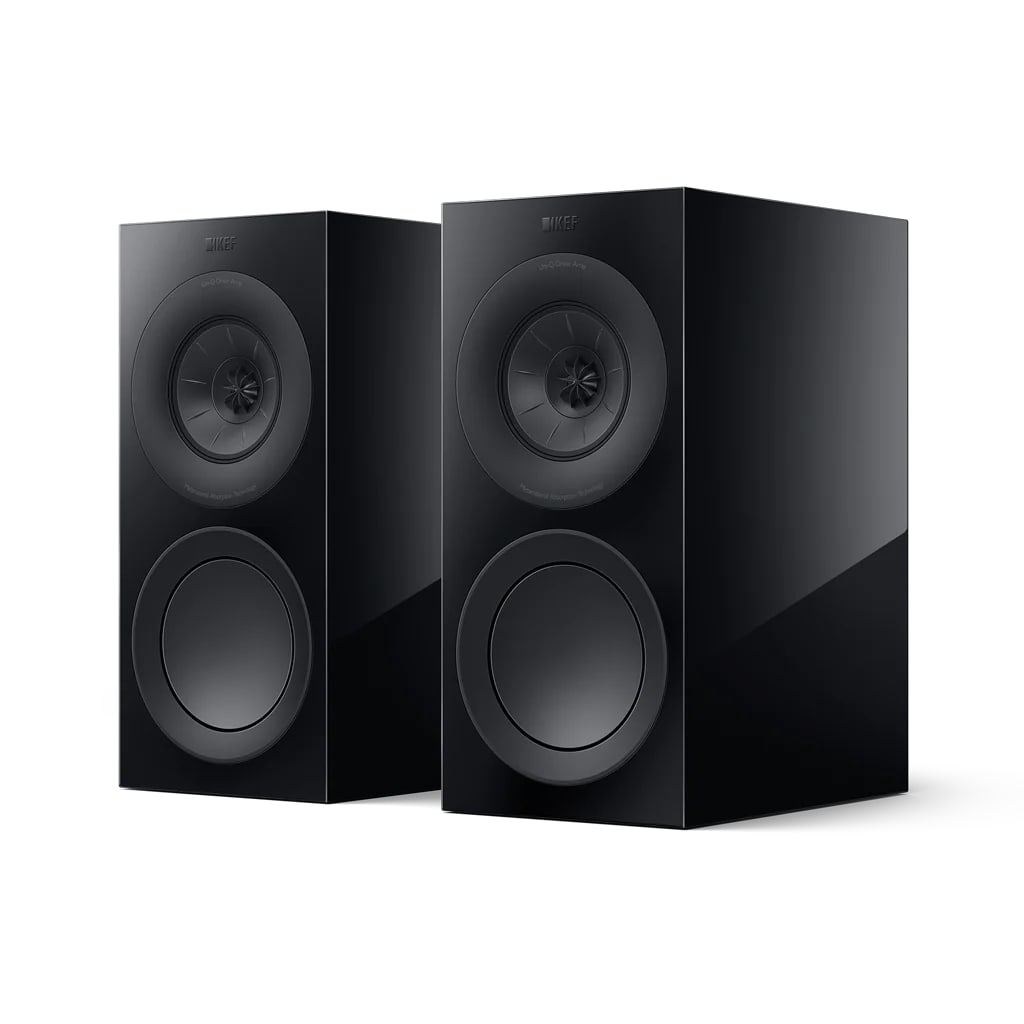
A true three-way standmount with a 12th-gen Uni-Q MAT array and a dedicated 6.5-inch hybrid aluminium bass driver, aimed at listeners wanting near-floorstander scale and dynamics from a bookshelf-sized speaker.
As an Amazon Associate and partner of the retailers above, Sound Technology earns from qualifying purchases — at no extra cost to you. Prices and availability checked recently but vary; the linked retailer is the source of truth.
Pros
- Three-way design gives a cleaner midrange and fuller bass than most standmounts
- Excellent build quality and finish for the price
- Wide, coherent dispersion from the Uni-Q array
Cons
- Large and heavy for a standmount, needs sturdy stands
- 4-ohm load benefits from a robust amplifier
Opening take
Let me be upfront about something: I have a complicated relationship with standmounts that try to be floorstanders. Too often the ambition outruns the engineering, and you end up with a speaker that has neither the genuine bass extension of a proper floor-stander nor the focused, uncoloured midrange that makes a good two-way so rewarding. The KEF R3 Meta, at A$3,900 the pair, is one of the rare exceptions that earns the right to its own category. It is genuinely large, genuinely heavy, and genuinely a three-way — and those three facts together explain almost everything worth saying about it.
KEF has been refining the Uni-Q coincident driver array for decades, and the R3 Meta represents the 12th generation of that technology, now incorporating Metamaterial Absorption Technology (MAT) in the tweeter rear chamber. That is not a cosmetic update. It is a substantive change to how the high-frequency unit is loaded, and the engineering rationale is sound enough to take seriously even before you consider the rest of the design. At this price point in Australia, the R3 Meta faces real competition, but it is competing on genuinely different terms to most of its rivals.
Design & engineering
The three-way architecture and why it matters
Almost every speaker at this size and price is a two-way. KEF builds the R3 Meta as a true three-way, meaning a dedicated 165mm hybrid aluminium cone handles low frequencies, a separate 125mm aluminium cone handles the midrange, and the 25mm vented aluminium dome Uni-Q tweeter handles the top end. The crossover points are 420 Hz and 2.3 kHz. That lower crossover at 420 Hz is the critical number here: it means the bass driver is relieved of almost all vocal and upper-bass duty, handing over cleanly to the midrange cone well below the region where most instruments and voices live. The practical consequence is that the midrange driver operates in a much narrower, well-controlled band, which is exactly what you want for low colouration and clean imaging.
Two-way standmounts, even very good ones, ask their bass-mid driver to cover an enormous frequency range — often from below 100 Hz to well above 2 kHz. That is a genuinely difficult engineering brief, because a driver optimised for bass extension behaves differently to one optimised for midrange linearity. The R3 Meta sidesteps this compromise entirely. It is a design decision with a real acoustic rationale, not a marketing point.
Uni-Q and MAT
The coincident driver arrangement — tweeter mounted at the acoustic centre of the midrange cone — is KEF's defining approach, and the physics behind it are well established. A point-source driver produces a more consistent radiation pattern across its operating band, which in practice means the off-axis response more closely tracks the on-axis response. For a speaker placed in a real listening room, where reflected sound from walls, floor, and ceiling contributes significantly to what you hear, a more consistent dispersion pattern tends to produce a more stable, believable stereo image and a more natural tonal balance at different listening positions.
MAT — Metamaterial Absorption Technology — addresses a specific, real problem: the tweeter dome's rear surface produces sound that can travel back through the dome and colour the output. The MAT structure, developed with the University of Salford, acts as an acoustic labyrinth that absorbs this rearward energy with claimed 99% efficiency. The engineering is published and peer-reviewed. It is not marketing language dressed up as science. Whether that translates to audible differences compared to a conventionally damped rear chamber is a matter for careful listening, but the mechanism is genuine.
The bass driver and cabinet
The 165mm hybrid aluminium cone LF driver works in a bass-reflex enclosure tuned to extend the usable low-frequency output. KEF specifies a ±3dB frequency response of 58 Hz to 28 kHz. That lower limit of 58 Hz is honest and useful — it tells you this speaker reaches into the upper bass with genuine authority, though it will not pressurize a large room with deep sub-bass. The cabinet itself is substantial: 422mm tall, 336mm deep, and 12.4 kg per unit. These are not small numbers. The depth in particular means you need to plan your stand and placement carefully; the speaker will project significantly forward from any wall it's near.
The nominal impedance is 4 ohms, with a minimum of 3.2 ohms. This is an important specification for Australian buyers, many of whom are running integrated amplifiers at the A$1,500–$3,000 level. A 4-ohm load draws more current than an 8-ohm load at the same voltage, and amplifiers that are not designed for low-impedance operation will either clip, distort, or engage protection circuits at higher listening levels. At 87 dB sensitivity — slightly below average for a speaker of this size — the R3 Meta asks its amplifier to work harder still. This is not a speaker to partner with a lightweight 50W integrated and assume everything will be fine.
Sound
Bass
By design, the R3 Meta should deliver bass that is significantly more tuneful and controlled than most two-way standmounts at this price, because the dedicated bass driver is doing a single, well-defined job. The 58 Hz lower limit means you will hear kick drum weight, upright bass fundamental, and the bottom octave of a piano with real conviction. What you will not get — and should not expect — is the room-pressurising extension of a floorstander with a 200mm or larger driver and a significantly larger cabinet volume. In a medium-sized Australian listening room of 20–30 square metres, the R3 Meta is likely to be sufficient for most programme material without a subwoofer. In a larger open-plan space, or for listeners who regularly play organ music, electronic music, or film soundtracks at reference levels, a subwoofer will remain on the shopping list.
Midrange
This is where the three-way architecture pays its most obvious dividend. The 125mm aluminium cone, operating between 420 Hz and 2.3 kHz, covers the heart of the human voice, the body of most acoustic instruments, and the region where tonal accuracy matters most to most listeners. Because this driver is not also being asked to extend into the upper bass or handle energy at the crossover to the tweeter simultaneously, it should deliver the kind of clean, low-colouration midrange that is genuinely difficult to achieve in a two-way design. Owners and long-term users of the R3 Meta consistently report that vocals in particular have an unusual clarity and presence — not hyped or forward, but simply unobstructed. That is consistent with what the architecture would predict.
Treble
The 25mm vented aluminium dome with MAT loading is specified to reach 28 kHz — well beyond the limits of human hearing, which suggests KEF is prioritising phase coherence and response linearity in the upper audible range rather than simply pushing for an impressive headline number. Aluminium dome tweeters have a reputation for being detailed and extended, occasionally at the cost of brightness or a slightly analytical quality. The Uni-Q arrangement and MAT loading are both intended to mitigate this: the coincident mounting reduces interference between the tweeter and midrange at the crossover region, and the MAT reduces high-frequency colouration from reflected rear energy. On paper, this is a well-engineered unit. In practice, system matching — particularly cable and amplifier character — will have real influence on how the top end is perceived.
Dynamics & soundstaging
The coincident driver array is, by its geometry, a more accurate point source than a conventional tweeter-above-woofer arrangement. This is expected to produce a more stable, precisely located stereo image, with better depth layering and a more convincing sense of instruments occupying specific positions in the recorded space. Wide dispersion from a consistent point source also means the listening sweet spot is broader than with many conventional designs — a genuine practical advantage in Australian listening rooms, where the furniture rarely cooperates with the ideal equilateral triangle. Dynamic response should be solid within the speaker's power handling range (up to 180W per the spec), though 87 dB sensitivity means you are relying on your amplifier for headroom rather than the speaker's efficiency.
Setup & system matching
Amplification
I want to be direct here, because this is where Australian buyers sometimes make costly mistakes. The R3 Meta's 4-ohm nominal impedance and 3.2-ohm minimum demands an amplifier that is rated and stable into 4 ohms. This typically means a well-engineered integrated amplifier from A$2,000 upward — something like a Rega Elicit, a Cambridge Audio Evo 150, a Naim Nait XS 3, or a Hegel H190, all of which are available through Australian distributors with proper local support. Running these speakers off a mid-tier AV receiver or a valve amplifier without adequate current delivery is a reasonable recipe for disappointment at best, amplifier failure at worst. If your budget for electronics is under A$1,500, the R3 Meta is probably not the right speaker for your system right now.
Stands & placement
At 12.4 kg per unit and 336mm deep, the R3 Meta needs proper stands — not the lightweight, hollow-post options sold at mass-market retailers. Dedicated stands in the A$300–$700 range from brands like Target, Atacama, or Sound Anchors are appropriate. Filling the stand posts with dry sand is not audiophile mythology; it genuinely reduces resonance transmission. Placement will require experimentation: the bass-reflex port on the rear means the speaker is sensitive to boundary distance, and placing it too close to a rear wall will produce bass overhang. Give it at least 30–40cm from the rear wall as a starting point, and be prepared to adjust.
Cabling
Speaker cable choices should be sensible rather than extravagant. A quality 4mm2 copper cable of moderate length is appropriate. The R3 Meta does not require exotic cables to perform well, and spending more on wire than on stands is a questionable allocation of resources. If your system is balanced-output capable, the upstream components and interconnects deserve more attention than the speaker cables at this price tier.
Living with it
The R3 Meta is available in three finishes in Australia — White Gloss, Black Gloss, and a Walnut wood veneer — all of which are executed to a standard that holds up at this price. The gloss finishes are striking but unforgiving of fingerprints in the way that any gloss lacquer is; the Walnut finish is, in my view, more liveable in most Australian interiors. Build quality is robust: the cabinet feels solid, the driver grilles are properly machined rather than flimsy, and the binding posts accept banana plugs, spade lugs, or bare wire. The rear port is generously sized and cleanly finished.
KEF's Australian distribution is through Len Wallis Audio and a network of specialist retailers around the country, with a warranty service infrastructure that is reliable by the standards of the local high-end audio market. Parts availability for KEF products has historically been good, and the R3 Meta is a current, actively sold product rather than a closeout, which matters for long-term ownership confidence. At A$3,900, you are not buying a boutique product from a small manufacturer whose support may evaporate; you are buying into a global brand with genuine engineering depth and a real service network.
How it compares
At A$3,900, the R3 Meta's most obvious competition includes the Dynaudio Emit 30, the Focal Aria 906, the Bowers & Wilkins 706 S3, and the Wharfedale Elysian 2. Of these, none is a true three-way design. That architectural difference is the R3 Meta's most significant competitive advantage, and it is a real one rather than a spec-sheet point: the midrange cleanliness that follows from the three-way topology is genuinely difficult to replicate in a two-way at any price. The Dynaudio and Focal offerings arguably have a more immediately engaging top-end character that some listeners will prefer, but neither can match the R3 Meta's midrange coherence on paper. The B&W 706 S3 is excellent and offers a similar point-source midrange approach with its Continuum cone, but it remains a two-way and its bass extension is less ambitious. For listeners who genuinely need floorstander performance in a standmount footprint, the R3 Meta has few credible rivals below A$5,000.
Who it's for / who should look elsewhere
The R3 Meta is for listeners who take midrange coherence seriously, have an amplifier capable of driving a 4-ohm load properly, have a suitable stand budget, and are working with a medium-to-large listening room where near-floorstander bass extension will be appreciated. It rewards careful setup and a quality source chain. It is a long-term purchase — not a speaker you will outgrow quickly.
Look elsewhere if: your amplifier is a mid-tier AV receiver or anything rated below 80W into 4 ohms; your room is genuinely small (under 15 square metres) and a two-way with a sealed or small-port cabinet would suit the acoustics better; you are expecting sub-bass extension without a subwoofer; or your budget for stands is less than A$400, because partnering a A$3,900 speaker with inadequate stands is genuinely wasteful. Also look elsewhere if you find the physical size problematic — 422mm tall and 336mm deep is a large object on a stand, and in some Australian living rooms the domestic acceptability factor will be a real constraint.
Verdict
The KEF R3 Meta is one of the most honestly engineered standmounts available in Australia at its price point. The three-way architecture, 12th-generation Uni-Q array, and genuine MAT implementation are not marketing fabrications — they are design decisions with clear acoustic rationale and predictable sonic consequences. It will not perform miracles if partnered with an inadequate amplifier or placed on wobbly stands, and it will not replace a genuine floorstander for listeners who need deep bass in a large room. But for what it sets out to do — deliver coherent, uncoloured, wide-dispersion sound at near-floorstander scale from a standmount cabinet — it sets the benchmark at this price in this market.
Common questions
- Does the KEF R3 Meta need a subwoofer for home theatre use?
- For most music listening in a medium-sized room, the R3 Meta's 58 Hz lower limit is sufficient without a subwoofer. For home theatre — particularly films with significant LFE content, or for larger open-plan Australian living areas — a subwoofer will meaningfully improve the experience. The R3 Meta's controlled, well-defined bass character actually makes it an excellent candidate for subwoofer integration, because the handover from the speaker to the sub is less likely to be confused by bass overhang from the mains.
- What amplifier power is actually needed to drive the R3 Meta properly in Australia?
- KEF specifies 15–180W, but the 4-ohm nominal impedance and 87 dB sensitivity mean real-world power requirements are higher than a comparable 8-ohm speaker. A well-engineered integrated amplifier rated at 80–100W into 4 ohms is a sensible minimum for moderate-to-loud listening in a medium room. Brands commonly available through Australian specialist retailers — Rega, Hegel, Cambridge Audio, Naim — all produce suitable amplifiers in the A$2,000–$4,000 range. Avoid mid-tier AV receivers, which are often rated into 8 ohms only and will struggle with the R3 Meta's impedance curve.
- Are the KEF R3 Meta and the KEF R3 the same speaker?
- No. The R3 Meta is a distinct generation that incorporates Metamaterial Absorption Technology (MAT) in the tweeter rear chamber. This is a substantive engineering update, not a cosmetic rebadge. The original R3 did not include MAT, which was introduced in KEF's Reference series before being applied to the R-series. If you are buying used, confirm which version you are purchasing, as the MAT version commands a price premium and the two are not identical in engineering or specification.
- How important are stands for the KEF R3 Meta, and what should Australian buyers budget?
- Stands are not optional — they are a functional requirement. At 12.4 kg per unit and with a rear-ported bass-reflex design, the R3 Meta needs a stable, damped platform to perform correctly. Lightweight or hollow stands will couple cabinet vibration into the floor and degrade bass definition. Budget A$400–$700 for dedicated speaker stands of appropriate height (typically 60–70cm, depending on your listening position) from brands such as Atacama, Target, or equivalent. Filling hollow stand posts with dry sand is a genuine acoustic benefit and should be done as standard practice.
- Is the KEF R3 Meta available to audition in Australia, and what is the warranty?
- Yes. KEF's Australian distribution is through a national network of specialist audio retailers, including Len Wallis Audio in Sydney and equivalent stores in Melbourne, Brisbane, and other major cities. Audition is strongly recommended given the amplifier-matching sensitivity of this speaker. KEF provides a standard manufacturer's warranty of two years in Australia, and parts and service support through the local distributor. As a current, actively produced product from a major global manufacturer, ongoing support is not a concern for the medium term.