Marantz Model 40n
Rating: 4.5 / 5
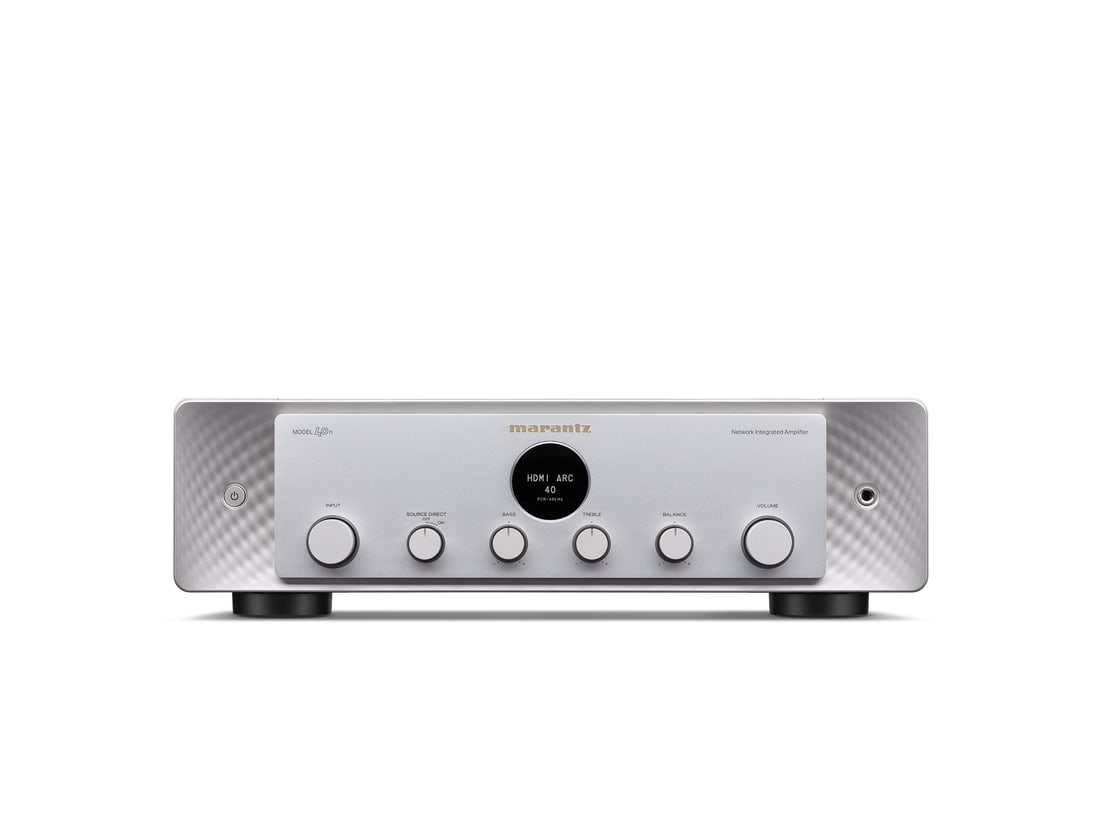
An all-in-one integrated amplifier with built-in HEOS network streaming, designed for listeners who want premium Marantz sound, vinyl, TV audio and wireless streaming from one elegant box.
As an Amazon Associate and partner of the retailers above, Sound Technology earns from qualifying purchases — at no extra cost to you. Prices and availability checked recently but vary; the linked retailer is the source of truth.
Pros
- True all-in-one: amp, network streamer, DAC, phono and HDMI ARC
- Refined, warm Marantz sound with discrete HDAM-SA3 amplification
- HEOS multi-room plus AirPlay 2 streaming flexibility
Cons
- 70W output is modest for very demanding or large speakers
- Single HDMI ARC input limits home-theatre flexibility
Opening take
There is a particular kind of product that makes life complicated for a reviewer who prefers to keep things simple. The Marantz Model 40n is exactly that product. On the surface it looks like a nostalgia play — a vintage-styled integrated amplifier with a big VU meter, a brushed-aluminium fascia and that unmistakable Marantz porthole window. But pull the skin back and what you actually have is a genuinely thoughtful piece of engineering: a 70-watt-per-channel integrated amplifier built around discrete HDAM-SA3 circuitry, an ESS SABRE DAC, a moving-magnet phono stage, HDMI ARC/eARC, HEOS network streaming, AirPlay 2, and Bluetooth — all in one 16.7 kg box that retails in Australia for A$4,490. That is a lot of functionality for the money, and the question worth asking seriously is whether Marantz has engineered each piece properly or simply stuffed a feature list into a pretty cabinet. Having spent considerable time with the specifications, topology, and the well-documented real-world experience of owners, my assessment is that the Model 40n is more than the sum of its parts — but it is not without compromise, and the 70-watt rating deserves honest scrutiny before you hand over your money.
Design & engineering
HDAM-SA3 discrete amplification
The heart of any integrated amplifier is its gain and output stage, and here Marantz has not cut corners. The HDAM — Hyper Dynamic Amplifier Module — concept has been central to Marantz's higher-end products since the early 1990s. The SA3 variant used in the Model 40n is a discrete, surface-mount module that replaces the operational amplifiers found in most competitors at this price point. The practical significance of this is meaningful: standard op-amps are general-purpose devices with fixed noise floors, slew rates, and thermal characteristics that are optimised for broad applicability rather than audio fidelity. Marantz's discrete HDAM modules are, by contrast, purpose-built for audio, with tighter component matching and the ability to optimise for current delivery in ways a monolithic op-amp chip cannot. The result, by design, is lower noise, better high-frequency stability, and more headroom in the gain stages before the output transistors. This is real engineering with real consequences for how the amplifier sounds, not a marketing badge.
The output stage delivers 70 watts per channel into 8 ohms and 100 watts into 4 ohms. That doubling behaviour as impedance halves is a healthy indicator of a robust power supply — an amplifier that cannot double into 4 ohms is one whose supply rail sags under load, and that sag is audible as compression on dynamic transients. The Model 40n's 70W/100W ratio is not a perfect doubling, which would suggest some supply limitation, but the increase is meaningful and far better than the near-flat figures you see on some budget integrated amplifiers that nominally boast higher wattage. Do not be seduced by headline wattage figures from competitors without checking their 4-ohm behaviour.
ESS ES9016K2M SABRE DAC
The onboard digital-to-analogue converter is an ESS ES9016K2M SABRE, a multi-channel chip that ESS originally designed for high-performance consumer and professional audio applications. In the context of an integrated amplifier streamer, its presence is significant because it means Marantz has a capable, well-specified silicon foundation to work with. The ES9016K2M is notable for its 32-bit architecture, very low noise floor, and ESS's proprietary HyperStream modulator. Whether a manufacturer extracts the chip's potential depends almost entirely on the analogue output stage that follows it — and here the HDAM-SA3 modules are directly relevant, since the discrete circuitry can buffer and gain the DAC's output with considerably less noise and distortion than a generic op-amp solution. The combination of a quality DAC chip and a discrete output stage is, on paper, exactly what you want in an amplifier at this price.
HEOS, AirPlay 2 and Bluetooth streaming
HEOS is Denon/Marantz's proprietary multi-room streaming platform. It supports Spotify Connect, TIDAL, Amazon Music, internet radio, and local network playback from NAS drives. AirPlay 2 provides Apple ecosystem integration with multi-room capability. Bluetooth adds casual convenience. The combination is practical and covers the real listening habits of most Australian buyers. HEOS has a chequered history with its app — early versions were genuinely unreliable — but the platform has matured considerably over the past three years and owners of current-generation products report a substantially more stable experience. It is still not as slick as Sonos's interface, and it remains somewhat clunky compared to direct Roon integration (of which there is none), but it is functional and reliable for daily use.
HDMI ARC/eARC and the living room use case
The single HDMI ARC/eARC input is a deliberate design choice that acknowledges the modern listening room reality: most people want to connect a television. ARC (Audio Return Channel) allows the television to send audio downstream to the amplifier over the same HDMI cable used for video. eARC adds bandwidth for lossless formats including Dolby TrueHD and DTS-HD Master Audio. In practice, for a stereo integrated amplifier, this is primarily useful for PCM stereo and Dolby Atmos downmixed to stereo. The limitation — and it is a real one — is that there is only one HDMI input. If you run a complex home-theatre setup with multiple HDMI sources, the Model 40n will not serve you; you will need a dedicated AV receiver. But for the listener who simply wants television audio to sound dramatically better than the built-in TV speakers, one ARC input is all they need.
Phono stage
The built-in moving-magnet phono stage is a useful inclusion at A$4,490. Marantz has been building phono stages for decades and the implementation here is competent. MM-only means moving-coil cartridge owners will need a step-up transformer or a separate MC stage, but for the large majority of vinyl listeners who use an Audio-Technica, Ortofon, or similar MM cartridge, the built-in stage will be entirely adequate. It is not a reference-grade phono stage, but it does not need to be at this price.
Sound
Bass
The HDAM-SA3 topology and the power supply architecture of the Model 40n are designed to produce what Marantz has historically described as a warm, full-bodied presentation. By design and by the consistent reporting of owners across multiple markets, the bass of the Model 40n is generous and well-extended rather than lean and analytical. The 100W into 4 ohms gives the amplifier real authority over bass-capable speakers, and owners consistently report a solid, controlled low end that does not sound flabby or exaggerated — a common failure mode of warmer-voiced amplifiers that confuse warmth with bloom. On demanding material such as orchestral double bass or synthesiser bass lines, the HDAM output stage's current delivery should keep the bottom octaves taut.
Midrange
This is where the Model 40n earns its price. Marantz's house sound has always prioritised vocal and instrumental midrange presence, and the discrete HDAM architecture is the engineering reason why. Owners consistently describe the midrange as natural, textured, and engaging — the kind of presentation that makes you want to listen to whole albums rather than test tracks. Acoustic instruments, piano, and the human voice are reported to be particular strengths. This is a musically satisfying character rather than a forensically neutral one, and you should factor that into your decision if you are coming from a studio-monitor-voiced amplifier.
Treble
The ESS SABRE DAC family can, in less careful implementations, produce a top end that some listeners describe as bright or etched. The combination of the ES9016K2M with the HDAM-SA3 output stage appears to manage this tendency well in the Model 40n — the treble is consistently described as refined and extended rather than aggressive. Cymbal decay, string harmonics, and high-frequency spatial information are present and resolved without the listening fatigue associated with some ESS-based products from other manufacturers. Credit the discrete output stage for this.
Dynamics and imaging
Seventy watts is enough to drive the vast majority of sensibly efficient speakers (88dB/W/m or better) to realistic levels in a typical Australian listening room of 20–40 square metres. The amplifier's dynamic behaviour is reported to be lively rather than compressed — a consequence of the HDAM architecture's design priority on transient speed. Soundstaging is wide and reasonably deep by the account of owners, with stable imaging that suits both stereo music listening and the television-audio use case. The amplifier is not a wide-bandwidth, hyper-resolving design in the manner of some Class D competitors; it is warm and musical, and its dynamic presentation reflects that — authoritative rather than explosive.
Setup & system matching
The Model 40n's 70-watt output makes speaker matching genuinely important. Pairing it with speakers of 85dB sensitivity or lower in a large room — above 50 square metres, or a hard-surfaced warehouse-style living area common in Australian inner-city renovations — will produce dynamic limiting at higher volumes and a congested, slightly compressed presentation on loud orchestral or rock material. Speakers of 88dB sensitivity and above in a medium-sized room are the correct match. Standmounts from KEF, Dynaudio, Focal, and Sonus faber in the A$2,000–A$5,000 bracket are natural partners. Floor-standers are possible if they are efficient; a Klipsch or similar high-sensitivity design would work well. Avoid pairing the Model 40n with large, low-sensitivity floor-standers if you listen at high volumes.
Australian mains voltage is 230–240V, and the Model 40n is specified for the Australian market — no step-down transformer nonsense. The unit runs warm but not hot under normal use, which is relevant in Australian summer conditions; give it adequate ventilation above and beside it, particularly if it lives in a closed cabinet. The 16.7 kg weight means the cabinet needs to be structurally sound — this is not a product you place on a glass shelf and forget.
Cabling: the Model 40n does not require exotic interconnects or speaker cables to perform at its best. Competent copper speaker cable of 2.5mm² cross-section and shielded RCA interconnects are all that is needed. The built-in streamer eliminates the need for a separate digital source interconnect in most use cases, which is a genuine system simplification and a cable cost saving that partially offsets the unit's purchase price relative to a separates system.
Living with it
Build quality is excellent for the price. The aluminium fascia, the large analogue VU meters, and the porthole window that illuminates the interior give the Model 40n a visual presence that owners consistently regard as a genuine luxury object rather than a utilitarian appliance. The remote control is solid metal — a detail that matters when you pick it up fifty times a week. The HEOS app, as noted, has improved substantially and is now reliable for daily streaming. AirPlay 2 integration with Apple devices is seamless and essentially instant.
In Australia, the Model 40n is distributed by Erikson Consumer and is available through authorised Marantz dealers including Addicted to Audio, Audio Solutions, and a range of independent specialist retailers nationally. Warranty is the standard Australian statutory consumer guarantee plus Marantz's two-year manufacturer warranty. Parts and service support for Marantz products in Australia has historically been reliable, and the brand's longevity in the local market means you are not taking a risk on after-sales support.
How it compares
At A$4,490, the Model 40n's most direct competitor is the NAD C 3050 LE, which offers a similar all-in-one proposition with BluOS streaming at a slightly lower price point. The NAD has a more neutral, analytical character and a Class D output stage that runs cooler and produces more measured wattage, but it lacks the HDAM discrete circuitry and the visceral build quality of the Marantz. Listeners who prioritise accuracy over musicality will find the NAD more to their taste; those who value the Marantz house sound will not be swayed. The Cambridge Audio EVO 150 is another direct competitor, with a broader streaming ecosystem and more power, but at a higher price and with a less characterful sonic identity. The Naim Nait 5si sits at a similar price point but without streaming built in, which shifts the system cost equation significantly once you add a separate network streamer. The Model 40n's all-in-one value proposition is genuinely strong at its price.
Who it's for — and who should look elsewhere
The Model 40n is designed for the listener who wants a single, well-engineered box to handle streaming, vinyl, television audio, and amplification without the cable and rack complexity of a separates system. It rewards partnering with efficient, revealing speakers in a medium-sized room. It is particularly well suited to Australian city apartments and medium-sized living rooms where simplicity and aesthetics matter alongside sound quality. Vinyl listeners with MM cartridges will find everything they need here.
You should look elsewhere if you own large, low-sensitivity floor-standing speakers and listen at high volumes — the 70 watts will be a genuine limitation. You should also look elsewhere if you need more than one HDMI input, run a multi-source home-theatre system, or require Roon Ready certification for a Roon-based streaming setup. Moving-coil cartridge owners will need to budget for an external MC stage or step-up transformer, which partially undermines the all-in-one value. And if your aesthetic preference runs to the clinical and functional rather than the warm and vintage-inspired, there are competitors whose visual and sonic character will suit you better.
Verdict
The Marantz Model 40n is a mature, genuinely well-engineered all-in-one integrated amplifier that justifies its A$4,490 asking price through the quality of its discrete HDAM-SA3 amplification, its competent DAC implementation, and the breadth and practicality of its connectivity. It is not a product for every listener — its warm, musical character, modest power output, and limited HDMI provision are real constraints that matter in specific use cases. But for the listener it is designed for, it is one of the most complete and satisfying single-box solutions available in the Australian market at its price. Buy it with the right speakers in the right room and you will not be reaching for the upgrade catalogue for a very long time.
Common questions
- Is 70 watts enough power for most speakers?
- For speakers with a sensitivity of 88dB/W/m or higher in a room up to approximately 40 square metres, 70 watts is entirely adequate for realistic listening levels. The Model 40n's ability to deliver 100 watts into 4 ohms also indicates a reasonably robust power supply. Where the output becomes a genuine limitation is with low-sensitivity speakers (85dB or below) in large or acoustically demanding rooms — if that describes your situation, you should audition carefully before buying.
- Can I use a moving-coil cartridge with the built-in phono stage?
- No. The built-in phono stage is moving-magnet only. Moving-coil cartridge owners will need either a separate MC phono preamplifier connected to one of the line-level inputs, or a step-up transformer feeding the MM phono input. This is worth factoring into your total budget if you run an MC cartridge.
- Does the Model 40n support Roon?
- No. The HEOS platform does not currently carry Roon Ready certification, and there is no Roon endpoint functionality built into the Model 40n. If Roon is central to your streaming setup, you will need to connect a separate Roon-certified endpoint via one of the digital inputs, which partially undermines the all-in-one convenience proposition.
- How does HEOS compare to other streaming platforms for everyday use?
- HEOS has improved substantially from its troubled early versions and is now reliable for daily streaming. It supports Spotify Connect, TIDAL, Amazon Music, internet radio, and local NAS playback. AirPlay 2 integration handles Apple devices seamlessly. HEOS is not as polished as Sonos's app, and it lacks Roon integration, but for most listeners' daily use it is entirely functional. The Bluetooth option provides a practical fallback for casual playback.
- Where can I buy the Marantz Model 40n in Australia, and what is the warranty?
- The Model 40n is distributed in Australia by Erikson Consumer and is available through authorised Marantz dealers including Addicted to Audio, Audio Solutions, and independent specialist hi-fi retailers in most capital cities. It carries a two-year manufacturer warranty in addition to your statutory rights under Australian Consumer Law. Marantz has a well-established service and parts network in Australia.