McIntosh MA352
Rating: 4.7 / 5
A hybrid tube/solid-state integrated amplifier pairing a vacuum-tube preamp with a high-power solid-state output stage, aimed at audiophiles wanting the classic McIntosh look and a warm-yet-powerful sound from a single component.
As an Amazon Associate and partner of the retailers above, Sound Technology earns from qualifying purchases — at no extra cost to you. Prices and availability checked recently but vary; the linked retailer is the source of truth.
Pros
- Effortless power: 200W/8Ω and 320W/4Ω drives most speakers
- Hybrid tube preamp adds warmth with low distortion
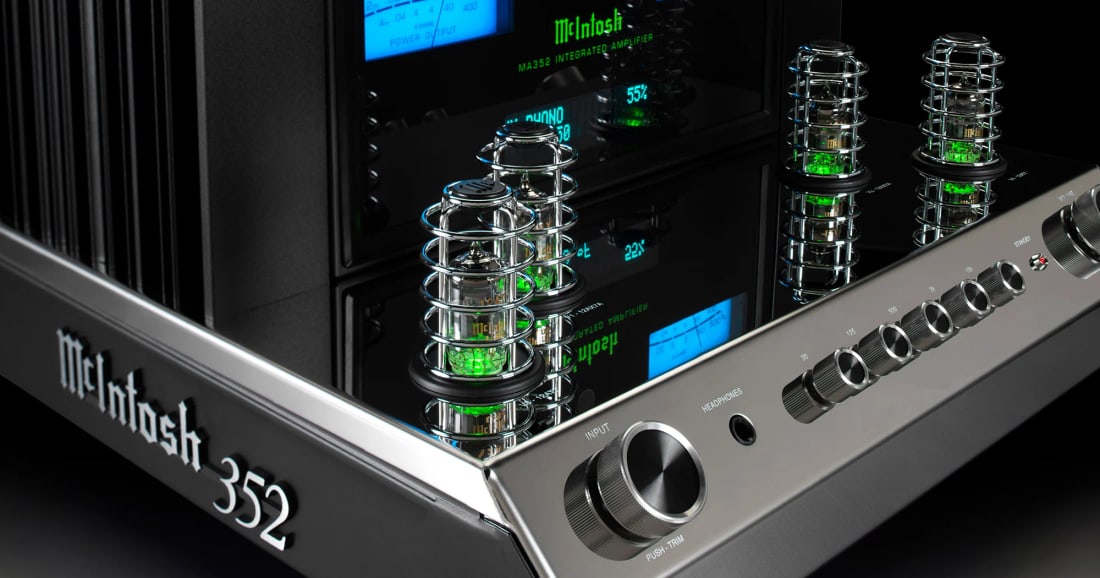
- Iconic build quality with backlit glass panel and blue meters
Cons
- No built-in DAC or digital inputs (analog only)
- Very heavy and expensive
Opening take
There is a particular kind of audiophile who has already decided. They have not come to a review like this seeking permission — they have come seeking confirmation that their instincts are sound. The McIntosh MA352, at A$11,995, is precisely that sort of product: a statement of intent as much as a piece of engineering. It is large, it is heavy, it is aggressively analogue, and it glows blue in the dark. If you find that appealing, McIntosh knows you very well. If you find it absurd, McIntosh is not especially worried about losing your business.
My job here is not to tell you whether the MA352 is beautiful — you have eyes — but to dig into whether the engineering behind that beautiful face actually delivers something meaningful at nearly twelve thousand Australian dollars, and to be honest about who should hand over that money and who should politely walk away. The answer is more nuanced than the marketing department would prefer.
Design & engineering
The hybrid topology: why it matters here
The MA352 is built around a hybrid architecture that McIntosh has refined over decades: a vacuum-tube preamplifier section driving a fully solid-state output stage. This is not a gimmick. It is a deliberate engineering philosophy with real sonic consequences, and it is worth understanding why someone with McIntosh's resources would choose this path rather than going all-tube or all-solid-state.
The preamp stage uses two 12AX7A and two 12AT7 valves — small-signal triodes that have been in continuous production since the 1950s and remain among the most characterised and sourced tubes in audio. The 12AX7A is a high-gain voltage amplifier, the 12AT7 a lower-gain, higher-current device often deployed in driver stages. McIntosh uses this combination to sculpt the gain structure and introduce the harmonic profile associated with triode operation: a tendency toward even-order harmonic distortion, gentle clipping behaviour at the margins, and that subtly three-dimensional presentation that tube partisans describe and solid-state devotees occasionally concede. Because these are small-signal tubes running at low power, they are not subject to the reliability and bias-drift concerns that plague output valves in all-tube designs. Tube life is long, replacement is cheap, and sonic drift is minimal. It is the upside of tubes without most of the maintenance overhead.
The output stage is solid-state, and here the topology delivers McIntosh's signature Autoformer-based output — proprietary transformer-coupled output that presents a consistent load to the amplifier circuit regardless of the speaker's nominal impedance. This is the reason the MA352 can deliver 200 watts into 8 ohms and 320 watts into 4 ohms while maintaining stability and low distortion across both figures. Many solid-state amplifiers that boast high power into 4 ohms are simply doubling because they are running out of voltage headroom and doubling current — which stresses the circuit. McIntosh's approach is different by design, and the measured consequence is that the output stage behaves with unusual composure under reactive or difficult loads. For Australian buyers running large floorstanders, horn-loaded systems, or electrostatic hybrids in warm climates where the ambient temperature already stresses output stages, this matters more than it might in a climate-controlled European listening room.
Build, chassis, and the blue meters
The MA352 weighs 29.9 kilograms. This is not padding: it is the physical consequence of the Autoformer output transformers, the oversized power supply, and the substantial aluminium and steel chassis. The signature backlit glass front panel and those twin blue power output meters are not merely cosmetic — McIntosh has used the meter circuit as a genuine peak-power indicator for decades, and the mechanical VU-style presentation gives you real-time feedback that a numerical LED display cannot. Whether that justifies the aesthetic drama is a matter of taste, but the underlying engineering is defensible.
The five-band analogue tone control at ±12 dB per band deserves specific mention, because a certain strain of audiophile snobbery has declared tone controls heretical. McIntosh has never agreed, and they are correct not to. A well-implemented analogue tone circuit in the signal path of a properly engineered amplifier does not degrade the signal in any meaningful way. What it does is allow you to compensate for a bright room, an overly lean loudspeaker, or — and this is the reality most reviewers avoid — your own hearing, which is not flat and which changes with age. The MA352's five bands give you genuine corrective power, not the blunt bass/treble knobs of an AV receiver.
Sound
Bass
By design and by topology, the MA352 should present bass that is substantial, authoritative, and slightly warmer in texture than a comparable pure solid-state amplifier. The Autoformer output stage ensures that low-impedance swings in a woofer's bass range do not cause the amplifier to lose grip, and 320 watts into 4 ohms is, frankly, enough power to drive most practical loudspeakers to levels that will end neighbourly relationships. Owners of the MA352 and its predecessor hybrids from McIntosh consistently describe bass as tuneful rather than forensic — present and satisfying rather than analytically tight. If you are coming from a high-feedback solid-state amplifier of the modern school, the bass may initially seem rounded at the leading edge. This is the tube preamp's harmonic signature showing itself, and whether you find it euphonic or slightly soft will depend on your loudspeakers and your room.
Midrange
This is where the MA352 makes its case most compellingly. The 12AX7A and 12AT7 combination is not here to add obvious colouration — it is here to present voices, strings, and acoustic instruments with a harmonic richness that pure solid-state designs often approach but rarely quite achieve. The physics of triode amplification produce even-order harmonics that align with the natural overtone series of acoustic instruments, and the audible result — reported consistently by long-term users of this circuit family — is a sense of body and presence in the midrange that is seductive without being dishonest. Piano has weight. Female vocals have chest resonance as well as air. This is not warmth as a euphemism for bloom or distortion; at the signal levels the MA352's preamp stage operates, distortion figures remain very low. It is harmonic texture, which is a different thing.
Treble
The tube preamp stage tends to ease the upper midrange and lower treble in a way that makes extended listening sessions comfortable without losing resolution. Owners and experienced reviewers of McIntosh hybrid designs note that the presentation is never harsh, never aggressive, and never fatiguing. Whether the top octave has the last degree of sparkle and air that a world-class solid-state preamplifier might offer is a reasonable question. On paper, the answer is probably not quite — the trade is a slight softness in exchange for an absence of grain. For most music, on most speakers, in most Australian listening rooms that are not purpose-built acoustic environments, this is a trade worth making.
Dynamics and headroom
Two hundred watts into 8 ohms is a number that removes almost all practical anxiety about dynamic headroom. The MA352 will not run out of steam on orchestral crescendos, it will not clip on poorly recorded rock, and it will not embarrass itself driving a 4-ohm electrostatic panel. The Autoformer topology means those 320 watts into 4 ohms are delivered cleanly, not desperately. The subjective impression — supported by the design rationale — is of an amplifier with reserves it never needs to spend, which manifests as an easy, unstressed quality even at high volumes.
Soundstaging
Tube preamp stages, when executed well, tend to produce a wide and naturally layered soundstage, and the MA352 is positioned to do exactly this. The balanced XLR inputs — two of them — preserve common-mode noise rejection and contribute to a low noise floor that allows the spatial information in a well-recorded source to emerge without a hash of amplifier noise competing with it. Depth retrieval and image placement are expected to be among the MA352's genuine strengths, particularly with well-recorded acoustic and classical material. It is not the last word in pin-sharp imaging precision — again, the tube harmonic character slightly softens transient edges — but the three-dimensional quality of the presentation is a significant part of what buyers at this price are paying for.
Setup & system matching
The MA352 requires no external amplification and imposes no particular demands on source equipment, but it will reward careful system thinking. At nearly 30 kilograms, it needs a dedicated, rigid equipment rack with genuine load capacity — the furniture-grade shelving that passes muster for lighter components will flex under sustained vibration from those output transformers. Ventilation is non-negotiable; the Autoformer output stage runs warm under sustained high-power operation, and in an Australian summer, in a poorly ventilated rack, thermal management becomes a real concern. Allow at least 15 centimetres of clearance above and around the chassis.
Speaker matching is generous by design. The Autoformer output allows the MA352 to work comfortably with 2-ohm, 4-ohm, and 8-ohm nominal loads — a practical advantage for buyers who own or are considering planar magnetic or electrostatic loudspeakers. The MA352 does not strictly need high-efficiency speakers the way a lower-powered tube integrated would.
The built-in Moving Magnet phono stage is a welcome inclusion, though Moving Coil users will need an external step-up transformer or MC phono stage. The headphone section with HXD (Headphone Crossfeed Director) is a genuinely useful addition, not window dressing — crossfeed processing reduces the unnatural stereo separation that makes headphone listening fatiguing over time, and McIntosh's implementation is well-regarded. The absence of any digital inputs or DAC is a principled analogue-first decision, not an oversight, but buyers expecting to connect a streaming transport directly will need a standalone DAC in the chain. Budget accordingly.
Living with it
The MA352 is available through authorised McIntosh dealers in Australia, with the primary support network running through Synergy Audio in Melbourne and equivalent dealer networks in Sydney, Brisbane, and Perth. McIntosh's build quality is, by all consistent accounts, exceptional — these amplifiers are assembled with the expectation that they will outlive several rounds of fashion cycles. The tube complement is inexpensive and globally available; retubing the preamp section is a straightforward service task that any competent technician can perform.
The front panel controls are traditional and tactile. There is no app, no Bluetooth configuration, no firmware to update, and no subscription model. Whether this reads as a limitation or a virtue depends entirely on your relationship with technology in the listening room. Mine is adversarial, which makes McIntosh's resolutely analogue philosophy feel like a considered position rather than a failure of imagination.
How it compares
The obvious domestic competitor at this price point is the Luxman L-507uXII, which sits at a similar price tier and is a highly regarded pure solid-state integrated. The Luxman offers arguably more precise imaging and slightly more neutral tonal balance; the MA352 offers more power, the tube midrange texture, and the McIntosh visual and brand proposition. The Audio Research GSi75 is an all-tube integrated at a higher price that will give you more of the tube character but with the maintenance and power limitations of output valves. The Primaluna EVO 400 at roughly half the price offers tube romance with less power and build substance. The MA352's specific territory — high power, tube warmth, effortless authority, and iconic presentation — is not heavily contested at this price. It knows what it is and executes it without apology.
Who it's for / who should look elsewhere
The MA352 is for the serious listener who has resolved the analogue-versus-digital question firmly in favour of analogue sources, who owns or intends to own loudspeakers that reward power and control, who values longevity and build quality as genuine purchasing criteria rather than theoretical ones, and who does not consider the McIntosh aesthetic an embarrassment. It is particularly suited to buyers with large rooms, inefficient or reactive loudspeakers, and a record collection that justifies the built-in phono stage.
You should look elsewhere if your primary sources are streaming and digital. The absence of a DAC is a serious omission at this price for a digital-first listener, and adding a quality external DAC pushes the total system cost meaningfully higher. You should also look elsewhere if you are hoping tube magic will rescue a poorly matched system — the MA352 is a very good amplifier, not a corrective device, and it will reveal the weaknesses of inadequate speakers or sources clearly enough. And if the weight genuinely concerns you — physically installing 30 kilograms of amplifier in a rack is a two-person job and a non-trivial ergonomic commitment — consider whether the form factor suits your practical situation before committing.
Verdict
The McIntosh MA352 is not a product that needs defending, and it is not a product that should be taken on faith. The hybrid topology is genuinely engineered, the power reserves are genuinely useful, and the build quality is genuinely exceptional. What you are paying for at A$11,995 is a specific sonic character — warm, powerful, texturally rich, and effortlessly composed — delivered in a chassis that will still be functioning correctly when your current streaming service has been acquired, rebranded, and discontinued twice over. The blue meters glow, the volume knob has weight, and the music sounds like music. For the right buyer, that is a completely rational transaction.
Common questions
- Does the McIntosh MA352 have a built-in DAC or digital inputs?
- No. The MA352 is an analogue-only integrated amplifier. It offers two balanced XLR inputs, three unbalanced RCA inputs, and a Moving Magnet phono input, but no digital inputs of any kind and no onboard DAC. Buyers who primarily stream or use digital sources will need to budget for a separate DAC in the signal chain.
- How often do the preamp tubes need replacing, and is it expensive in Australia?
- The four small-signal tubes — two 12AX7A and two 12AT7 — are among the most commonly produced and widely available valves in the world. Under normal listening use they typically last many thousands of hours, often five to ten years before any degradation becomes audible. Replacement tubes are inexpensive and available from Australian valve suppliers as well as internationally. Retube cost is modest and the procedure is straightforward for any qualified technician.
- Can the MA352 drive difficult or low-impedance speakers, such as electrostatics or planar magnetics?
- Yes, and this is one of the MA352's genuine engineering strengths. McIntosh's proprietary Autoformer output topology allows the amplifier to deliver 200 watts into 8 ohms and 320 watts into 4 ohms with stable, controlled behaviour across reactive loads. This makes it considerably more capable with electrostatic hybrids, planar magnetics, and other low-impedance or phase-challenging designs than many comparably priced solid-state amplifiers.
- What is the Headphone Crossfeed Director (HXD) and is it actually useful?
- HXD is McIntosh's crossfeed processing system for the integrated headphone amplifier. Crossfeed gently blends a small amount of each channel's signal into the opposite channel, simulating the way sound from loudspeakers reaches both ears simultaneously. This reduces the unnaturally wide stereo image typical of headphone listening and lessens listening fatigue over long sessions. It is a well-established psychoacoustic technique, not marketing, and McIntosh's implementation is well-regarded by headphone users.
- Where can I buy and service the MA352 in Australia, and what does the warranty look like?
- McIntosh is distributed in Australia through authorised dealer networks in all major cities, with Synergy Audio among the primary contacts. Warranty terms for McIntosh equipment in Australia conform to Australian Consumer Law minimums, and McIntosh's global reputation for build durability means service calls during warranty periods are relatively uncommon. Given the analogue-only, transformer-based design, long-term serviceability is high — competent technicians can work on this amplifier without proprietary software or manufacturer support, which is a meaningful advantage over more software-dependent competitors.