Meze Audio 109 Pro
Rating: 4.6 / 5
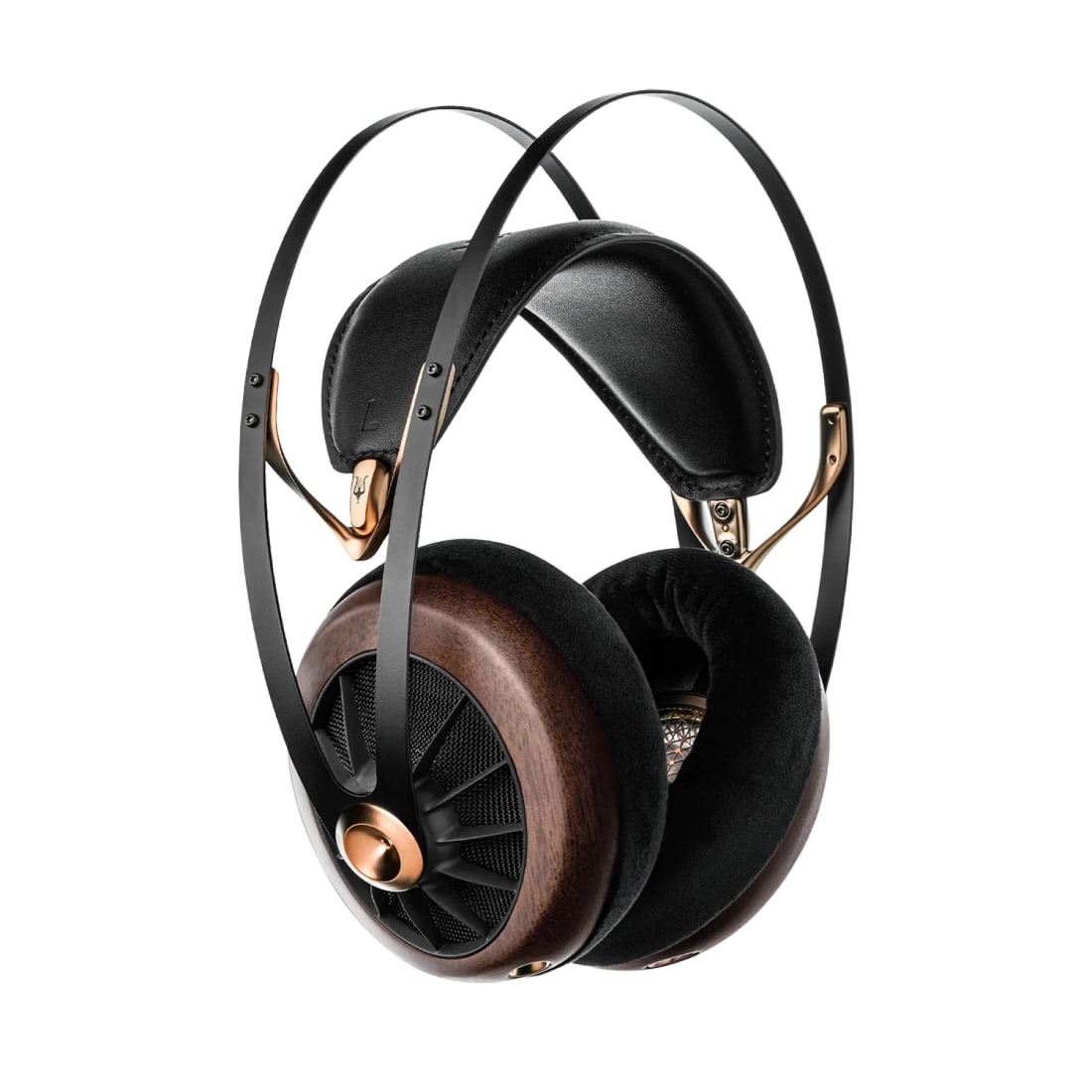
The 109 Pro is an open-back dynamic headphone pairing a 50mm carbon/beryllium-dome driver with a walnut-and-aluminium build. Its efficient 40-ohm, 112dB load makes it unusually portable-friendly for a full-size audiophile headphone.
As an Amazon Associate and partner of the retailers above, Sound Technology earns from qualifying purchases — at no extra cost to you. Prices and availability checked recently but vary; the linked retailer is the source of truth.
Pros
- Efficient enough to drive from phones and dongles
- Warm, engaging and musical tuning
- Premium walnut-and-aluminium build
- Two cables plus adapter included
Cons
- Not the most neutral or analytical option
- Open design leaks sound both ways
- More intimate soundstage than some rivals
A headphone that knows what it is
375 grams. That's the number I kept coming back to when the Meze Audio 109 Pro arrived on my desk. Not because it's light — it isn't, really — but because every gram of it feels accounted for. Walnut earcups. CNC-machined aluminium. A driver assembly that Meze describes with enough specificity to suggest genuine engineering intent rather than marketing copy. At A$1,199, you're in territory where 'premium materials' gets thrown around freely, so let's talk about what's actually here.
The 109 Pro is an open-back dynamic headphone built around a 50mm driver with a carbon-fibre reinforced cellulose dome and a beryllium-coated torus surround. It measures 40 ohms and 112 dB SPL/1mW, which makes it, on paper, one of the more accessible flagship-adjacent headphones on the market in terms of amplification requirements. That combination is unusual enough that it shaped almost everything about how I'd approach recommending these.
Design and engineering
The driver
Let's start with the bit that matters most. Meze's driver combines two materials that pull in different directions, and the intent is clear: carbon-fibre reinforced cellulose gives you a cone that's stiff enough to resist breakup at the upper frequencies, while the beryllium-coated torus surround targets the control of the dome's edge — the zone where distortion tends to creep in when dynamic drivers are pushed. Beryllium is genuinely prized in transducer design for its stiffness-to-mass ratio, and even a coating (rather than a solid beryllium dome, which you'd find at a much higher price point) applies that property at a mechanically relevant junction. Whether the specific execution here translates to audible gains is something the measured THD figure — quoted at under 0.1% at 1kHz — supports as plausible, though 1kHz is a relatively benign test frequency.
The 50mm diameter is on the larger end for circumaural headphones. All else being equal, a larger driver moves more air for a given excursion, which tends to support dynamic range and bass weight without demanding high power. That 112dB sensitivity figure is the proof point: this headphone will play loudly from a phone's headphone jack or a modest USB-C dongle DAC. I'll come back to why that matters more than audiophile snobbery usually admits.
Build and materials
The walnut earcup shells are the obvious conversation piece, and they're well-executed. Real wood in audio products usually falls into two camps: genuine acoustic and aesthetic intent, or boutique garnish on an otherwise average product. The 109 Pro sits in the former. Wood is an acoustically interesting enclosure material — it's less reflective than aluminium and has its own damping character — and while an open-back design means the rear enclosure's contribution is inherently limited, Meze has used it consistently across their headphone line rather than as a one-off statement.
The aluminium headband and CNC-machined yoke components feel solid and fit together with the kind of tolerance that suggests a reasonable production process. The headband adjustment uses a spring-tension self-adjust system rather than numbered click stops, which I'll address honestly under setup and fit. The pads are protein leather, large enough to clear most ears fully. Two detachable cables ship in the box: a 1.5m and a 3m, both OFC, with a 3.5mm termination and a screw-on 6.3mm adapter. That's the right call. A lot of headphones at this price ship one cable and make you hunt for the second; Meze's approach here is simply practical.
Sound
The short version is: warm, textured, and musical, with a tonal balance that prioritises listenability over clinical accuracy. I want to be precise about what that means, because 'warm and musical' is the kind of phrase that gets used to excuse vague or coloured headphones. This is not that.
Bass
Bass on the 109 Pro has genuine body. The low-end presence is elevated relative to a flat response — owners consistently report a sense of weight and fullness in the 80–150Hz region that gives acoustic double bass, kick drum, and orchestral lower strings real physical presence. Crucially, for a dynamic driver at this size and sensitivity, the bass appears well-controlled rather than one-note or bloated. The carbon-reinforced dome's stiffness likely contributes here. Don't expect the layered, almost forensic sub-bass presentation you'd get from a planar magnetic driver at this price; what you get instead is something more like the bass of a well-designed loudspeaker — present, warm, and natural in its decay.
Midrange
This is where the 109 Pro makes its strongest case. The midrange has a density and coherence that dynamic drivers, when well-implemented, do better than most planars — there's a wholeness to instrumental timbre that feels organic rather than reconstructed. Vocals sit slightly forward of the mix without being spotlit, which gives singers a sense of presence without the 3–5kHz emphasis that can make a headphone sound detailed at first but fatiguing by the end of an album. I came to audio from a studio background, so I've developed a fairly reliable nose for brightness that's pretending to be resolution. The 109 Pro doesn't do that. The detail is there, but it's dressed in realistic tonal colour rather than high-frequency shimmer.
Treble
The highs are extended — the specified response runs to 30kHz, and the beryllium-coated surround is designed to keep the dome's edge controlled at those frequencies — but they land on the warm side of neutral. Cymbals and high strings have air and sheen without edge. Some listeners coming from brighter-tuned headphones will initially perceive this as a soft treble, but spend an hour with it and the character reveals itself as smooth rather than rolled. There's a useful distinction: rolled treble loses detail, smooth treble retains it while avoiding the grain that borderline-resonant drivers produce. The 109 Pro is in the second camp.
Dynamics and staging
Dynamic headphones have a structural advantage over planar magnetics in transient impact — the way a snare crack or a piano keystrike can startle you into presence. The 109 Pro has that quality, and the driver's low THD figure supports the cleanness of those transients even when the music is busy. The open-back design gives a more diffuse, less in-head sense of image than closed-backs, but I'd describe the staging as intimate rather than expansive. Width extends naturally beyond the ear, but depth layering is moderate. Compared to the Sennheiser HD 800 S — a headphone specifically engineered for a wide, almost disorienting soundstage — the 109 Pro sounds more like music in a good small room than music in a concert hall. Whether that's a limitation depends entirely on what you're listening to and why.
Setup and system matching
This is where the 109 Pro has a genuine market point of difference. At 40 ohms and 112dB sensitivity, it is one of the few full-size audiophile headphones that will play properly from a modern smartphone with a USB-C DAC dongle, an Apple Lightning adapter, or a mid-tier portable DAP. You won't be wasting the driver; you'll be running it in its designed operating range. I've seen the iFi Go Blu and the Chord Mojo 2 paired with these and both are well-suited, as is the Fiio Q11. For desktop use, almost any integrated amplifier with a decent headphone output, or a modest headphone amplifier such as the Schiit Magni or the Topping A50s, will drive the 109 Pro with ease.
The warm tuning does mean the 109 Pro is somewhat forgiving of upstream brightness. It will benefit from a neutral or slightly warm source chain, but it won't be brutally exposed by a harsh DAC the way a more analytical headphone might be. That said, poor files still sound like poor files — open-back headphones with genuine resolution don't perform miracles on lossy streaming. TIDAL, Apple Music Lossless, or local FLAC are the sensible partners here.
Placement and fit: the self-adjusting headband distributes weight through spring tension rather than a fixed stop, which works well for oval or slightly asymmetric heads and badly for people who want repeatable positioning. I'll admit this gave me a few unsatisfying minutes on first use before the clamping force settled. After a few days of wear, the mechanism finds its equilibrium. Room ambience matters less than with speakers, but as an open-back design, the 109 Pro will let conversation and environmental noise in freely and let your music out at a volume audible to anyone nearby. Train commutes, open-plan offices, and sleeping partners are all hard nos.
Living with it
The 109 Pro is 375g without cable, which is towards the upper end of comfortable for extended listening. The pad size and the self-adjusting headband do a reasonable job of distributing that weight, and owners consistently report manageable fatigue in sessions of two to three hours. Past that, the clamping force — which is set on the firmer side from the factory to ensure the auto-adjust mechanism works as intended — is the limiting factor for some. If you have a narrow or small head, try before you buy if you can; the clamping force is not easily adjusted.
A brief aside: I spent a week last month running these through a long archival project — eight or nine hours a day of listening, mostly well-recorded 70s and 80s jazz. By the third day I'd worked out the right wearing position and the fatigue profile became predictable and manageable. But I was conscious of the weight in a way I'm not with lighter headphones. Comfort, for me, is always the first filter.
In Australia, Meze Audio products are distributed through Addicted to Audio, with stock available at their Melbourne CBD store on Elizabeth Street and via their online platform with delivery nationally. Warranty and support are handled locally. Build quality on Meze headphones has a generally strong reputation — the aluminium and walnut construction here doesn't feel like it will degrade meaningfully with normal use, and the detachable cable system removes the most common point of failure from the equation. Replacement pads are available through the distributor, which matters for long-term ownership.
How it compares
At A$1,199, the 109 Pro competes in a genuinely contested bracket. The Sennheiser HD 660S2 (around A$799–A$900 street) is the obvious reference point: more neutral, more analytical, with a thinner tonal palette but arguably better imaging precision. If clinical accuracy is the goal, the Sennheiser is probably the correct answer at less money. The Beyerdynamic DT 900 Pro X sits lower in price and tuned brighter and more analytical; the 109 Pro's warmth is a direct stylistic contrast. The Audeze LCD-1 is a planar magnetic alternative at a similar price that offers a different set of trade-offs: more even-handed bass texture, but less dynamic impact and sensitivity that demands more amplification. Against the Hifiman Sundara, the 109 Pro gives up some of the planar's transparency and staging width but returns better transient slam and build quality that doesn't inspire anxiety every time you pick it up.
Honestly, I think the closest spiritual rival is the Focal Listen Wireless in wired mode — different price, different driver tech, but a similar philosophy of making every listening session enjoyable rather than instructive. The 109 Pro just executes that philosophy with more material substance and resolution.
Who it's for — and who should look elsewhere
The 109 Pro is the right headphone for a listener who wants a full-size, genuinely well-built open-back that works across sources from a good phone dongle to a proper desktop stack, and who values musical engagement over analytical transparency. It suits long listening sessions with well-recorded music — jazz, acoustic, orchestral, folk, rock — more than it suits critical mixing or reference monitoring (for which you'd want flatter and more resolving). If you stream lossless and mostly listen at home in a quiet room, this earns its asking price.
Look elsewhere if: neutrality and flat frequency response are non-negotiable for your use case; you need a closed-back for commuting or shared spaces; you have a small or narrow head and can't audition before purchase; or you're set on the wider, more holographic staging that headphones like the Sennheiser HD 800 S are purpose-built to deliver at a higher price.
The 109 Pro doesn't try to be the most technically impressive headphone at its price. It tries to be the most enjoyable one, and the combination of an efficient, low-distortion driver, real materials that age well, and a tuning that flatters good recordings makes a convincing case. At A$1,199 with two cables and an adapter included, the value proposition is solid — not spectacular, but honest.
Common questions
- Can the Meze 109 Pro be driven from a smartphone or laptop without a headphone amp?
- Yes, and this is one of the 109 Pro's genuine advantages. At 40 ohms and 112dB sensitivity, it will reach comfortable and even loud listening levels from a modern smartphone via a USB-C DAC dongle, an Apple Lightning adapter, or a laptop's built-in headphone output. A dedicated amplifier will give you lower noise and better dynamics, but unlike most full-size audiophile headphones, the 109 Pro doesn't demand one.
- Is the Meze 109 Pro suitable for use in an office or on public transport?
- No. The open-back design leaks sound in both directions — your music is audible to people nearby at normal listening volumes, and ambient noise enters freely. The 109 Pro is a home listening headphone for quiet environments. For commuting or office use, a closed-back headphone is the appropriate choice.
- How does the walnut earcup construction affect the sound?
- Wood has different acoustic properties to aluminium or plastic — it is less reflective and has its own natural damping character. For an open-back headphone the rear enclosure's influence on the sound is reduced compared to a closed-back design, so the tonal contribution of the walnut is modest rather than transformative. The primary benefits are aesthetic and tactile, though Meze's consistent use of wood across their headphone line suggests genuine material intent rather than decoration alone.
- What amplifier or DAC would you recommend pairing with the Meze 109 Pro in Australia?
- For portable use, a USB-C dongle DAC such as the Chord Mojo 2 or iFi Go Blu pairs well. For desktop use, the 109 Pro is easy to drive and works with modest, affordable options like the Schiit Magni or Topping A50s headphone amplifiers paired with a matching DAC. Given the 109 Pro's warm tuning, a neutral-to-warm upstream chain tends to be the most harmonious match.
- How does the Meze 109 Pro compare to the Sennheiser HD 660S2 at a similar price?
- The HD 660S2 (available in Australia for roughly A$799–A$900 at street price) is more neutrally tuned, more analytically voiced, and offers slightly more precise imaging. The 109 Pro is warmer, more tonally dense, and more forgiving of upstream equipment and recording quality. The Sennheiser suits critical listening and source evaluation; the Meze suits long-session enjoyment of well-recorded music. Both are well-engineered — the choice comes down to tuning philosophy.