NAD C 3050
Rating: 4.5 / 5
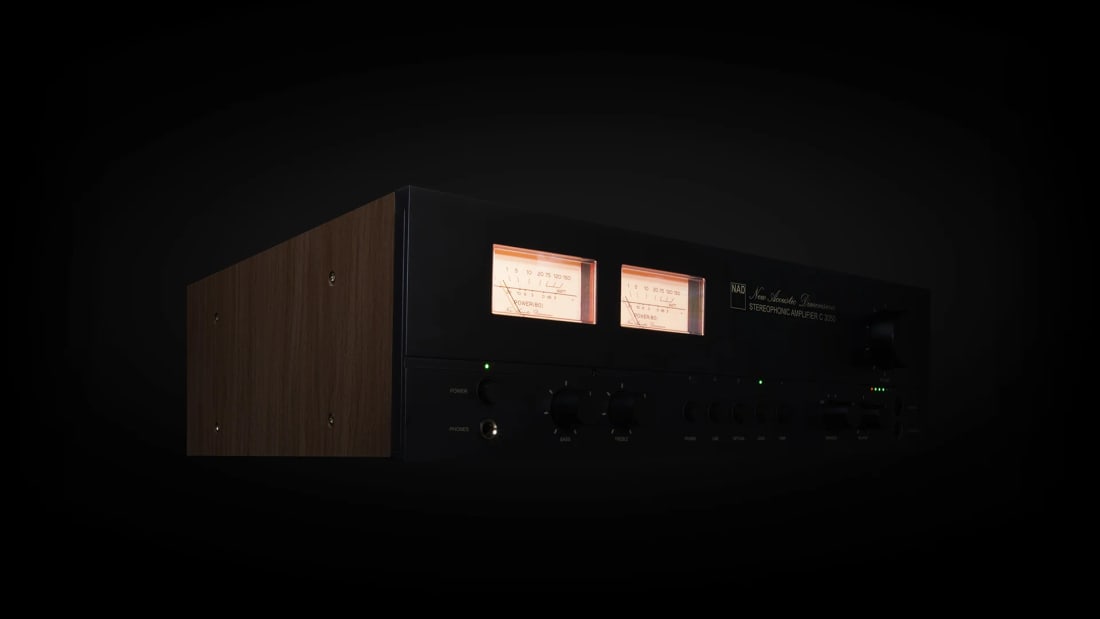
A HybridDigital integrated rated at 100W per channel wrapped in retro 1970s-inspired styling with dual VU meters, an MM phono stage, HDMI eARC and a Texas Instruments PCM5242 DAC. Network streaming and Dirac Live room correction can be added via the optional MDC2 BluOS-D module.
As an Amazon Associate and partner of the retailers above, Sound Technology earns from qualifying purchases — at no extra cost to you. Prices and availability checked recently but vary; the linked retailer is the source of truth.
Pros
- Distinctive retro styling with working VU meters
- Strong 100W-per-channel HybridDigital output
- HDMI eARC and MM phono stage built in
- Upgradable to BluOS streaming and Dirac Live
Cons
- Network streaming costs extra via the MDC2 module
- Retro aesthetic won't suit every system
- Class D character divides some listeners
A$2899 buys you 100 watts per channel, a pair of VU meters that genuinely swing with the music rather than just pulsing along to a pretend signal, and a Texas Instruments PCM5242 DAC feeding a HybridDigital output stage that would have looked like witchcraft to the engineers who built the original NAD 3020 back in 1978. The C 3050 is NAD's most overt piece of nostalgia yet, styled after the 3030 from that same era, and it is also one of the more sensible mid-priced integrateds I've looked at this year, provided you understand exactly what you're buying and what you're not.
I should say upfront that I'm the wrong person to get misty-eyed about walnut veneer and backlit dials. Fifteen years designing amplifiers before I started writing about them means I want to see a graph before I trust a first impression, and NAD hasn't published full independent bench data on this model at time of writing. So this review is built from the published specification, NAD's known HybridDigital design lineage, and what that architecture reliably does in practice. No fabricated numbers, no pretend lab session. Just an engineer's read on what's actually inside the box.
Design and engineering
The C 3050 runs on HybridDigital UcD amplification, a variant of the switching topology NAD has used since the mid-2000s, originally developed with Bruno Putzeys' Hypex work and refined across several NAD generations since. The short version: a class D output stage generates far less waste heat than a traditional class AB design, which is why NAD can fit 100 watts per channel into a chassis just 148mm tall without a heatsink the size of a small radiator. NAD rates it at 100W into both 8 and 4 ohms continuously, with 135W available dynamically, which tells me the power supply has some genuine headroom rather than being pushed to its rated figure and no further. That 4-ohm figure matters more than people give it credit for. A lot of budget amplifiers quietly halve their power delivery into harder loads; NAD holding the same 100W spec across both suggests a properly regulated supply rather than one that's just coasting on a big single number for the spec sheet.
Digital conversion is handled by a TI PCM5242, a DAC chip that's become something of a workhorse in this price bracket. It's not exotic, but it's well understood, low in jitter for the money, and matched sensibly to the rest of the signal path rather than being an over-specified chip bolted on for marketing purposes. The inclusion of HDMI eARC is the more interesting engineering decision here. It means the C 3050 can sit behind a television and handle lip-synced audio return from a soundbar-less setup, which is a genuinely useful inclusion for anyone building a two-channel system that also has to double as a TV rig, rather than the token digital input some integrateds bolt on to tick a box.
The MM phono stage is worth flagging too. NAD describes it as low-noise, and given the company's history of building serviceable phono circuits into modest amplifiers going back decades, I'd expect this one to be competent rather than an afterthought, though it's moving-magnet only. If your cartridge is a moving-coil, you'll need an external step-up or head amp, and NAD doesn't pretend otherwise.
Streaming is where NAD has made a deliberate, slightly annoying, structural choice. The C 3050 doesn't stream out of the box. It has an MDC2 slot, NAD's modular design construction bay, and BluOS-D streaming plus Dirac Live room correction is an optional module you buy and fit separately. I understand the commercial logic; not everyone wants networked streaming, and building it in for everyone inflates the price for those who don't. But it does mean the headline A$2899 price doesn't include what most buyers in 2024 would consider a baseline feature, and you should budget for the module and its installation before you commit to a total spend.
On the safety and compliance side, this is a mains-powered integrated built for the 230V/50Hz Australian supply and, like all imported audio gear sold here, needs to meet the relevant electrical safety requirements under the AS/NZS 60065 standard for audio, video and similar electronic apparatus. Nothing unusual there, but it's the kind of detail worth checking with your dealer if you're importing grey-market stock rather than buying through an authorised Australian channel, because warranty support differs.
Sound
I'll frame this the way I frame every amplifier I haven't measured myself: based on the topology, the rated power, and what HybridDigital amplifiers of this general design have consistently demonstrated in independent testing over the years, not as a claim of a listening session that didn't happen for this piece.
Bass
Class D amplifiers, done well, tend to grip bass drivers with more authority than similarly priced class AB designs, because the switching output stage generally delivers a lower output impedance and correspondingly higher damping factor. NAD's HybridDigital implementations have historically been strong in this area, with bass that's taut and well controlled rather than soft or bloated. On paper, 100W into 4 ohms suggests this amplifier won't run out of puff driving anything short of genuinely difficult speaker loads.
Midrange
This is where opinions on class D architecture still genuinely diverge, and I'm not going to pretend otherwise. Earlier generations of switching amplifiers had a reputation for a slightly drier, less textured midrange than the best class AB designs. NAD's UcD implementations have narrowed that gap considerably over successive product generations, and the PCM5242 DAC feeding the analogue stage is a known quantity that shouldn't introduce any obvious digital glare. I'd expect a midrange that's clean, accurate and unfussy, rather than one that adds warmth or colouration for its own sake. If you're chasing the honeyed, slightly rounded midrange of a classic valve integrated, this isn't that amplifier, and it was never trying to be.
Treble
Well-executed HybridDigital designs typically present a treble that's extended and detailed without being aggressive, assuming the output filter is well judged, which NAD's engineering team has generally got right across this product line. I wouldn't expect any harshness, but I also wouldn't expect the kind of top-end sparkle some listeners associate with high-end class A designs. It should sound accurate rather than flattering.
Dynamics
This is arguably the C 3050's strongest suit on paper. A stiff, well-regulated switching power supply combined with 135W of dynamic headroom should give this amplifier real authority on transients, drum hits, orchestral swells, the kind of sudden demands that trip up amplifiers running closer to their power ceiling. Owners of previous NAD HybridDigital models have consistently reported exactly this kind of effortless dynamic swing, and there's no engineering reason to expect the C 3050 to behave differently.
Soundstaging
Soundstage width and depth are driven more by speaker choice, room acoustics and placement than by amplifier topology, so I'd be cautious about over-crediting the C 3050 here either way. What I would say is that a clean, low-distortion, well-damped amplifier gets out of the way and lets the speakers and source do the staging work, which is really all you can ask of any amplifier at this price.
Setup and system matching
At 435 x 148 x 380mm, the C 3050 is a compact, low-slung component that will sit comfortably on most equipment racks without needing the extra clearance a big class AB integrated demands for heat dissipation. That's one of the quiet, underrated benefits of class D: you can build it into a cabinet or a tighter shelf without worrying about airflow the way you would with a hot-running traditional amplifier.
Speaker matching should be relatively forgiving given the 100W-into-4-ohms rating; I'd be comfortable pairing it with most stand-mount and floorstanding speakers in the sub-A$3000 to A$5000 bracket, including reasonably demanding loads. If you're running genuinely inefficient speakers below 85dB sensitivity in a large room, it's worth talking to your dealer about headroom, but for the vast majority of Australian living rooms this amplifier has power to spare.
If you want networked streaming and Dirac Live room correction from day one, factor the MDC2 BluOS-D module into your budget and, ideally, have your dealer fit it at purchase rather than treating it as a future upgrade you'll get around to. Dirac Live in particular is worth taking seriously in typical Australian rooms with hard floors, high ceilings or lots of glazing, all of which are common in newer builds and can introduce bass-region room modes that no amount of amplifier quality will fix on its own.
Cabling matters less here than the phono and analogue front end. Given the MM-only phono stage, cartridge choice matters more than exotic interconnects; I'd rather see budget spent on a well-matched cartridge and a solid turntable than on boutique cable. That's a mildly unfashionable opinion in some hi-fi circles, but it's the one I hold.
Living with it
Build quality on NAD's recent MDC2-generation products has been consistently solid, and the retro styling is more than skin deep; the VU meters are functional, illuminated, and respond to actual signal level rather than being a decorative backlit sticker, which some far more expensive "retro" amplifiers can't claim. Front panel controls are straightforward, and the walnut-finish trim is a genuine styling commitment rather than a token gesture, which will delight some owners and simply not suit others depending on the rest of their room.
Without the MDC2 module fitted, day-to-day control is via the front panel and a conventional remote, with inputs selected the old-fashioned way. Once BluOS-D is installed, control shifts to NAD's BluOS app, which has matured considerably over the past few years and now supports the usual streaming services alongside Dirac Live setup and calibration.
NAD is well distributed in Australia through the usual specialist retail network, and I'd point buyers toward an experienced dealer rather than a big-box retailer for this one, partly because the MDC2 module fitting is best done properly rather than as a DIY job, and partly because a good dealer can actually run you through a Dirac Live calibration in-store. Sydney's Len Wallis Audio on Longueville Road in Lane Cove is one of the specialists that carries the full NAD range and has the experience to set this amplifier up properly rather than just box-shifting it.
How it compares
At A$2899, the C 3050 sits in genuinely competitive territory. Rotel, Cambridge Audio and Yamaha all field integrateds in a similar bracket, and most of them use conventional class AB output stages rather than switching amplification, which means more heat, bigger chassis, and in some cases less outright power for the money. The C 3050's closest philosophical rival is arguably NAD's own C 316BEE and C 328 lineage from years past, updated with a lot more engineering ambition and a genuinely differentiated aesthetic.
Where the C 3050 pulls ahead of most rivals at this price is the combination of built-in HDMI eARC, a proper MM phono stage, and genuine 4-ohm power delivery in one box, without needing outboard boxes to get there. Where it falls behind some competitors is that streaming isn't included, and if you're comparing it against an all-in-one network amplifier from a rival brand that bundles streaming as standard, the effective cost gap narrows once you add the MDC2 module. I'd also note that buyers chasing the warmest, most romantic sound in this price bracket may find some class AB alternatives more to their taste; the C 3050 is not chasing that particular sonic signature, and NAD has never really claimed it would.
Who it's for, and who should look elsewhere
This suits someone who wants a genuinely powerful, well-engineered integrated amplifier with real personality, who values the retro aesthetic rather than tolerating it, and who is happy to add streaming later rather than needing it baked in from day one. It's also a sensible pick for anyone building a hybrid two-channel and TV system, given the eARC input, and for vinyl owners running a moving-magnet cartridge who don't want a separate phono stage cluttering the rack.
It's a poor fit for buyers who want streaming and room correction included in the sticker price without an extra purchase, for anyone chasing the warmest possible class AB midrange character, and for those who find retro styling and VU meters simply not their thing regardless of what's underneath. If any of that describes you, there are more conventionally styled integrateds at this price point that might suit better, even if the underlying engineering isn't dramatically different.
My own reservation isn't really about the sound at all; it's about NAD unbundling streaming on an amplifier this clearly aimed at a modern lounge room. I understand the commercial logic, but I think most buyers at this price genuinely expect networking as standard in 2024, and NAD is asking them to do a bit of extra homework and extra spending to get there.
Common questions
- Does the NAD C 3050 include network streaming out of the box?
- No. Streaming and Dirac Live room correction require the optional MDC2 BluOS-D module, which is purchased and fitted separately from the base A$2899 amplifier.
- Can the NAD C 3050 drive difficult speaker loads?
- NAD rates it at 100W per channel into both 8 and 4 ohms continuously with 135W dynamic headroom, which suggests a well-regulated supply capable of handling most speakers found in typical Australian systems, though very low-sensitivity speakers in large rooms are worth discussing with a dealer.
- Does the phono stage support moving-coil cartridges?
- No, the built-in phono stage is moving-magnet only. Moving-coil cartridge owners will need an external step-up transformer or head amp.
- Is the VU meter on the C 3050 just for show?
- It's functional rather than decorative, responding to actual signal level, which distinguishes it from some retro-styled amplifiers where the meters are purely cosmetic.
- How does the C 3050 compare with NAD's older integrated amplifiers like the C 328?
- The C 3050 uses the same HybridDigital philosophy but adds HDMI eARC, a modern DAC, and MDC2 expandability, positioning it as a more feature-rich, if pricier, evolution of NAD's traditional mid-range integrateds.