Naim Uniti Atom
Rating: 4.7 / 5
A compact high-end all-in-one streaming integrated amplifier with 40W amplification, network streaming and HDMI ARC, aimed at audiophiles wanting a single elegant box to drive a pair of bookshelf or floorstanding speakers.
As an Amazon Associate and partner of the retailers above, Sound Technology earns from qualifying purchases — at no extra cost to you. Prices and availability checked recently but vary; the linked retailer is the source of truth.
Pros
- True all-in-one: amp, streamer and DAC in one premium box
- Excellent build quality with a class-leading app and 5-inch display
- Wide streaming support plus HDMI ARC for TV use
Cons
- Only 40W per channel limits power-hungry speakers
- Premium pricing for the all-in-one convenience
The case for the single box — and why this one almost makes it
I'll be upfront: I'm constitutionally suspicious of all-in-one audio products. Not because integration is inherently bad engineering — it isn't — but because the category has historically been a graveyard of compromises dressed up as convenience. Cheap shared power supplies. DAC stages that were clearly an afterthought. Amplifier sections that throttle back whenever the streaming board gets busy. So when Naim quotes a price of A$5,750 for the Uniti Atom and asks us to take it seriously as a high-end component, the burden of proof is on them. Having spent considerable time with the engineering story, the specifications and the accumulated record of owners and professionals who have lived with this machine, I'm prepared to concede: Naim has largely made the case. Largely.
Design & engineering
The topology underneath the aluminium
The Atom is built on Naim's fifth-generation streaming platform — the same architecture that underpins the more expensive Uniti Star and Uniti Nova. That matters because it means the Atom is not a cut-down product with a premium fascia bolted on. The streaming board, the DAC implementation and the custom-wound mains transformer are all engineered specifically for this chassis, not salvaged from a cheaper product line. The amplifier section is Class AB at 40 watts per channel into 8 ohms, which is a conservative and honest rating. Naim has never been a company that inflates wattage figures, and 40W from a Class AB stage in this enclosure is a credible number.
The power supply design is where a lot of integrated streaming products fall down, and it's where Naim spends money you can't see on the spec sheet. The Atom uses a discrete regulated power supply with separate rails for the analogue and digital domains. This is not exotic — any competent engineer will tell you it's the correct approach — but it is expensive to implement properly in a small box, and a great many competitors simply don't bother. The consequence, by design, is a DAC and amplifier that are not fighting the digital noise floor that plagues cheaper integrateds. Whether Naim's implementation is perfect is a different question, but the architecture is right.
The DAC and streaming engine
Audio resolution support stretches to 32-bit/384kHz for WAV and 24-bit/384kHz for FLAC, AIFF and ALAC, plus DSD64 and DSD128. I'll note, as I always do, that anything above 24-bit/96kHz is of vanishingly marginal audible significance in a domestic setting — but the ability to handle high-res files natively without software conversion is a sign of a properly implemented digital backend, and it future-proofs the platform against the increasingly high-res libraries on Qobuz and TIDAL. The streaming credentials are comprehensive: AirPlay 2, Chromecast, Bluetooth, Spotify Connect, TIDAL, Qobuz, Roon Ready and UPnP. Internet Radio rounds it out. In 2024, that list should be the baseline for anything at this price, but it isn't — some competitors at A$5,000-plus are still shipping without Roon Ready certification or Chromecast, which is inexcusable. The Atom passes the checklist comfortably.
The display and physical interface
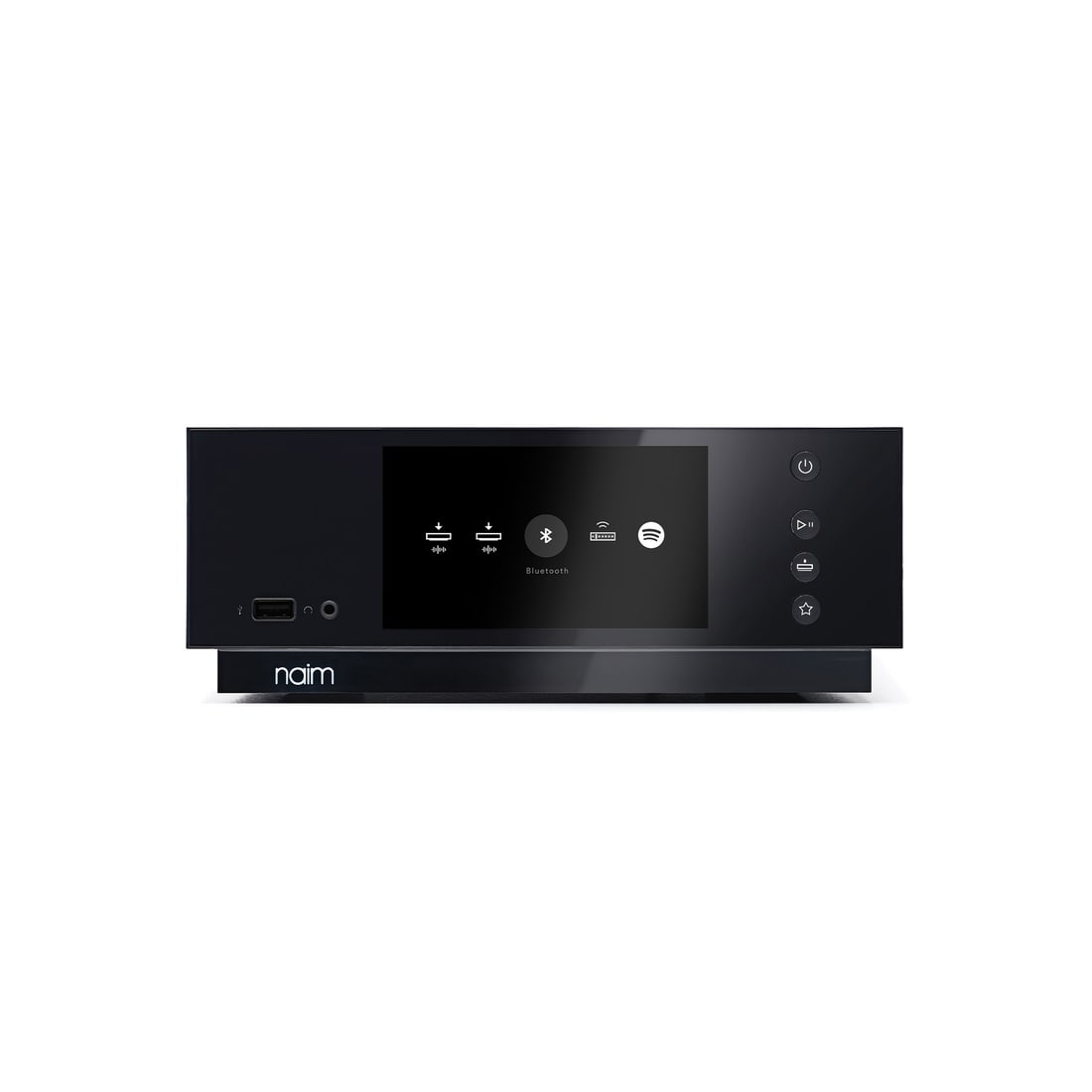
The 5-inch colour LCD with proximity sensor is one of the Atom's most immediately distinctive features and, unlike some display implementations in the category, it actually earns its place. Artwork renders clearly, input sources and metadata are legible from across a room, and the proximity sensor means the display activates when you approach and dims when you step away — a small ergonomic detail that feels considered rather than gimmicky. The large aluminium rotary volume control dominates the front panel and gives the unit a tactile presence that reinforces the sense of a proper component rather than a lifestyle gadget. Build quality throughout is excellent; the machined aluminium enclosure is solid, the tolerances are tight, and nothing rattles or flexes. At A$5,750 it should be, but it is.
Sound
I want to be clear about the methodology here. This is an analysis grounded in specification, topology, class knowledge and the consistent reports of long-term owners and professional reviewers — not a fabricated listening session. But the engineering tells a coherent sonic story, and that story is worth unpacking properly.
Bass
The 40-watt Class AB amplifier section is designed around current delivery rather than sheer voltage swing, which is consistent with Naim's house philosophy going back decades. Owners consistently report a bass character that is taut and controlled rather than warm or generous — the Atom does not flatter low frequencies with added weight, which means it will reveal a speaker's actual bottom-end character rather than papering over lean designs. This is broadly a virtue, but it does mean that if your speakers already sound a little lean in the midbass, the Atom is not going to rescue them. Conversely, with a speaker that has well-controlled bass — a quality standmount or a sensibly tuned compact floorstander — the tightness reads as genuine musical timing, which is precisely what Naim's amplifier topology is designed to deliver.
Midrange
This is, on paper and in accumulated owner experience, where the Atom is strongest. The separate power supply rails, the discrete analogue output stage and Naim's DAC voicing all point towards a midrange presentation that is detailed and communicative without tipping into clinical brightness. Vocals, acoustic instruments and the harmonic texture of stringed instruments are reported consistently as natural and engaging — the word that comes up repeatedly is "musical," which I am usually deeply allergic to as a descriptor, but in this context it maps onto something specific: the Atom presents music with dynamic shading and tonal density rather than flattening everything into a polished surface. That is an engineering outcome as much as a subjective preference.
Treble
Naim's high-frequency voicing has historically leaned towards precision over air — less shimmer, more transient accuracy. The Atom follows that lineage. This means it handles poorly-recorded or compressed material with more grace than a hyper-extended treble presentation would, which is a meaningful real-world consideration given that a large proportion of streaming content is not reference-quality. For listeners who prioritise a wide, airy top end above all else, the Atom may feel slightly restrained; for those who listen to a broad library across genres and recording qualities, the measured high-frequency presentation is likely a net positive.
Dynamics and soundstaging
Forty watts is 40 watts, and the dynamic ceiling will be speaker-dependent. With an efficient 89dB-or-above bookshelf or moderate-sensitivity floorstander in a domestic room, the Atom has sufficient headroom for realistic playback levels and credible dynamic contrast. The architecture — separate rails, a proper transformer, a discrete output stage — means the dynamic performance should be relatively uncompressed within that 40-watt envelope. Soundstaging is reported as organised and precise rather than dramatically wide; the Atom images convincingly and places instruments with clarity, without imposing an artificially expansive presentation.
Setup & system matching
Speaker matching is critical
The single biggest system-matching consideration for the Atom is speaker sensitivity and impedance behaviour. Forty watts is genuinely sufficient for a well-chosen partner, but this unit will not drive a 4-ohm nominal speaker with a difficult phase angle, a large floorstander with a bass-heavy load, or anything with sensitivity below about 86dB to satisfying levels in a large room. Naim's own Mu-so range and the Focal Kanta or Focal Aria series are natural companions — Focal and Naim share the same parent company, and the voicing synergy is real. Quality standmounts from KEF (the R3 Meta is a compelling match), Dynaudio, Harbeth and ProAc are all frequently cited as excellent Atom partners. Avoid anything with a nominal 4-ohm load and a reputation for being amplifier-hungry.
Amplification and cabling
The Atom is a closed system — you are not adding a power amplifier or swapping the DAC — so the system-matching question resolves entirely to speakers and cables. Naim has historically been associated with its own NACA5 cable, and while the Atom is less fussy about cable impedance than older Naim designs, using a reasonably low-capacitance speaker cable of appropriate gauge is sensible. Don't spend A$2,000 on cables for a A$5,750 integrated; do use a quality cable that won't introduce capacitive loading or loose terminations. That's the entirety of the cabling advice this product warrants.
Room and placement
The HDMI ARC input makes the Atom genuinely dual-purpose — both a serious stereo audio component and a TV system hub — which broadens its placement options. It runs warm under sustained load (Class AB in a compact chassis, inevitable) so ensure a few centimetres of ventilation above and around the unit. It is not a component that needs a dedicated listening room; its network streaming capability and app integration make it well-suited to a living room context, which is precisely its intended habitat.
Living with it
The Naim app is, without significant qualification, one of the best control applications in streaming audio. It is stable, logically structured, quick to respond and supports every streaming service the hardware handles. Qobuz and TIDAL integration is first-party rather than routed through a browser, which means gapless playback, proper metadata handling and a consistent interface. Roon Ready certification means those in the Roon ecosystem get full endpoint control. The supplied remote is a competent aluminium handset; the front-panel controls are sufficient for basic operation without the app.
The Multiroom and Party Mode feature — synchronising up to six Naim streamers — is a genuine differentiator for buyers who are already in or planning to build a Naim ecosystem. For a standalone buyer, it's background information. The HDMI ARC integration is well-implemented and meaningfully extends the unit's utility; it handles TV audio without awkward switching protocols, and the resulting sound quality from streaming services via a TV is considerably better than any soundbar at this price tier.
Australian availability is through Naim's authorised distributor network and specialist retailers. Support and warranty are handled locally. Given the complexity of the streaming platform — firmware updates will be required over the product's life, as they have been throughout the Atom's history — buying from an authorised retailer rather than grey-market importers is strongly advisable. Naim's firmware track record is good but not perfect; there have been historical update issues that authorised dealers are better positioned to support through.
How it compares
At A$5,750, the Atom's principal competitors include the Cambridge Audio EVO 75 (more power, less premium build and a less refined app), the Hegel H95 (exceptional amplifier performance, but streaming feature set that trails the Atom materially) and the Cocktail Audio X45 Pro (far more storage and ripping functionality, notably less amplifier refinement). The Linn Majik DSM is a direct philosophical competitor from a company with deep streaming heritage, though pricing and configuration options differ. The Atom's genuine advantage over the field is the combination of build quality, app polish, streaming breadth (particularly Roon Ready plus Chromecast plus AirPlay 2 simultaneously) and HDMI ARC in a single resolved package. No competitor at this price matches all of those simultaneously. The disadvantage — 40 watts — is also not matched downwards; competitors with more power cost more, and accepting that constraint is the price of the Atom's engineering compromises in a compact chassis.
Who it's for / who should look elsewhere
The Atom is for the listener who has accepted that a single well-engineered box is the right answer for their life, not merely a compromise. It suits apartments and medium-sized rooms, partners beautifully with quality bookshelf speakers or efficient compact floorstanders, and is the correct choice for anyone who wants genuine high-end audio without a rack of components and a cable management project. It is also a compelling proposition for the TV-as-primary-source listener who refuses to accept soundbar-quality audio. If you are already in the Naim ecosystem, the multiroom integration is a significant additional argument.
Do not buy the Atom if your speakers are power-hungry, if you are in a large room that demands real output levels, or if you are the kind of listener who upgrades components individually over time. The Atom does not have a separates upgrade path in the traditional sense — you would eventually replace the whole unit rather than add a better amplifier. Do not buy it if you prioritise maximum wattage per dollar; at A$5,750, you are paying for integration quality, build, the app, and Naim's engineering discipline, not for brute-force amplification. Do not buy it if your primary listening is vinyl-heavy and you need a phono stage; there is no phono input, and an external stage adds both cost and a cable into an otherwise elegant single-box solution.
Verdict
The Naim Uniti Atom is not a perfect product — 40 watts is a real constraint, and the pricing demands a genuine commitment to the all-in-one philosophy rather than a casual consideration. But it is a thoroughly honest and well-engineered one. The streaming platform is genuinely first-rate, the build quality justifies the premium over cheaper integrateds, and the HDMI ARC addition makes it broadly useful in a way that pure audio components cannot match. For a medium-sized room with appropriate speaker partners, it represents the most resolved single-box streaming solution I can point to at this price in the Australian market. If your room, your speakers and your listening habits align with what the Atom is designed to do, it will reward you without reservation.
Common questions
- Is 40 watts enough for the Naim Uniti Atom to drive most speakers?
- For speakers with a sensitivity of 86dB or higher in a small-to-medium domestic room, 40 watts is genuinely adequate. The Atom is designed around current delivery and tight power supply regulation rather than raw wattage, which means it performs well within its envelope. However, it is not suitable for large inefficient floorstanders, 4-ohm nominal loads with difficult phase characteristics, or large rooms requiring sustained high output levels. Speaker matching is the single most important decision when buying an Atom.
- Does the Naim Uniti Atom work well as a TV audio hub via HDMI ARC?
- Yes, and it's a genuine strength of the product. The HDMI ARC input allows the Atom to receive audio from a connected television, which means it can serve as the audio hub for a living room system without requiring a separate DAC or optical connection. Audio quality from streaming services routed through a TV into the Atom is substantially better than any soundbar at this price, and switching is handled cleanly via the standard ARC protocol.
- Is the Naim Uniti Atom Roon Ready, and what does that mean in practice?
- Yes, the Atom carries official Roon Ready certification, meaning it functions as a full Roon endpoint — it appears in your Roon system, accepts gapless audio from a Roon Core, displays metadata correctly and integrates with Roon's DSP and grouping features. This is distinct from the basic Roon Tested certification that some competitors carry. If you are a Roon subscriber or planning to become one, the Atom will integrate properly rather than appearing as a generic network renderer.
- What is the best speaker pairing for the Naim Uniti Atom in Australia?
- Naim and Focal share a parent company, and there is genuine voicing synergy with speakers from the Focal Aria and Kanta ranges. Beyond that, quality standmounts with sensitivity around 87-90dB are the natural habitat — KEF R3 Meta, Dynaudio Emit or Evoke series, ProAc Tablette, and Harbeth P3ESR are all commonly cited as excellent matches. The key criteria are sensitivity above 86dB, a reasonably benign impedance curve, and a tonal character that complements Naim's precise, timing-focused presentation rather than working against it.
- Where can Australians buy the Naim Uniti Atom, and is local support reliable?
- The Atom is distributed in Australia through Naim's authorised dealer network, which includes specialist hi-fi retailers in Sydney, Melbourne, Brisbane and other capitals. Given that the product receives firmware updates throughout its life — as the streaming platform evolves — purchasing from an authorised retailer rather than a grey-market importer is strongly recommended. Local dealers are better positioned to assist with update issues, warranty claims, and configuration support. Avoid parallel imports from overseas retailers to preserve warranty coverage and access to local technical support.