RME ADI-2 DAC FS
Rating: 4.8 / 5
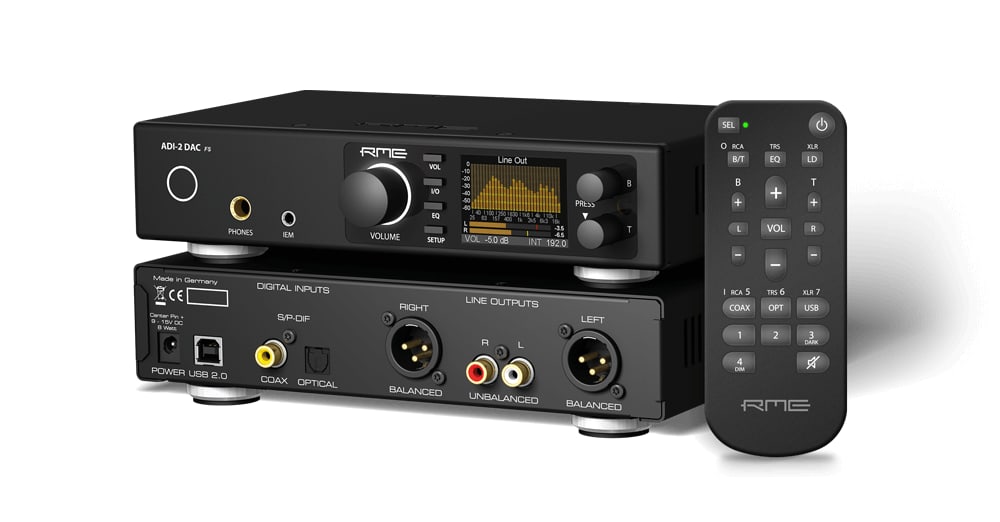
The ADI-2 DAC FS is a reference two-channel USB DAC and headphone amplifier built around an ESS ES9028Q2M in a bespoke RME circuit with extensive DSP and parametric EQ. It suits measurement-minded listeners and studios wanting transparent output, a dedicated IEM jack and deep tone control.
As an Amazon Associate and partner of the retailers above, Sound Technology earns from qualifying purchases — at no extra cost to you. Prices and availability checked recently but vary; the linked retailer is the source of truth.
Pros
- Reference-grade measured performance
- Powerful phones output plus separate low-noise IEM jack
- Deep parametric EQ/DSP with remote control
- Class-compliant USB works on any platform
Cons
- Dense menu system has a real learning curve
- External PSU and a small fiddly remote
- No streaming or network features
An opening position
A$1849 buys you a lot of promises in the DAC market. What it buys you here is something more useful: a published noise floor you can actually verify. The RME ADI-2 DAC FS has been sitting on studio desks and high-end listening rigs for long enough now that its measured performance is well-documented, and the numbers hold up under independent scrutiny. That matters to me more than almost anything else I could tell you about this box.
I'll admit I got excited about DACs for the wrong reasons for a few years. Spent time chasing exotic output stages and premium-sounding marketing copy before eventually accepting that transparent really does mean transparent, and that the graph doesn't lie the way my auditory memory does. The ADI-2 DAC FS is built for people who've arrived at the same conclusion, or who are on their way there.
Design and engineering
The chip and what RME actually did with it
The ESS ES9028Q2M is a well-regarded converter, but the chip alone tells you almost nothing useful. ESS silicon turns up in products ranging from genuinely excellent to deeply mediocre, because the surrounding circuit is where the engineering either happens or doesn't. RME's implementation is the point. They run the chip in a custom configuration with their proprietary SteadyClock FS, which is a femtosecond-class jitter-rejection system. In practice this means incoming jitter from USB, optical, or coaxial SPDIF sources is effectively rejected before it reaches the conversion stage. That's not marketing — it's the reason the ADI-2 measures the same whether you're feeding it from a mediocre laptop or a well-clocked source.
The published SNR is 123 dBA (DA). THD sits below -120 dB. For context, -120 dB is below the theoretical noise floor of a 20-bit word. These are reference-grade figures. You will not hear distortion from the DAC stage. What you hear will be your recording, your headphones, and your room — in that order.
Outputs and the IEM jack
Two headphone outputs is smart design, not a gimmick. The 6.35mm Extreme Power output drives low-sensitivity, high-impedance headphones hard — we're talking planars and dynamic cans that need real current. The 3.5mm IEM output is a separate, independently optimised low-noise circuit. In-ear monitors are brutally revealing of amplifier noise floors because their sensitivity is so high; a standard headphone amplifier hisses into them. RME clearly tuned the IEM output for this, and owners of sensitive IEMs consistently report a black background. By design, these two outputs aren't interchangeable, and you shouldn't treat them as such.
The balanced XLR outputs pair naturally with active studio monitors or a balanced line-level input on a downstream amplifier. RCA is there for everything else. All analogue outputs can be level-controlled from the front panel, so you can run the ADI-2 direct to powered monitors as a DAC-preamp and lose nothing in the chain.
DSP: parametric EQ and why it's legitimate
Five bands of parametric EQ, bass and treble shelves, a loudness curve, and a crossfeed processor. That's a serious DSP toolkit for a standalone DAC, and I'd push back against anyone dismissing it as tinkering. Parametric EQ in the digital domain, applied before conversion, adds no analogue noise. It's mathematically precise. If your headphones have a measured frequency response anomaly — and most do — correcting it here is strictly better than trying to compensate with an analogue EQ downstream. The crossfeed function, which mixes a small time-delayed signal between channels, reduces the unnatural hard-panning that affects many stereo recordings over headphones. Whether you use it is a personal call, but it's implemented cleanly.
All of this is remote-controllable, which matters more than it sounds. Getting out of your chair to adjust EQ during a listening session breaks concentration. The included remote is small and plasticky — I'll come back to that — but it reaches the DSP without requiring you to dive into menus every time.
Expected sonic character
Bass
By design, the ADI-2 DAC FS has no bass character of its own. What's on the recording is what you get. That might sound obvious, but it's actually unusual. A lot of DAC-amplifier combinations at this price point have house sounds — slightly warm output stages, slightly soft transients, slightly elevated low-frequency noise floors that add a sense of fullness. The ADI-2 doesn't do any of that. Owner reports consistently describe bass as tight, controlled, and completely dependent on the transducer. If your headphones have slow, bloated bass, the ADI-2 will show you that clearly. If they're excellent, it'll show you that instead.
Midrange
With THD below -120 dB and no audible second-harmonic colouration, the midrange presentation on paper is essentially colourless. Vocals and instruments reproduce with whatever tonal balance the recording carries. There's no euphonic warmth here, and no hardness either. Some listeners, particularly those coming from valve-based sources, find this initially unsatisfying — the word "clinical" comes up in forum discussions. Honestly, I think that reaction is largely about unfamiliarity with the absence of colouration rather than a genuine fault in the ADI-2. Give it a few weeks.
Treble
The ESS chip's natural tendency can run slightly towards an extended, analytical top end in some implementations. RME's custom circuit and output stage appear to temper this; owners don't consistently report a bright or fatiguing character, which is notable given how many ESS-based products do exhibit it. The SteadyClock FS plays a role here — reduced jitter means reduced high-frequency smear, which can read as harshness in less well-implemented converters.
Dynamics and soundstaging
A 123 dBA SNR leaves enormous dynamic headroom. Quiet passages are genuinely quiet; loud transients don't clip or compress at sane listening levels. Over headphones, the soundstage width and depth will be entirely a function of your transducer and the recording — the ADI-2 isn't adding anything. Engage the crossfeed if the stereo image feels uncomfortably wide; disengage it for orchestral work where width serves the music. That flexibility is one of the better arguments for buying this over a purely transparent DAC with no DSP.
Setup and system matching
Amplification requirements
The ADI-2 DAC FS is effectively self-contained for headphone listening. The Extreme Power output handles almost anything: high-impedance dynamics, orthodynamic planars, studio cans. If you're running it into a separate power amplifier for speakers, you're using the balanced XLR or RCA outputs as a preamp stage, and the volume control is clean enough that you lose nothing measurable doing so. No additional preamplifier is needed.
USB and source requirements
Class-compliant USB means it works on Windows, macOS, Linux, and iOS without driver installation. On Windows, installing RME's ASIO drivers unlocks lower latency for anyone using it in a recording context, but for pure playback it genuinely doesn't matter. The SteadyClock FS means your source quality affects the ADI-2 far less than it would with a lesser reclocker — feeding it from a Raspberry Pi running Volumio or a Mac Mini running Roon are both fine options.
Room and placement
For headphone-only use, room is irrelevant. For speaker output, the parametric EQ gives you real room correction capability if you're prepared to measure your room with something like REW (Room EQ Wizard, freely available) and apply correction filters manually. Five parametric bands won't fix a badly treated room, but they'll handle the most audible modal problems. That's a genuine differentiator at this price.
Cabling
Use competent cables, not exotic ones. Balanced XLR from a reputable Australian cable maker like Oehlbach or Sommer is fine. The ADI-2's measured performance is not going to be the bottleneck. Anyone trying to sell you an $800 USB cable to "let the RME breathe" deserves a sceptical look.
Living with it
Build quality and ergonomics
The ADI-2 DAC FS is a half-rack-width metal chassis, solid and well-finished, with a clear OLED display and a multifunction encoder knob that does most of the heavy lifting. It looks purposeful rather than beautiful. On a dedicated audio desk it sits unassumingly and earns no comments from visitors, which I regard as a virtue.
The menu system is where things get genuinely complicated. RME has packed an enormous amount of functionality into this unit, and accessing parametric EQ bands, crossfeed settings, or channel-specific level trims requires real engagement with a hierarchical menu. There's no touchscreen, no app, no graphical interface — just the encoder and the OLED. I spent a solid afternoon with the manual before I felt comfortable, and I do this for a living. Casual users will find the learning curve real. Once you've mapped the menu logic it becomes second nature, but the entry cost is non-trivial.
The remote
Small, lightweight plastic. Does the job. Feels underdone next to a $1849 product. That's a minor gripe, but it's a fair one.
The external PSU
A 12V 2A external brick. Works on Australian 240V mains without a second thought. It does add a cable to manage, and some users report very slight noise in sensitive IEM setups from cheap switched-mode supplies; RME's supplied unit is fine, but if you're noticing anything, a linear 12V replacement is an easy and inexpensive fix.
Australian availability and support
RME products are distributed in Australia through Amber Technology, which has been handling the brand locally for years and maintains genuine service capability. The ADI-2 DAC FS is stocked at most serious audio and pro-audio retailers. At A$1849 it's not an impulse purchase, but it's priced consistently with the global going rate when you account for the exchange rate and GST. Warranty support through Amber is straightforward.
One aside: I was setting up a review system in our building on King Street in Sydney last quarter, running the ADI-2 off a NUC with Roon, and the thing just worked from the moment I plugged it in. Class-compliant USB on Linux, no fiddling. Some products in this category make you earn every hour of listening time. This one didn't.
How it compares
At A$1849, the obvious alternatives are the Topping D90SE (strong measurements, less DSP), the iFi Pro iDSD Signature (warmer, more coloured, more analogue-facing), and the Benchmark DAC3 HGC (which costs considerably more and is arguably the only unit in this class that definitively measures better).
The RME's case rests on three things the others don't combine at the price: the parametric EQ with remote control, the dedicated IEM output, and the SteadyClock FS jitter rejection. If you want a transparent, feature-minimal converter and nothing else, the Topping is cheaper and measures nearly as well. If you want warmth and a more "musical" (read: coloured) presentation, the iFi scratches that itch. The ADI-2 is for the listener who wants measurement-grade transparency AND the tools to adjust, correct, and personalise the output — all in one box, all remote-controllable.
The Benchmark DAC3 HGC is the only unit in my experience that unambiguously outperforms it on paper, and it costs substantially more in Australia. For most buyers, that gap is not audible in any meaningful sense.
Who it's for, and who should look elsewhere
Buy the ADI-2 DAC FS if you own a mix of sensitive IEMs and high-impedance cans, want to apply headphone EQ correction in the digital domain, value remote-controlled DSP, and need a system-agnostic USB input that works without drivers on any platform. Studio users who want a reference monitor output alongside a headphone stage will find it earns its keep twice over.
Look elsewhere if: you want a streaming or network endpoint (the ADI-2 has no Wi-Fi, no Ethernet, no Roon-ready network input — you need a separate source); if deep menus make you anxious; if you're primarily a speaker listener who doesn't need the headphone outputs or parametric EQ and can spend the same money on a better DAC stage alone; or if you want a warm, euphonic presentation rather than accuracy. The ADI-2 is not going to flatter poor recordings or soft-pedal the faults in your headphones. If that's what you need, buy something with a valve output stage and stop arguing about it.
Verdict
At A$1849, the RME ADI-2 DAC FS is the most complete and technically honest DAC-headphone-amplifier combination I can recommend to a measurement-minded Australian buyer. The menu system will test your patience early on, and yes, the remote is cheap. But the engineering underneath — a 123 dBA SNR, femtosecond-class jitter rejection, a genuinely quiet IEM output, and a full parametric EQ toolkit that you can operate from your chair — represents a coherent design philosophy executed without compromise. This is a product built around what the numbers say rather than what the marketing wants you to feel. In my experience, that's exactly where you want to start.
Common questions
- Does the RME ADI-2 DAC FS need drivers to work with my Mac or Windows PC?
- No driver installation is required for basic playback. The ADI-2 DAC FS is USB class-compliant and is recognised natively by macOS, Windows, and Linux. On Windows, RME offers optional ASIO drivers for lower-latency operation — useful for recording or production use, but not necessary for pure listening.
- Can the ADI-2 DAC FS drive planar magnetic headphones like the Audeze LCD series?
- Yes. The 6.35mm Extreme Power headphone output is designed for exactly this use case — high-current delivery into low-sensitivity, low-impedance loads including planar magnetics. The 3.5mm IEM output is a separate, lower-noise circuit optimised for sensitive in-ear monitors and should not be used for demanding full-size headphones.
- Does the parametric EQ affect the balanced XLR and RCA outputs as well as the headphone outputs?
- RME's implementation allows the EQ and DSP processing to be applied to all outputs, but the routing is configurable. You can apply EQ to the headphone outputs independently of the line outputs, which is useful if you want corrected headphone listening while sending a flat signal to studio monitors. Check the manual's DSP routing section — it's one of the areas where the learning curve pays off.
- Is the A$1849 price consistent with international pricing?
- Reasonably so. The ADI-2 DAC FS retails in Germany (where RME is based) at around €1,099–1,149, which translates to roughly A$1,800–1,900 at current exchange rates before local retailer margin and GST. Australian pricing via Amber Technology is broadly fair rather than exploitative.
- What's the difference between the ADI-2 DAC FS and the ADI-2/4 Pro SE?
- The ADI-2/4 Pro SE adds two balanced analogue inputs, making it a four-channel device suited to recording and monitoring workflows. It costs considerably more. The ADI-2 DAC FS is a playback-only device with no analogue inputs — if you don't need to record or route analogue signals, it's the more focused and better-value choice for a listening system.