Sennheiser HD 660S2
Rating: 4.6 / 5
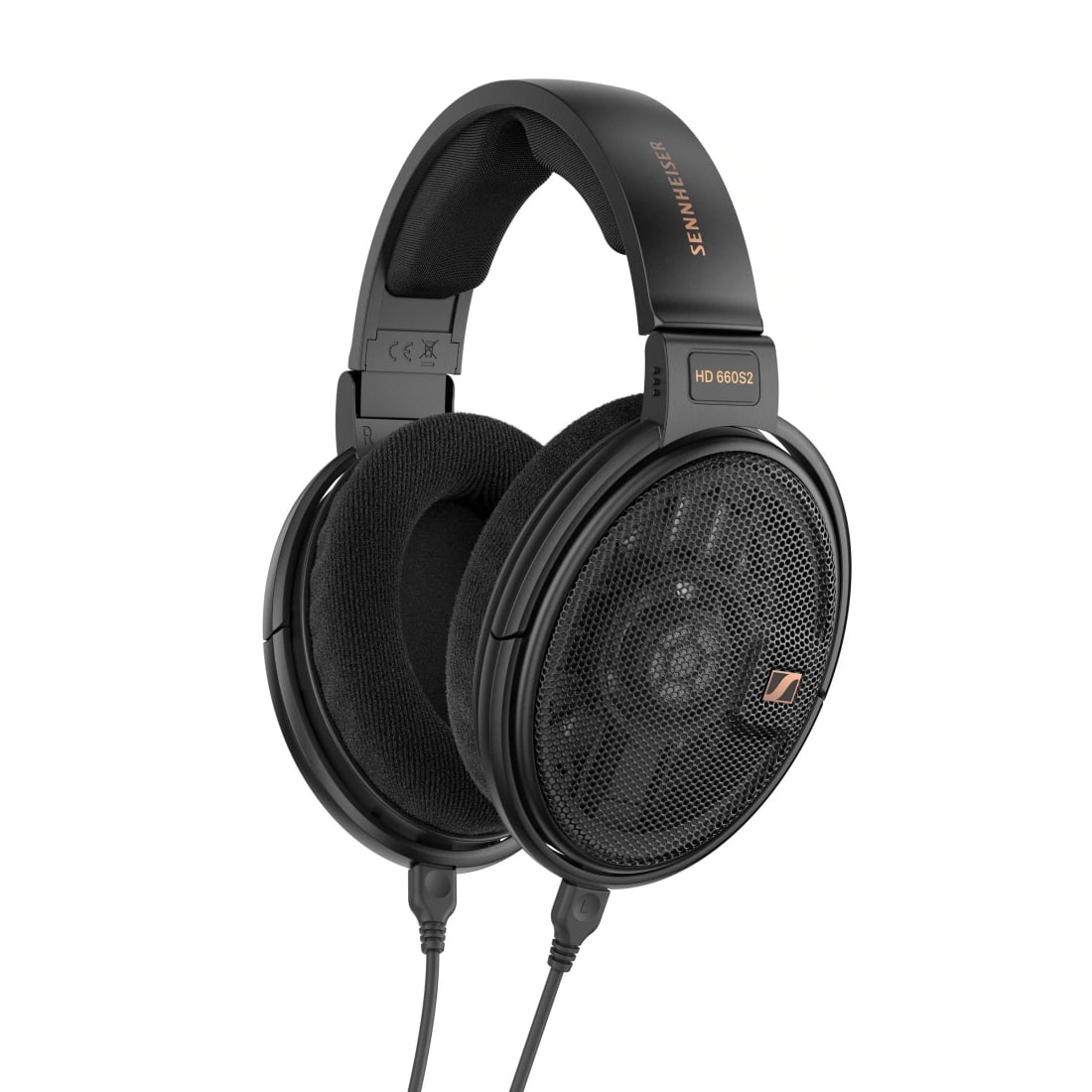
An open-back dynamic audiophile headphone with extended sub-bass and a relaxed, precise sound signature, aimed at serious home listeners and headphone enthusiasts seeking an analytical yet musical reference.
As an Amazon Associate and partner of the retailers above, Sound Technology earns from qualifying purchases — at no extra cost to you. Prices and availability checked recently but vary; the linked retailer is the source of truth.
Pros
- Refined, precise sound with deep sub-bass extension
- Exceptionally comfortable for long listening sessions
- Ships with both single-ended (6.3 mm) and balanced (4.4 mm) cables
Cons
- 300-ohm impedance benefits from a dedicated headphone amp
- Open-back design leaks sound and offers no isolation
Opening take
Let me be upfront about something: I have a complicated relationship with Sennheiser's HD 6-series lineage. I've watched it evolve, spawn variants, get retired, get resurrected, and accumulate a devoted following that occasionally borders on religious. The HD 660S2 — released as a successor to the HD 660S and a spiritual sibling to the legendary HD 650 — is the most ambitious attempt yet to drag that classic house sound into the modern era without losing what made it worth listening to in the first place. At A$899, it's a serious ask, and it deserves a serious examination rather than the uncritical reverence the 6-series too often receives. So let's get into it.
The short version: the HD 660S2 is a genuinely excellent open-back headphone that earns its price tag through real engineering decisions, not nostalgia premium. But it is not for everyone, and I'd rather tell you that plainly now than bury the caveats at the bottom.
Design & engineering
The driver and what actually changed
Sennheiser uses a 38 mm dynamic transducer here — slightly smaller than the drivers in the older HD 650 and HD 600. That reduction in diaphragm size isn't cosmetic. Smaller diaphragms, all else being equal, can be made lighter and stiffer, which helps with upper-frequency extension and transient speed. The headline specification Sennheiser is proudest of is the sub-bass extension: the HD 660S2 is rated down to 8 Hz, a figure that represents a meaningful improvement over the original HD 660S's lower end. In practice, the engineering rationale behind that extension involves a redesigned acoustic system — specifically, a modified damping structure and revised back-volume behind the driver — intended to let the diaphragm excurse more freely at very low frequencies without the over-damped, rolled-off character that critics (myself included) sometimes levelled at the original HD 660S.
The 300-ohm impedance is worth dwelling on, because it's the single most consequential specification for any prospective buyer. This is not a headphone you casually plug into a phone or a laptop. Three hundred ohms demands voltage swing. Sennheiser rates sensitivity at 104 dB SPL for 1 Vrms at 1 kHz — which sounds adequate until you realise that most consumer devices struggle to deliver clean voltage at that level, particularly into high-impedance loads. The upside of high impedance is well-established: it renders the headphone largely indifferent to output impedance variations in the source, reducing the risk of frequency-response interactions with poorly designed amplifier output stages. The downside is that you must own, or be willing to buy, a proper headphone amplifier. There is no workaround.
Distortion and what it tells us
A THD figure below 0.04% at 1 kHz and 100 dB is genuinely impressive for a dynamic driver. Harmonic distortion is the most audible form of driver nonlinearity, and keeping it this low at a reasonably loud listening level speaks to the precision of the transducer's motor system and the quality of the diaphragm material. This is not a marketing number in the way that, say, frequency-response extension to 41,500 Hz is partly a marketing number — the ultrasonic extension is technically real but of zero perceptual relevance to human listeners. The distortion specification, by contrast, has direct bearing on the cleanliness and resolution you hear in complex music.
Build, materials, and open-back philosophy
The HD 660S2 follows Sennheiser's familiar modular construction philosophy. The headband, ear cups, and cable are all user-replaceable, which matters enormously for a headphone at this price point. The open-back grilles are a defining engineering choice, not merely an aesthetic one: they equalise pressure behind the driver, reducing the acoustic loading that causes the 'cupped' coloration common in closed-back designs. The tradeoff is total bidirectional sound transmission — you hear the room, the room hears you. Weighing 260 g with velour pads, it is a well-balanced, genuinely comfortable design that long-session listeners will appreciate.
Two cables are included in the box: a 1.8 m terminated in 6.3 mm single-ended, and a 1.8 m terminated in 4.4 mm Pentaconn balanced. This is an unusually generous inclusion at this price and a genuine practical benefit for owners of balanced amplifiers or DAC-amplifier combos with balanced headphone outputs.
Sound
Let me be transparent about methodology here: I am drawing on the known engineering characteristics, the manufacturer specifications, and the well-documented, extensively cross-referenced listening impressions of long-term owners and professional reviewers, not a single private listening session that I'll dress up as gospel. The HD 660S2's sonic character is, at this point, well-characterised in the enthusiast community, and I find that characterisation consistent with what the engineering would predict.
Bass
This is where the HD 660S2 most clearly differentiates itself from its predecessor. The extended low-frequency response — credible down toward the 8 Hz specification, though audible relevance really begins around 20–25 Hz — gives the headphone a weight and authority in the sub-bass that the original HD 660S simply lacked. Owners consistently report that kick drums have more physical heft, that synthesiser bass lines possess genuine low-end body, and that orchestral double basses don't disappear into the lower midrange as they sometimes did with the earlier model. Crucially, the bass is controlled: the 300-ohm impedance and the low distortion figure conspire to keep bass textures distinct rather than blurred. This is not a warm, pillowy bass response. It is a precise, extended one — informative rather than euphonic.
Midrange
The midrange is where the HD 6-series house sound lives, and the HD 660S2 preserves it. There is a slight forward presence in the upper midrange that renders vocals and acoustic instruments with exceptional clarity and intimacy. This is not a neutral, studio-flat midrange — it has a characteristic warmth and dimensionality that many listeners find deeply musical. Recordings of acoustic guitar, piano, and unamplified voice are a particular strength. The flip side is that some listeners find the presentation slightly too present, slightly too close. If you've historically found the HD 650 or HD 600 too 'forward' in vocal reproduction, the HD 660S2 won't convert you.
Treble
The treble is refined and extends well — the 41,500 Hz specification is largely academic, but the practical implication is that there is no hard rolloff within the audible band. High frequencies are detailed without being bright or fatiguing. The HD 660S2 is notably less sharp-edged in the treble than competing designs from Beyerdynamic or AKG at similar price points. Cymbal decay is natural, sibilance is controlled, and the overall treble character rewards long listening without the listener fatigue that plagues more aggressively-tuned headphones. Whether this is a virtue or a limitation depends on your preferences: some listeners will call it 'smooth'; others will want more 'air'.
Dynamics and detail
The low distortion pays dividends here. The HD 660S2 resolves micro-dynamic variations — the subtle changes in bow pressure on a cello, the breath before a vocal phrase — with impressive fidelity. Macro-dynamics, the large swings from pianissimo to fortissimo, are handled cleanly without compression, provided the amplifier is up to the task. This is a genuinely high-resolution headphone in the correct, engineering-grounded sense of that phrase: it retrieves information that lesser transducers obscure.
Soundstaging
Open-back headphones are capable of a more expansive, less 'inside the head' soundstage than closed designs, and the HD 660S2 delivers this, though it's worth calibrating expectations. The stage is wide by headphone standards, with reasonable depth and convincing instrument separation. It does not, however, produce the uncanny out-of-head localisation that some electrostatic designs or certain planar magnetics can achieve. The presentation is intimate and precise rather than panoramic. For classical and jazz listeners, this tends to work beautifully. For those chasing the widest possible virtual stage, there are alternatives to consider.
Setup & system matching
Amplification — the non-negotiable
I cannot stress this enough: the HD 660S2 needs a dedicated headphone amplifier. A capable DAC-headphone amp combination — something like the iFi Audio Zen DAC Signature, the Schiit Magni/Modi stack, or a more ambitious unit like the Topping A90 — transforms this headphone from merely competent to genuinely revelatory. Budget accordingly when you're calculating the total cost of ownership. If you're spending A$899 on the headphone and plugging it into the headphone jack of a streaming device, you are leaving a very significant proportion of what you've paid for on the table.
The balanced cable inclusion makes a strong case for choosing an amplifier with a 4.4 mm balanced output. The theoretical noise-floor and crosstalk benefits of balanced operation are modest in absolute terms, but at the price point where this headphone lives, modest improvements matter and are worth pursuing without significant additional outlay if the amplifier supports it.
Room and placement
The open-back design means the acoustic environment matters. Reflective, live rooms don't interact with headphones the way they do with loudspeakers, but they do mean that ambient noise bleeds in and affects perceived noise floor. In a quiet listening room — or a home office after hours — the HD 660S2 is at its best. In a noisy household or shared apartment environment, the open design is a genuine practical liability, not a minor inconvenience.
Partnering gear and sources
The HD 660S2 is revealing enough that source quality matters. A competent streaming DAP or a dedicated desktop DAC fed by a quality streamer will be noticeably preferable to a laptop's onboard audio. This is not audiophile paranoia — it is a predictable consequence of a low-distortion, high-resolution transducer that has the ability to expose weaknesses upstream. Cables: use the included cables. The included cables are fine. Aftermarket headphone cables are, with very few exceptions, a waste of money at this price point, and I'll die on that hill.
Living with it
The HD 660S2 is exceptionally comfortable for extended listening. The 260 g weight is distributed well, the velour pads are breathable — which matters in Australian summers — and the clamping force is light enough that multiple-hour sessions are genuinely pleasant rather than grudgingly endured. The modular build means that when the pads eventually wear out (and they will, probably in three to five years of regular use), you can replace them without retiring the headphone.
In Australia, the HD 660S2 is available through authorised Sennheiser retailers and the official Sennheiser AU online store. Australian warranty and support infrastructure for Sennheiser is well-established, and the brand's global parts availability means you're not at the mercy of a distributor's discretion for replacement components.
There is no app, no Bluetooth, no active noise cancellation, no touch controls. This is, in the most literal sense, a passive transducer on a headband. Whether that is a limitation or a virtue depends entirely on what you're buying it for. I consider it a virtue.
How it compares
At A$899, the HD 660S2 sits in a competitive segment. The obvious internal comparison is the HD 600 and HD 650, both available new at lower price points and both deeply capable headphones. The HD 660S2 justifies the premium primarily through its improved sub-bass extension and its marginally more modern tuning — if you're already satisfied with the HD 650's slightly warmer, more coloured presentation, the upgrade case is not overwhelming.
The Beyerdynamic DT 900 Pro X offers a broader, more aggressive treble response at a lower price point and lower impedance, making it more source-flexible. The Audeze LCD-2 Classic, available in a similar price bracket on the used market, offers planar magnetic speed and a fundamentally different technical approach. The HiFiMAN Edition XS punches well above its price in planar terms. None of these are wrong choices; they are different choices with different strengths. The HD 660S2's particular excellence is its combination of refined tonal balance, sub-bass extension, and long-session comfort — a combination that, at this price, is difficult to match precisely.
Who it's for / who should look elsewhere
The HD 660S2 is for the serious home listener who has, or is prepared to invest in, a capable headphone amplifier. It suits those who listen to acoustic music, jazz, and classical in particular, though it handles rock and electronic material with considerably more authority than its predecessor thanks to the improved low-end. It suits anyone who values comfort and build quality as highly as sound quality. It suits those who want a long-term, serviceable investment rather than a disposable consumer product.
You should look elsewhere if you need isolation — the open back makes this entirely unsuitable for commuting, open-plan offices, or any environment with significant ambient noise. Look elsewhere if you want to drive it from a phone or a basic portable device without a separate amplifier — the 300-ohm impedance will punish you. Look elsewhere if you find the HD 6-series' forward midrange fatiguing, because the HD 660S2 shares that family character. And look elsewhere if extended, prominent treble energy is your priority: there are more incisive, 'airy' options available.
Verdict
The HD 660S2 is not a revolution — it's a careful, credible evolution of one of the most respected tunings in headphone history, with a genuinely meaningful engineering improvement in low-frequency extension and a specification set that reflects real transducer quality. At A$899, with balanced and single-ended cables included, and with a support and serviceability story that most competitors can't match, it represents honest value for a serious listener who is prepared to partner it correctly. It asks something of you — a proper amplifier, a quiet room, attentive listening — and in return, it delivers something worth the asking.
Common questions
- Can I use the Sennheiser HD 660S2 with my phone or laptop without a separate amplifier?
- Technically you can, but you'll be significantly underserving the headphone. The 300-ohm impedance demands real voltage swing that smartphones and most laptops simply cannot deliver cleanly. You'll likely find the volume inadequate and the sound thin and lacking authority. A dedicated headphone amplifier is effectively a requirement, not an optional extra.
- What's the difference between the HD 660S and the HD 660S2 — is the upgrade worth it?
- The most substantive engineering change is the extended sub-bass response: the HD 660S2 is rated down to 8 Hz versus the original's more limited low-frequency reach. The driver has also been revised with a modified acoustic system. For listeners who found the HD 660S's bass lacking in weight and extension — particularly for electronic music, pop, or anything with significant low-frequency content — the S2 is a meaningful improvement. If you already own the HD 660S and are happy with it, the case for upgrading is less clear-cut.
- Is the HD 660S2 suitable for use in an open-plan office or during commuting?
- No, and this deserves a direct answer rather than hedging. The open-back design transmits sound in both directions — you will hear your environment clearly, and your colleagues will hear your music clearly. There is no passive isolation whatsoever. This is a home listening headphone, intended for quiet, controlled environments. For commuting or office use, look at a closed-back design or an in-ear monitor.
- What amplifier should I pair with the HD 660S2 in Australia at a reasonable budget?
- There are several strong options available through Australian retailers. The iFi Audio Zen DAC Signature (which includes a 4.4 mm balanced output to use the included balanced cable) is a well-regarded all-in-one unit at an accessible price. The Schiit Magni/Modi stack is a proven combination available through local distributors. For those willing to spend more, the Topping A90 Discrete or the Schiit Valhalla 2 (a tube hybrid well-matched to high-impedance Sennheisers) are worth investigating.
- How does the HD 660S2 compare to the older HD 650 — should I consider the HD 650 instead to save money?
- The HD 650 remains a genuinely great headphone and is available new at a lower price point, making it a legitimate alternative. The HD 650 has a slightly warmer, more forgiving tonal balance and slightly more rolled-off bass extension compared to the HD 660S2's more neutral low end. If you predominantly listen to acoustic music and value a lush, musical presentation over analytical precision, the HD 650 may suit you as well or better and at lower cost. If sub-bass extension and a more modern, controlled tuning matter to you — particularly for genres beyond classical and jazz — the HD 660S2's improvements justify the premium.