SVS SB-3000
Rating: 4.7 / 5
A compact sealed-cabinet powered subwoofer with a 13-inch driver and 800W RMS Sledge amplifier, designed for home theatre and music enthusiasts who want deep, accurate bass without a large ported enclosure.
As an Amazon Associate and partner of the retailers above, Sound Technology earns from qualifying purchases — at no extra cost to you. Prices and availability checked recently but vary; the linked retailer is the source of truth.
Pros
- Massive, controlled deep bass from a compact cube
- Full DSP tuning via the intuitive SVS smartphone app
- Tight, musical sealed-cabinet response with low group delay
Cons
- Heavy at 24.7 kg for its compact footprint
- Sealed design rolls off lower than equivalent ported models at the deepest frequencies
The sub that punches you in the chest from a box you can actually live with
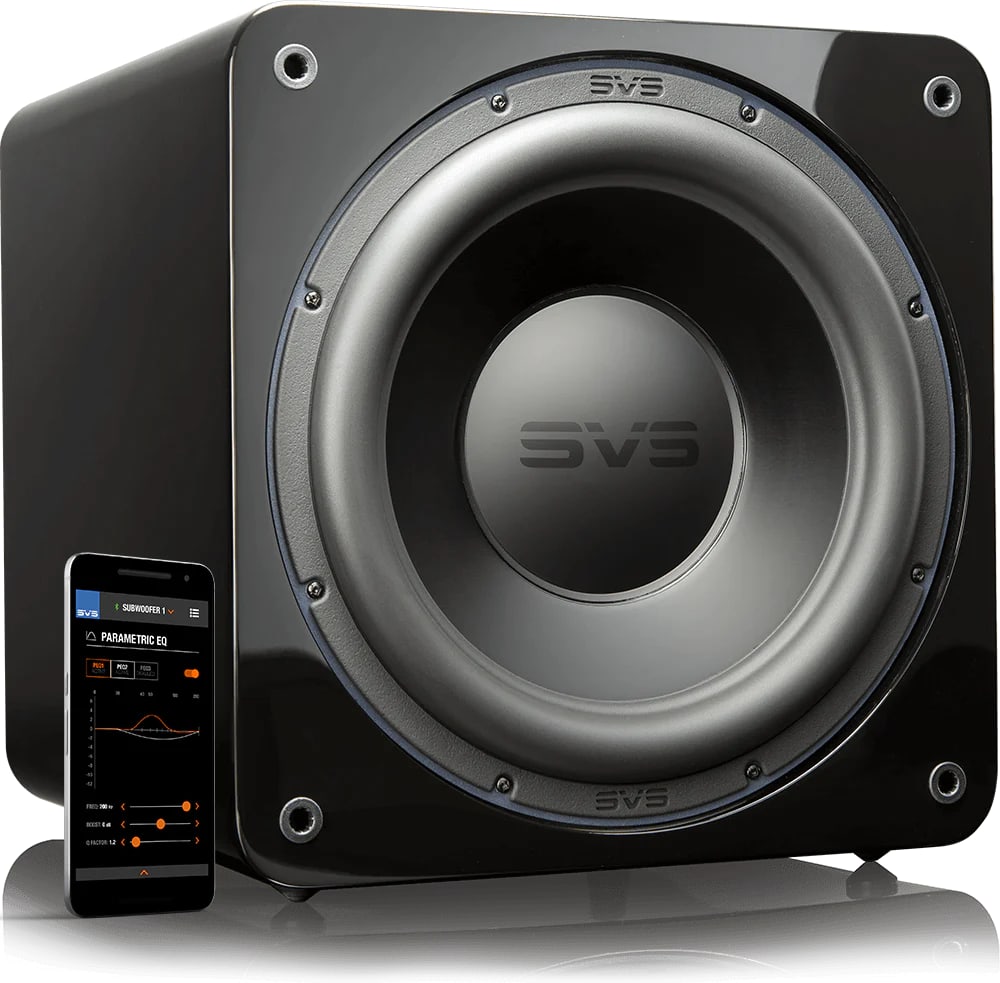
There's a particular type of home cinema enthusiast I meet a lot in this job — the one whose partner has already drawn a line in the carpet about where the subwoofer can go, how big it can be, and whether it's allowed to exist at all. The SVS SB-3000 is, in many ways, engineered for that person. It's a near-cube of a thing, 39.7 cm tall and not much wider, finished in a gloss black or premium black ash vinyl that looks like serious gear rather than a bargain-bin box. At A$1,999, it sits in the upper-middle tier of the Australian subwoofer market — not entry-level, not stratospheric — and it makes a compelling argument that you don't need a ported behemoth to move serious air in a real room.
I'll be upfront: I have a known soft spot for sealed subwoofers done well. Ported boxes can dig deeper on paper, but the group delay, the one-note overhang on poorly damped recordings, the tuneful boom that flatters some content and masks detail on others — I've heard enough of it to know that tightness and accuracy matter as much as raw extension. The SB-3000 is SVS's pitch for the listener who agrees with me. Let's see if the engineering backs that up.
Design & Engineering
The driver
The 13-inch aluminium cone driver is where this story starts. Aluminium is a deliberate material choice here, not an aesthetic one — it's stiffer than polypropylene or paper at this cone area, which means the driver can be pushed harder before the cone itself starts to flex and add colouration. SVS pairs it with what they describe as a high-excursion motor assembly, which matters enormously in a sealed enclosure. Unlike a ported or passive-radiator design, a sealed box doesn't have a port to extend low-frequency output — all the deep bass work is done by driver displacement. You need a driver that can move a lot of air cleanly, without mechanical bottoming or distortion at high excursion. The 13-inch format, in a cabinet of this internal volume, is a calculated trade-off: large enough to displace meaningful air at 20 Hz, compact enough to sit in a normal listening room without requiring a furniture rearrangement.
The amplifier
The Sledge STA-800D2 is SVS's own-branded Class D amplifier module, rated at 800 watts RMS continuous with claimed peaks above 2,500 watts. Class D at this power level is an entirely sensible engineering choice — it's thermally efficient, which is why the SB-3000 doesn't need a massive heatsink or active cooling fan, and why it stays manageable at 24.7 kg despite the dense cabinet and large driver. That peak headroom figure is worth pausing on: subwoofer transients — the LFE crack of an explosion, the first impact of a kick drum — are extraordinarily brief but demand enormous instantaneous power. The gap between 800W RMS and 2,500W+ peak means the SB-3000's amplifier isn't being compressed into clipping on those moments. On paper, that's the difference between a subwoofer that impresses and one that truly startles.
The DSP
The 50 MHz Analog Devices Audio DSP with 56-bit filtering is probably the most underrated part of this package. This isn't a marketing afterthought — it's why the SVS smartphone app is genuinely useful rather than merely present. The DSP gives you parametric EQ bands, a variable low-pass filter, phase control (0–180° continuously variable), polarity switching, room gain compensation, and three saveable presets. You can, in practice, tune the SB-3000 to your specific room without touching a laptop or a web browser. For Australian buyers particularly, where rooms vary wildly from Sydney apartments to Melbourne terrace houses to Brisbane Queenslanders with timber floors and little acoustic treatment, that flexibility isn't a nice-to-have — it's essential. The 56-bit filtering means the DSP is operating with enough numerical precision that rounding errors in the signal path aren't audible artefacts. That's a meaningful spec, not window dressing.
The sealed cabinet and what it costs you
Acoustic suspension — the sealed box — loads the back of the driver with a trapped air spring. This adds mechanical resistance to the driver, which improves damping and transient response, but it also means the low-frequency roll-off is gentler in slope (typically 12 dB per octave) and begins higher than an equivalently-sized ported design. SVS specifies 18 Hz (±3 dB) for the SB-3000. That's genuinely low — most content, including the vast majority of cinema LFE tracks and music, lives above 25 Hz — but you should know that the sealed design is working harder to reach those depths than a ported competitor would be at the same price. The trade-off you're accepting is: less ultimate extension and somewhat less maximum SPL at the very lowest octave, in exchange for tighter, more accurate, lower-distortion bass across the majority of the working bandwidth. For serious listeners, that's often the right trade-off. For the person who just wants the house to shake, a ported box might be more satisfying.
Sound
Bass character and extension
By design, the SB-3000's sealed topology produces bass that owners and reviewers consistently describe as fast, controlled, and articulate. The aluminium cone and high-excursion motor don't produce the warm, rounded low end you hear from cheaper polypropylene-cone designs — this is bass with definition, where you can hear the difference between a 40 Hz fundamental and a 30 Hz one rather than experiencing them both as a generalised chest pressure. In a typically-sized Australian living room of 30–50 square metres, the room gain effect — the natural acoustic reinforcement rooms provide below roughly 80 Hz — will add several decibels to the SB-3000's perceived deep bass output, which effectively mitigates the sealed design's shallower extension on real-world material.
Dynamics and transients
This is where the combination of the high-excursion 13-inch driver and the Sledge amplifier's peak headroom should make itself felt. Home cinema content — the LFE track on a well-mastered Atmos mix, the percussion on a concert Blu-ray, the seismic underpinning of a properly mixed action sequence — demands that a subwoofer be able to go from near-silence to very loud very quickly. The sealed alignment's inherent low group delay is a measurable advantage here: group delay describes how much the bass lags behind the midrange, and lower is more accurate. On music particularly, low group delay means kick drums don't smear forward in time relative to the rest of the kit. Owners consistently report that the SB-3000 is unusually musical for its power class, capable of sitting in a two-channel music system without sounding like a cinema blunt instrument.
Integration and the upper bass
The 270 Hz upper limit of the SB-3000's specified frequency response is worth noting — it's broad enough that some AVR crossover implementations won't reach a hard wall before the sub rolls off naturally. In practice, most users will cross this over at 80–120 Hz depending on their satellite speakers, which puts the SB-3000 well within its flat passband. The DSP's parametric EQ becomes particularly useful here: a slight cut around the room's dominant resonance frequency (common between 50–80 Hz in rectangular rooms) can transform a boomy listening experience into a tight one without expensive room treatment.
Setup & System Matching
Amplification and AVR compatibility
The SB-3000 is a powered subwoofer — it has its own amplifier, so your AVR or stereo pre-amplifier only needs to provide a line-level signal via a standard RCA subwoofer output (or LFE output on a surround processor). It's compatible with essentially every AVR sold in Australia from Denon, Marantz, Yamaha, Pioneer, Sony, and Onkyo, as well as stereo integrated amplifiers with subwoofer pre-outs. The Bluetooth connection for the app is a convenience feature for setup and doesn't carry audio — the signal path remains purely analogue from your processor to the SB-3000's input stage. One recommendation: run your AVR's room correction (Audyssey, YPAO, MCACC, or similar) before using the SVS app's parametric EQ. Get the AVR to do the heavy lifting for crossover alignment first, then use the SB-3000's own DSP to fine-tune residual room issues.
Placement
Sealed subwoofers are generally more placement-flexible than ported designs because there's no port to interact with room boundaries. That said, corner placement will still produce bass reinforcement that may need taming with the room gain compensation control in the SVS app. For Australian homes with hardwood or tiled floors, a quality isolation platform or footer set is worth considering — the SB-3000's output will couple through a timber suspended floor with enthusiasm, which your neighbours may not appreciate. SVS's own SoundPath isolation feet are a sensible accessory purchase if that's your situation.
Cabling
A decent quality RCA interconnect of 3–5 metres is all you need. Don't spend more than A$50–80 on a subwoofer cable unless you have a very specific noise problem to solve. Anyone telling you a $400 RCA lead will transform your subwoofer's performance should be selling you something else instead.
Living With It
The 24.7 kg weight is real, and anyone positioning this on their own should plan carefully. It's not a one-handed carry — two people or a furniture dolly for final placement is sensible, particularly given the gloss finish on the top panel is vulnerable to scratching on a single careless move. The build quality is genuinely premium for the price: the cabinet is dense and inert, the driver surround is properly finished, the rear panel layout is logical with clearly labelled inputs, controls, and the Bluetooth pairing button.
The SVS smartphone app is, genuinely, one of the better implementation of subwoofer control software available at this price. The interface is clear, the parametric EQ implementation is accessible rather than intimidating, and the three-preset system means you can store a cinema setting (more output, room gain compensation for movies), a music setting (tighter, lower volume), and a reference setting without reconfiguring every time. The Bluetooth pairing is reliable on both iOS and Android in my experience with SVS products generally.
SVS is well established in the Australian market through authorised distribution, with stock typically available through dedicated audio retailers rather than mass-market chains. Warranty support is backed locally. The brand's owner-direct communication reputation — they're known for responsive customer service — is genuinely useful if you encounter setup questions.
How It Compares
At A$1,999, the SB-3000 competes most directly with the KEF KC62 (roughly similar pricing, very different design philosophy — a dual opposing driver compact cube with impressive extension for its size but limited maximum output), the JL Audio E110 (a perennial benchmark sealed sub at a higher price point that the SB-3000 genuinely challenges on value), and SVS's own SB-2000 Pro (A$300–400 less, 12-inch driver, 550W RMS — a step down in authority and DSP depth). The PB-3000, SVS's ported sibling, costs a similar amount and will go louder and deeper on paper — but it's a significantly larger cabinet. If raw extension and cinema slam are your primary brief, the PB-3000 deserves audition. If you care about musicality, placement flexibility, and living with the thing in a real home, the SB-3000 makes a stronger case.
Who It's For — and Who Should Look Elsewhere
The SB-3000 is for the serious listener who wants a subwoofer that performs well on both cinema and music, fits into a real living space without dominating it, and provides enough DSP control to actually work properly in a typical Australian room. It's for the person who's graduated from entry-level subwoofers and wants to hear what proper bass control feels like. It's for the two-channel enthusiast running a stereo pair of bookshelf or standmount speakers who wants to fill in the bottom octave without sacrificing the timing and transient accuracy of their main speakers.
You should look elsewhere if your primary use is a large, acoustically untreated room above 60 square metres where you want maximum output and extension — the ported PB-3000 will serve you better. Look elsewhere if budget is the primary constraint — the SB-2000 Pro does most of what the SB-3000 does for less. And if your vision of bass performance is primarily about volume and physical impact over accuracy, a ported sub at this price will likely satisfy you more.
Verdict
The SVS SB-3000 is what happens when an experienced subwoofer manufacturer takes the sealed alignment seriously, throws a proper amplifier at it, and adds DSP control that's actually usable. At A$1,999, it's not cheap, but it earns its price in the quality of its bass — tight, deep, authoritative, and tuneable to your specific room. It's one of the more complete subwoofer packages available in Australia at this price point, and it's the one I'd recommend to most serious listeners looking to upgrade their bass foundation without compromising on either performance or practicality.
Common questions
- Can the SVS SB-3000 be used for music as well as home cinema?
- Yes, and it's one of its genuine strengths. The sealed enclosure's low group delay and tight transient response make it unusually musical for a sub at this power level. Owners consistently use it in two-channel setups alongside bookshelf or standmount speakers, and the three-preset SVS app system makes it easy to switch between a cinema setting and a tighter music configuration without manual readjustment.
- Is 800W RMS really necessary, and what does the 2,500W peak figure mean in practice?
- The RMS rating reflects continuous output capability, but subwoofer transients — the crack of an explosion, a kick drum hit — are brief and demand much higher instantaneous power. The 2,500W+ peak headroom means the SB-3000's Sledge amplifier has significant reserve capacity for those moments, which translates to dynamics that don't compress or clip on demanding material. You won't be running it at 800W continuously in any normal listening room.
- How does the SVS app work, and do you need it to set up the subwoofer?
- The SVS smartphone app (iOS and Android) connects via Bluetooth purely for control — it doesn't carry audio. You don't need it for basic operation, but it unlocks the SB-3000's full DSP capability including parametric EQ, variable phase, room gain compensation, and three saveable presets. For Australian rooms that vary widely in size and construction, using the app to dial in the sub to your specific space is strongly recommended and meaningfully improves the result.
- Will the SB-3000 go deep enough for serious home cinema use?
- The specified 18 Hz (±3 dB) extension covers essentially all recorded cinema and music content — the vast majority of LFE material lives above 25 Hz. The sealed design does roll off more gently than a ported equivalent, so a ported sub at the same price may measure a decibel or two louder at 16–18 Hz, but in a real room with normal acoustic reinforcement below 80 Hz, the SB-3000 will produce authoritative deep bass for nearly all material. If your use case is specifically very large rooms and maximum SPL at extreme low frequencies, consider SVS's PB-3000 instead.
- What's the best way to position the SB-3000 in an Australian home, particularly on hardwood or tiled floors?
- Sealed subwoofers are more placement-flexible than ported designs since there's no port to interact with room boundaries, but corner placement will still boost output and may require EQ compensation. For Australian homes with suspended timber floors or hard tiles, bass coupling to the structure can be significant — SVS's own SoundPath isolation feet, or a quality aftermarket isolation platform, are worth considering to both reduce floor coupling and protect against transmission to adjacent rooms or apartments.