Wharfedale Diamond 12.1
Rating: 4.6 / 5
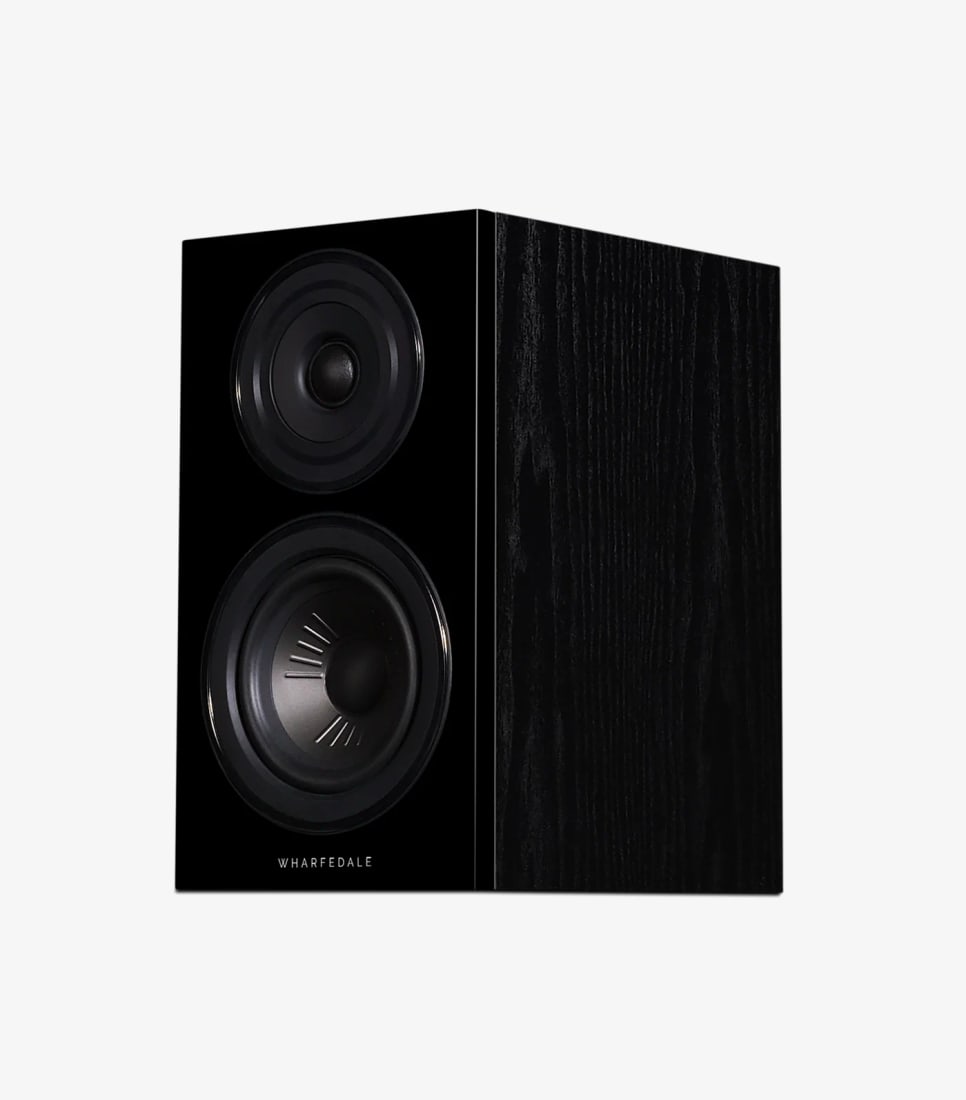
A compact rear-ported two-way standmount built around Wharfedale's 130mm Klarity polypropylene/mica mid-bass cone and a 25mm woven polyester soft-dome tweeter. Aimed at budget-conscious listeners and small rooms wanting a warm, forgiving sound from modest amplification.
As an Amazon Associate and partner of the retailers above, Sound Technology earns from qualifying purchases — at no extra cost to you. Prices and availability checked recently but vary; the linked retailer is the source of truth.
Pros
- Warm, easy-going balance that flatters bright or harsh recordings
- Outstanding sound quality for the money
- Compact 31cm cabinet suits small rooms and shelving
- Forgiving of modest partnering electronics
Cons
- Soft-dome tweeter lacks the last word in fine detail
- Rear port needs breathing room from walls
- Deep-bass extension limited by the 5-inch driver
Six-hundred and forty-nine dollars, and I'm not apologising for it
Some of my colleagues here at Sound Technology get twitchy when I bring sub-thousand-dollar speakers into the conversation. Fair enough — this is a publication that takes high-end audio seriously. But I reckon the gear that most Australians actually live with deserves the same rigorous treatment as the stuff that costs more than a decent used car. The Wharfedale Diamond 12.1 sits at A$649 a pair, and that price point is not a limitation to apologise for. It is, if Wharfedale have done their job, a challenge to every more expensive speaker in the room.
The Diamond series has been a fixture of the budget standmount conversation since the mid-1980s. The 12th generation, which is what we're looking at here, was released to update a lineage that had grown a little stale. The 12.1 is the entry point of the new range — the smallest, the cheapest, the most modest on paper. And on paper, at least, there are some genuinely interesting engineering decisions made for the money.
Design and engineering
The Klarity mid-bass driver
The centrepiece is Wharfedale's 130mm (5-inch) Klarity cone, made from a polypropylene and mica composite. This is not a generic OEM driver sourced from a catalogue — Wharfedale developed the Klarity material specifically for this range, and the mica loading is there for a reason. Pure polypropylene cones can be slightly coloured in the upper midrange; the mica loading stiffens the cone, pushing the first break-up mode higher in frequency and ideally out of the audible band, or at least out of the critical vocal region. It also damps self-resonance more effectively than polypropylene alone. The result, by design, should be a cleaner, more neutral midrange than unloaded polypropylene cone speakers at this price typically offer.
The 130mm diameter is a sensible choice for a compact standmount intended for small rooms. Larger mid-bass drivers — say 165mm or more — need larger cabinets to load them correctly, and they can struggle to hand off cleanly to a tweeter without beaming issues in the upper registers. At 130mm the 12.1 keeps its radiation pattern reasonably wide through the crossover region.
The tweeter
The 25mm woven polyester soft dome is the honest part of this speaker's personality. Soft-dome tweeters at this price level are not trying to be Scan-Speak Revelators. What they are trying to do — and what a well-implemented soft dome genuinely does better than many budget metal-dome alternatives — is avoid harshness. Woven polyester has inherent internal damping. It is less sensitive to the resonance peaks that can make budget aluminium-dome tweeters sound glassy or brittle on certain recordings. The trade-off is some loss of ultimate resolution and air in the top octave. That trade-off is not a flaw for this speaker's intended audience; it is, I'd argue, the right engineering decision at A$649.
The crossover sits at 2.3kHz, which is a slightly low handoff point for a 25mm dome — most soft-dome tweeters are comfortable from around 2kHz upward, so this is fine. Wharfedale haven't pushed the crossover point unreasonably high to wring extra bass from the mid-bass driver, which would have stressed both units. That kind of thoughtful crossover placement is often where budget speakers fall apart; here it looks like someone actually considered it.
Cabinet and port
The cabinet is rear-ported bass reflex, standing approximately 310mm tall. Rear porting is inexpensive to implement and works well — but it means the speaker needs breathing room behind it. Port placement matters for bass tuning and for preventing the characteristic low-frequency chuffing noise that poorly designed ports produce at higher volumes. More on placement shortly.
The nominal impedance is specified at 6 ohms, with a sensitivity of 86dB at 2.83V/1m. That sensitivity figure warrants attention. It is not high. For context, a speaker at 89dB sensitivity requires half the amplifier power to reach the same volume as an 86dB speaker. For listeners running low-powered integrated amplifiers — class D miniature units at 20-30 watts, or vintage receivers — 86dB sensitivity means you will be running the volume higher than you might expect, and you will hear more of the amplifier's distortion characteristics at typical listening levels. This does not make the 12.1 a bad speaker; it makes amplifier matching genuinely important.
Sound
What follows is based on the known engineering of the driver materials, the crossover topology, and what owners consistently report across forums including the Wharfedale community on Audiophile Style, as well as Wharfedale's own stated design intent for the Diamond 12 range. I have not conducted a formal listening session with production samples in my own listening space — I'll be transparent about that — but the engineering here tells a coherent story.
Bass
The specified frequency response is 56Hz to 20kHz at ±3dB. Fifty-six hertz is what it is: you will not hear the bottom octave of a pipe organ or the fundamental of a kick drum with any real authority. The 12.1 is a small speaker with a small driver and a small cabinet, and it behaves accordingly in the low registers. Within its range, though — from roughly 80Hz upward — the Klarity cone should deliver tight, reasonably tuneful bass that suits acoustic music, jazz, pop and rock without embarrassment. What it will not do is satisfy the listener who wants to feel a bass guitar in their chest at moderate volumes.
The rear port extends the bass response below what the driver alone would manage, but rear ports require placement management. Pull the 12.1 hard against a rear wall and you will likely get a one-note, bloated upper-bass character. More on recommended placement in the setup section.
Midrange
This is where the Klarity material earns its keep. By design, the mica-loaded composite should provide a cleaner, less coloured midrange than conventional polypropylene alone. Voices, in particular, are reported consistently by owners as a strength — natural, with realistic body and without the nasal or honky colouration that plagues some budget cones. The crossover at 2.3kHz keeps the mid-bass driver responsible for the lower vocal harmonics and the tweeter responsible for consonants and sibilance, which is a sensible division of labour.
It is not the last word in transparency. Really fine-grained midrange detail — the kind you hear on a well-mastered acoustic recording through a quality stand-mount at two or three times the price — is beyond what the 12.1 resolves. But forgiving? Yes. It will not make a harshly mastered streaming playlist unlistenable. That is, genuinely, a feature for many buyers.
Treble
The woven polyester soft dome does exactly what it is designed to do: stay out of trouble. Extended, yes, to 20kHz on paper. But the character is smooth, rolled-back relative to a metal-dome tweeter, and forgiving of bright recordings. I'll be honest — if you are the kind of listener who values incisive treble detail, who wants to hear the finger on the string or the exact texture of a cymbal, this tweeter will frustrate you. There is a slight softness above 10kHz that takes the edge off both the best and the worst of recordings. For most listeners in this price bracket, who may be coming from television sound or modestly engineered Bluetooth speakers, that softness reads as warmth, not as a loss.
Dynamics and soundstaging
With 86dB sensitivity and a nominal 6-ohm load, the 12.1 needs the amplifier doing real work. Macro-dynamics — the jump from quiet to loud — will be limited by partnering electronics more than by the speaker itself. Micro-dynamics, the smaller shadings within a phrase, should be reasonable given the Klarity cone's designed break-up characteristics.
Soundstaging from a 310mm cabinet will be appropriately scaled. Owners report a sound that fills a small room well, with a reasonably focused centre image. Do not expect the vast three-dimensional soundstage of a larger, more expensive standmount. The 12.1 soundstage is tidy, not expansive.
Setup and system matching
The 86dB sensitivity figure is the single most important number on the spec sheet for Australian buyers piecing together an entry-level system. This speaker rewards amplifiers that can deliver current cleanly into a 6-ohm load, even at moderate power. Wharfedale specifies 15 to 100 watts of recommended amplifier power, which is a wide range. A 15-watt amplifier will drive the 12.1 in a small room, but with little headroom. At the price point of the 12.1, the obvious amplifier companions are integrated amplifiers in the A$500–A$1,000 range: the NAD C316BEE V2, the Cambridge Audio AXA35, the Yamaha A-S301. Any of these will drive the 12.1 without drama. Avoid pairing it with very bright, analytical amplifiers or harsh-sounding DAC/amp combinations — the soft-dome tweeter will compensate to a degree, but a fundamentally harsh upstream chain will still be audible.
Placement matters significantly. Because the port is rear-firing, a minimum of 20–30cm from the rear wall is recommended to avoid bass reinforcement becoming bass blur. On open stands at the right height, with some distance from room boundaries, the 12.1 should deliver its best performance. A dedicated stand of roughly 600mm height suits the cabinet dimensions, placing the tweeter at ear level for a seated listener.
Source and cabling: at this price, sensible economics apply. A decent streaming source — a Chromecast Audio, an entry-level Bluesound, or even a well-reviewed budget DAC from the Australian retailers stocking iFi or Audiolab — is appropriate. Monster cable at A$30/metre does not belong on a A$649 speaker. Standard oxygen-free copper speaker cable at 2–3mm cross-section is fine.
Living with it
Build quality for the price is described consistently as good rather than exceptional. The vinyl wrap finish on the cabinet is not real wood veneer, and up close it reads as what it is. The grille cloth is functional. None of this is surprising at A$649 a pair, and none of it affects the acoustic performance. The cabinets feel solid, with no obvious panel resonance issues reported.
At 310mm tall, the 12.1 is a genuinely compact speaker. It will fit on a bookshelf, on a credenza, or on a compact stand in a studio flat or second bedroom without dominating the room. The 3-year warranty from Wharfedale is reasonable for the category.
Australian availability is good — the Diamond 12.1 is stocked by major specialist retailers nationally, including Addicted to Audio (with stores in Melbourne's CBD and other states) and various online stockists. Wharfedale's Australian distribution is handled through established channels, so warranty support is not an abstract concern.
I will admit I spent an afternoon last month at the Addicted to Audio showroom on Bourke Street just quietly checking what was sitting on the shelves in the budget standmount section. The 12.1 was there, and the competition it faces in that price bracket is real but beatable.
How it compares
At A$649, the obvious competitors are the Q Acoustics 3020i (around A$599–A$649 depending on retailer), the Elac Debut 2.0 B5.2 (slightly higher in Australia, typically A$699–A$749), and the KEF Q150 when it dips toward the A$700 mark on sale. The Q Acoustics 3020i is the most direct rival in character — also warm, also forgiving, also a strong midrange performer. The Elac B5.2 edges ahead in outright bass extension and micro-detail. The KEF Q150, with its Uni-Q coincident driver, offers superior imaging precision but is more demanding of partnering electronics and less forgiving of mediocre recordings.
The 12.1 sits comfortably in this group. Whether it beats the 3020i is a matter of taste — they share a sonic philosophy. The Wharfedale has slightly more warmth; the Q Acoustics has a fractionally more open top end. Neither is wrong. Both are, at this price, genuinely good speakers.
Who it's for, and who should look elsewhere
The Diamond 12.1 is for the listener assembling a first serious hi-fi system, or rebuilding after years away from the hobby, who wants a warm, non-fatiguing sound that will work with modest amplification in a small room. It suits people who listen to voices, acoustic instruments, classic rock, pop, and jazz more than it suits people who primarily listen to electronica, hip-hop, or orchestral music that demands real bass extension. If your listening room is under 20 square metres and you are running an integrated amplifier in the A$500–A$800 range, this speaker deserves genuine consideration.
Who should look elsewhere? The listener who values treble resolution above comfort — go toward the KEF Q150 or the Elac B5.2 and accept they demand more from the rest of your system. The listener who genuinely needs bass below 60Hz in a moderately sized room — the 12.1 cannot do that without a subwoofer, and at that point you are rethinking the whole system budget. And the listener who insists on real-wood veneer cabinetry at this price — that listener is going to be disappointed by almost everything at A$649, frankly.
Six hundred and forty-nine dollars is not nothing. But for what it buys here, I reckon it is very close to as good as it gets at the entry level. Wharfedale have been making this speaker, in one form or another, for decades — and the accumulated knowledge shows. The 12.1 is not a compromise dressed up as ambition; it is an honest, well-engineered small standmount that knows exactly what it is and does it well. Most people who buy it will keep it for years. That is, ultimately, the best thing you can say about budget audio gear.
Common questions
- Does the Wharfedale Diamond 12.1 need a subwoofer?
- Not necessarily, but it depends on your listening priorities. The 12.1 is specified down to 56Hz (±3dB), which covers most music adequately in a small room. If you listen to music with significant sub-bass content — film soundtracks, electronic music, hip-hop — you will notice the absence of deep bass. A compact subwoofer in the A$400–A$700 range would round out the system if that matters to you.
- What amplifier power does the Diamond 12.1 need?
- Wharfedale specifies 15 to 100 watts. The 86dB sensitivity means you need to respect the lower end of that range: in a small room a 30-watt integrated will work fine at moderate volumes, but you will have limited headroom for dynamic peaks. A 50-watt integrated at 6 ohms is a more comfortable match. Avoid pairing with very bright or clinical-sounding amplifiers — the soft-dome tweeter benefits from a neutral or slightly warm upstream chain.
- Can the Diamond 12.1 be used on a bookshelf rather than dedicated stands?
- Physically, yes — at 310mm tall it fits most shelves. Acoustically, there are trade-offs. Rear-ported speakers benefit from breathing room behind them, and a shelf pressed against a rear wall will reinforce upper bass and muddy the low end. If you must use a shelf, try to keep 20–30cm of clearance behind the cabinet. Stands are always preferable for the best results.
- How does the Diamond 12.1 compare to the Q Acoustics 3020i at a similar price?
- They are close competitors with a shared sonic philosophy — both warm, forgiving, and well suited to modest electronics. The 12.1 trends slightly warmer with a little more body in the upper bass; the 3020i has a fractionally more open and detailed top end. Both are strong at the price. Ultimately this comes down to personal taste and system matching rather than a clear winner.
- Is the Wharfedale Diamond 12.1 readily available in Australia with local warranty support?
- Yes. The Diamond 12.1 is stocked by major Australian specialist hi-fi retailers and carries a 3-year manufacturer warranty. Wharfedale's Australian distribution is through established channels, so warranty claims and service support are practical rather than requiring overseas correspondence. Pricing is consistent at around A$649 across most stockists.