Slew rate, damping factor and THD: which amp spec actually predicts sound
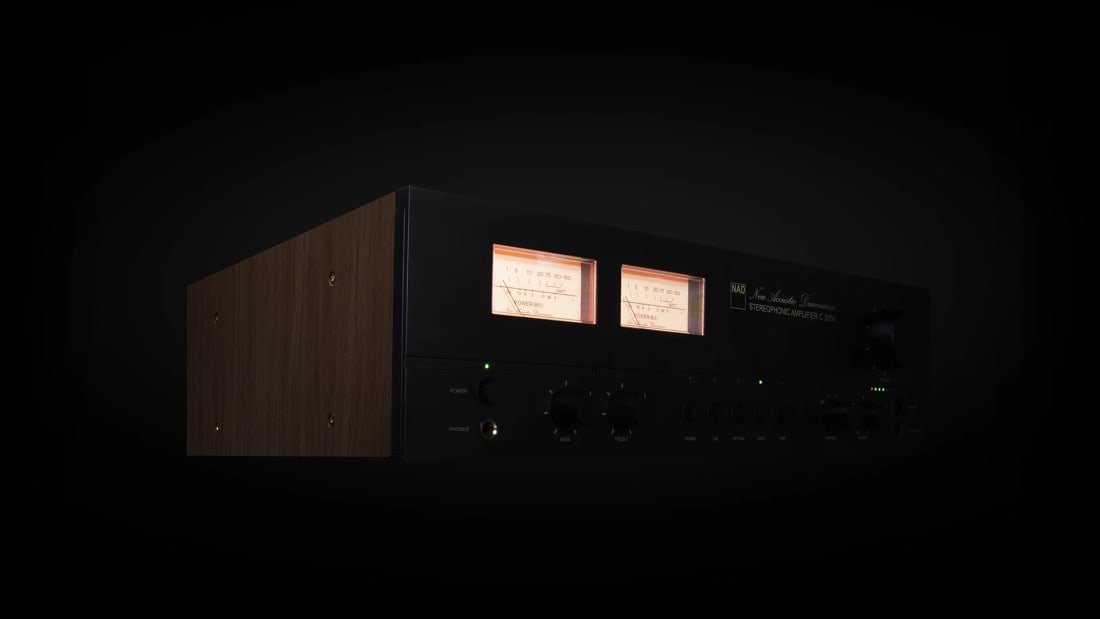
A reader emailed me last month with a spec sheet from a Chinese Class D module and asked, in genuine confusion, why a $180 amp claimed 0.0005% THD while the McIntosh MA352 sitting in my rack quotes something a full order of magnitude higher. Was the cheap amp actually better? The honest answer is no, and the reason why is basically the whole subject of this article.
Spec sheets are printed by marketing departments, not by the engineers who designed the circuit, and marketing departments know that a smaller THD number looks like a bigger win to a shopper scanning a table on a retailer's website. Some specs on that page tell you almost nothing useful. A couple of them, read properly, tell you quite a lot. I spent fifteen years on the design side of this industry before I started writing about it, and I still keep a folder of amplifier measurements I trust more than any glossy datasheet. Let's go through what's actually worth your attention.
THD: the number everyone quotes and almost nobody needs
Total harmonic distortion gets top billing on every amplifier box because it's a single, tidy figure that implies precision. The trouble is that below roughly 0.1%, THD stops correlating with anything you can hear in a blind comparison. Modern solid-state amplifiers, even mid-priced ones like the Cambridge Audio CXA81 MkII or the Rega Brio Mk7, comfortably clear that threshold. Going from 0.01% to 0.001% is not nothing from an engineering standpoint, but it's very unlikely to be audible in your lounge room, and manufacturers know a smaller number sells.
What THD doesn't tell you is the harmonic profile. Second and third harmonic distortion, which valve amps tend to produce more of, is perceived very differently to the higher-order harmonics that some solid-state and Class D designs generate under stress. A valve amp with "worse" THD on paper can sound more musical to plenty of listeners because the added harmonics are ones our ears associate with warmth rather than harshness. This is exactly why Priya's world and mine don't always align, and honestly, that's fine. The number alone can't tell you which amp you'll prefer; it can only tell you how linear the circuit is at a specific, usually very polite, test condition — 1kHz, moderate power, resistive load. Real music and real speakers rarely stay that well behaved.
Damping factor: overstated, but not meaningless
I've written elsewhere about what damping factor and output impedance actually do at the speaker terminal — worth a read if you want the full derivation — but the short version bears repeating because it's one of the most misunderstood numbers on any spec sheet. Damping factor describes how tightly an amplifier can control a woofer's cone motion once the signal stops, by absorbing the back-EMF the driver generates. A number of 100 versus 400 makes essentially no audible difference; a number of 20 versus 100 might, particularly on a speaker with a lively low-frequency alignment.
Where this actually matters is valve amplifiers, which typically have much higher output impedance than solid-state designs and therefore lower damping factor by an order of magnitude or more. That's not automatically bad — it interacts with your speaker's own impedance curve in ways that can sound quite pleasant on some pairings and loose on others. It's one reason valve-speaker matching is its own discipline rather than a simple spec lookup. Past a damping factor of about 20, for most domestic speaker loads, I'd argue you're chasing a number rather than a sound. Read the amplifier and speaker specifications together for /guides/loudspeaker-sensitivity-and-amplifier-matching and you'll get further than reading either in isolation.
Slew rate: mostly a non-issue today
Slew rate measures how fast an amplifier's output voltage can change, and it used to be a genuine limitation in early solid-state designs from the 1970s, where slow op-amp stages produced audible slew-induced distortion on fast transients. These days, with modern devices, a competently designed amplifier from any of the three main topologies has slew rate to spare for anything a loudspeaker or your ears will ever need. I'd treat a slew rate figure on a current amplifier's spec sheet as background information rather than a decision point — it's there because it fills a line on the datasheet, not because it's differentiating.
Where topology genuinely changes the story
This is the part the spec sheet can't show you at all: how the number holds up as load and signal actually vary. A THD figure measured at 1kHz into 8 ohms tells you almost nothing about how that same amplifier behaves at 20Hz into a speaker's 3-ohm impedance minimum, which is exactly where most amplifiers start to struggle and where the published spec quietly stops applying. I covered this in more detail in amplifier topology and speaker impedance dips, but the practical takeaway is that Class D amplifiers, valve amplifiers and solid-state amplifiers each degrade differently as the load gets difficult, and no single number captures that.
Class D amps have genuinely closed the gap on measured performance — I've said as much before, and I stand by it — but the output filter interacting with a speaker's impedance curve can still shift frequency response by fractions of a dB in ways a resistive-load THD figure will never show you. Valve amps, with their output transformers, are even more load-dependent; the same amp can sound noticeably different driving a Wharfedale Diamond 12.1 versus a Focal Kanta No.2 purely because of how each speaker's impedance curve interacts with the transformer's characteristics. Solid-state designs from the likes of the Marantz Model 40n tend to be the most load-agnostic of the three, which is one reason I default to recommending solid-state for readers who haven't settled on speakers yet.
The measurements I actually trust
If I'm assessing an amplifier properly, I want to see THD+N plotted against frequency and against power, not a single number at one operating point. I want an output impedance sweep across the audio band, because a flat curve behaves very differently to one that rises at the frequency extremes. And I want frequency response measured into a real speaker load, or at minimum a simulated impedance curve, not just 8 ohms resistive.
Publications like Stereophile and the engineering write-ups on Audio Science Review do this properly, with full THD-versus-power sweeps and impedance-interaction plots, and I'd trust either of those over a manufacturer's one-line datasheet claim every time. If you want the primary reference on how these measurements are meant to be taken, the AES has published standards on amplifier measurement methodology for exactly this reason — because a single number, measured under ideal conditions, can be made to say almost anything.
What this means for actually choosing an amplifier
None of this is an argument for ignoring specifications altogether — I'd never suggest that, and anyone who tells you specs don't matter at all is usually selling something with none. It's an argument for reading past the headline number on the box. A damping factor of 40 is fine. A THD figure under 0.1% at rated power is fine. Beyond those thresholds, for most amplifiers paired with most sensible domestic speakers, you're picking based on features, build, and how the amp behaves at the harder end of a speaker's impedance curve, not based on decimal places nobody will hear.
My honest recommendation, if you're shopping right now, is to spend less time on the spec sheet and more time checking that the amplifier's power output comfortably matches your speaker's sensitivity and impedance minimum — that's covered properly in watts on paper vs watts that matter — and more time again on an actual listen with your own speakers if you can arrange it. Integrated amps like the ones in our best integrated amplifiers guide vary more in character than their spec sheets would suggest, and that's not a flaw in the measurement process, it's just a reminder of what measurement can and can't tell you.
A small confession
I'll admit something that sits slightly against type for someone who trusts a graph over an anecdote: I've had amplifiers on the test bench that measured essentially identically and still left me reaching for one over the other, repeatedly, over weeks. That's usually down to something the standard test suite doesn't probe — output stage behaviour into reactive loads, or thermal drift over a long listening session, things that don't show up in a five-minute bench sweep at room temperature. It's a small admission but it's the honest one. The measurement gets you 90% of the way to a sound decision. The last 10% still wants ears, ideally your own, in your own room, with your own speakers.
The number on the box isn't lying to you, exactly. It's just answering a much narrower question than the one you're actually asking.
— Marcus Vale, Editor — Electronics & Measurement
Common questions
- Is a lower THD figure always better when comparing amplifiers?
- Not once you're below about 0.1%. At that point THD stops correlating reliably with what you'll hear, and the harmonic profile — not just the total figure — matters more than the headline number.
- Does damping factor matter for bookshelf speakers?
- Less than for large floorstanders with demanding bass alignments, but it's not irrelevant. Past a damping factor of roughly 20 for most domestic loads, further increases are unlikely to be audible.
- Why do valve amps have lower damping factor than solid-state amps?
- Valve amplifiers use an output transformer and typically run higher output impedance than solid-state designs, which reduces damping factor by design rather than by flaw. It's a tradeoff, not a defect.
- Should I ignore spec sheets entirely when buying an amplifier?
- No — a competent THD figure under load and a sensible damping factor are still useful sanity checks. The mistake is treating small differences beyond sensible thresholds as meaningful when they generally aren't.

I'm Marcus, and I'll be honest up front: I trust a measurement before I trust my own ears, because my ears lie to me daily. I spent fifteen years designing audio electronics before I started writing about them, so when a brand tells me a number, I want to see the graph. That doesn't make me cold about this hobby — I love a system that disappears as much as anyone — it just means I'll tell you when an expensive box is selling you confidence rather than performance.
Former audio electronics engineer; objectivist; runs the test bench
More from Marcus Vale
 Why your turntable's earth wire isn't optionalTurntable earthing fixes most phono hum problems. Here's how grounding actually works, why it fails, and how to track down a noisy connection.
 Why your AVR runs cool on music but throttles on AtmosAVR thermal throttling explained: why nine-channel Atmos mixes push receivers into protection mode that two-channel music never triggers.
- Subwoofer delay settings: why your AVR's number is a guessAVR auto-calibration estimates subwoofer delay from distance, not timing. Here's how to measure and correct it properly for tighter bass.
- AVR auto-calibration: what Audyssey, YPAO and Dirac actually measureAudyssey, YPAO and Dirac Live all run a mic sweep and spit out numbers, but they're not measuring the same things or fixing the same problems. Here's what's actually happening.
- Cartridge break-in: what actually changes in the first 40 hoursDoes a new cartridge really need 40 hours to "open up"? I measured one to find out what's mechanical fact and what's audiophile folklore.
- DAC output stages: what the chip doesn't tell youThe DAC chip gets all the marketing attention, but the analogue output stage after it does most of the work shaping what you actually hear.