Height channel placement: why most Atmos ceilings underperform
I sat in a client's theatre room in Brisbane last year — my colleague Jonno had actually done the install, and asked me to come listen because something felt "flat" to the owner despite a full 7.2.4 Atmos rig. Four ceiling speakers, decent AVR, room acoustically treated. On paper it should have sung. Rain effects in the demo scene sounded like they were coming from somewhere vaguely above and behind, never precisely overhead, never moving convincingly across the ceiling plane. The fix wasn't a new speaker. It was moving two height modules about 40 centimetres and re-angling the other two. That's the whole article, really, but let's get into why it matters and how to actually do it.
Height channel placement is the part of Atmos setup that gets the least attention and causes the most disappointment. Everyone obsesses over subwoofer count and screen size, and rightly so to a point, but the overhead layer is where Atmos either delivers something genuinely new or just adds diffuse noise from above that never resolves into discrete, locatable sound. I've heard more rooms get this wrong than right, and it's almost always geometry, not gear.
What Dolby's spec actually says versus what installers do
Dolby publishes fairly specific placement guidance for Atmos height speakers, whether you're running in-ceiling modules, up-firing add-on modules bounced off the ceiling, or dedicated height speakers on the front and rear walls. For a four-speaker overhead layer, the guidance centres on placing the front pair roughly 30 to 45 degrees forward of the main listening position (measured from directly overhead) and the rear pair a similar angle behind it, both pairs spaced symmetrically either side of the centreline. Dolby's own Atmos home installation guidelines lay this out with the trigonometry included, which is worth reading if you're doing this yourself rather than trusting a tape measure and a guess.
What actually happens in most installs is different. Ceiling joists dictate placement more than acoustic theory does. An installer finds a joist bay that's close enough, cuts the hole, and moves on. I understand why — retrofitting a hole in the wrong spot in a plastered ceiling is a real cost, and joist spacing under the standard truss layouts used in most Australian project homes doesn't always cooperate with Dolby's ideal angles. But "close enough" compounds. Get all four height speakers slightly wrong in the same direction and the overhead field collapses toward one axis. Objects that should pan smoothly overhead instead jump or smear.
The angle that matters more than the count
If you take one thing from this, take this: the angle from your ear to the speaker matters more than how many height speakers you own. A four-speaker overhead array with correct geometry will convincingly outperform a poorly-placed six or eight speaker layout, and I say this having sat through both in the same week doing a comparison for another client.
The reason is simple psychoacoustics. Our ability to localise sound above and behind the head is genuinely poor compared with our horizontal localisation — it's why film sound designers use height channels for atmosphere and transient effects rather than dialogue-critical information. But poor localisation ability doesn't mean no localisation ability. When height speakers sit at roughly the angles Dolby specifies, your brain gets just enough directional cue to place effects convincingly. When they're bunched too close to directly overhead, or spread too wide toward the side walls, that cue collapses into vague diffuseness. It stops sounding like rain moving across a ceiling and starts sounding like a hiss coming from "up there somewhere."
This is also why up-firing modules — the add-on boxes that sit on top of your existing front and surround speakers and bounce sound off a flat ceiling — are such a mixed bag. They can work reasonably well in rooms with a flat, hard, reasonably low ceiling and no acoustic treatment directly above the reflection point. Put the same module under a raked ceiling, or a ceiling with exposed beams, or acoustic tile, and the reflected sound arrives smeared, deadened, or aimed at entirely the wrong spot. If you're building a room from scratch, in-ceiling speakers at the correct calculated angle beat up-firing modules in nearly every case I've measured. If you're renting, or can't cut holes, up-firers are a reasonable compromise but worth setting expectations around.
Working out your own angles without a CEDIA calculator
You don't need Jonno's install software to get close. Sit in your main listening position and measure the height from your ear level to the ceiling — call it H. Then measure the horizontal distance from directly overhead your seat to where you want the front height pair. For a 30-degree angle forward of overhead, that horizontal distance should be roughly H multiplied by 0.58 (that's the tangent of 30 degrees). For 45 degrees, it's roughly equal to H. Do the same measurement backward for the rear pair. It sounds fiddly with a tape measure and a phone calculator, but it takes about ten minutes and it's the single highest-value ten minutes in the whole install.
Left-right spacing matters too, and this is where a lot of rooms go wrong even when the front-back angle is right. Dolby recommends keeping the height pair spaced similarly to your main left-right speaker spread, not pushed out toward the side walls. I've seen rooms where the ceiling speakers ended up almost directly above the surround speakers on the side walls because that's where the joist bay happened to be. It looks tidy on the ceiling plan. It sounds wrong, because the overhead image gets pulled toward the sides instead of sitting centred above the seating position where object-based panning actually needs it.
Room correction won't fix a placement problem
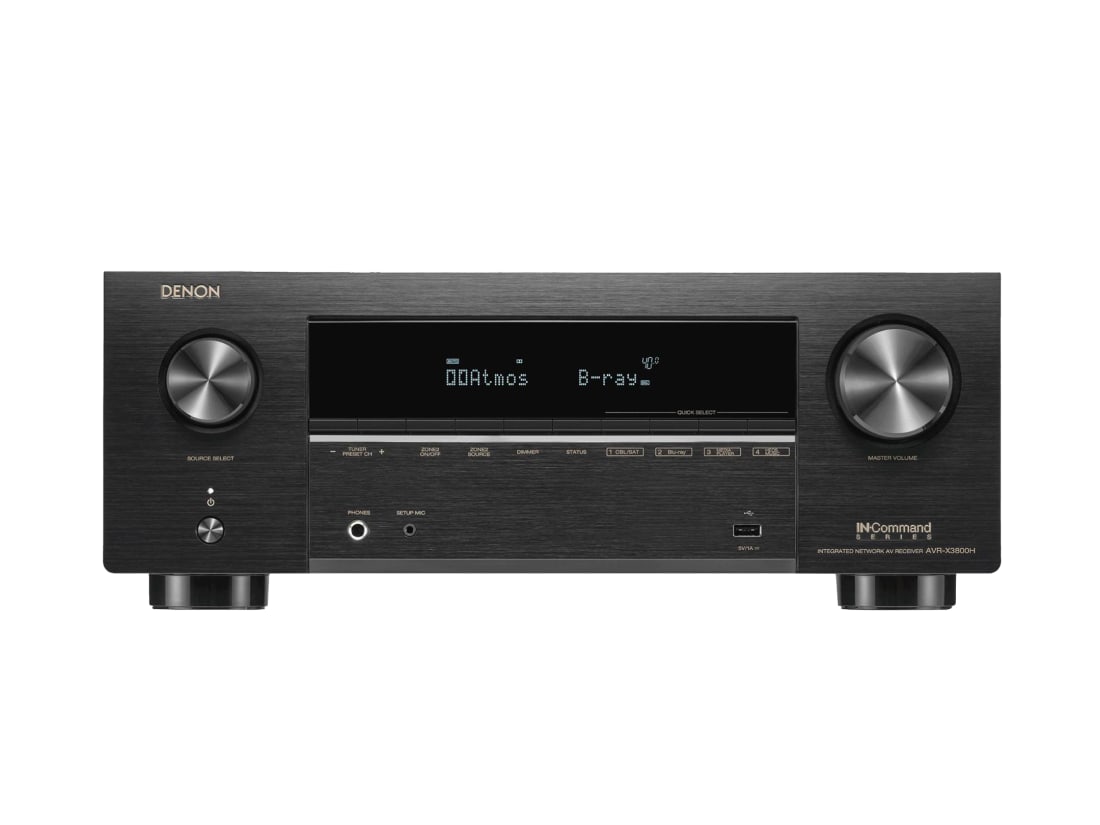
This is worth being blunt about, because I still get asked whether Audyssey, Dirac, or the AVR's built-in room EQ can compensate for height speakers in the wrong spot. It can't, not for this. Room correction adjusts level, delay, and some frequency response smoothing based on where the microphone measured the room. It has no way of moving a speaker's physical angle relative to your ears — that's geometry, and geometry is fixed once the speaker's mounted. A good processor like the one in the Denon AVR-X3800H (check price) will time-align and level-match your height channels beautifully. It will not un-collapse an overhead image that's fundamentally aimed at the wrong angle. This is the same distinction I keep coming back to with room correction versus room treatment generally — DSP fixes what a microphone can measure, not what a tape measure should have caught first.
AVR channel count versus processor flexibility
Getting height channels right also interacts with how you're driving them. Most mid-range AVRs, the Denon AVR-X3800H among them, give you 4 height channel outputs with reasonable flexibility on assignment, but check the manual before assuming your model supports the specific configuration you want — front heights, rear heights, or top-middle placement, since not every AVR supports every layout Dolby has defined. If you're building toward a genuine statement theatre with more than four height channels, or want independent bass management and channel assignment that a receiver's menu system doesn't give you, that's when a separate processor and outboard amplification start making sense over an all-in-one AVR — a topic that comes up constantly when I talk to Jonno about bigger commercial builds, and one we've covered in more depth elsewhere on site.
For most home theatres, though, a good AVR is plenty of processing grunt. The bottleneck is almost never the electronics. It's the four holes in the ceiling.
What this means if you're planning a build
If you're at the planning stage — reading our guide to building a home cinema before committing to a layout — get the height speaker geometry into the plan before the frame stage, not after the plaster's up. It costs nothing to plan joist positions around Dolby's recommended angles if you're doing it during a build or renovation. It costs a genuine argument with your builder if you're doing it after. I'd rather see someone spend an extra afternoon with a tape measure and a spirit level getting four holes in the right spot than spend the same money on a fifth height speaker to paper over bad placement. That's a slightly unpopular opinion in an industry that likes to sell more speakers, but I've sat in enough rooms now to stand by it.
None of this is exotic. It's trigonometry, a tape measure, and the discipline to fight the joist layout instead of surrendering to it. Get the angles right and Dolby Atmos does something genuinely different from bolted-on surround. Get it wrong and you've spent real money on speakers that add noise from above instead of sound that moves.
Common questions
- Can I mix in-ceiling height speakers with up-firing modules in the same room?
- You can, but I wouldn't recommend it for the main four-speaker overhead layer. The two approaches produce different reflection and localisation characteristics, and mixing them tends to create an asymmetric overhead image where one side sounds more precise than the other. If budget only allows two proper in-ceiling speakers now, prioritise the front height pair and add rears later rather than mixing types front to back.
- Do height speaker angles change for a 5.1.2 versus 7.1.4 layout?
- The underlying angle guidance from Dolby stays consistent, but a 5.1.2 layout only has one height pair to place, which Dolby generally recommends positioning roughly overhead or slightly forward of the listening position rather than splitting front and rear. Once you move to four height channels, you split them into front and rear pairs, each angled further forward or behind the listening position.
- Is it worth cutting new holes in an existing ceiling to fix bad height placement, or should I just live with it?
- It depends how far off the current placement is and how much you paid for the system. If your height speakers are within about 10-15 degrees of ideal, room correction and careful level matching will get you most of the way there. If they're bunched near-overhead or pushed out toward side walls, the overhead effect is probably collapsing enough that a reposition is worth the plaster repair, especially if you're not going to move house any time soon.

I'm Eleanor — most people call me Nell. I came to this from the studio side, so I spend more time with headphones on my head than speakers in a room, and I've learned to hear the difference between detail and brightness pretending to be detail. I'm obsessive about fit and comfort, because the best-sounding headphone in the world is useless if it's clamping your skull after twenty minutes. I review everything from $200 daily-drivers to silly flagship planars.
Mastering-adjacent background; IEM and open-back specialist
More from Eleanor Shaw
 Why your headphone chair and desk still need bass trappingClosed headphones don't escape room modes. Here's why bass trapping near your desk changes what you feel through the chair and the leakage you hear.
 Why your headphone desk needs a sub (and how to set it up)A subwoofer under the desk can fix what headphones can't do: chest-felt bass. Here's how to add one without wrecking your headphone sound.
- Dongle DACs vs desktop DACs: when the small one is actually enoughDongle DACs have closed the gap on desktop units for most headphones. Here's where the small ones genuinely hold up, and where they don't.
- Bluetooth codecs and multiroom: why your headphones sound different on Wi-FiWhy the same headphones sound different depending on whether they're fed over Bluetooth, AirPlay or a multiroom app — and how to get the best signal path at your desk.
 Cartridge tracking force: why "close enough" costs you detailTracking force outside the maker's range doesn't just risk your records — it quietly wrecks the detail and channel balance you paid for. Here's how to get it right.
- Streaming to headphones: getting multiroom apps to actually feed your DACMultiroom apps are built for speakers in rooms, not headphones at a desk. Here's how to get Spotify Connect, AirPlay and Roon actually feeding your DAC properly.