Ortofon's MC Vertex: a solid-diamond cantilever arrives at the top of the range
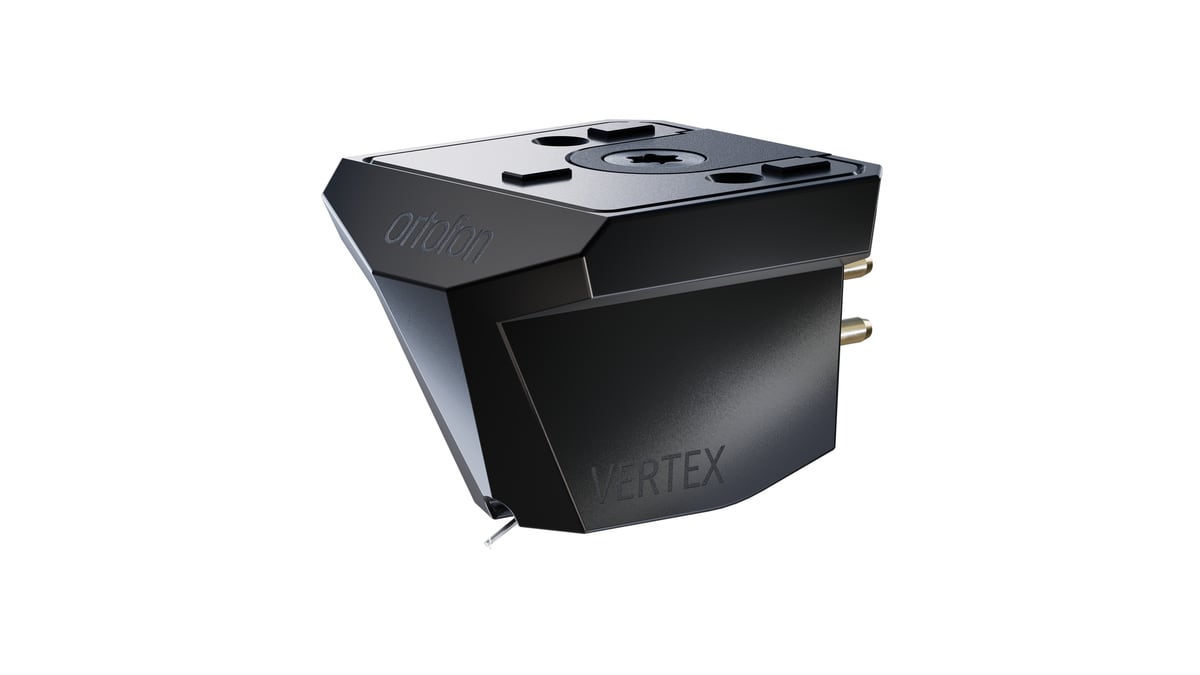
Something significant just happened in Vienna
There are moments in high-end audio where a manufacturer doesn't merely release a new product — they draw a line in the sand and declare this is where the state of the art now lives. Ortofon's announcement of the MC Vertex at High End Vienna on June 4, 2026 feels very much like one of those moments. The Danish cartridge maker, a company whose history with the moving-coil format stretches back further than most of us have been alive, has placed its most technically ambitious MC cartridge ever at the summit of its Exclusive Series. Alongside it comes a new MC X model, broadening the range in a different direction, but it's the Vertex that commands attention. Priced at around US$16,999 — or £12,999 in the UK and EUR 14,999 including VAT in Europe — this is a cartridge that makes a very deliberate statement about what Ortofon believes is now achievable in vinyl playback.
For Australian enthusiasts, local pricing hasn't been formally confirmed at the time of writing, but given current exchange rates and typical AU import pricing structures, expect to be looking north of AU$26,000 to AU$28,000 by the time it lands here. That puts it in rarefied territory — the kind of purchase that demands you have everything else in your chain absolutely sorted, from your tonearm and turntable through to your phono stage. We'll come back to that.
What actually makes the MC Vertex different
Let's talk about what Ortofon has actually done here, because the engineering is worth understanding properly rather than glossing over with superlatives.
The solid diamond cantilever
The centrepiece of the MC Vertex is its solid diamond cantilever — and I want to dwell on this for a moment, because it's not the same thing as a diamond-coated cantilever, which is a technique that's been around for some time and is found across a range of premium cartridges. A solid diamond cantilever is machined, in its entirety, from a single piece of diamond material. Diamond has an extraordinarily high stiffness-to-mass ratio; it is, in practical terms, as close to a perfectly rigid transmission medium as we can currently manufacture for a cantilever application. The theoretical benefit is significant: when the stylus tip traces a groove modulation, you want that mechanical energy transmitted to the generator system with as little loss, resonance, or flexure in the cantilever itself as possible. Any compliance in the cantilever material introduces a degree of mechanical low-pass filtering and potential colouration. A solid diamond cantilever, ideally, gets out of the way and lets the groove geometry speak directly to the generator.
Ortofon has paired this with a newly developed diamond profile on the stylus tip itself. The specifics of the geometry haven't been disclosed in detail at launch, but the language around "newly developed" suggests this isn't a standard line-contact or even a Replicant 100 profile — both of which appear across other Ortofon models. A bespoke profile at this price tier implies optimisation specifically for the mechanical properties of the solid diamond cantilever, tuning the contact geometry to the compliance and resonant characteristics of the system as a whole. That's the kind of holistic engineering approach that separates truly reference-grade cartridges from those that are merely assembled from premium components.
Titanium structure and revised magnetic and damping systems
The MC Vertex employs a titanium body structure, which Ortofon says has been integral to the revised magnetic and damping systems that contribute to better groove tracing. Titanium is a material with well-understood acoustic properties in cartridge applications — it's rigid, relatively lightweight, and less prone to coloration than some other metals. The body of a cartridge isn't just a housing; it's a structural element that influences how vibrations are managed, both in terms of what gets transmitted to the tonearm and headshell, and what gets reflected back into the generator. Getting that structure right at a mechanical level matters enormously.
The mention of revised magnetic and damping systems is particularly interesting. In a moving-coil cartridge, the damping system — typically a rubber or elastomer element — controls the compliance of the cantilever suspension. At the extreme price tier Ortofon is targeting here, getting the damping characteristics correct is absolutely critical: too stiff and the cartridge loses the ability to track dynamic groove modulations accurately; too compliant and low-frequency control suffers, and the cartridge becomes sensitive to tonearm resonance issues. A revised damping system suggests Ortofon has done careful work to optimise this for the unique mechanical signature of a solid diamond cantilever — which, being stiffer and lighter than boron or aluminium alternatives, will have a different dynamic behaviour that the damping must compensate for.
The revised magnetic system, meanwhile, points toward further optimisation of the generator itself — the coil geometry, the magnet placement, or the gap topology. Moving-coil generators are extraordinarily sensitive to these parameters, and marginal improvements at this level of refinement can translate into meaningful differences in output linearity, channel separation, and high-frequency extension.
Context: where the Vertex sits in the broader landscape
Ortofon's Exclusive Series has long been home to the MC Anna Diamond — a cartridge that itself featured a diamond cantilever and set a high benchmark for what the Danish brand could achieve. The MC Vertex now tops that series, which is a significant internal statement. It's worth noting that Ortofon doesn't position new flagships lightly; the company has a long history of careful, methodical development rather than annual refresh cycles for the sake of marketing optics. When they say this is their most advanced MC cartridge ever, there's engineering substance behind that claim rather than mere promotional language.
The simultaneous launch of the MC X model alongside the Vertex is also worth noting, even if the MC X hasn't been the headline story. Adding a new model to the range at the same time as a flagship launch suggests a deliberate portfolio strategy — Ortofon appears to be reinforcing its serious MC credentials across multiple price points simultaneously, rather than simply planting a flag at the top and leaving the mid-range static.
Globally, the Vertex enters a market where competition at the extreme end of cartridge pricing is genuinely fierce. Names like Lyra, Koetsu, Air Tight, and DS Audio all compete for the attention of buyers at this level, each with their own engineering philosophies. The Vertex's solid diamond cantilever and bespoke stylus profile give Ortofon a technically distinct proposition — and Ortofon's scale and manufacturing depth mean that the engineering here has been developed with a rigour that smaller boutique makers sometimes can't match.
What the MC Vertex demands of your system
This is where I want to be genuinely useful for Australian readers considering the Vertex, or even just calibrating where it sits relative to their aspirations. A cartridge at this level is only as good as the system it operates in — and I mean that without any exaggeration.
Turntable and tonearm matching
A solid diamond cantilever is extremely stiff, which generally implies a relatively low compliance figure. That matters for tonearm matching: low-compliance cartridges pair best with medium-to-high-mass tonearms to achieve a combined resonant frequency in the optimal 8–12 Hz range. If you're running a vintage Japanese tonearm with a low effective mass, the Vertex may not be the right fit. If you're on a high-mass arm — a Graham Phantom, an SME V, a Kuzma 4Point — you're in much better territory. Getting this pairing right isn't optional at this price point; it's fundamental to whether the cartridge delivers what it's capable of.
The phono stage question
A cartridge of this calibre demands a phono stage that is absolutely up to the task. Moving-coil cartridges produce very low output signals that require significant gain — typically 60–70 dB for a low-output MC — and at this level of source resolution, any noise floor issues, harmonic distortion, or gain structure problems in the phono stage will be audible. This is not the time to be running a phono stage that cost one-tenth of the cartridge. You're looking at a dedicated, high-quality MC phono stage — the kind of component that deserves its own substantial budget. Understanding gain structure through your entire signal chain becomes non-negotiable here.
Impedance loading is another consideration. Most moving-coil cartridges respond to loading, and finding the optimal resistive load for the Vertex will likely require experimentation with a phono stage that offers variable loading. Too low a load and you can lose high-frequency air; too high and you can introduce brightness or edginess. With a newly developed generator system and a novel cantilever material, the optimal loading for the Vertex may differ from other Ortofon MC models — something to factor into system planning.
Downstream considerations
It almost goes without saying, but a cartridge at this price only makes sense in the context of a system that can reveal what it's doing. Soundstage and imaging precision is one of the areas where a truly resolved MC cartridge demonstrates its superiority over lesser alternatives — you hear not just more detail, but a more coherent, three-dimensional presentation of the recording space. Realising that requires loudspeakers, amplification, and room acoustics that aren't imposing their own limitations on the presentation. If your speakers are congesting the midrange or your room has untreated first-reflection issues, those are the bottlenecks to address first.
The Vertex in the Australian context
Australia's high-end vinyl community is genuinely vibrant, and perhaps more so than casual observers might expect. There are serious collectors and system builders in Sydney, Melbourne, Brisbane and beyond who are operating at this tier of investment, and who travel to shows like High End Munich — and now Vienna — specifically to hear what's coming next. The Vertex will land in that community with considerable interest.
The practical challenge for Australian buyers, as always, is audition access. Cartridges of this calibre need to be heard in a controlled environment on a properly matched system to be properly evaluated — a brief listen at a dealer demo is useful, but ideally you want extended time with a setup that mirrors your own. That's difficult to arrange for a product this new, and it underscores the importance of working with Australian specialist dealers who have both the turntable infrastructure and the technical knowledge to set up a cartridge like the Vertex correctly. A cartridge at this price, set up incorrectly, will be a disappointment regardless of its engineering pedigree. Set up correctly, it should be revelatory.
It's also worth noting that the Vertex arrives at a moment when the Australian vinyl market is in rude health. Record pressing quality has improved meaningfully over the past few years, and there is a broader cultural moment around analogue playback that has brought new listeners into the fold alongside dedicated long-term enthusiasts. For those who have been building serious analogue systems over years or decades, a product like the MC Vertex represents a genuine advancement of the art — the kind of engineering development that makes the next level of playback quality accessible, at whatever investment that demands.
A note on the broader category
I've been writing about vinyl playback for long enough to have seen a number of claimed "revolutions" in cartridge technology that turned out to be incremental at best. The MC Vertex feels different, because the solid diamond cantilever is a genuine materials engineering step rather than a marketing refinement. The use of solid diamond as a cantilever material has been the subject of research and limited application for years, but achieving it at scale in a production cartridge with the level of consistency and quality control that Ortofon's manufacturing process demands is a meaningful accomplishment.
Whether it translates to a listening experience that justifies the investment over an already exceptional cartridge — like Ortofon's own MC Anna Diamond — is something that will only be answered by extended comparative listening. But the engineering rationale is sound, the company has the pedigree to execute on it, and the launch at High End Vienna signals that this is a product Ortofon has committed to fully rather than releasing tentatively. I'll be seeking out an Australian audition as soon as one becomes available, and I'll report back with ears-on impressions.
For now, if you're in the market at this level, the MC Vertex should absolutely be on your radar. And if you're earlier in your vinyl journey — perhaps working with something like a Rega Planar 3 (check price) and building toward a more serious system — products like the Vertex are worth knowing about, because they define the direction in which the technology is moving and inform what to aspire to as your system evolves.
Common questions
- What is a solid diamond cantilever and why does it matter in the Ortofon MC Vertex?
- A solid diamond cantilever is machined entirely from diamond material, as opposed to a diamond-coated cantilever where another material (typically boron or aluminium) is coated with a diamond layer. Because diamond has an exceptionally high stiffness-to-mass ratio, a solid diamond cantilever transmits groove modulations to the generator with minimal flexure or mechanical loss. In the MC Vertex, Ortofon pairs this with a newly developed diamond stylus profile specifically optimised for the mechanical characteristics of the solid diamond cantilever, making the system more coherent than simply swapping in a premium cantilever material.
- What kind of phono stage do you need to run the Ortofon MC Vertex?
- The MC Vertex is a low-output moving-coil cartridge and requires a phono stage capable of providing significant MC gain — typically in the 60–70 dB range — with a very low noise floor. At this price tier, only a dedicated, high-quality MC phono stage is appropriate. Variable impedance loading is strongly recommended, as the optimal load for the Vertex may differ from other MC cartridges given its novel cantilever and generator design. Matching the phono stage budget to the cartridge investment is essential; a phono stage that can't resolve what the Vertex is doing will be the limiting factor in the system.
- What is the Australian price of the Ortofon MC Vertex?
- Ortofon has not officially confirmed Australian pricing at the time of launch. The international pricing is approximately US$16,999, £12,999, and EUR 14,999 including VAT. Based on current exchange rates and typical Australian import pricing structures, expect local retail pricing in the AU$26,000–$28,000 range, though this will depend on the official Australian distributor's pricing when it is confirmed. Contact Ortofon's Australian distributor directly for the most current information.
- How does the Ortofon MC Vertex compare to the MC Anna Diamond?
- Both the MC Anna Diamond and the MC Vertex sit in Ortofon's Exclusive Series and both employ diamond cantilever technology, but the MC Vertex now tops the series as Ortofon's most technically advanced moving-coil cartridge ever. The Vertex features a newly developed diamond profile on its solid diamond cantilever, alongside a revised titanium structure and updated magnetic and damping systems that Ortofon says deliver improved groove tracing. The MC Anna Diamond remains a highly regarded cartridge, but the Vertex represents a further engineering step in every key area of the design.

Hello — I'm Priya. I ran a second-hand record shop in Fitzroy for the better part of a decade, which is a polite way of saying I have three thousand records and nowhere to put them. I listen to vinyl through valve amplification because I like the ritual as much as the sound, and yes, I know the measurements aren't perfect — I don't care, and I'll explain why on the page. If you want someone to tell you a turntable is "just a motor and a bearing," I am not your person.
Record collector (3,000+); valve-amp enthusiast; ex record-shop owner
More from Priya Anand
 Audio Note marks 35 years of the Oto with a refreshed SE 35 anniversary editionAudio Note (UK) debuts the Oto SE 35 at £5,950/$5,950 — the first major technical refresh of its beloved EL84 integrated in decades.
 McIntosh returns to all-tube integrateds with the $15,000 MA2375McIntosh's MA2375 is its first all-valve integrated in over a decade — 75 watts per channel, pure analogue, with phono and headphone stages built in.
 Audio-Technica's AT-MCD1 flagship cartridge debuts with a one-piece diamond stylus and cantileverAudio-Technica's AT-MCD1 arrives June 4, 2026, with a unified CVD diamond cantilever-and-stylus and dual moving-coil design at US$11,000.
 US vinyl revenue breaks $1 billion for the first time — and what it means for Australian record buyersThe RIAA confirmed US vinyl hit $1.04 billion in 2025 — its 19th straight year of growth. We look at what the milestone means for AU buyers.
 Australia posts a seventh straight year of growth, with vinyl up againARIA's 2025 figures confirm seven consecutive years of growth for Australian recorded music, with vinyl revenue rising 4.1% to A$46.3 million.
 UK Vinyl Hits a 30-Year High as the Recorded-Music Market Tops £1.5 BillionBPI data shows UK vinyl revenue surged 19.9% to £174.7m in 2025 — the highest in over 30 years. What does it mean for Australian enthusiasts?