Bowers & Wilkins 801 D5: the new $65,000 flagship that reinvents an audiophile icon
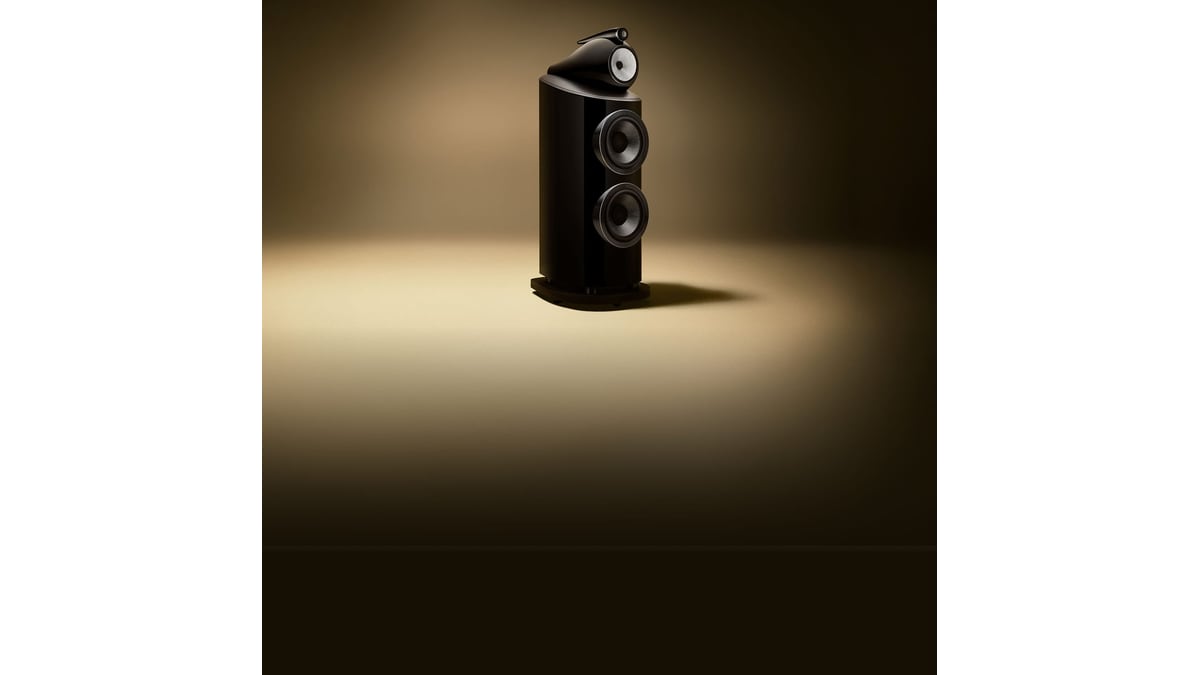
A new chapter for one of audio's most consequential loudspeakers
There are perhaps a handful of loudspeaker bloodlines that genuinely define eras in high-end audio. The Bowers & Wilkins 800 Series is one of them. Since the original 801 entered service in 1979 — appearing in Abbey Road Studios and subsequently becoming a reference tool in recording facilities across the world — each generational update has been a genuine event, not merely a product launch. So when B&W pulled the covers off the 801 D5 at High End Vienna on 4 June 2026, announcing Australian pricing at $65,000 per pair and a sales start date of 6 September 2026, the room paid attention. So did I.
This is the fifth-generation Diamond iteration of the 801, and it arrives as the flagship of an entirely refreshed seven-model D5 range that spans from the 805 D5 standmount at the entry point through to this statement floorstander. A complete family refresh of this scope doesn't happen casually at B&W. The engineering investment is substantial, the expectations from a global community of existing 800 Series owners are enormous, and the competitive landscape has never been more ferocious. At $65,000 a pair, the 801 D5 enters a rarefied tier where it contends with the finest floorstanders Europe, the United States and Japan can produce. Whether it earns its position there is a question only extended listening will answer definitively — but the architecture B&W has described gives us more than enough to unpack.
What's actually new: cabinet, drivers, crossover
B&W has identified three principal pillars of change in the 801 D5: a revised Diamond Dome tweeter, a new cabinet architecture, and an upgraded crossover. Let's take each in turn, because the details — even the high-level details we have at this point — illuminate where the engineering focus has been directed.
The Diamond Dome tweeter, fifth iteration
The diamond tweeter has been B&W's calling card since the D1 generation arrived in 2005. Synthetic diamond — grown through chemical vapour deposition — has a combination of stiffness-to-mass ratio and internal damping that no conventional tweeter dome material can approach. The first breakup mode of a B&W diamond dome sits well above 70kHz, which means the tweeter is behaving as a near-perfect piston across the entire audible range and well into ultrasonic territory. In practice, this translates to a top-end resolution and spatial specificity that remains, in my experience, among the most immediately identifiable sonic signatures in high-end audio.
The D5 revision to this driver is described as revised rather than entirely reconceived, which suggests B&W's engineers have been refining the motor system, the surround geometry, or both, rather than discarding what already works exceptionally well. Given that the D4 diamond tweeter was already formidable — I spent considerable time with D4-generation 803s and 804s at various points and the treble presentation is consistently among the most articulate available — any meaningful improvement here will be audible to serious listeners. Whether those improvements manifest as lower colouration, better integration with the midrange, or extended dynamic headroom at high listening levels is something we'll need to establish through direct listening sessions ahead of the September release.
Cabinet architecture: the harder engineering problem
Cabinet resonance management is, in my view, the less glamorous but arguably more consequential engineering discipline in loudspeaker design. Driver technology gets the headlines; cabinet work determines whether those drivers can actually perform as intended under real-world conditions. The 800 Series has long employed sophisticated cabinet engineering — the Matrix internal bracing structure that dates to the 1980s remains one of the most rigorous approaches to resonance control in production loudspeakers — and the D5 generation brings a new cabinet architecture to the flagship.
The details of exactly how the new architecture differs from the D4 will emerge in the coming weeks as B&W releases fuller technical documentation, but the category of change is significant. Cabinet architecture in a three-way design of this complexity encompasses the enclosure geometry for the bass section, the isolated midrange housing (B&W's 'Turbine Head' or equivalent midrange decoupling approach has been a feature of the 800 Series for several generations), and the structural integration of the tweeter assembly. Changes in any of these areas can produce meaningful sonic consequences: tighter, better-defined bass; a more coherent midrange that is better isolated from low-frequency cabinet excitation; and a treble presentation that benefits from a mechanically quieter environment.
For Australian buyers considering placement in typical domestic listening rooms — often rectangular, sometimes with parallel hard surfaces and limited acoustic treatment — the way a speaker manages cabinet-borne resonances is not a marginal concern. It is one of the primary variables that separates a speaker that sounds magnificent in an acoustically managed showroom from one that sounds magnificent in your home as well. If the new cabinet architecture reduces colouration under real-world conditions, that is an immediately practical benefit, not merely a specification improvement. If you haven't yet addressed your room's acoustics, it's worth understanding the fundamentals of acoustic treatment before committing to any statement-level investment.
The crossover: where everything meets
An upgraded crossover is the third pillar of the D5 revision, and in some respects it's the most technically intricate to evaluate from the outside. A crossover network in a three-way loudspeaker of this calibre is not simply a collection of passive components — it's a precision filter network that determines how signal energy is distributed between the bass, midrange and tweeter sections, how the drive units integrate in phase and magnitude across the crossover frequencies, and ultimately how coherent and seamless the combined radiation pattern appears to a listener in the room.
At $65,000 per pair, the components specified in a crossover network are not cost-constrained. What the engineers are optimising at this level is the electrical and acoustic interaction between the filter network and the revised drivers — a relationship that must be tuned anew whenever either the drivers or the cabinet geometry changes. The combination of a revised tweeter and new cabinet architecture almost certainly necessitated a comprehensive crossover redesign rather than incremental adjustment, which is consistent with B&W describing it as 'upgraded' rather than 'refined.' Understanding the relationship between crossover design and overall impedance behaviour is also relevant here — a well-designed crossover will present a load to an amplifier that is both more predictable and more benign, and that has direct implications for amplifier matching.
The D5 family in context
The 801 D5 does not arrive alone. It is the statement product within a seven-model range that begins with the 805 D5 — B&W's celebrated two-way standmount, long considered one of the finest monitors in its category and a frequent reference tool in serious two-channel systems. Between the 805 D5 and the 801 D5 sit five additional models, covering standmount and floorstander formats at varying price points and room-size suitabilities.
This matters for a few reasons. First, it means that the core technologies developed for the 801 D5 will filter down through the range to varying degrees — a situation that historically has made certain mid-range 800 Series models extraordinary value propositions relative to the engineering effort they embody. Second, it means that Australian dealers will be building out complete D5 demonstration capabilities from September onwards, which creates genuine listening opportunities at multiple price points. For anyone currently considering an 800 Series purchase and wondering whether to move now or wait, the answer is almost certainly to wait: the D4 generation will likely see pricing adjustments as D5 stock begins to arrive, and the demonstrable sonic differences between generations may or may not justify the price premium for your particular priorities.
It's also worth noting where the 801 D5 sits globally. At £43,000 in the UK and €50,000 in Europe, the $65,000 Australian price represents a premium over the raw currency conversion — not unusual for the Australian high-end market given logistics, local support infrastructure and relatively modest volume — but it places the 801 D5 within the expected range for statement-level European loudspeakers in this country. Comparable products from Focal, Wilson Audio, Magico and Sonus faber occupy similar or higher price territory in Australia.
Amplifier matching: the question every potential buyer must confront
A $65,000 loudspeaker demands a commensurate source and amplification chain. This is not a snobbish observation; it's a practical one. The 801 D5's resolution ceiling will expose weaknesses in upstream components with a clarity that more forgiving speakers would obscure. The question of what to drive them with is therefore immediate and serious.
B&W's 800 Series has historically maintained relationships with amplifier manufacturers including Classe, Rotel and McIntosh, and the D5 generation is likely to see similar partnership demonstrations at launch events. But the 801 D5 is ultimately format-agnostic: it will respond to a well-implemented solid-state design as readily as to a powerful valve amplifier, provided the amplifier has sufficient current delivery to control the bass section authoritatively. The sensitivity and impedance characteristics of the D5 will be critical data points for matching purposes, and we'll be pursuing those specifications from B&W ahead of the September release.
For the complete digital front end, understanding what your source components are doing — particularly in terms of soundstage and imaging resolution — becomes acutely relevant at this level. The 801 D5's spatial resolution will illuminate everything from the quality of your DAC's output stage to the jitter performance of your network streamer. If your front end is not at a comparable level of refinement, the full potential of these speakers will remain partially unrealised.
High End Vienna: the context of the launch
The choice of High End Vienna as the reveal venue is interesting and worth a moment's consideration. High End Munich has traditionally been the primary European launch event for statement products of this significance — it is larger, more established, and draws a global press contingent. Vienna, while a serious event in its own right, represents a somewhat different audience and atmosphere: perhaps more intimate, more focused on the European luxury market, and with a slightly different roster of attendees.
Whether B&W's choice of Vienna over Munich for the 801 D5 reveal reflects scheduling considerations, a deliberate strategy to create a more exclusive unveiling environment, or simply the pragmatics of having the product ready at a particular moment, I cannot say definitively. What I can say is that the European high-end market — particularly the UK, Germany, Austria and the Benelux region — remains critically important to B&W commercially, and a Vienna reveal is not a soft launch. It is a genuine statement of intent to the European trade and press community.
What Australian buyers should do right now
The 801 D5 goes on sale 6 September 2026, and if you are seriously considering a pair, there are several practical steps worth taking between now and then.
- Contact your B&W dealer now. Allocations for statement-level products of this nature can be limited in the initial production run, and expressing serious intent early is not merely performative — it can determine whether you receive a pair in September or in Q1 2027.
- Audit your amplification and source. If you are currently running equipment that may not be at the level required to partner the 801 D5, now is the time to begin that evaluation process. A speaker of this resolution with an inadequate amplifier is a genuinely frustrating experience.
- Assess your room seriously. The 801 D5 is a large three-way floorstander. It will have bass output that demands room volume and careful placement. If your listening room has not been evaluated for acoustic suitability — dimensions, parallel surfaces, low-frequency modes — commissioning a professional acoustic assessment before the speakers arrive is money extremely well spent.
- Consider the D4 market. As D5 inventory builds and D4 models are discounted, there may be exceptional value available in pre-owned or end-of-line D4 stock. This is not the right choice for everyone, but for buyers who have auditioned the D4 generation and are comfortable with its performance, significant savings may be achievable.
- Wait for independent reviews. We will be pursuing a full review of the 801 D5 as quickly as Australian review samples become available. Given the September 6 release date, we anticipate our evaluation will be published before the end of 2026. Do not commit $65,000 without hearing the speakers yourself in conditions that approximate your listening environment.
The weight of history and the pressure of the present
I want to close with something that goes beyond specifications and launch dates, because the 801 has always been more than a product. It is an object with a specific place in the history of recorded music reproduction — a loudspeaker that has been present in the rooms where some of the most important recordings of the past four decades were mixed, monitored and evaluated. When you sit in front of a pair of 801s in a well-resolved system in a properly treated room, you are, in some literal sense, hearing through the same transducers that engineers at some of the world's great studios have trusted to tell them the truth about what they were recording.
That heritage creates an obligation as much as an opportunity. Each generation of the 801 must justify its existence not only against its predecessor but against a legacy that the audiophile community takes seriously. The fifth Diamond generation — with its revised tweeter, new cabinet architecture and upgraded crossover — has the structural elements of a genuinely meaningful update. Whether those structural elements translate into a meaningful sonic advancement over an already excellent D4 flagship is the question we will be positioned to answer once we have extended time with a pair in our listening room.
September 6, 2026 cannot arrive quickly enough.
Common questions
- What is the Australian price of the Bowers & Wilkins 801 D5, and when does it go on sale?
- The 801 D5 is priced at $65,000 per pair in Australia and goes on sale on 6 September 2026. It was unveiled at High End Vienna on 4 June 2026. UK pricing is £43,000 and European pricing is €50,000 per pair.
- How many models are in the new B&W D5 range, and where does the 801 D5 sit within it?
- The D5 range spans seven models, from the 805 D5 standmount at the entry point up to the 801 D5 flagship floorstander. The 801 D5 is the statement product of the range and represents the pinnacle of B&W's current 800 Series engineering.
- What are the key changes in the 801 D5 compared to the previous generation?
- B&W has identified three principal areas of development: a revised Diamond Dome tweeter, a new cabinet architecture, and an upgraded crossover network. The 801 D5 is a three-way floorstander that builds on the established 800 Series platform with these targeted refinements across each major system component.
- What amplification is recommended for the Bowers & Wilkins 801 D5?
- Full amplifier matching specifications — including sensitivity and impedance — have not yet been released, and Sound Technology will pursue these ahead of the September launch. However, a speaker at this resolution and price level demands amplification of commensurate quality with strong current delivery for bass control. We will include amplifier pairing recommendations in our full review, which is planned for late 2026.

I'm Sofia, and I get to play with the silly stuff — the statement amplifiers, the reference loudspeakers, the cost-no-object systems that most of us will only ever hear at a show. Someone has to, and I take it seriously: at this level the price stops mapping to performance and starts mapping to engineering, craft and ego, and part of my job is telling you which is which. I love the extreme end of this hobby, but I'm not dazzled by a big number on a price tag.
Covers flagship and cost-no-object reference systems
More from Sofia Laurent
 Six-figure DACs: what the money actually buys over a good $2,000 boxI've compared statement DACs costing more than a car against a good $2,000 unit. Here's where the extra money genuinely goes, and where it doesn't.
 Diffusion vs absorption: the treatment decision statement rooms get wrongSix-figure speakers, dead-flat frequency response, and a room that still sounds wrong. The fix is usually a diffusion problem, not an absorption one.
- Statement turntables: what six figures of vinyl front-end actually buysFrom air-bearing platters to outboard motor pods, what separates a reference turntable from a very good one, and why the gains get smaller as the price climbs.
- Acoustic treatment at the statement level: what six figures of speaker buys you in a bad roomEven reference loudspeakers can't out-engineer a bad room. Here's what serious acoustic treatment actually buys a statement system, and where the money should go first.
- The last ten per cent: where statement systems actually spend their moneyPast a certain point, extra dollars buy engineering headroom and craft, not more sound. Here's how to tell the difference in a statement system.
 What a statement headphone system actually buys you over a good oneA look at what genuinely changes when you push a headphone system into cost-no-object territory, and what you're really paying for once the sound has stopped improving.