D'Agostino Momentum Z monoblocks: $125,000 per pair
When cost-no-object actually means something
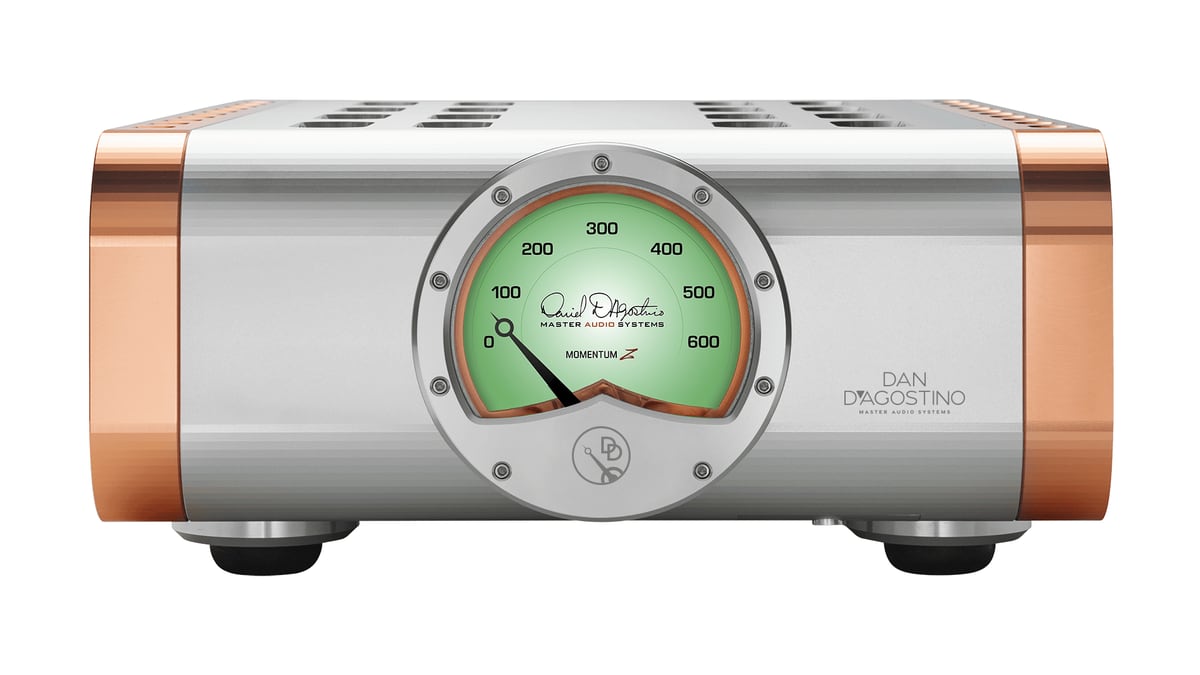
There is a particular kind of amplifier announcement that arrives not with breathless marketing superlatives but with the quiet, almost unsettling confidence of something that simply does not need to justify itself. Dan D'Agostino's Momentum Z monoblocks, unveiled in April 2026 and shipping from spring 2026, are exactly that kind of announcement. At $62,500 per chassis, or $125,000 for the pair you will inevitably need, the Momentum Z sits at the absolute summit of what D'Agostino Master Audio Systems has ever offered. It represents a genuinely new chapter for a company whose amplifiers are already considered among the finest expressions of the circuit designer's art.
For those who have followed Dan D'Agostino's career, from his founding of Krell Industries in the early 1980s through to the establishment of his eponymous company in 2009, the Momentum name carries immense weight. The original Momentum monoblock, when it appeared, redefined what high-power solid-state amplification could sound like: muscular without brutality, detailed without etch, and capable of controlling even the most recalcitrant loudspeaker loads with an authority that most amplifiers can only approximate. The Momentum Z, the company says, takes everything that made the Momentum series legendary and rebuilds it around a new power-supply architecture and a level of operational transparency that is genuinely unprecedented in this sector of the market.
This is not an incremental revision. It is a statement about where high-end amplification is going, and, as I will argue, it matters even if you will never own one.
The Momentum Z monoblocks: the numbers and what they mean
Let us begin with the headline specifications, because in this context they tell a meaningful story. The Momentum Z delivers 500 watts into 8 ohms, doubling to 1,000 watts into 4 ohms. That doubling behaviour, which engineers refer to as a load-invariant or near-ideal power delivery characteristic, is the single most important data point here. Many amplifiers claim high power figures but fail to sustain them as speaker impedance drops. A speaker that measures 4 ohms nominal will routinely dip to 2 ohms or below in certain frequency regions, and it is precisely at those moments of maximum current demand that lesser amplifiers compress, harden, or simply give up. We cover that failure mode in more detail in our piece on why amplifiers struggle below 4 ohms.
The ability to double output power as impedance halves is the hallmark of a properly engineered power supply and output stage, one with sufficient current reserves to track the loudspeaker's needs rather than impose its own limitations on the music. For context, some of the most electrically demanding loudspeakers in production today, including large planar magnetostatics, electrostatics, and certain high-mass dynamic designs, can present loads that would cause even well-regarded amplifiers to struggle. The Momentum Z, with its 1 kilowatt at 4 ohms, is plainly engineered for exactly these scenarios.
Raw wattage, while important in these contexts, is only part of the story. The character and quality of those watts (how the amplifier manages transient demands, how low its output impedance remains across the audio band, how cleanly it handles the back-EMF generated by real loudspeaker motors) ultimately determines how a system sounds. If those terms are new, our explainer on output impedance and damping factor is a good place to start. D'Agostino's history gives us reasonable grounds for confidence on these fronts, even before we hear the amplifier in a system.
Kinetic Drive Regulator: a new power-supply architecture
The most technically significant aspect of the Momentum Z is D'Agostino's new Kinetic Drive Regulator power-supply technology. The company has positioned this as a foundational development rather than a refinement, and while the full engineering details have not been disclosed, the implications of the name and its application are instructive.
Power-supply design is arguably the most consequential, and most underappreciated, element of amplifier engineering. The power supply is not merely a reservoir of energy; it is the engine that determines how quickly and consistently the amplifier can respond to musical demands. A poorly designed power supply introduces noise, allows rail voltages to sag under dynamic loads, and generally acts as a bottleneck between the incoming mains supply and the music. The finest amplifiers have always distinguished themselves as much by their power-supply engineering as by their output-stage topology, a point we unpack in power supply topology in high-end amplifiers.
D'Agostino's Kinetic Drive Regulator appears to address this at a fundamental level, promising more consistent delivery of voltage and current under the kind of extreme dynamic conditions that, say, a full orchestral tutti or a deep, fast bass transient demands. The "kinetic" framing suggests an approach that anticipates rather than merely reacts to load changes, a predictive or feedforward element to supply regulation, though I caution that I am drawing reasonable inferences here rather than stating confirmed engineering detail. What is confirmed is that this technology is new, and that it is central to the Momentum Z's design brief.
Understanding gain structure and signal path integrity becomes even more critical in a system anchored by an amplifier of this calibre. The Momentum Z's power-supply technology will reveal the limitations of everything upstream of it, which is, of course, precisely the point of a reference-grade amplifier.
The network port: amplifier monitoring enters a new era
Perhaps the most forward-thinking feature of the Momentum Z is the one least likely to feature in audiophile folklore: an Ethernet port that streams real-time data on operating voltages, temperature, bias and DC offset. In a sector of the industry that has historically been deeply, and sometimes irrationally, suspicious of digital intrusion into analogue signal paths, this is a genuinely bold move.
It is also an entirely sensible one.
An amplifier operating at this price point and this power level generates significant heat and places considerable demands on its componentry. Bias, the quiescent current flowing through the output transistors in the absence of a signal, is critical to the amplifier's linearity and character. As output devices age and as ambient temperature changes, bias can drift, subtly altering the amplifier's behaviour. DC offset at the output, if allowed to develop, can damage loudspeaker voice coils. Operating voltages outside their specified range can affect both performance and longevity.
In a conventional amplifier, these parameters are set at the factory, checked during service intervals, and otherwise invisible to the owner. The Momentum Z changes this entirely. By streaming these parameters over a network connection in real time, it allows owners, or more practically their dealers and D'Agostino's service network, to monitor the amplifier's health continuously and remotely. This is not a gimmick. For an amplifier that will likely be installed in a dedicated listening room or home theatre environment and expected to perform flawlessly for decades, the ability to detect a developing issue before it becomes a failure is genuinely valuable.
There is also a philosophical dimension to this. D'Agostino is, in effect, treating the Momentum Z as a precision instrument rather than a black box, one whose operating state should be observable and verifiable rather than opaque. For owners spending $125,000 on a pair of monoblocks, that transparency is entirely appropriate. It also opens the door to a future in which servicing is proactive rather than reactive, and in which firmware or calibration updates can be delivered without requiring the amplifier to leave its installation.
This kind of networked intelligence in high-end analogue amplification is still rare, and it positions D'Agostino ahead of the curve in thinking about how statement-level products can be serviced and supported over their operational lifetime.
What speakers are we talking about, realistically?
An amplifier of this specification and price does not exist in a vacuum. It implies a particular kind of system, and it is worth being candid about what that looks like.
The Momentum Z's 500W into 8 ohms and 1kW into 4 ohms make it relevant to a fairly specific category of loudspeaker: those that are either very difficult to drive, very large, or both. We are talking about the kind of flagship floorstanders offered by Wilson Audio, Magico, Sonus faber, YG Acoustics, and similar manufacturers; large-scale planar and electrostatic designs from MartinLogan or Magnepan at their upper reaches; or bespoke statement systems that treat acoustic output levels and dynamic headroom as non-negotiable priorities.
Understanding sensitivity is critical here. A speaker with 85 dB sensitivity will need dramatically more power than one with 96 dB sensitivity to achieve the same listening level, and in a large room, or for a listener who demands reference-level dynamics, that difference compounds quickly. Our guide to pairing statement amps and speakers makes the same point from the other direction: watts are the least of it. The Momentum Z is for the owner who will not countenance a situation where the amplifier is the limiting factor in the system's capability. At 1 kilowatt into 4 ohms, almost no loudspeaker will present a challenge it cannot meet.
For Australian buyers specifically, this is a product that sits within a market where the country's premium dealer network, concentrated in Sydney, Melbourne and Brisbane but with specialist retailers in most capital cities, has long maintained relationships with D'Agostino's Australian distributor. Buyers at this level should expect extended home demonstration arrangements, careful impedance and sensitivity matching consultations, and in many cases bespoke installation support. The Momentum Z is not a product you purchase online and configure yourself.
The broader context: what this launch signals for high-end amplification
D'Agostino's Momentum Z arrives at an interesting moment for the high end. On one hand, the market for genuinely cost-no-object amplification has never been healthier globally, with strong demand in Asia, the Middle East and the United States driving manufacturers to push further into statement territory. On the other hand, the conversation around amplifier design has never been more fragmented, with class-D technology advancing rapidly, as our own explainer on amplifier classes covers in detail, and a growing number of audiophiles reconsidering the received wisdom about topology and power.
D'Agostino's response to this moment is characteristically uncompromising. The Momentum Z does not dabble in digital amplification or switching topologies. It doubles down on the high-current, high-bias solid-state approach that has defined the company's house sound and, before that, defined Krell's legacy. The addition of the Kinetic Drive Regulator and the network monitoring port are not concessions to modernity; they are genuinely new engineering, applied in service of the same fundamental goal that has always animated this designer's work: making the amplifier as close to invisible as possible, so that only the music remains.
Whether you are building a reference two-channel system or designing a serious dedicated cinema space, the kind of installation our home cinema guide covers, the Momentum Z represents the outer limit of what is currently available in solid-state monoblock amplification. Its network monitoring capability, in particular, points toward a future where statement audio equipment is not just built to last but engineered to be maintained and verified across its entire service life.
Australian pricing and availability
The Momentum Z is priced at $62,500 USD per chassis, equating to $125,000 USD per stereo pair. Australian pricing will depend on the prevailing exchange rate and local importer margin at the time of order, so prospective buyers should contact D'Agostino's Australian dealer network directly for a landed price in AUD, and should factor in the typically significant customs and freight costs associated with amplifiers of this mass and construction quality. Shipping is confirmed from spring 2026, meaning Australian stock could reasonably be expected through mid-2026 depending on allocation.
Demand at this level is typically managed through dealer allocation rather than open stock, and early expression of interest through your preferred premium dealer is advisable if you are genuinely considering a purchase.
Who the Momentum Z is really for
D'Agostino's reputation is not merely the product of clever marketing. These are amplifiers that do what great amplifiers are supposed to do: they get out of the way. The Momentum Z, with its doubled power reserves, its new Kinetic Drive Regulator supply, and its unprecedented real-time operational transparency, appears to be the fullest expression of that philosophy yet realised.
At $125,000 per pair, it is emphatically not for everyone. I'd argue that for most listeners the money is better spent elsewhere in the chain, a question we tackle in when to upgrade your amplifier versus your speakers. But it is for the owners of speakers and systems that have, until now, been asking more of their amplification than any amplifier could reliably deliver. For that audience, the Momentum Z is a serious answer to a serious question.
The rest of us will watch, and wait, and perhaps one day sit down in front of a pair of Wilson Alexandrias or Magico M9s with the Momentum Z driving them, and understand, viscerally, what all of this engineering was actually for.
Common questions
- What is the D'Agostino Momentum Z monoblock's power output?
- The Momentum Z delivers 500 watts into 8 ohms, doubling to 1,000 watts into 4 ohms. This load-doubling behaviour is a key indicator of a robust power supply and output stage capable of driving even the most demanding loudspeakers without compression or dynamic limiting.
- What does the Ethernet port on the Momentum Z actually do?
- The Ethernet port streams real-time data on the amplifier's operating voltages, temperature, bias and DC offset. This allows owners, dealers and D'Agostino's service network to monitor the amplifier's health continuously and remotely — a significant step forward for long-term maintenance and reliability assurance in a statement-level component.
- How much does the D'Agostino Momentum Z cost in Australia?
- The Momentum Z is priced at $62,500 USD per monoblock chassis, or $125,000 USD per stereo pair. Australian pricing in AUD will vary depending on the exchange rate and local importer margin. Prospective buyers should contact D'Agostino's Australian dealer network for a current landed price and availability information.
- What kind of speakers is the Momentum Z designed for?
- The Momentum Z is engineered for loudspeakers that are large, difficult to drive, or both — including flagship dynamic floorstanders, large planar magnetostatic and electrostatic designs, and bespoke statement systems. Its 1kW into 4 ohms capability means virtually no production loudspeaker will present a load challenge it cannot manage. Understanding your speaker's impedance curve and sensitivity rating is essential when considering amplifiers at this level.

I'm Sofia, and I get to play with the silly stuff — the statement amplifiers, the reference loudspeakers, the cost-no-object systems that most of us will only ever hear at a show. Someone has to, and I take it seriously: at this level the price stops mapping to performance and starts mapping to engineering, craft and ego, and part of my job is telling you which is which. I love the extreme end of this hobby, but I'm not dazzled by a big number on a price tag.
Covers flagship and cost-no-object reference systems
More from Sofia Laurent
 The synergy tax: why mismatched gear costs more than cheap gearThe synergy tax explained: why pairing mismatched hi-fi components quietly costs more than buying modest, well-matched gear.
 Rear-port floorstanders near a glass wall: a risky pairingRear-ported floorstanders against glass walls cause boundary reinforcement and reflections. Here's how to place, measure and tune them properly.
- Infrasonic bass below 20Hz: chasing the octave you feel, not hearBelow 20Hz is infrasonic bass: felt more than heard. Here's what it takes to reproduce it properly, and whether a statement system should bother.
- Why statement systems still get beaten by the zone two speakerA $150,000 reference system is only as good as the worst-sounding zone it's networked to. Here's why multiroom integration is the statement system's real weak point.
- Why a statement floorstander can be the wrong speaker in the roomSix-figure floorstanders fail in rooms that were never built for them. Here's how to tell if your space can actually support one before you buy.
- Diffusion in statement rooms: when scattering sound beats absorbing itIn a statement room, piling on absorption kills the air around the music. Here's when diffusion is the better tool, and where I've seen it misused.