Four million taps: inside Chord's £25,000 Quartet FPGA upscaler
What just happened
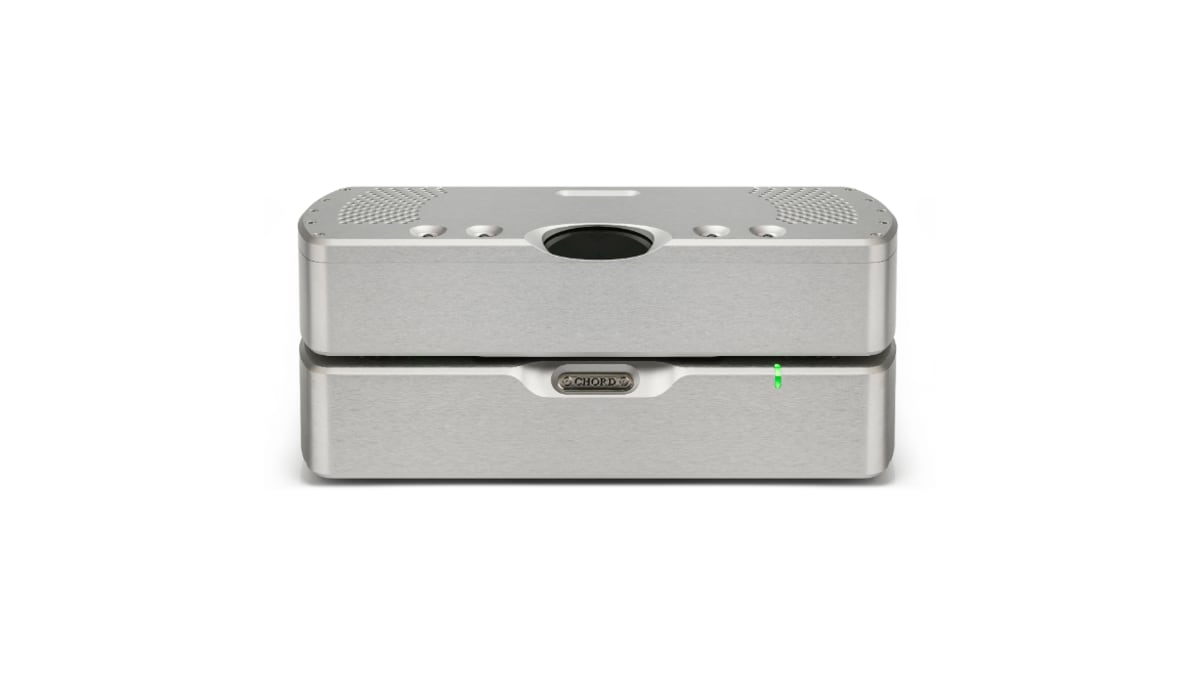
Chord Electronics has a habit of making the rest of the digital audio industry look like it's moving in slow motion. In February 2026 the British firm teased something new, and on 4 June 2026 — at High End 2026 in Vienna — the wraps came fully off. The product is the Quartet, a dedicated digital upscaler priced at £25,000 (approximately $35,995 in Australia), and it is, without hyperbole, the most computationally intensive consumer audio device Chord has ever produced.
Five Xilinx FPGAs. Four million filter taps. A brand-new filter algorithm the company calls 'Blackbird'. And — for the first time on any Chord upscaler — a built-in analogue-to-digital converter, meaning your turntable can feed into the thing and benefit from the same reconstruction process as your streaming files. That last detail is the one that's been generating the most pub-argument energy in audiophile circles, and rightly so. Let's get into all of it.
A quick primer: what an upscaler actually does
Before we go further, it's worth being precise about what the Quartet is and isn't. It is not a digital-to-analogue converter — it stays entirely in the digital domain. Its job is to take a PCM signal (say, 44.1 kHz / 16-bit Red Book audio) and mathematically reconstruct it at a much higher sample rate — up to 768 kHz in the Quartet's case — before handing that upscaled bitstream to a downstream DAC.
Why would you want to do that? It comes down to the reconstruction filter inside your DAC. Every DAC chip has to perform interpolation — it has to figure out what the analogue waveform looked like between the discrete digital samples. The filter it uses to do that interpolation is typically short and computationally modest, because DAC chips are designed to be cheap, small and power-efficient. A dedicated upscaler like the Quartet does that interpolation work externally, in far greater mathematical depth, using hardware that would be laughably impractical to squeeze inside a DAC chip. By the time the signal reaches your DAC, the hard reconstruction work is already done, and the DAC's own filter is left with very little heavy lifting to do.
If you want to understand the foundational concepts here — bit depth and sample rate explained from first principles — we've covered that ground in our glossary. Worth a read before continuing if you're new to this territory.
The tap count arms race and what 'WTA' means
Chord's WTA — Watts Transient Aligned — filter architecture was developed by the company's founder Bob Watts, and it is the intellectual core of everything Chord makes. The central idea is that a longer filter (more taps) can more accurately reconstruct the original waveform, particularly in terms of preserving transient timing information. Conventional DAC filters run perhaps a few hundred taps. Chord's own Mojo 2 — a product I've spent a fair amount of time with, and one that still impresses me at its price point — runs a comparatively modest filter by Chord's own standards. The Hugo 2 moved the needle. The M Scaler, launched in 2018, was the previous top of the heap at one million taps, a figure that seemed almost absurd at the time.
Four million taps is four times that. The Quartet's new 'Blackbird' WTA filter isn't just the M Scaler scaled up — Chord describes it as a distinct algorithm, though the company hasn't published the full mathematical specification. What we do know is that it requires five Xilinx FPGAs running in parallel to execute in real time. That's an enormous amount of silicon for a piece of domestic audio equipment, and it goes a long way toward explaining the price.
An FPGA — Field-Programmable Gate Array — is a chip that can be configured to perform specific logical operations, unlike a general-purpose processor that executes instructions sequentially. For digital signal processing, FPGAs are ideal: they can execute thousands of operations truly simultaneously, in parallel, with deterministic timing. Chord has used Xilinx FPGAs for years, and the ability to update the firmware means the Blackbird filter could theoretically be refined post-purchase. That matters when you're spending $36,000.
Five FPGAs: what the hardware actually looks like
Chord hasn't published a block diagram of the Quartet's internal architecture, but from what was shown at High End 2026 and the specifications released, we can piece together a reasonable picture. The five Xilinx FPGAs are almost certainly arranged so that the filter computation is distributed across them — likely with one handling input reception and routing, with the remaining four (or some other partition) performing the parallel filter tap calculations. Running a four-million-tap filter in real time at 768 kHz output is an extraordinary computational load. The fact that it works at all in a box designed for a domestic listening room is a genuine engineering achievement.
Outputs are via dual BNC (capable of carrying the full 768 kHz signal), USB-B and optical. The dual BNC arrangement is significant: 768 kHz PCM is too fast for a single standard BNC connection, so it's split across two cables — a technique familiar to anyone who has used the M Scaler with a compatible DAC. That means to get the full benefit of the Quartet's upscaling, you need a DAC with dual BNC inputs capable of accepting 768 kHz. Chord's own DAVE is the obvious partner here, and I'd wager that's the pairing Chord demonstrated in Vienna.
The ADC: why this changes everything for vinyl
The genuinely new development — and the one I find most interesting from a signal-chain perspective — is the built-in Pulse Array ADC. Every previous Chord upscaler has been a purely digital device: digital in, digital out. The Quartet breaks that pattern by accepting an analogue line-level input and converting it to digital internally before the Blackbird filter processes it.
The practical implication is significant. Connect a phono stage — or any analogue line-level source — to the Quartet's analogue input, and your vinyl playback gets routed through a four-million-tap WTA reconstruction before it reaches your DAC. Chord calls it a 'custom Pulse Array ADC', which suggests it's not a standard off-the-shelf converter chip but something designed specifically for this application. Pulse array architectures are well-suited to high-resolution conversion with low noise floors, and this is consistent with Chord's broader design philosophy of avoiding conventional DAC chips entirely in favour of custom implementations.
This is a meaningful development for serious analogue enthusiasts who also run a high-end digital chain. The phono stage remains essential — the Quartet takes line level, not cartridge level, so your MC or MM stage still does its job — but the ADC then brings that analogue signal into the digital domain at a quality level commensurate with the rest of the hardware. Whether the sonic benefits justify the enormous cost compared to simply running a great phono stage into a great DAC directly is a question that will require extended listening to answer. But the architecture is coherent, and the intention is clearly to make the Quartet the single digital processing hub for an entire high-end system, regardless of source type.
For context on building a complete source chain around a product like this, our guide to the best DACs and network streamers covers how to think about the broader ecosystem.
108-bit EQ and programmable latency: the less-discussed features
Buried under the headline tap count are two features that deserve more attention than they've been getting in the initial coverage.
The first is a 108-bit, ten-shelf lossless digital EQ with a range of plus or minus 18 dB per shelf. At 108-bit internal processing depth, you are not going to lose any meaningful resolution to rounding errors regardless of how aggressively you apply correction — the dynamic range headroom is essentially infinite by any practical measure. The 'lossless' descriptor refers to the fact that the EQ operates at the full processing resolution of the filter chain, rather than as a downstream brickwall. Ten shelves gives you genuine flexibility for room correction or speaker compensation work without needing a separate device in the chain.
This is interesting territory. Dedicated room correction has traditionally been the domain of products like Dirac Live or Audyssey, typically found in AV processors or all-in-one devices. A discrete upscaler with parametric EQ built in at this processing depth is unusual, and it suggests Chord is pitching the Quartet not just as a purist's reconstruction engine but as a full system integration tool.
The second feature is programmable latency, adjustable from 10 milliseconds to 3 seconds. This is directly related to the filter length — longer filters require more processing time, and the M Scaler's latency was already noticeable in certain use cases. Three seconds of latency is obviously unsuitable for video or interactive use, but at maximum latency you're getting the full depth of the Blackbird filter's computation. The 10 ms minimum setting trades some filter performance for compatibility with applications where timing matters. It's a sensible design decision that gives the user genuine control over the performance-compatibility tradeoff.
The price: who is this actually for?
Let's be honest about what £25,000 / $35,995 means. The Quartet is not a product most people reading this will buy. It is a statement product aimed at a narrow slice of the market: people who already own (or are building) reference-level systems anchored by a compatible high-end DAC, and for whom the incremental gains of moving from one million to four million filter taps represent meaningful value.
In Australia, at approximately $36,000, the Quartet sits comfortably in the territory of Chord's own DAVE DAC, Wilson Audio standmounts and the like. It assumes a system context where the upscaler is not the most expensive component. That's a real market — it's just a small one.
What the Quartet does do for everyone else is push the state of the art forward in ways that will eventually filter down. Chord's M Scaler was £2,999 at launch and brought one-million-tap filtering to a less rarified price point. The technology in the Quartet will almost certainly inform future products at lower price points in the years ahead. That's how Chord has always worked: the extreme flagship establishes what's possible, and the learnings propagate downward through the range.
What to make of FPGA upscaling in 2026
The broader context matters here. The market for standalone digital upscalers has always been a niche within a niche — a product category that requires the buyer to already own a capable DAC and be willing to insert another box, another cable run and another power supply into the chain in the belief that the filter improvement is audible and significant. That belief is not universally shared, and the measurements community has had vigorous arguments about whether tap count beyond a certain point yields audible differences.
I'm not going to resolve that argument here. What I will say is that the Quartet represents a serious attempt to push the mathematical depth of PCM reconstruction further than anyone else has managed in a domestic product. Whether four million taps sounds meaningfully different from one million — and whether the Blackbird algorithm represents a genuine qualitative improvement over the M Scaler's filter — are questions that require time with the hardware. I'm hoping to get the Quartet on the test bench later this year, and I'll have a great deal more to say at that point.
For now, the Quartet stands as the most ambitious consumer digital upscaler ever made, with a feature set that goes beyond simple upscaling to encompass ADC conversion, high-resolution EQ and latency control. It's an attempt to build a single digital hub for a reference-level system, and the engineering ambition behind it is genuinely impressive regardless of where you sit on the tap-count debate.
Practical takeaways for Australian buyers
- DAC compatibility is everything. To extract the Quartet's full 768 kHz output, you need a DAC with dual BNC inputs rated for that rate. Check your downstream DAC's spec sheet before getting excited.
- The ADC opens vinyl into the chain. If you run a serious analogue source, the built-in Pulse Array ADC means your phono stage output can benefit from Blackbird processing — but you still need a quality phono stage upstream.
- The EQ is genuinely useful. Ten shelves at 108-bit depth is not a gimmick — it's a capable correction tool that could reduce or eliminate the need for a separate room correction device in the right system context.
- Latency management matters. If you're running the Quartet in a system that also handles video, the 10 ms minimum setting is your friend. Understand the tradeoff before you commit to a setting.
- AU pricing is approximate. At £25,000 / ~$35,995, local pricing will depend on the distributor and the exchange rate at time of purchase. Confirm with your Chord dealer.
Common questions
- What is an FPGA filter tap, and why does the Quartet's four million taps matter?
- A 'tap' in a digital filter is essentially one multiplication-and-addition operation applied to a sample of the audio signal. More taps mean the filter can look further back and forward in time across the audio data when reconstructing the waveform — in theory producing a more accurate representation of the original analogue signal. Chord's Quartet runs four million taps through its new Blackbird WTA algorithm, compared to one million on the previous M Scaler, requiring five Xilinx FPGAs in parallel to achieve this in real time. Whether the difference is audible is a matter of active debate, but the mathematical depth is objectively greater.
- Can I use the Chord Quartet with any DAC, or does it require a Chord DAC downstream?
- The Quartet outputs via dual BNC (up to 768 kHz), USB-B and optical, so it can connect to any DAC with compatible inputs. However, to receive the full 768 kHz upscaled signal — and therefore the maximum benefit from the four-million-tap Blackbird filter — your downstream DAC needs dual BNC inputs capable of accepting 768 kHz PCM. Many DACs max out at lower rates, in which case the Quartet will still provide upscaling but at a lower ceiling. Chord's DAVE is the natural companion here. USB-B and optical outputs serve DACs without high-rate BNC connectivity, though at reduced maximum sample rates.
- The Quartet has a built-in ADC — does that mean I don't need a separate phono stage for my turntable?
- No — the Quartet's built-in Pulse Array ADC accepts analogue line-level signals, not phono-level signals. A turntable cartridge outputs a very small, frequency-unequal signal that requires RIAA equalisation and significant gain before it reaches line level. You still need a phono stage (or a preamp with a phono input) in the chain. The Quartet's ADC then takes the line-level output of that phono stage and converts it to digital for processing through the Blackbird filter.
- Is the Chord Quartet's built-in EQ a substitute for dedicated room correction software?
- The Quartet's ten-shelf, 108-bit EQ offers meaningful flexibility for frequency correction, and the 108-bit processing depth means there's negligible risk of resolution loss from applying corrections. However, it doesn't include the measurement and automatic calibration tools found in dedicated room correction systems like Dirac Live. It's a precision parametric EQ with very high internal resolution — useful for a knowledgeable user dialling in corrections manually, but not a self-contained room correction solution in the way that automated systems are.

Theo here. By day I write software, by night I argue with people on forums about whether bit-perfect playback is "solved" (it mostly is, and then it isn't). I cover the digital end — DACs, streamers, servers, the whole messy ecosystem of getting a file to sound its best. My promise to you: I'll separate the genuine engineering from the audiophile folklore, and I'll never tell you a $500 streaming bridge sounds "blacker" unless I can explain why.
Software engineer; network-audio and DAC specialist
More from Theo Mensah
 Cartridge alignment: why the last half-millimetre matters more than the cartridgeOverhang, zenith angle and azimuth decide more about vinyl sound quality than the cartridge you buy. Here's the engineering, explained by a digital guy.
- Streamer output stage vs speaker sensitivity: matching the digital front end to your pairYour streamer's output impedance and gain structure interact with speaker sensitivity more than most buying guides admit. Here's how to actually match them.
- Bass management over network audio: why your streamer's DSP matters for subsModern streamers now carry crossover and room EQ duties that used to live in an AVR. Here's what that shift actually changes for your subwoofer.
 Digital source, analogue speakers: why your streamer choice still shapes the pairA DAC engineer's take on why speaker matching starts upstream — how digital volume, output stage and streamer choice interact with standmounts and floorstanders.
- Phono preamp gain and loading, explained by someone who'd rather not own a turntableGain and loading settings on a phono stage aren't optional extras. Here's what they actually do to your cartridge's signal, explained without the mysticism.
 AVR vs processor plus power amps: when to make the jumpThinking about splitting your AV receiver into a processor and separate amps? Here's the engineering case for and against, without the marketing fog.