5.1.2 vs 7.1.4: the Atmos layout decision for real rooms
A bloke messaged me last month asking whether he should save up another eight hundred bucks for a 7.1.4 package or just run what he had, a tidy 5.1.2, and spend that money on acoustic treatment instead. He'd been reading forum threads for a fortnight and was no closer to an answer. I told him what I'll tell you: the channel count on the box is the least interesting number in this decision. The shape of his lounge room, the width of his couch and how close the side walls sat to his listening position mattered far more than whether Dolby's badge said 5.1.2 or 7.1.4.
This is where I reckon the home cinema industry does buyers a disservice. Every AVR brochure treats channel count as a straight upgrade ladder, more is better, and retailers will happily sell you four height speakers you don't have the ceiling for. I've sat in rooms with full 9.2.6 rigs that sounded worse than a well-placed 5.1.2 because nobody checked whether the room could actually support the extra channels. Giant-killing isn't just about cheap gear, it's about not buying channels your room can't use. And honestly, I've made this exact mistake myself in an old rental, hung two extra height speakers off a cornice bracket because it was the only mounting point available, and spent six months wondering why the overhead effects sounded like they were coming from the hallway instead of above me.
What the numbers actually mean
Quick refresher because the notation trips people up. The first number is your bed layer, front left/right, centre, and surrounds. The middle number, when present, is subwoofers. The last number is height channels, either in-ceiling speakers or upward-firing modules that bounce sound off the ceiling. So 5.1.2 is five bed speakers, one sub, two height channels. 7.1.4 adds a pair of rear surrounds and doubles the height channels to four.
Dolby's own object-based audio spec, which you can read about in detail on Dolby's Atmos technology page, doesn't actually mandate a channel count. Atmos is a rendering engine; it takes sound objects and positions them using whatever speakers you've told the processor you have. A well-calibrated 5.1.2 room can render the same mix a 7.1.4 room plays, just with less precision in where effects land. The question isn't "does more sound better" in the abstract. It's whether your specific room has the geometry to make those extra channels earn their keep.
It's worth being precise about what "less precision" actually means in practice, because it's not the same as "worse sound". With fewer physical speakers, the Atmos renderer has to phantom-image more objects between the channels it does have. A rain effect that should pan smoothly from rear-left to rear-right across four discrete points instead gets blended across two wider-spaced surrounds. You still hear rain moving. It's just a slightly coarser brush. For most film and TV content, that difference is genuinely marginal unless you're doing A/B comparisons on a demo disc, the kind of thing Dolby itself uses at trade events rather than anything you'll notice three episodes into a series on a Tuesday night.
The room geometry question nobody asks first
Rear surrounds in a 7.1.4 layout need to sit behind and slightly above ear height, ideally with a reasonable amount of space behind the main seating row. In a lot of Australian project-home living rooms, the couch is jammed against the back wall because that's where the room ends. Stick rear surrounds there and they're six inches behind your head firing sound almost ear-level into skull, which creates a weird, too-localised effect rather than the diffuse envelopment surrounds are meant to deliver.
I've measured this in a client's room in Mount Gravatt a few years back, a lovely open-plan space but with barely 400mm between the couch and the rear glass sliding door. We tried rear surrounds there for about a week and then pulled them, running 5.1.2 instead with the side surrounds doing double duty with wider dispersion drivers. It genuinely sounded better once we stopped forcing a layout the room didn't want. That's a mildly contrarian thing to say when every spec sheet implies 7.1.4 beats 5.1.2, but rooms don't read spec sheets.
Height channels have their own geometry rules. Dolby's placement guidelines (covered well in our own piece on screen-wall speaker placement if you're building around a UST projector) want height speakers roughly 45 to 60 degrees above ear level at the listening position, not jammed into the corners where downlights happen to be. If your ceiling has beams, sloped sections or a ceiling fan right where a height speaker wants to go, you're fighting physics for marginal gain. Four height channels in a room that can only properly support two is just expensive confusion.
Worked example, because the angles matter more than people expect. Say your main seat is 3.2 metres from the front wall and your ceiling sits at 2.7 metres. For the front height pair, you want the speaker roughly above the point about a metre or so in front of your seating position, not directly overhead and not right against the screen wall. Get that wrong by shoving the height speaker too far forward, hard up against the cornice above the TV, and the effect collapses into the front soundstage instead of sitting genuinely overhead. For the rear height pair in a 7.1.4 setup, you need a second clear run of ceiling further back again, and in a standard 4.2 metre deep project-home living room that often means the rear heights end up almost directly above the listener's head rather than properly behind-and-above, which flattens the separation between front and rear overhead effects that 7.1.4 is supposed to deliver in the first place.
Where 5.1.2 actually wins
For most single-row seating in a room under about 4.5 metres wide, 5.1.2 is not a compromise, it's the correct answer. You get front localisation, a solid surround field and overhead effects without needing speaker positions your room physically can't give you cleanly. The AVR has to do less guesswork too; fewer channels generally means your auto-calibration routine has fewer variables to get wrong, and Audyssey, YPAO or Dirac all tend to produce tighter, more consistent results with a simpler layout.
The money you save going 5.1.2 instead of 7.1.4, often two to four height/surround speakers plus the extra amplifier channels to drive them, is better spent on a decent subwoofer with proper DSP (I've banged on about this before: a $400 sub with a mic beats a $1200 one without), on acoustic treatment for first reflection points, or on a better centre channel, which does more heavy lifting for dialogue clarity than any height speaker ever will.
Run the numbers on a typical upgrade path and the trade-off gets clearer. Four reasonable in-ceiling height speakers plus a pair of rear surrounds will usually run you somewhere in the $600 to $1,200 bracket depending on brand, before you've even accounted for extra amplifier channels or in-wall cabling if you're doing it properly rather than running speaker wire along the skirting. For similar money you could treat the two first-reflection points on your side walls, add a bass trap in the front corners, and still have change left over for a subwoofer upgrade. In a room under five metres wide, I'd back the treatment and the sub to produce a more noticeable night-and-day improvement than the extra four speakers, every time. That's not a universal rule, but it's the way I'd bet if someone handed me the same budget and the same lounge room.
Where 7.1.4 actually earns its keep
Wide rooms, multi-row seating, or rooms where the couch sits well clear of the back wall, that's when 7.1.4 stops being a vanity purchase. If you've got genuine distance behind the main seats for rear surrounds to do their job, and ceiling height and geometry that let you place four height speakers at proper angles rather than cramming them together, the extra channels genuinely add resolution to the overhead and rear fields. Atmos mixes with a lot of discrete object movement, aircraft flybys, rain, debris, do sound more continuous and less like four point sources with four 4s instead of two.
Dedicated theatre rooms built from scratch, the kind covered in our building a home cinema guide, are where 7.1.4 makes the most sense, because you're designing the geometry around the layout rather than retrofitting a layout into whatever geometry the builder gave you. If you're starting with a blank slab and stud walls, there's no excuse not to plan for it properly. Second-row seating, in particular, almost demands the extra rear channels because without them that back row gets a noticeably thinner surround experience.
The second-row case deserves a bit more detail because it's the single strongest argument for going the full 7.1.4 route. With only 5.1.2, the side surrounds are typically positioned to flank the front row, which means anyone sitting a row or two back ends up well forward of those speakers rather than beside them. The surround field for the back row collapses towards the front of the room, and overhead effects from a two-speaker height layer barely reach past the first row at a useful angle. Add the rear surrounds and the second height pair, positioned correctly above and slightly behind the second row, and you give that back row its own proper surround and overhead field instead of a diminished version of the front row's experience. If your theatre room genuinely has two rows of seating in regular use, I'd put 7.1.4 close to mandatory rather than a nice-to-have.
The AVR and amplification reality
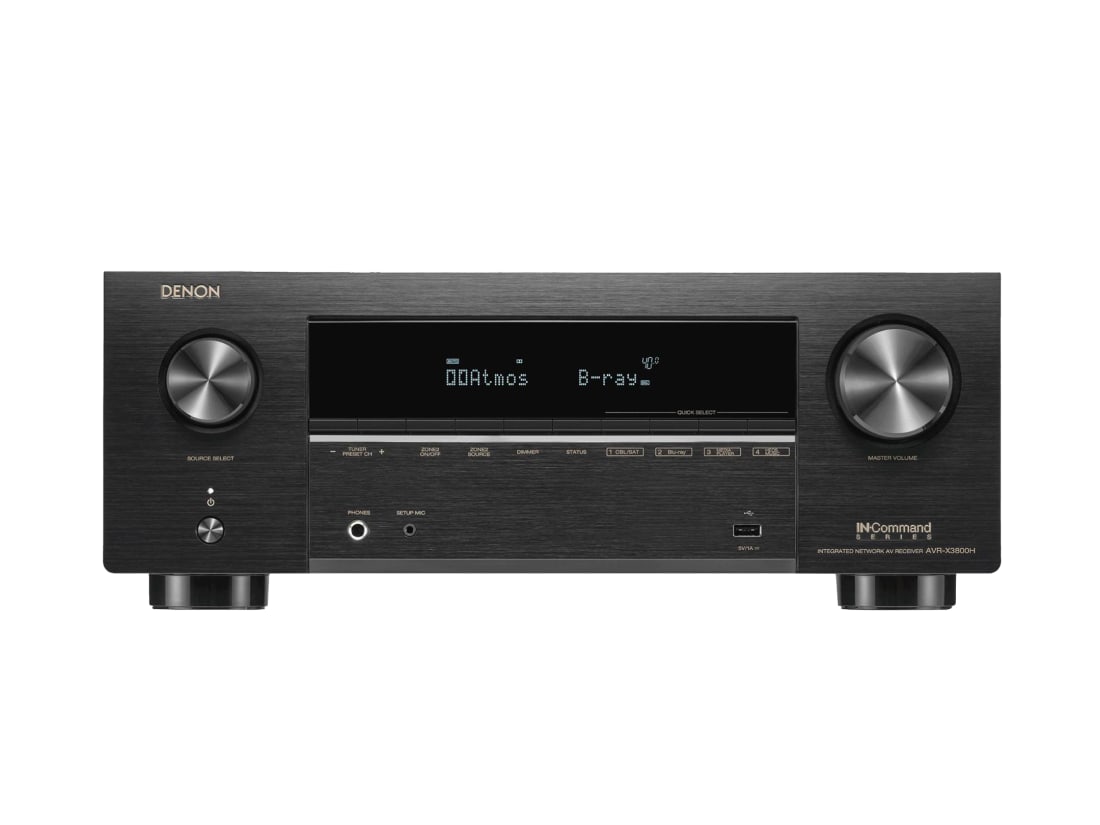
Here's a practical wrinkle that catches people out: going from 5.1.2 to 7.1.4 isn't just buying speakers, it's buying an AVR with enough amplified channels, or adding external amplification. A lot of mid-tier AVRs, the sort of thing we cover in reviews like the Denon AVR-X3800H (check price), will do 7.1.4 processing but only amplify a subset of those channels internally, meaning you need external amps for the rest. That's real extra cost and real extra complexity in your rack, cabling and AVR versus processor decision-making that a lot of buyers don't budget for upfront.
Work through a realistic scenario. An eleven-channel-processing AVR that only amplifies nine channels internally will happily decode and route a 7.1.4 bed, but you'll need a two-channel power amp for the remaining pair, typically the rear surrounds or the second height pair, depending on how you've assigned the pre-outs. Budget for that amp, the interconnects to feed it, and somewhere in the rack or cabinet to physically put it, because it's rarely a small unit. I've seen total project costs blow out by thirty to forty percent over the original "just buy the speakers" estimate once the amplification and cabling were factored in properly, and that's before anyone's touched the acoustic treatment the room probably needed anyway.
If you're buying secondhand to fund this, and I'd generally recommend you do (see my piece on buying secondhand first), check carefully that the used AVR you're eyeing actually has enough onboard amp channels for the layout you want, not just enough HDMI inputs and a shiny feature list. I've seen people buy a beautiful ex-demo processor-grade AVR only to realise it needs four more power amp channels they hadn't budgeted for. Always check the actual amplifier channel count in the spec sheet, not just the "channels supported" marketing line, because those two numbers are routinely different and the gap is exactly where budgets get blown.
My actual recommendation
Measure your room before you shop. Walk it out: distance from the main seating row to the rear wall, ceiling height and whether there's a clear, obstruction-free zone roughly a third of the way back from the screen for height speakers. If your rear wall is close enough that a rear surround would sit behind your head rather than behind and above it, don't buy rear surrounds, full stop, you'll be fighting the room forever. Run 5.1.2 properly executed over 7.1.4 poorly executed, every single time.
And if you're genuinely torn, start with 5.1.2, live with it for a few months, and add the extra channels later if the room and your viewing habits justify it. The upgrade trap piece we ran a while back covers this logic in more depth, buying in stages beats buying everything upfront and discovering half of it doesn't suit your space. Dolby's own certification guidelines, summarised reasonably well on the Wikipedia entry for Dolby Atmos, note that layout flexibility was baked into the format specifically so smaller rooms weren't locked out. Use that flexibility. Don't let a spec sheet talk you into speakers your ceiling was never going to host properly.
If you want a rough decision process rather than a rule, try this: measure the clear space behind your main seating row first. Under about 600mm and rear surrounds are off the table, full stop. Then check your ceiling for a genuinely obstruction-free zone at the right angles for height speakers, front and rear if you're considering four. If both checks pass and you've got either wide seating or a second row, 7.1.4 is worth the extra outlay and the amplifier headache that comes with it. If either check fails, spend the difference on treatment and a better sub, and don't feel like you're settling. You're not.
The bloke from the start of this piece ended up sticking with his 5.1.2 and spending the difference on a pair of bass traps and a better centre channel. Last I heard he was pretty happy about it, and so was his neighbour, who no longer gets rattled by rear-channel bleed through a shared wall.
— Dave Okafor, Value & Giant-Killers Contributor, Sound Technology
Common questions
- Is 7.1.4 always better than 5.1.2 for Dolby Atmos?
- No. Dolby Atmos is object-based and renders to whatever speakers you have, so the extra channels in 7.1.4 only help if your room has the depth and ceiling geometry to place them properly. In a lot of standard lounge rooms, a well-placed 5.1.2 outperforms a cramped 7.1.4.
- Do I need external amplifiers to run 7.1.4?
- Often yes. Many mid-tier AVRs process 7.1.4 but only amplify a subset of those channels internally, so you may need to add power amps for the remaining channels, which adds real cost and rack complexity.
- What's the minimum room size for 7.1.4 to make sense?
- There's no official figure, but as a practical guide you want clear space behind the main seating row for rear surrounds (not jammed against a back wall) and an obstruction-free ceiling zone for four height speakers at proper angles. Without both, you're better off with 5.1.2.
- Should I spend the 7.1.4 budget difference elsewhere?
- In most rooms, yes. A better subwoofer with DSP, a stronger centre channel, or basic acoustic treatment at first reflection points will usually improve the experience more than adding speakers your room can't properly support.

I'm Dave, and I'm the cheapskate of the team — and proud of it. My whole thing is finding the gear that punches three times above its price, the so-called "giant-killers," because most people don't have forty grand for a system and shouldn't feel bad about it. I've heard the megabucks stuff, and a lot of it is gloriously good; I've also heard $800 setups that get you 85% of the way there. I'll always tell you where the law of diminishing returns kicks in.
Lifelong bargain-hunter; budget-to-midfi specialist
More from Dave Okafor
 Matching speaker and amp cost: ignore the price-parity mythForget the old rule of matching speaker and amp cost dollar-for-dollar. Here's what actually decides a good pairing, and why it isn't price.
 Turntable mats and platters: what actually changes the soundFelt, rubber, cork or acrylic — turntable mats and platter materials change the sound more than most upgrades. Here's what actually works.
- Buying a demo unit: the giant-killer move retailers hateEx-demo hi-fi gear can save 20-40% with near-zero risk. Here's how to actually negotiate it, what to check, and when to walk away.
- Flutter echo: the room fault that sounds like nothing's wrongFlutter echo blurs detail in parallel-wall rooms without obvious boom. Here's how to find it cheaply and kill it without over-treating.
 Amp power ratings into 8 vs 4 ohms: the spec sheet trapWhy an amp's 4-ohm wattage figure can mislead buyers, and how to actually match power output to real speaker loads on a budget.
- Streamer apps ranked by what they actually do to your fileRoon, the WiiM app, Lumin, Chromecast built-in — they all claim bit-perfect. I pulled them apart to see which ones actually leave your file alone.