Audeze LCD-5s brings electrostatic airflow tech to planars
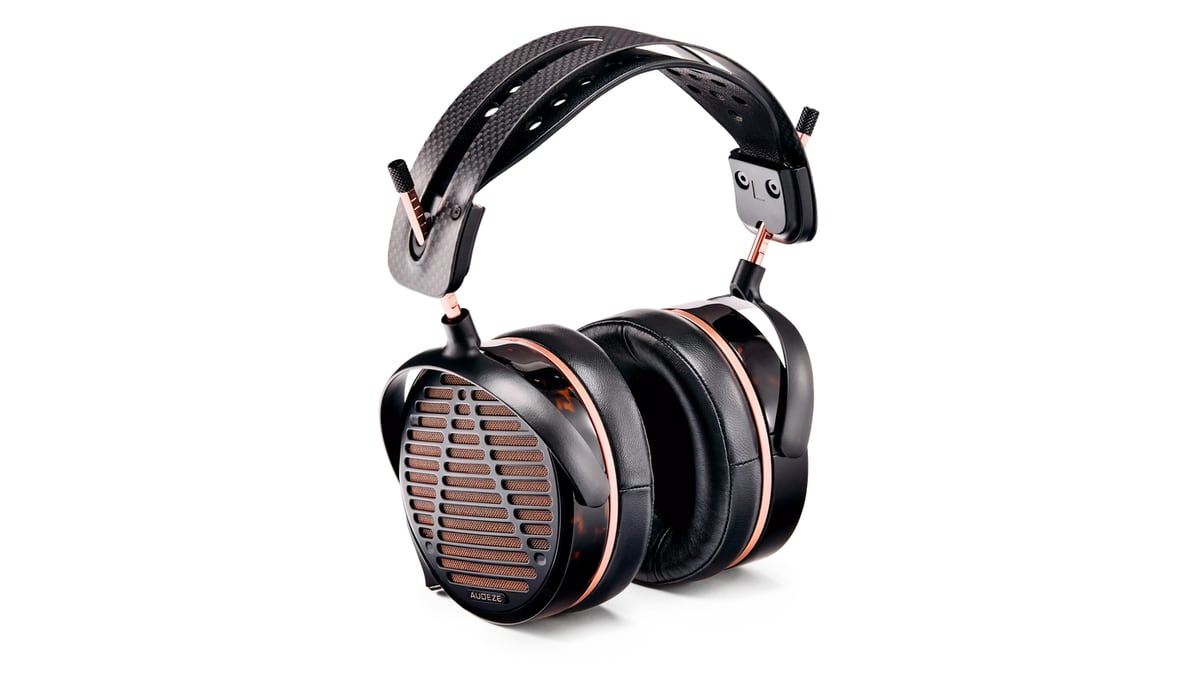
There is a particular kind of announcement that stops you mid-scroll: not a marginal refresh, not a colourway drop, not another wireless codec press release. What Audeze revealed at NAMM 2026 in Anaheim, California, is something rarer: a genuine architectural change to a reference-class headphone, one that traces its lineage directly to a different transducer technology altogether. The Audeze LCD-5s, priced at AU-equivalent of USD $4,500, arrives as the successor to the outgoing LCD-5 with a single defining addition. That addition is SLAM, or Symmetric Linear Acoustic Modulator, a patent-pending airflow-control system that Audeze first developed for the 2024 CRBN2 electrostatic headphone. The fact that this technology has now crossed the divide between electrostatic and planar magnetic is not a footnote. It is, in my view, the most interesting driver-level development in high-end headphones in several years.
Here is why, and why Australian enthusiasts at the serious end of personal audio should be paying close attention. If you want the bass side of the story, we have a separate piece on SLAM bass technology in the LCD-5s, and the manufacturer's own site, Audeze, is the place to confirm official specifications.
What the Audeze LCD-5s actually is
Start with the fundamentals. The LCD-5s is an open-back planar magnetic headphone, and it builds on the same core driver architecture that made the original LCD-5 one of the most critically discussed reference headphones of its generation. The driver is a 90mm planar magnetic unit, a substantial surface area, using what Audeze calls nano-scale Parallel Uniforce diaphragms paired with Fluxor magnet arrays built from Neodymium N50 magnets, among the strongest rare-earth magnets in common use. (For background on the material itself, see this explainer on neodymium magnets.)
The specifications Audeze is publishing are characteristically ambitious: frequency response of 5 Hz to 50 kHz, an impedance of 30 ohms, sensitivity of 90 dB per milliwatt, and a maximum SPL exceeding 130 dB. The weight comes in at 475 grams. The chassis is constructed from carbon fibre and magnesium, which is very much the right answer for a headphone sitting at this price point. Both materials are structurally rigid without adding unnecessary mass to what is already a substantial load on the head.
On paper, the 30-ohm impedance makes the LCD-5s considerably more approachable than many planar flagships, which have historically demanded serious amplifier current. That 90 dB/mW sensitivity, though, is not especially high, and planars in general reward quality amplification. If you are investing at this level, you want a dedicated headphone amplifier, ideally paired with a resolving DAC. Understanding your gain structure matters here; a headphone this capable will ruthlessly expose a weak link in the upstream chain. Our explainer on headphone impedance and power output covers why the numbers on the spec sheet need reading together.
SLAM: what airflow control means, and why it started with electrostatics
The story of SLAM begins not with planar magnetics but with the CRBN2, Audeze's 2024 electrostatic flagship. To understand why that is significant, you need to appreciate how differently electrostatic and planar magnetic transducers move air, and where their respective failure modes lie. If you want the broader picture, we have written about what electrostatic and planar magnetic technology demands of the rest of your system.
An electrostatic driver suspends an ultra-thin diaphragm between two perforated stator plates, and the diaphragm moves in response to a high-voltage electrostatic field. Because the diaphragm has virtually no mass, transient response can be extraordinarily fast. But the open architecture of an electrostatic driver creates a particular acoustic challenge: air movement around the driver is largely uncontrolled, and acoustic reflections from surrounding structures (ear cup geometry, stator frames, the space behind the driver) can introduce colouration, phase anomalies, and what engineers sometimes describe as a congested or smeared upper midrange. Managing airflow in an electrostatic environment requires extraordinary precision because any mechanical intervention risks disrupting the field geometry that makes the driver work in the first place.
SLAM, as Audeze developed it for the CRBN2, is an attempt to impose symmetric, controlled airflow patterns on both sides of the diaphragm simultaneously, hence the "Symmetric" in the name. The "Linear Acoustic Modulator" portion refers to the goal of making that airflow control frequency-independent. It should not introduce resonances or roll-offs of its own, but act as a neutral boundary condition that lets the driver itself define the acoustic output. The patent-pending status tells you Audeze believes the implementation is genuinely novel, not merely an incremental tuning of conventional baffle geometry.
Applying SLAM to a planar magnetic driver
The leap to planar magnetics is less obvious than it might seem. A planar driver does share conceptual territory with an electrostatic in that it uses a large, low-mass diaphragm, but the driving mechanism is fundamentally different, using a voice-coil trace printed or etched onto the diaphragm surface and operating within a magnetic field. The diaphragm moves with more force and over a wider excursion range than an electrostatic, which creates different airflow dynamics and different failure modes. Where electrostatics tend to struggle with acoustic reflections at high frequencies, planars can develop asymmetric airflow around the magnet arrays, the very structures that define the driver's topology. That leads to micro-level non-linearities in the diaphragm's motion that manifest as subtle harmonic distortion and reduced image precision.
Applying SLAM to the 90mm Parallel Uniforce driver in the LCD-5s is, in essence, an attempt to solve these planar-specific airflow problems using a control methodology refined in the electrostatic domain. The Parallel Uniforce diaphragm geometry, where the voice-coil traces are arranged to distribute driving force uniformly across the diaphragm surface, is already designed to minimise differential motion between the driven and un-driven portions of the membrane. SLAM, by managing what happens to the air on both faces of that diaphragm, should theoretically extend the linearity of that control into the acoustic domain itself.
Why this matters for soundstage and imaging
If I am honest, my principal interest in the LCD-5s is not in its frequency extension or its maximum SPL ceiling, specifications that, beyond a certain point, describe capability rather than character. What excites me about SLAM applied to a planar is what it promises for spatial precision and timbral coherence in the critical midrange and lower treble.
The reference-class headphone market, at and above the $4,000 threshold, is populated by instruments of genuine quality. What separates the truly exceptional from the merely excellent, in my view, is not extension or detail retrieval per se. It is the quality of the space that the headphone constructs around the listener. The best open-back headphones at this level stop presenting sound as something happening at your ears and start presenting it as something happening around your head, with credible scale, depth layering, and the sense that individual instruments occupy distinct positions in a three-dimensional field. If you are weighing that kind of presentation against a sealed design, our comparison of open-back and closed-back headphones sets out the trade-offs.
Uncontrolled airflow is an enemy of that spatial coherence. When acoustic reflections from driver structures blur the temporal integrity of transients, the brain's ability to localise sound sources is compromised. The first milliseconds of a note, the attack phase, carry an enormous proportion of the spatial cues that allow us to place a sound in space. If those milliseconds are smeared or loaded with spurious reflections, the image collapses toward the listener's head rather than projecting outward. SLAM's symmetric control of airflow on both driver faces is directly targeted at this problem.
Whether Audeze has achieved this in practice is something only extended listening sessions will confirm. But the engineering intent is coherent, and the provenance (a system first used in the CRBN2 electrostatic, which drew strong critical notices for precisely its spatial presentation) gives me genuine reason for optimism.
The materials story: carbon fibre and magnesium at this price point
At $4,500, buyers are entitled to expect materials engineering that justifies the investment, and the LCD-5s delivers on this front. Carbon fibre and magnesium are not merely prestige choices. They represent a considered answer to one of the persistent problems in flagship headphone design: how do you build a structurally stable, acoustically inert chassis that does not punish the wearer for extended listening sessions?
Magnesium alloys offer an extremely high stiffness-to-weight ratio and good vibration damping, properties that make them attractive for precision optical and acoustic instruments alike. Carbon fibre adds directional stiffness exactly where you want it in headphone structural members, without the mass penalty of aluminium or the resonance characteristics of plastics. At 475 grams, the LCD-5s is not a light headphone, because planar drivers and their magnet arrays carry inherent mass. But the chassis materials ensure that, gram for gram, structural mass is working hard.
This matters acoustically as well as ergonomically. A chassis that flexes or resonates under the mechanical energy of a driven diaphragm will colour the sound in ways that are difficult to model and harder to eliminate at the tuning stage. Audeze's choice of these materials is consistent with a philosophy of solving problems at the source rather than compensating for them downstream.
Driving the LCD-5s: what the Australian buyer needs to consider
Thirty ohms and 90 dB/mW puts the LCD-5s in an interesting position for Australian buyers assembling a reference desktop system. It is not as demanding as some older planar flagships, but it is not something you want to run from a laptop headphone output or a basic dongle DAC. The dynamic range and resolution this driver is presumably capable of will only manifest with appropriately clean, powerful amplification.
A resolving digital-to-analogue converter is non-negotiable at this level. My advice to anyone building at this tier is to treat the DAC and headphone amplifier as co-equal investments with the headphone itself. Skimping on source components with a $4,500 transducer is an act of self-sabotage. If you are exploring source options, our roundup of the best DACs and network streamers covers several options relevant to a system anchored by a headphone at this level, and our piece on whether you need a separate headphone amp helps with the next decision.
The 5 Hz lower extension is, for practical purposes, a way of saying the driver has no meaningful low-frequency limit within the range of human hearing. But reproducing sub-bass on a headphone depends as much on the seal and the driver's mechanical compliance as on the quoted specification. As an open-back design, the LCD-5s will not deliver the same tactile bass reinforcement as a closed-back. What it should deliver, and what well-designed open-backs at this level consistently do, is bass that is tonally accurate and properly integrated with the midrange, without the tubbiness or bloom that comes from an over-damped or poorly tuned enclosure.
Context: where the LCD-5s sits in the reference headphone landscape
The reference open-back market above $3,000 is not crowded, but it is competitive. Audeze faces pressure from the traditional electrostatic houses as well as from dynamic driver manufacturers who have demonstrated that moving-coil designs can match or exceed planars in specific performance dimensions. The LCD-5s' differentiator is not simply its driver size or magnet system, since other manufacturers field comparable specifications, but the SLAM technology, which represents a specific and defensible engineering thesis about the source of performance limitations in high-end planar design.
What Audeze is arguing, implicitly, is that the ceiling for planar performance has not been determined by the driver itself but by the acoustic environment in which the driver operates. That is a compelling claim, and it is one that the CRBN2's reception suggests has at least partial validity in the electrostatic domain. If the LCD-5s demonstrates the same effect in a planar context, it represents a genuine step change rather than an incremental refinement.
For Australian listeners who have followed the LCD lineage, or who are ready to make a serious investment in personal audio, the LCD-5s is worth significant attention. The combination of a mature, well-understood driver platform, credible new acoustic engineering in the SLAM system, and premium materials execution creates a proposition that is intellectually honest as well as commercially serious.
What to watch for
NAMM announcements live and die by subsequent listening reports, and the LCD-5s is no exception. The specifications are compelling, the engineering story is coherent, and the provenance of SLAM is encouraging. But the proof is always in the listening, specifically in how the headphone handles complex orchestral passages, in whether the midrange transparency is genuine or flattering, and in whether the spatial presentation achieves the kind of head-external imaging that separates truly reference-class headphones from those that are merely excellent at playing measurements.
Australian availability and local pricing will be the immediate practical question for readers here. Historically, Audeze has been well-supported through specialist audio retailers in Australia, and a flagship launch of this significance should translate to demonstration availability at the better-stocked headphone specialists in major cities. If you have the opportunity to audition the LCD-5s, I would suggest bringing familiar recordings with complex spatial information, such as chamber music with clearly placed instruments, or well-recorded jazz with a convincing room acoustic, and listening specifically for how confidently the headphone places images in space. That is where SLAM's influence should be most audible, and that is the test that matters most to me.
This is, in any case, the most interesting flagship planar announcement in a good while. The cross-pollination of electrostatic acoustic engineering into the planar magnetic domain is exactly the kind of lateral thinking that moves headphone design forward, and Audeze has a strong enough track record to earn the benefit of the doubt until listening confirms what the engineering promises.
Common questions
- What is SLAM technology and where did it come from?
- SLAM stands for Symmetric Linear Acoustic Modulator. It is a patent-pending airflow-control system developed by Audeze, first introduced in the 2024 CRBN2 electrostatic headphone. It is designed to impose symmetric, controlled airflow on both faces of a driver's diaphragm simultaneously, reducing acoustic reflections and improving spatial coherence. The LCD-5s is the first planar magnetic headphone to incorporate it.
- What amplification does the Audeze LCD-5s require?
- The LCD-5s has a 30-ohm impedance and 90 dB/mW sensitivity. While this is relatively approachable for a planar flagship, it still benefits significantly from a dedicated headphone amplifier with good current delivery. At the $4,500 price point, pairing with a quality DAC and headphone amplifier is strongly recommended to realise the headphone's full capability.
- How heavy is the LCD-5s and what is it made of?
- The LCD-5s weighs 475 grams and uses a chassis constructed from carbon fibre and magnesium. These materials are chosen for their high stiffness-to-weight ratio and vibration-damping properties, which benefit both ergonomics during extended listening and acoustic performance.
- What are the key specifications of the Audeze LCD-5s?
- The LCD-5s uses 90mm planar magnetic drivers with nano-scale Parallel Uniforce diaphragms and Fluxor Neodymium N50 magnet arrays. Frequency response is rated at 5 Hz to 50 kHz, impedance is 30 ohms, sensitivity is 90 dB per milliwatt, and maximum SPL exceeds 130 dB. It debuted at NAMM 2026 priced at USD $4,500.
- Is the LCD-5s an open-back or closed-back headphone?
- The Audeze LCD-5s is an open-back planar magnetic headphone. Open-back designs generally offer a more natural, spacious soundstage compared to closed-back headphones, but do not provide isolation from ambient noise and will leak sound to those nearby.

I'm Sofia, and I get to play with the silly stuff — the statement amplifiers, the reference loudspeakers, the cost-no-object systems that most of us will only ever hear at a show. Someone has to, and I take it seriously: at this level the price stops mapping to performance and starts mapping to engineering, craft and ego, and part of my job is telling you which is which. I love the extreme end of this hobby, but I'm not dazzled by a big number on a price tag.
Covers flagship and cost-no-object reference systems
More from Sofia Laurent
 The synergy tax: why mismatched gear costs more than cheap gearThe synergy tax explained: why pairing mismatched hi-fi components quietly costs more than buying modest, well-matched gear.
 Rear-port floorstanders near a glass wall: a risky pairingRear-ported floorstanders against glass walls cause boundary reinforcement and reflections. Here's how to place, measure and tune them properly.
- Infrasonic bass below 20Hz: chasing the octave you feel, not hearBelow 20Hz is infrasonic bass: felt more than heard. Here's what it takes to reproduce it properly, and whether a statement system should bother.
- Why statement systems still get beaten by the zone two speakerA $150,000 reference system is only as good as the worst-sounding zone it's networked to. Here's why multiroom integration is the statement system's real weak point.
- Why a statement floorstander can be the wrong speaker in the roomSix-figure floorstanders fail in rooms that were never built for them. Here's how to tell if your space can actually support one before you buy.
- Diffusion in statement rooms: when scattering sound beats absorbing itIn a statement room, piling on absorption kills the air around the music. Here's when diffusion is the better tool, and where I've seen it misused.