Bowers & Wilkins 805 D5: the iconic tweeter-on-top standmount gets a fifth-generation overhaul
What's happened, and why it matters
Bowers & Wilkins unveiled the 800 Series Diamond D5 range at High End Vienna in June 2026, and sitting at the foot of that new family is the 805 D5 — a loudspeaker that carries more symbolic weight than almost any other standmount on the market. For decades, the 805 has been the answer serious listeners give when someone asks, "What's the best two-way monitor you can actually live with?" It has graced professional studios, reference listening rooms and impeccably furnished living spaces in equal measure. So when Bowers & Wilkins commits to a fifth-generation redesign, the entire high-end community pays attention.
The 805 D5 goes on sale on 6 September 2026, priced at $15,000 per pair in Australia. That is not a casual outlay — it places this speaker firmly in the statement-system category, the territory I spend most of my professional life thinking about. But for what the 805 has historically represented, and for what the D5 generation appears to bring to the table, it is a price point that deserves careful, serious consideration rather than reflexive sticker shock.
Let me unpack exactly what has changed, why those changes matter from an engineering standpoint, and what Australian buyers need to think about before September arrives.
The lineage: why the 805 occupies a unique place
The 800 Series Diamond is Bowers & Wilkins' halo range — the line from which the company's technical innovations cascade downward into the broader catalogue. The 805 has always been its most accessible entry point, and "accessible" is relative: even in previous generations, the 805 commanded a price that put it beyond reach for most enthusiasts. What it has always offered in return is a genuinely reference-grade listening experience in a form factor that doesn't demand a dedicated room or a sympathetic architect.
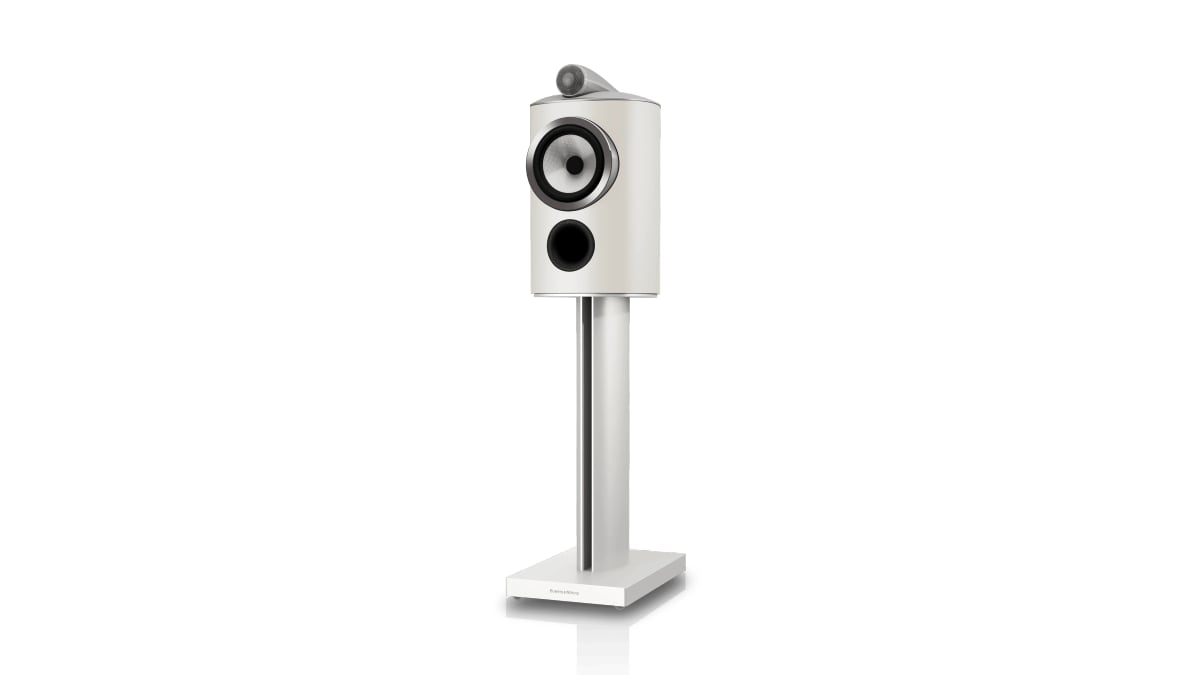
The tweeter-on-top configuration is central to the 805's identity. By physically decoupling the tweeter from the main cabinet and mounting it above on its own isolated housing, B&W eliminates one of the most persistent problems in loudspeaker design: cabinet-induced coloration contaminating the most sensitive, spatially informative part of the frequency spectrum. High frequencies are extraordinarily revealing of the enclosure resonances and diffraction effects that a conventional flush-mounted tweeter would inherit from the baffle. The 805's separated tweeter head sits above all of that, allowing it to radiate into free space with minimal interference. The result, when it works well, is an airiness and precision of imaging that larger, more expensive floorstanders sometimes struggle to match. If you want to understand the theory behind why imaging matters so much in a high-end context, our Soundstage & Imaging glossary entry covers the fundamentals clearly.
What's new in the D5: Diamond Dome, Continuum and cabinet refinement
The 805 D5 is a two-way standmount built around two driver technologies that have been central to the 800 Series story for some time, now refined for this fifth generation.
The Diamond Dome tweeter
The Diamond Dome is B&W's signature high-frequency transducer — a tweeter dome machined from pure diamond, one of the hardest known materials, which allows the dome to operate in what engineers call "pistonic" mode far further up the frequency range than aluminium or fabric alternatives can manage. The first breakup mode — where the dome starts to flex rather than move as a rigid unit — occurs so far beyond the audible range that it is effectively irrelevant to what you hear. What you get instead is a tweeter that remains perfectly controlled through the entire audible bandwidth and well beyond it.
The D5 generation brings a refined version of this dome. B&W has not published the full technical specification changes at the time of writing, but the pattern across previous generational updates has involved improvements to the motor system, revised surround geometry and enhanced housing isolation. The solid-body tweeter housing is a key detail here: rather than a fabricated assembly, the housing is machined from a single solid billet, which dramatically reduces the micro-resonances that can smear fine detail even when the dome itself is operating perfectly. This is the kind of refinement that doesn't show up in a frequency response graph but absolutely shows up in extended listening.
The Continuum Cone midrange/bass driver
The 805 D5's 6.5-inch bass/midrange driver uses B&W's Continuum Cone technology — a woven composite material developed as a successor to the Kevlar-based Yellow Cone that defined the 800 Series for many years. Continuum was engineered specifically to eliminate the characteristic "colouration" that Kevlar cones introduced as a trade-off for their stiffness: a subtle but pervasive tonal character that experienced listeners could identify. The Continuum material achieves comparable stiffness with a smoother, more controlled breakup behaviour, which translates to a midrange that is both more accurate and more neutral.
In the context of a two-way standmount like the 805, the midrange/bass driver is doing the majority of the work. It covers everything from the upper bass through the critical midrange frequencies — the band where vocals, strings, piano and brass all live, and where the ear is most sensitive to coloration. Getting this driver right is not incidental to the 805 D5's performance; it is central to it.
The reverse-wrap cabinet
The 805 D5's cabinet uses what B&W describes as a reverse-wrap construction — a technique where the main structural surfaces are oriented to minimise parallel internal surfaces and reduce standing waves within the enclosure. Lower resonance translates directly to a cleaner, better-defined bass response and a reduction in the kind of low-level cabinet noise that can smear the spatial presentation of a recording. Combined with the solid-body tweeter housing above, the complete package represents a coherent approach to minimising every source of unwanted mechanical noise in the system.
For a speaker operating at this price point and with this level of ambition, these are not small considerations. The difference between a well-engineered cabinet and a great one is precisely the sort of thing that distinguishes a genuinely reference-grade product from one that merely sounds impressive on a brief audition.
$15,000 per pair: how does this sit in the Australian market?
Fifteen thousand dollars for a standmount loudspeaker requires justification, and I want to address that directly rather than sidestep it. It is a significant sum — roughly comparable to what a sensible person might spend on a reliable used car — and the Australian market has no shortage of outstanding speakers in the $3,000–$8,000 range that will satisfy the vast majority of listeners. Our guide to the best standmount speakers for serious listening covers that territory thoroughly.
But the 805 D5 is not competing in that space, and evaluating it as though it were misses the point entirely. At this level, you are paying for several things simultaneously: the engineering and material cost of a diamond dome tweeter (not a metaphor — literally synthetic diamond, grown for acoustic purity), the refinement of a decades-long research programme into cone materials, and the manufacturing precision that a solid-body tweeter housing requires. These are not marketing exercises. They have measurable acoustic consequences.
The more meaningful Australian price comparison is with competitors in the $10,000–$20,000 standmount category. Speakers from Wilson Audio, Magico, YG Acoustics and other boutique manufacturers occupy similar territory, and many of them are built in smaller facilities with longer lead times and less widespread dealer support than B&W's global network provides. The 805 D5 will be available through authorised Australian B&W dealers from September, which means meaningful local auditioning — something you should absolutely insist upon before committing to any speaker at this price.
What amplification and source equipment does the 805 D5 deserve?
A speaker of this calibre will be merciless with the chain upstream of it. I want to be direct about this: pairing the 805 D5 with amplification that isn't up to the task is an expensive mistake. The Diamond Dome's resolution and the Continuum Cone's neutrality will expose every weakness in the signal chain — poor power supply regulation, mediocre output stages, inadequate gain structure. This is not a criticism of the speaker; it is precisely the characteristic that makes it genuinely useful as a reference tool.
In terms of amplification style, the 805 D5 will reward class-A or high-quality class-AB designs with substantial current delivery. While it is not an unusually difficult load by standmount standards, its sensitivity and impedance characteristics mean it will scale with better amplification in ways that more forgiving designs won't. Integrated amplifiers in the $5,000–$15,000 range from the likes of McIntosh, Gryphon, Nagra or Vitus would be natural partners. Our McIntosh MA352 review (check price) gives a sense of the kind of amplifier character that works beautifully with a high-resolution transducer — warm but detailed, with genuine authority at the frequency extremes.
On the source side, the 805 D5 equally rewards investment. A high-quality DAC and network streamer is the most practical modern source configuration for most Australian buyers, and the choices in the $2,000–$8,000 range have never been better. If you are assembling a complete system around the 805 D5, our guide to the best DACs and network streamers is a sensible starting point for that part of the budget conversation.
Room considerations: the standmount advantage and its limits
One of the most compelling arguments for the 805 D5 over a flagship floorstander is its adaptability to real rooms. A two-way standmount with a 6.5-inch driver does not pressurize a room the way a large floor-standing speaker does, which means it is less susceptible to the severe bass modes that plague many Australian living rooms and dedicated listening spaces. Stand placement flexibility is also meaningfully greater — you can dial in the imaging sweet spot with finer adjustments than a large floorstander typically allows.
That said, the 805 D5 will still benefit from considered acoustic treatment, particularly in the first reflection points on the side walls and the front wall behind the speakers. At this level of transparency, what the room does to the sound matters enormously. And if your room is genuinely challenging in the bass, adding a high-quality subwoofer — something like the SVS SB-3000, which we have reviewed — is a legitimate option that the 805 D5's crossover architecture accommodates well. Our Standmount vs Floorstander glossary entry explores these trade-offs in more detail for readers still weighing up the format question.
The competitive landscape: what is the 805 D5 up against?
In the Australian market at $15,000 per pair, the 805 D5 will face competition from a relatively small but serious group of rivals. The Focal Scala Utopia Evo at the high end, the Dynaudio Confidence 20 and the KEF Blade Meta at the stratospheric end — though most of those push well beyond the 805 D5's price. More direct competitors include upper-range offerings from Spendor, ProAc and the Wilson Audio Tune Tot, each with its own philosophical approach to what a reference standmount should prioritise.
The 805's historical advantage over most of its competitors has been the combination of extraordinary high-frequency refinement — a genuine consequence of that diamond dome — and the kind of spatial presentation that the tweeter-on-top configuration enables. If the D5 generation maintains those advantages while meaningfully advancing the midrange and cabinet performance, it will retain its position as one of the defining standmounts at any price.
My assessment and what to do before September
I have followed the 800 Series through multiple generations, and the trajectory has been consistently upward. Each generation has brought meaningful improvements rather than cosmetic refreshes, and the D5 range appears to continue that tradition. The specific combination of a refined solid-body tweeter housing and the D5-generation Continuum driver in a lower-resonance reverse-wrap cabinet represents a coherent and considered set of upgrades, not a marketing exercise dressed up as engineering.
For Australian buyers who are serious about the 805 D5, I have three practical recommendations before September's on-sale date. First, contact your nearest authorised B&W dealer now and register your interest — demonstration stock will be limited initially, and the best dealers will already be building their audition lists. Second, begin thinking seriously about amplification if you haven't already: the 805 D5 will not be doing its best work into an amplifier that isn't up to the task. Third, read our existing coverage of the broader landscape — our Bowers & Wilkins 705 S3 review (check price) gives useful context on where the 800 Series' engineering values sit relative to the 700 Series, and what the step up to the flagship family genuinely provides.
The 805 D5 is not for everyone, and it should not be. It is a speaker for people who have decided that sound quality is a genuine priority in their lives, who have the room and the associated system to support it, and who want a standmount that will serve as a reference point for as long as they own it. On that basis, and from everything revealed so far, it looks very much like business as usual for one of high-end audio's most enduring icons — which is high praise indeed.
Common questions
- What is the Australian price of the Bowers & Wilkins 805 D5, and when does it go on sale?
- The Bowers & Wilkins 805 D5 is priced at $15,000 per pair in Australia and goes on sale on 6 September 2026. It was revealed as part of the 800 Series Diamond D5 range at High End Vienna in June 2026.
- What driver technology does the 805 D5 use?
- The 805 D5 is a two-way standmount featuring B&W's Diamond Dome tweeter — a dome machined from pure synthetic diamond for exceptional rigidity and extended high-frequency control — mounted in a solid-body tweeter housing above a 6.5-inch Continuum Cone bass/midrange driver. The cabinet uses a reverse-wrap construction for reduced resonance.
- Why is the tweeter mounted on top of the 805 D5 rather than flush with the baffle?
- The tweeter-on-top configuration physically decouples the high-frequency driver from the main cabinet, eliminating cabinet-induced resonances and diffraction effects that would otherwise compromise the tweeter's output. This approach, which B&W has used throughout the 800 Series for many years, contributes directly to the precise soundstage and imaging that the 805 is known for.
- What amplification would suit the Bowers & Wilkins 805 D5?
- The 805 D5's high resolution will reward quality class-A or class-AB amplification with substantial current delivery. Integrated amplifiers in the $5,000–$15,000 range from brands like McIntosh, Gryphon or Nagra are natural partners. The speaker's transparency means it will expose weaknesses in lower-quality amplification, so matching it with appropriate upstream components is important.

I'm Sofia, and I get to play with the silly stuff — the statement amplifiers, the reference loudspeakers, the cost-no-object systems that most of us will only ever hear at a show. Someone has to, and I take it seriously: at this level the price stops mapping to performance and starts mapping to engineering, craft and ego, and part of my job is telling you which is which. I love the extreme end of this hobby, but I'm not dazzled by a big number on a price tag.
Covers flagship and cost-no-object reference systems
More from Sofia Laurent
 Six-figure DACs: what the money actually buys over a good $2,000 boxI've compared statement DACs costing more than a car against a good $2,000 unit. Here's where the extra money genuinely goes, and where it doesn't.
 Diffusion vs absorption: the treatment decision statement rooms get wrongSix-figure speakers, dead-flat frequency response, and a room that still sounds wrong. The fix is usually a diffusion problem, not an absorption one.
- Statement turntables: what six figures of vinyl front-end actually buysFrom air-bearing platters to outboard motor pods, what separates a reference turntable from a very good one, and why the gains get smaller as the price climbs.
- Acoustic treatment at the statement level: what six figures of speaker buys you in a bad roomEven reference loudspeakers can't out-engineer a bad room. Here's what serious acoustic treatment actually buys a statement system, and where the money should go first.
- The last ten per cent: where statement systems actually spend their moneyPast a certain point, extra dollars buy engineering headroom and craft, not more sound. Here's how to tell the difference in a statement system.
 What a statement headphone system actually buys you over a good oneA look at what genuinely changes when you push a headphone system into cost-no-object territory, and what you're really paying for once the sound has stopped improving.