Class-D arrives at the flagship single-box tier with the Marantz Model 10
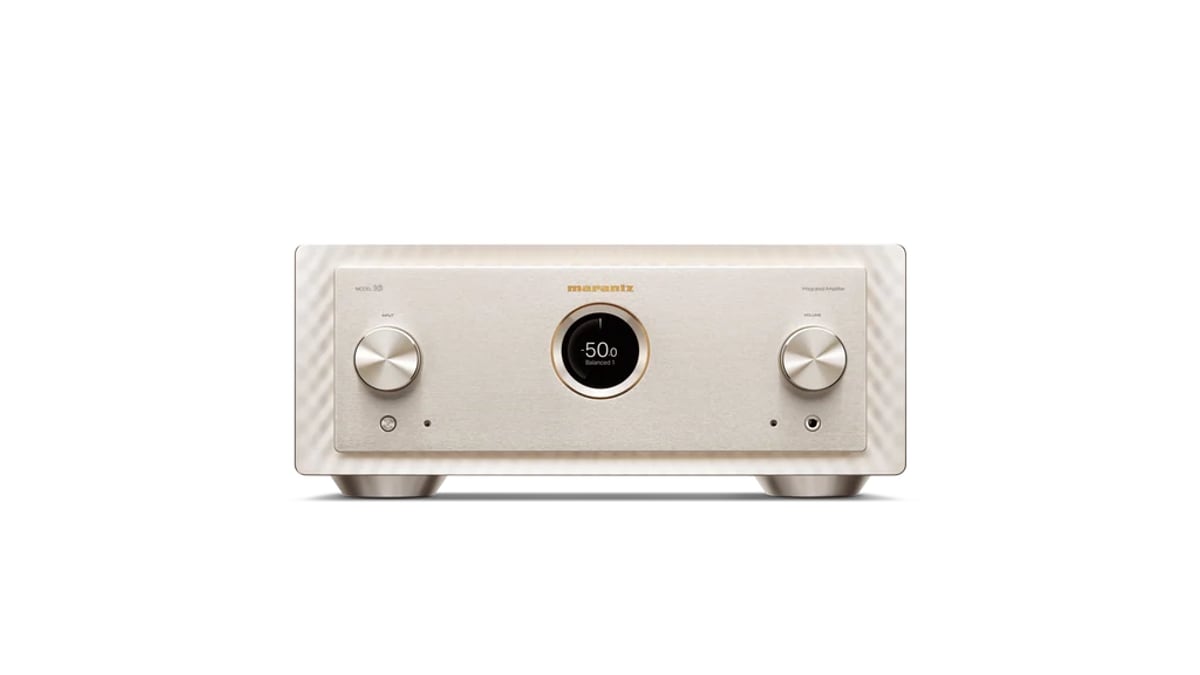
The moment switching amplification stopped being a compromise
There's a particular kind of stubbornness that runs through the high-end audio community, and for two decades it has been aimed squarely at Class-D amplification. The argument was always roughly the same: yes, it measures well; yes, it runs cool and light; yes, the efficiency numbers are impressive — but it doesn't sound right. The top end is glassy. The midrange is thin. It lacks the body and authority of a properly biased Class-A or the muscular warmth of a good Class-AB design. For years, those criticisms had enough truth in them to stick.
Then, quietly, the technology matured. And now Marantz has put a line through the debate in a way that's hard to dismiss: the Model 10, a $15,000 integrated amplifier built around custom Purifi Class-D modules, has just taken the EISA High-End Integrated Amplifier 2025–2026 award. EISA — the Expert Imaging and Sound Association — is not a publication that hands out lifetime-achievement trophies or industry-sponsorship baubles. When their panel of European experts assembles a shortlist of the best products available across every price tier, and the top integrated amplifier slot goes to a Class-D machine, it means something has genuinely changed. The Model 10 isn't a technical curiosity or a value proposition. At fifteen grand, it's occupying the same psychological and financial space as the reference amplifiers that serious listeners build systems around. And it's doing it with switching output stages.
That's the news. Now let's talk about why it matters, what Marantz has actually done here, and what it means if you're thinking seriously about your next integrated amplifier purchase in Australia.
What Purifi brings to the table — and why it's different this time
To understand what the Model 10 is doing, you need to understand Class-D amplification and why Purifi's approach represents a genuine departure from the Class-D designs that earned the technology its early reputation problems.
Traditional Class-D designs — the kind that populated budget home-theatre receivers and powered subwoofers through the 2000s and early 2010s — used relatively simple switching architectures. The output transistors toggled at high frequency, the signal was reconstructed through an output filter, and the result was an amplifier that was efficient and compact but whose distortion characteristics were strongly load-dependent. That last point is critical. A Class-D amplifier whose distortion performance degrades as speaker impedance changes is going to sound different with different speakers, and not always in a flattering way. Real-world loudspeaker loads are messy: impedance varies with frequency, phase angles swing, and an amplifier that can't handle that gracefully will have a measurable and audible character even if it measures beautifully into a resistive test load.
Purifi, the Danish engineering firm co-founded by Bruno Putzeys — the same engineer behind Hypex and a significant chunk of the intellectual foundation of modern Class-D — addressed this directly. Their first-generation Eigentakt modules, and the evolved custom variants that partners like Marantz commission, use a feedback architecture that maintains extremely low distortion across a wide range of load conditions, not just the idealised 8-ohm resistor that most amplifier measurements are taken at. The practical result is an output stage whose distortion floor remains vanishingly low whether it's driving a benign 8-ohm bookshelf or a difficult 2-ohm dip in a complex floorstander's impedance curve.
This is why Purifi modules have started appearing in amplifiers that cost real money. Companies like NAD, with their Masters series, and now Marantz at an even higher price point have recognised that the technology's output-stage performance has crossed a threshold where it's no longer a limiting factor. The question then becomes what you do with the rest of the amplifier — the input stage, the power supply, the physical execution — and that's where the Model 10 becomes interesting.
What Marantz has actually built
The Model 10 is described as the most powerful single-box integrated amplifier Marantz has produced, and the specifications support that. Two hundred and fifty watts per channel into 8 ohms, doubling to 500 watts into 4 ohms. That doubling behaviour — a clean 1:2 ratio as impedance halves — is itself a meaningful indicator of a well-designed power supply and output stage. Many amplifiers that nominally claim high power figures into 8 ohms fail to deliver proportional increases into 4 ohms because the power supply simply can't sustain the current. The Model 10's numbers suggest it's genuinely built to drive demanding loads, which at $15,000 is exactly what you'd expect but not always what you get.
The topology is dual-mono symmetrical — each channel has its own power supply and signal path, kept physically and electrically separate. This matters for a practical reason: crosstalk between channels is one of the ways amplifiers blur the soundstage and imaging that careful speaker placement and room treatment work to reveal. Keeping the channels genuinely isolated rather than sharing a common rail is a design decision that costs money and chassis space, and Marantz has committed to it here.
The chassis itself is aluminium — a sensible choice for RF shielding and mechanical rigidity — and the internal structure incorporates extensive copper shielding. Copper's conductivity makes it effective at containing electromagnetic interference generated by the switching output stages, which is one of the perennial engineering challenges with Class-D designs. If the high-frequency switching noise leaks into the signal path or the analogue input stage, it can manifest as a subtle hardness or grain in the treble. Heavy internal shielding is the mechanical solution to that problem, and the Model 10's weight of roughly 74 pounds tells you that Marantz hasn't skimped on material. For an amplifier based on switching output stages — which are inherently lighter than transformer-heavy Class-AB designs — that figure indicates serious iron in the power supply and substantial chassis construction.
The Purifi modules in the Model 10 are described as custom, tuned by Yoshinari Ogata, who carries the Sound Master designation within the Marantz organisation. That title has genuine significance in context: Marantz's Sound Masters have historically been responsible for the voicing decisions that distinguish Marantz amplifiers from technically similar designs by parent company Denon. The involvement of a Sound Master in tuning the Purifi modules suggests this isn't a case of bolting in off-the-shelf Eigentakt boards and calling it flagship. The modules have been characterised and adjusted to meet specific performance targets in the context of this particular circuit and chassis — which is consistent with how companies like NAD have approached their own Purifi-based designs, but at a higher level of investment and refinement.
The EISA award and what it signals to the market
Awards in audio journalism can mean almost anything, so it's worth being specific about what the EISA High-End Integrated Amplifier category actually represents. EISA panels consist of audio journalists and editors from across Europe, evaluating products on the basis of listening tests and technical assessment against whatever competition exists at the time of judging. The High-End tier isn't bounded by a fixed price ceiling — it's the best integrated amplifier available, full stop. Winning that category with a Class-D design is a statement that the evaluating panel, collectively, found the Model 10 to outperform competitors built on every other output topology available.
That's significant regardless of whether you agree with any individual award decision, because it reflects a shift in expert perception that's been building for several years. The audiophile community's resistance to Class-D has always been partly grounded in experience — the early designs genuinely had weaknesses — and partly in a kind of topology-based tribalism that treated the output device as a proxy for sonic character. What the Model 10's EISA recognition signals is that the last category of resistance — the best amplifiers simply can't use Class-D — is no longer credible. When a $15,000 switching amplifier beats the field in a serious comparative evaluation, the conversation has moved on.
For Australian buyers, this matters in a practical way. The local high-end amplifier market has been conditioned by years of Class-A and Class-AB dominance at the upper price tiers. Brands like McIntosh (check price) have built entire identities around their output stage topologies, and buyers at the $10,000-plus level have tended to see those technologies as part of what they're paying for. The Model 10 is asking you to evaluate amplifiers by their actual performance rather than the technology that generates it — which is, ultimately, the right way to do it.
Who the Model 10 is for, and what you'd pair it with
At $15,000, the Model 10 occupies a price point where the integrated amplifier is typically the centrepiece of a serious two-channel system rather than a component people audition casually. If you're considering it, you're almost certainly pairing it with speakers in a similar or higher price bracket, and you're expecting the amplifier to be a long-term keeper that can drive whatever you eventually throw at it.
The power output — 250 watts into 8 ohms, 500 into 4 — makes the Model 10 genuinely capable of driving loudspeakers that would embarrass more modest designs. Sensitivity and impedance interact in complex ways, and speakers that combine low sensitivity with low or variable impedance can make even nominally powerful amplifiers sound compressed and strained under dynamic peaks. With 500 watts on tap into 4 ohms, the Model 10 can control and drive the kind of demanding floorstanders that reward amplifier authority: the Focal Kanta range, larger Wilson Audio designs, or any number of planars and electrostatics whose impedance curves test output stages thoroughly.
If you're building toward that kind of system and haven't finalised your speaker choice, our guide to the best standmount speakers covers options at various price points that might serve as a reference starting point — though at the Model 10's power level, you're likely looking at full-range floorstanders that can use the available headroom. For context on what a serious single-box streaming solution looks like at a lower price tier, our Marantz Model 40n review (check price) covers the step below in Marantz's own lineup — useful reading to understand how the Model 10 positions within the range and what you're actually getting for the additional outlay.
Upstream source quality becomes important at this level. A $15,000 amplifier will reveal the weaknesses of mediocre digital sources, and if you're feeding it from a streaming source you should be looking seriously at what DAC and streamer combination you're using. Our guide to the best DACs and network streamers covers that territory in detail.
The broader implication: topology anxiety is over
I've been writing about electronics long enough to have watched several technologies go through the same cycle: initial promise, early disappointment, incremental improvement, and then a moment where a product arrives that makes the residual scepticism look like conservatism. Class-D has been in the improvement phase for most of the past decade, but the Model 10's EISA win feels like the moment the cycle completes.
The practical implications extend beyond Marantz. If a Purifi-based design can win the top integrated amplifier award at a serious European evaluation, every major manufacturer now has to reconsider whether Class-D belongs in their flagship lineup. Some — NAD, Mola Mola, Theta Digital — are already there. Others, particularly those whose brand identities are tightly bound to analogue output topologies, will face a harder internal conversation. But the market tends to follow performance, and the Model 10 has established a new reference point.
For Australian buyers, the specific takeaway is this: if you are in the market for a flagship integrated amplifier and you've been reflexively excluding Class-D designs from your shortlist, the Model 10 is the product that should make you stop doing that. Go and listen to it. Evaluate it on what it actually does to music through a good pair of speakers. The output stage topology is, finally, beside the point.
The $15,000 asking price is real money, and there is plenty of excellent competition at and around that level. But competition should be evaluated on performance, and the EISA jury's conclusion — that the Model 10 outperformed the best available alternatives — is not something to dismiss without a serious listen. Marantz and Purifi have together built the clearest argument yet that switching amplification has fully arrived at the top of the single-box world. The burden of proof has shifted.
Common questions
- What makes the Marantz Model 10 different from other Class-D amplifiers?
- The Model 10 uses custom Purifi Class-D modules that have been specifically tuned by Marantz Sound Master Yoshinari Ogata, rather than off-the-shelf switching boards. Combined with a dual-mono symmetrical topology, extensive internal copper shielding, and a power supply capable of delivering 500 watts into 4 ohms, it represents a level of engineering investment in Class-D that goes well beyond typical implementations. The result is an amplifier whose output stage performance remains consistent across varying loudspeaker loads, which has historically been a weakness of switching designs.
- Is $15,000 AUD a realistic price for the Marantz Model 10 in Australia?
- The $15,000 figure reflects the approximate Australian pricing at launch. For context, the UK pricing is around GBP 11,999 and European pricing is approximately EUR 14,499, which positions the Australian price within a reasonable range of those international figures once import duties, GST and distribution margins are accounted for. At that price it sits at the upper tier of the integrated amplifier market, directly competing with established high-end designs from brands like McIntosh, Naim and Hegel.
- What speakers would suit the Marantz Model 10?
- With 250 watts into 8 ohms and 500 watts into 4 ohms, the Model 10 is built to drive demanding loudspeakers that would stress less powerful designs. It's well suited to full-range floorstanders with low sensitivity or complex impedance curves — including larger Focal, Wilson Audio or planar/electrostatic designs. Given the amplifier's power reserve and resolution, matching it with similarly high-calibre speakers is sensible; pairing it with entry-level standmounts would leave most of its capability unused.
- Why does the EISA award matter for the Marantz Model 10?
- EISA — the Expert Imaging and Sound Association — is a panel of audio journalists and editors from across Europe who evaluate products through listening tests and technical assessment. The High-End Integrated Amplifier category has no fixed price ceiling; it recognises the best integrated amplifier available regardless of cost or topology. The Model 10 winning this award with Class-D output stages signals a meaningful shift in expert consensus: switching amplification is no longer considered a compromise at any price point, including the very top of the single-box integrated market.

I'm Marcus, and I'll be honest up front: I trust a measurement before I trust my own ears, because my ears lie to me daily. I spent fifteen years designing audio electronics before I started writing about them, so when a brand tells me a number, I want to see the graph. That doesn't make me cold about this hobby — I love a system that disappears as much as anyone — it just means I'll tell you when an expensive box is selling you confidence rather than performance.
Former audio electronics engineer; objectivist; runs the test bench
More from Marcus Vale
 First reflections: finding them with a mirror before you buy any panelsBefore you spend a cent on acoustic panels, find your actual first reflection points with a mirror and a torch. Here's the method, and why it beats guessing.
 Headphone impedance and power: why your amp's output matters more than wattsWatts on a spec sheet don't predict how a headphone amp will actually drive your cans. Here's the impedance and output-impedance story that does.
 Why your multiroom volumes never match (and how to actually fix it)Same track, same app, different loudness in every room. Here's the actual engineering reason multiroom volume matching fails, and how to fix it properly.
- Speaker cable gauge and length: when it actually changes what you hearSpeaker cable gauge and length can measurably shift frequency response over long runs. Here's the maths, the thresholds that matter, and where to stop spending.
 Lip sync and audio delay: why your AVR's setting isn't the whole fixYour AVR's lip-sync slider only fixes part of the chain. Here's where audio delay actually comes from and how to measure it properly.
 Damping factor and output impedance: what actually happens at the speaker terminalDamping factor gets thrown around like a quality score. It isn't. Here's what the number actually measures and when it matters.