Damping factor and output impedance: what actually happens at the speaker terminal
I had an email a few weeks back from a reader in Ocean Grove asking why his new integrated amp, spec'd at a damping factor of over a thousand, sounded "looser" in the bass than the twenty-year-old amp it replaced, which claimed a damping factor of about eighty. He wanted to know if the spec sheet was lying. It wasn't lying, but it also wasn't measuring what he thought it was measuring — and that gap is where a lot of amplifier folklore lives.
Damping factor is one of those numbers that gets printed on spec sheets like a badge of honour, then largely ignored by the engineers who actually design the amplifiers. I spent fifteen years on that side of the bench, and I can tell you the number matters, just not in the way most marketing implies. Let's get into what it actually measures, why it interacts with your speaker cable and crossover in ways that swamp the headline figure, and why valve, solid-state and Class D topologies handle this differently for reasons that have nothing to do with which one is "better."
What damping factor actually is
Damping factor is simply the ratio of your speaker's nominal impedance to the amplifier's output impedance. If your speaker is 8 ohms and the amp's output impedance is 0.1 ohms, you get a damping factor of 80. If the output impedance drops to 0.01 ohms, the damping factor jumps to 800. That's the entire calculation — it's an inverse measure of output impedance, dressed up as its own spec.
The engineering purpose is real, though. When a woofer cone stops moving after an impulse, it doesn't stop instantly — it has mass, suspension compliance and a voice coil that keeps generating back-EMF as it continues to move in the magnetic field. A low-impedance amplifier output effectively short-circuits that back-EMF, using the amp's own low impedance to brake the cone electrically. High output impedance leaves that back-EMF with nowhere useful to go, and the cone rings on for longer than it should. In principle, more damping means tighter control of the driver, particularly in the bass where cone excursion is largest.
In principle. In practice, once your damping factor climbs past roughly 20, you're deep into diminishing returns, and here's why.
Your speaker cable eats the number before it reaches the driver
This is the part the spec sheet conveniently leaves off. The amplifier's output impedance is only one part of the total series resistance between the amp and the voice coil. Your speaker cable adds its own resistance, and so does the crossover network — inductor DC resistance, in particular, can run to a full ohm or more in a passive two-way design.
Take a real example. A thin-gauge speaker cable — the sort of budget stuff people buy in a hurry from a hardware aisle — run five or six metres to a rear surround pair, can easily add 0.3 to 0.5 ohms of series resistance. Against an amplifier with a genuine 0.01 ohm output impedance and an 8 ohm speaker, that amplifier's own contribution to total damping factor was theoretically 800. Add the cable resistance and the effective damping factor at the speaker terminal falls to somewhere around 16 to 25. The thousand-point spec on the amplifier's data sheet was never going to survive contact with the actual system.
This is the answer I gave the Ocean Grove reader, more or less: his older amp's damping factor of eighty was already well past the point where cable and crossover resistance dominate the outcome. The newer amp's headline number of a thousand-plus was true and also almost entirely irrelevant, because by the time the signal reached the woofer, both amplifiers were probably landing in a similar effective range. Whatever difference he was hearing was more likely down to voicing, feedback topology or the speaker's own behaviour than to that spec.
Why valve amplifiers behave differently, and why that's not automatically a flaw
Valve amplifiers, particularly those without large amounts of global negative feedback, typically present output impedances in the range of 1 to 4 ohms rather than the fractions of an ohm you'll see from solid-state designs. That gives damping factors in the low single digits to perhaps 8 or so on an 8 ohm speaker — nowhere near the solid-state numbers, and by the letter of the spec, "worse."
But output impedance doesn't just affect bass control. It also interacts with the impedance curve of the speaker itself across the whole frequency range, not just at DC. Real loudspeakers don't present a flat 8 ohm load — impedance swings with frequency, often dipping toward 4 ohms in one region and rising above 20 ohms near the crossover point or driver resonance. When an amplifier has meaningful output impedance, that varying load creates a voltage divider that isn't constant, so the amplifier's actual output level shifts slightly at different frequencies depending on the speaker's impedance curve at that frequency.
For a solid-state amp with near-zero output impedance, that effect basically doesn't happen — the amp is close enough to an ideal voltage source that the speaker's impedance swings don't shape the frequency response. For a valve amp with 2 ohms of output impedance, they do, and the result is a small, speaker-specific response tilt, often a slight lift where impedance rises. That's part of why the same valve amplifier can sound noticeably different driving two different speaker models, in a way that's more audible than swapping a low-impedance solid-state amp between the same two speakers.
Is that a flaw? I'd argue it's a genuine electrical trait rather than a defect, and pretending otherwise misses the point. It's why matching a valve amplifier to a speaker is its own discipline — our piece on valve amplifiers and loudspeakers goes into which speaker impedance behaviours pair well and which fight the amp. Some listeners actively prefer what a moderate output impedance does to a given speaker's balance. I'm not going to tell you that preference is wrong, because it isn't measurably wrong — it's a different, legitimate way of interacting with the load. I will tell you it's not "more damping equals more accurate" in any way the number defends.
Class D and the output filter question
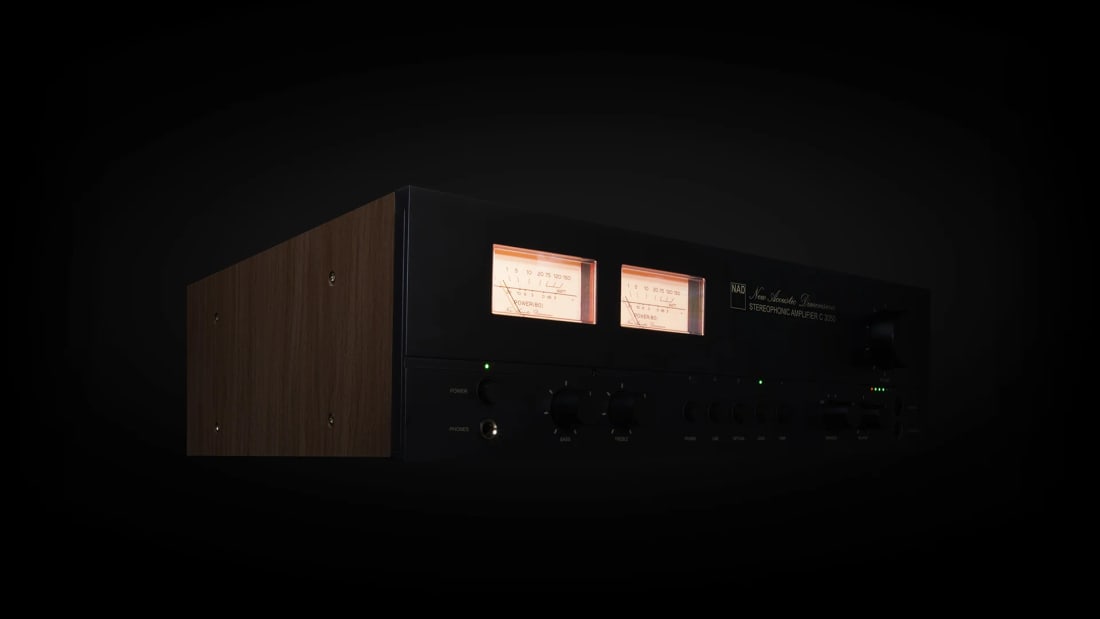
Class D amplifiers earned an early reputation for loose, ill-defined bass, and a chunk of that reputation was genuinely about output impedance and filter interaction, not just prejudice. Because Class D amps switch at high frequency and need an output low-pass filter (typically an LC filter) to strip the switching noise before it reaches the speaker, early designs without enough feedback around that filter would let the filter's own frequency response interact with the speaker's impedance curve — not unlike the valve amp scenario above, but for different underlying reasons. Current-generation Class D designs, including the modules used in a lot of respected integrated amplifiers now on the market, apply global feedback that includes the output filter within the loop. That drives output impedance down to solid-state Class AB territory or lower, and the damping factor specs on amps like the NAD C 3050 (check price) or the amplifier stage in something like the Naim Uniti Atom (check price) reflect that. The old "Class D equals soggy bass" line is outdated as a blanket statement — it depends entirely on the specific implementation, same as it always has for any topology.
Where this actually shows up in a buying decision
Honestly, for the vast majority of speaker and amplifier pairings in a normal Australian lounge room, damping factor as a spec is not something I'd let move a buying decision. What I would look at instead:
Whether the amplifier's output impedance is stable across the audio band or rises at high frequencies — some designs, particularly those relying heavily on feedback correction, show output impedance creeping up above 10-20kHz, which matters more for tweeter behaviour than most people assume. Whether the speaker you're pairing has a genuinely difficult impedance curve — some standmounts, including a few reviewed on this site like the KEF LS50 Meta (check price), are engineered to present a fairly benign, amplifier-friendly load, while some larger floorstanders with complex crossovers can dip uncomfortably low and swing widely, which is where amplifier output impedance and current delivery both start to matter together, not damping factor in isolation.
And practically: use decent-gauge speaker cable for any run over three or four metres, because that's genuinely more likely to move your effective damping factor than swapping amplifiers within the same topology. This isn't an argument for exotic cable — AS/NZS wiring standards and basic electrical theory cover it fine, you just want adequate cross-sectional area for the run length, nothing more mystical than that.
The number I'd actually ask a manufacturer for
If a spec sheet quotes damping factor, I want to know at what frequency it was measured, because a figure quoted only at 1kHz tells you nothing about behaviour at 20Hz or 20kHz. Reputable manufacturers with proper measurement documentation — Rotel and NAD have both published this kind of detail in service literature over the years — will show output impedance as a curve across frequency, not a single number at 1kHz that happens to look good in a table. That curve tells you whether the amplifier holds its damping character consistently or whether it's a headline figure that quietly degrades exactly where speaker impedance gets complicated. For reference on how amplifier output stage design affects this more broadly, the AES has published technical papers on feedback and output impedance behaviour that go well beyond what a one-line spec can convey — see the Audio Engineering Society's technical library for the deeper reading if you want to go down that path.
So does it matter at all?
Yes, but as one input among several, not a leaderboard stat. If you're pairing an amplifier from our best streaming amplifiers roundup with a modern standmount, you're very unlikely to run into a damping-factor problem regardless of which one you choose — the numbers on offer are all well past the point of audibility for that specific mechanism. Where it earns real attention is at the edges: long cable runs to surrounds in a home cinema build, valve amps on speakers with unusually reactive crossovers, or budget Class D designs that skimped on the output filter feedback loop. Everywhere else, I'd spend your attention on the things that actually separate amplifiers audibly — noise floor, distortion behaviour under real loads, and how the amp's current delivery holds up into a 4 ohm dip — rather than chasing a damping factor number into the thousands. My ears might occasionally lie to me, but this particular spec has been lying to buyers for longer.
— Marcus Vale, Editor · Electronics & Measurement
Common questions
- Is a higher damping factor always better?
- Not in any way that matters past a certain point. Once you're above roughly 20, the difference at the voice coil is dominated by your speaker cable and crossover resistance, not the amplifier. A spec of 400 versus 4000 tells you almost nothing about how an amplifier will sound.
- Why do valve amplifiers sound different on the same speaker as a solid-state amp?
- Mostly because of output impedance. A valve amp with an output impedance of 1-2 ohms interacts with the impedance swings in your speaker's crossover, producing small frequency response deviations that solid-state amps with near-zero output impedance don't produce. It's not that one is 'right' — they're doing genuinely different things electrically.
- Does speaker cable gauge matter more than damping factor?
- For any reasonable cable run in a domestic room, yes. A thin, long run of cable can add more series resistance than the amplifier's entire output impedance, which does more to erode a headline damping factor number than the amplifier's own design.
- Do Class D amplifiers have worse damping factor than Class AB?
- Not inherently. Modern Class D designs using global feedback around the output filter can post very high damping factor figures, sometimes higher than Class AB amps. Early Class D designs earned a reputation for loose bass partly because of output filter interaction with speaker impedance, but that's largely been engineered out in current designs.

I'm Marcus, and I'll be honest up front: I trust a measurement before I trust my own ears, because my ears lie to me daily. I spent fifteen years designing audio electronics before I started writing about them, so when a brand tells me a number, I want to see the graph. That doesn't make me cold about this hobby — I love a system that disappears as much as anyone — it just means I'll tell you when an expensive box is selling you confidence rather than performance.
Former audio electronics engineer; objectivist; runs the test bench
More from Marcus Vale
 Why your turntable's earth wire isn't optionalTurntable earthing fixes most phono hum problems. Here's how grounding actually works, why it fails, and how to track down a noisy connection.
 Why your AVR runs cool on music but throttles on AtmosAVR thermal throttling explained: why nine-channel Atmos mixes push receivers into protection mode that two-channel music never triggers.
- Subwoofer delay settings: why your AVR's number is a guessAVR auto-calibration estimates subwoofer delay from distance, not timing. Here's how to measure and correct it properly for tighter bass.
- AVR auto-calibration: what Audyssey, YPAO and Dirac actually measureAudyssey, YPAO and Dirac Live all run a mic sweep and spit out numbers, but they're not measuring the same things or fixing the same problems. Here's what's actually happening.
- Cartridge break-in: what actually changes in the first 40 hoursDoes a new cartridge really need 40 hours to "open up"? I measured one to find out what's mechanical fact and what's audiophile folklore.
- DAC output stages: what the chip doesn't tell youThe DAC chip gets all the marketing attention, but the analogue output stage after it does most of the work shaping what you actually hear.