NAD C 589 CD player: QRONO d2a and an ESS Sabre DAC
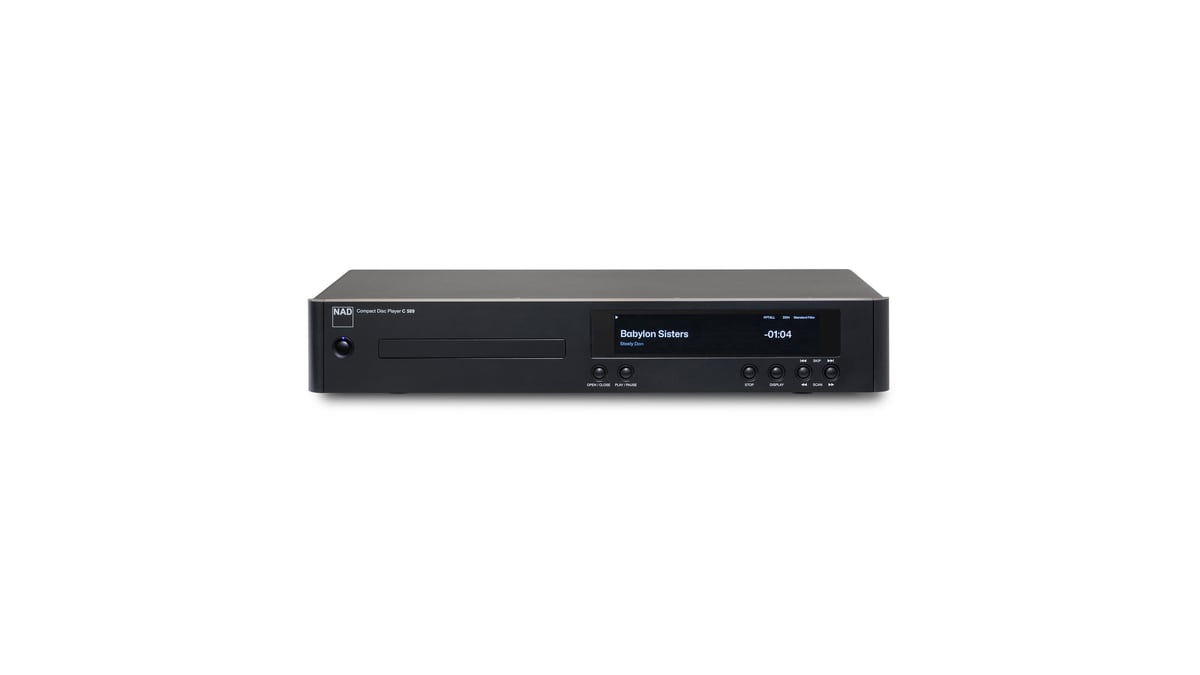
Why the NAD C 589 matters
On April 22, 2026, NAD announced the NAD C 589, a dedicated CD player positioned at the upper end of the brand's Classic Series. Priced at US$1,399 / CA$1,999 / £1,199 / EUR 1,599, it sits in a market segment that many predicted would be a ghost town by now. Yet here we are, and frankly it's a more interesting announcement than the price tag alone suggests. The reason is the technology under the bonnet: NAD has chosen to integrate MQA Labs' QRONO d2a digital reconstruction technology alongside an ESS Sabre DAC, a pairing that raises genuine questions about where both CD playback and MQA's commercial future are headed.
Let's be honest. When MQA's parent company, Meridian's spin-off MQA Ltd, went into administration in mid-2023, a lot of people assumed the format and its associated intellectual property would be quietly buried. The fact that MQA Labs has re-emerged as a licensing entity, and that a major mainstream brand like NAD is now shipping product with their QRONO d2a processing baked in, is genuinely newsworthy. It signals that the underlying digital reconstruction mathematics that MQA developed haven't simply evaporated, even if the streaming-format angle remains contentious. We've covered how the dust settled in the end of the MQA era and where QRONO landed.
Understanding QRONO d2a: not your father's MQA
To appreciate what QRONO d2a actually does, it helps to briefly revisit what MQA always claimed was its core proposition, and to separate that from the streaming codec controversy that ultimately damaged the brand so severely.
MQA's engineers were, from the beginning, primarily concerned with what they called "temporal blur" in digital audio. The idea was that conventional digital-to-analogue conversion introduces time-domain errors that smear transient information in ways that are audible even when frequency-domain measurements look clean. Their argument, reduced to its essentials, was that the filters used in the recording chain and in playback introduce pre-ringing and post-ringing artefacts that conventional PCM measurements don't fully capture. Whether you agreed with MQA's conclusions or not, the underlying research into digital filter behaviour and minimum-phase reconstruction was taken seriously by a meaningful portion of the engineering community. The Wikipedia entry on Master Quality Authenticated sets out the format's claims and the criticism in one place.
QRONO d2a appears to be MQA Labs' attempt to distil those timing and reconstruction ideas into a processing layer that works with standard CD audio, Red Book PCM, rather than requiring a proprietary encoded stream. In other words, it's decoupled from the MQA codec itself. You don't need a file tagged as MQA. You don't need a streaming service to send you an MQA-encoded track. The QRONO d2a processing operates on the incoming digital signal and applies its reconstruction algorithms before handing off to the DAC chip. For a CD player, that's the entire proposition: take the 16-bit/44.1 kHz Red Book data off the disc, apply QRONO d2a reconstruction, and convert to analogue via the ESS Sabre DAC.
This is a meaningful distinction, and it's worth dwelling on. The most vociferous critics of MQA, and there were many well-informed ones, objected primarily to the format as a gating mechanism for hi-res content, the way it encoded additional information that required a licensed decoder to access, and the commercial model that put MQA Ltd between the listener and their music. QRONO d2a, as deployed in the C 589, sidesteps all of that. There's no proprietary stream, no tier of access, no codec to decode. If the processing delivers on its promise, listeners simply benefit from it. If it doesn't, they've lost nothing except some confidence in NAD's engineering decisions.
For a deeper grounding in what digital reconstruction actually involves at the converter level, our Digital-to-Analogue Converter explainer is worth reading alongside this piece. It covers the fundamental trade-offs in filter design that QRONO d2a is specifically trying to address. And if you want to understand why bit depth and sample rate interact with reconstruction in ways that matter at the Red Book ceiling, our Bit Depth & Sample Rate glossary entry gives solid context.
How reconstruction filters shape CD sound
A short detour helps here, because the whole QRONO argument lives or dies on filtering. A compact disc stores audio as discrete samples, and a DAC has to turn those samples back into a smooth analogue waveform. To do that it uses a reconstruction filter, which removes the unwanted images that sampling creates above half the sample rate. The catch is that a very steep filter, one that cuts those images hard, tends to add ringing before and after sharp transients. A gentler filter reduces that ringing but lets more unwanted content through or rolls off the top end sooner.
That trade-off is old, and every DAC designer makes a call on it, whether through an on-chip filter, a custom digital filter or a selectable set of options. It's why two players using the same chip can sound different. If you want the longer version, our piece on jitter, oversampling and filters walks through which of these specifications actually deserve your attention. My own view is that filter choice is one of the more audible levers in digital playback, and also one of the least honestly explained on spec sheets.
The ESS Sabre DAC pairing
NAD has paired the QRONO d2a processing with an ESS Sabre DAC, a sensible choice, and one with some interesting technical logic to it. ESS Technology's Sabre DACs have long been associated with extremely low noise floors and high dynamic range, characteristics that their HyperStream architecture is specifically engineered to deliver. They're also well-regarded for their on-chip jitter reduction, which uses ESS's own Time Domain Jitter Eliminator circuit. Whether or not QRONO d2a does something complementary or partially overlapping with that jitter reduction is an interesting question that will require proper bench testing to answer.
At the US$1,399 price point, NAD would typically be deploying a capable but mid-tier ESS Sabre part, probably something in the ES9038 family, though NAD haven't specified the exact chip at the time of writing. What I'd want to know, and what will become clear once review samples ship, is how much of the signal chain NAD has kept in the analogue domain post-conversion, and how the output stage has been implemented. ESS Sabre DACs can sound quite different depending on the care taken with the I/V conversion and analogue filtering that follows the chip. A Sabre-based player can sound lean and analytical, or it can sound full and musical. The chip is only part of the story, a point we make at greater length in DAC chips versus DAC engineering.
The broader CD revival context
The C 589 doesn't arrive in a vacuum. The CD revival, and it is a genuine revival however much it amuses streaming-native listeners, has been gathering momentum for several years now. Physical media sales of CDs have been ticking upward in several markets, driven partly by a generation of listeners who grew up with streaming and are now craving something tangible and permanent. The used CD market is thriving. Manufacturers who had wound back their CD player lines are quietly restocking them.
NAD, to their credit, never entirely abandoned the format. The C 568 that preceded this model was a competent if unexciting performer at a lower price. The C 589 represents a clear step up in ambition. The QRONO d2a integration isn't cheap to licence, and choosing an ESS Sabre DAC over a more budget-oriented alternative signals genuine engineering intent.
It's worth contextualising the C 589 within the broader landscape of what AU buyers can access at similar money. In Australia, the price hasn't been officially confirmed at time of writing, but working from typical AU:USD conversion and import margins, expect something in the AU$2,199–$2,499 range when it lands locally. That puts it in direct competition with a cluster of well-regarded integrated options and standalone DAC-transport combinations. If you're building a system around the C 589, pairing it with a capable integrated amplifier and a strong standmount speaker becomes the natural conversation. Our guide to the best DACs and network streamers covers the competitive landscape for sources at this level, and is worth cross-referencing when you're working out where the C 589 sits relative to streaming alternatives.
MQA Labs' commercial rehabilitation
Let's address the elephant in the room directly. MQA as a company had a very public and damaging collapse. The technical credibility of their research was caught up in a firestorm of legitimate criticism about their business practices, their opacity around licensing, and their insistence on codec adoption as a condition of accessing hi-res content. By the time the company went under, a significant proportion of the enthusiast community had written off anything with the MQA name attached. Our analysis of what the MQA collapse tells us about hi-res audio goes into that fallout.
MQA Labs appears to be operating differently, positioning itself as a pure technology licensor rather than a content gatekeeper. The QRONO brand is new, and the d2a product is specifically designed to be codec-agnostic. Whether this repositioning succeeds commercially will depend on whether other manufacturers pick it up, and whether listeners can be persuaded to evaluate the technology on its own merits rather than through the lens of the original MQA controversy.
NAD adopting it is a meaningful signal. NAD is owned by Lenbrook Group, which also owns Bluesound and PSB, giving it meaningful distribution reach. If the C 589 sells well and QRONO d2a gets positive reviews, you'd expect to see it appear in other Lenbrook-family products. That's the real test of whether this technology has legs beyond the C 589 launch.
For readers who want to understand Master Quality Authenticated technology in its original form and the history behind it, our glossary entry covers the technical claims and the format's evolution in fair detail.
What Australian buyers should consider
If you're in the market for a dedicated CD player in the AU$2,000–$2,500 range, the C 589 is immediately one of the most technically interesting options. The combination of QRONO d2a processing and an ESS Sabre DAC is genuinely novel at this price, and NAD's build quality and after-sales support in Australia, handled through Convoy International, is well established.
A few practical considerations worth thinking through before committing:
- System matching: The C 589 is a source component; its performance will be constrained by whatever comes after it. At this price point, you want an amplifier capable of resolving the improvements that QRONO d2a processing claims to offer. Pairing it with something underpowered or congested in the midrange will obscure precisely the temporal and transient improvements the processing is designed to deliver.
- The streaming alternative: It's worth being honest with yourself about how much of your listening is from CD versus streaming. If you have a large physical collection and genuinely prefer disc-based playback, the C 589 is a compelling investment. If you're playing three or four CDs a month, a high-quality streaming DAC at similar money might serve you better. Our guide to streaming amplifiers and all-in-one systems covers that alternative path thoroughly.
- Audition availability: Given that QRONO d2a is a new and largely unreviewed technology in consumer products, I'd strongly encourage an in-store audition before buying. The claims around digital timing and temporal reconstruction are real claims that produce either audible differences or they don't, and at AU$2,000-plus, you should hear it for yourself rather than relying entirely on spec sheets.
- Resale and longevity: CD players occupy an interesting position in the used market. A quality player from a reputable brand at this price tends to hold value reasonably well as physical media interest continues its recovery. The ESS Sabre DAC is a known quantity with strong driver support. The QRONO d2a element adds some uncertainty, but NAD's warranty and Convoy's local service network mitigate that to a reasonable degree.
The technical verdict, preliminarily
Without a review sample in hand, I'm not in a position to tell you whether QRONO d2a processing delivers audible improvements over a conventional ESS Sabre implementation. What I can say is that the theoretical basis for the technology is more grounded than a lot of the marketing language around DAC performance tends to be. The questions being asked about digital filter behaviour, pre-ringing, and temporal accuracy at the reconstruction stage are real questions with real engineering answers, and the people at MQA Labs who developed this work have relevant credentials.
The ESS Sabre DAC partnership is encouraging. ESS's architecture has a proven track record across a wide range of implementations, from budget portables to flagship separates. What NAD does with the analogue output stage will be at least as important as the chip choice, and that's what reviewers will be scrutinising closely when samples land.
At US$1,399, and whatever that translates to in Australian dollars once it's officially listed locally, the C 589 needs to justify its price against both the previous generation of NAD CD players and the broader competitive set. The QRONO d2a processing gives it a genuine point of differentiation that isn't just a marketing claim; it's a licensable technology with a defined set of engineering goals. Whether it delivers on those goals in practice is the question a proper review will answer.
For now, the C 589 is the most interesting CD player announcement of 2026, and possibly the most interesting deployment of MQA Labs technology since the original company's collapse. Both of those things are worth paying attention to.
Common questions
- What is QRONO d2a processing and how is it different from original MQA?
- QRONO d2a is a digital reconstruction technology developed by MQA Labs — the company that emerged from MQA Ltd's intellectual property after the original firm went into administration. Unlike the original MQA codec, which required specially encoded audio files and licensed decoders to unlock hi-res content, QRONO d2a works with standard PCM audio including Red Book CD data. It applies MQA Labs' digital filter and timing reconstruction algorithms to the incoming signal without requiring any proprietary file format or streaming tier. In the C 589, it processes the CD data before passing it to the ESS Sabre DAC.
- When will the NAD C 589 be available in Australia and what will it cost?
- NAD announced the C 589 on April 22, 2026, with pricing confirmed at US$1,399 / CA$1,999 / £1,199 / EUR 1,599. An official Australian recommended retail price had not been announced at time of writing. Based on typical AU import margins and currency conversion, expect it to land somewhere in the AU$2,199–$2,499 range. For availability and local pricing, contact NAD's Australian distributor Convoy International or check with your local NAD dealer.
- Is the NAD C 589 worth buying if I already have a good streaming DAC?
- That depends on how much of your listening comes from physical CD. The C 589 is specifically optimised for disc playback, with its QRONO d2a processing and ESS Sabre DAC combination designed to extract the best from Red Book PCM. If you have a large CD collection and value physical media, it makes a strong case for itself. If your CD listening is occasional and streaming is your primary source, a dedicated network streamer or streaming amplifier at similar money is likely to serve your listening habits better.
- What DAC chip does the NAD C 589 use?
- The C 589 uses an ESS Sabre DAC. NAD has not specified the exact chip model at the time of the announcement. ESS Sabre is a well-regarded family of DAC chips known for low noise floors, high dynamic range, and the brand's own jitter-reduction circuitry. The specific performance of the C 589 will also depend significantly on how NAD has implemented the analogue output stage following the DAC chip, which is typically where the sonic character of an ESS-based design is shaped.

Theo here. By day I write software, by night I argue with people on forums about whether bit-perfect playback is "solved" (it mostly is, and then it isn't). I cover the digital end — DACs, streamers, servers, the whole messy ecosystem of getting a file to sound its best. My promise to you: I'll separate the genuine engineering from the audiophile folklore, and I'll never tell you a $500 streaming bridge sounds "blacker" unless I can explain why.
Software engineer; network-audio and DAC specialist
More from Theo Mensah
 Dongle DAC power limits: when a phone can't drive headphonesDongle DACs are brilliant until they aren't. Here's how to work out whether your phone-and-dongle rig actually has the current to drive your headphones.
 DNS and multiroom: why your streamer drops out at the worst timeMultiroom dropouts are rarely your Wi-Fi. Here's why DNS resolution quietly breaks streaming apps, and how to fix it for good.
- Parallel vs series IEM crossovers: why multi-driver in-ears sound so differentWhy do two IEMs with the same driver count sound nothing alike? The crossover topology is doing more work than the drivers themselves.
- Streaming a subwoofer's EQ filters: why your network player might be the bottleneckYour sub's miniDSP or app-based EQ can only act on a signal your streamer hasn't already mangled. Here's where network audio and bass management actually interact.
 Amplifier gain structure: the setting that decides your noise floorGain mismatches between DAC, preamp and power stage quietly wreck dynamic range. Here's how to actually set gain structure instead of guessing at the volume knob.
 Bass management by the numbers: what your AVR's crossover and slope actually doCrossover frequency gets all the attention, but slope, distance settings and speaker size flags quietly decide whether your bass management works or fights itself.