Arcam A50 Signature and CD25 mark 50 years
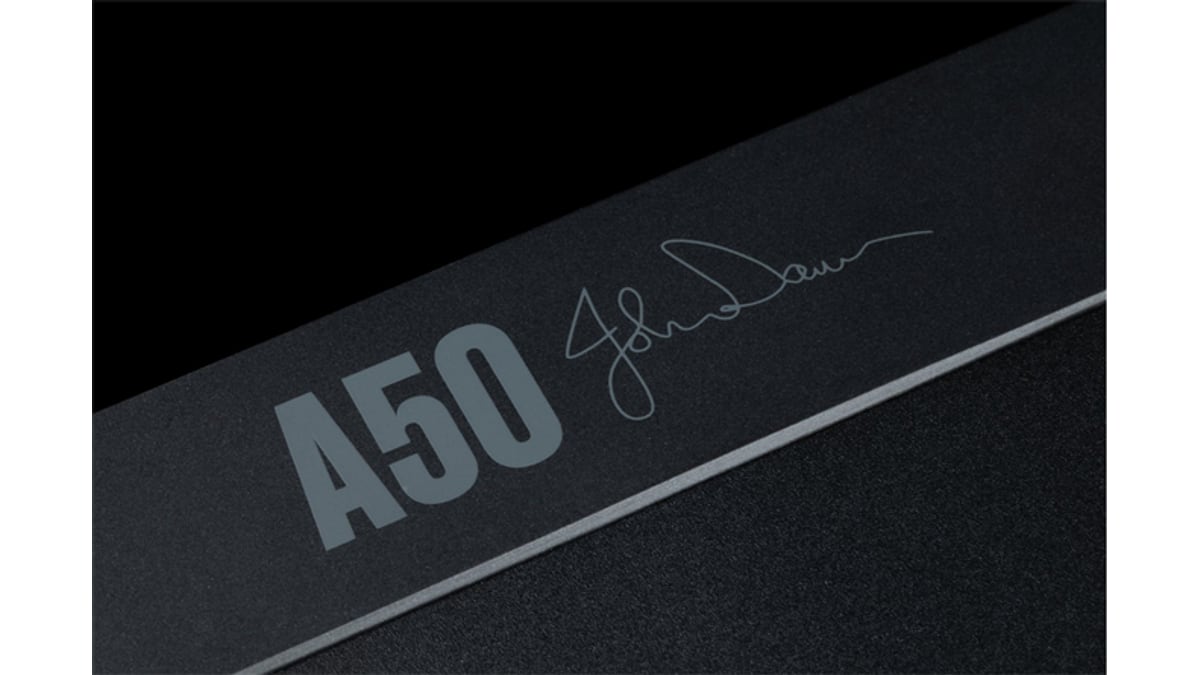
Half a century, two new products, and a signature that means something
There are anniversaries that amount to little more than a logo refresh and a press release, and then there are the ones where a brand takes the occasion seriously, where the milestone becomes the mandate to make something genuinely worth celebrating. Arcam, the Cambridge-born British electronics house, has emphatically chosen the latter path. At HIGH END Vienna 2026, the company made its global debut with two new products: the Arcam A50 Signature integrated amplifier and the CD25 CD player. Together, they mark Arcam's 50th year in business, and together they say something meaningful about where the brand stands and, perhaps more importantly, where it believes serious listening still lives.
For Australian enthusiasts, the timing matters. Both products are slated to reach dealers in Q3 2026, meaning the wait from announcement to audition is genuinely short. Pricing has been confirmed at $2,999.95 for the A50 Signature and $1,799.95 for the CD25. At those figures, Arcam is entering a stretch of the market where competition is fierce and expectations are high, a stretch I spend a significant amount of my time thinking about. Here is why I think these two products are worth your attention.
Why Arcam's 50th is a real milestone
Founded in Cambridge in 1976, Arcam grew out of the same fertile engineering culture that gave the world a number of enduring British audio brands. The company built its reputation methodically, on integrated amplifiers, CD players and AV receivers that punched above their price point with unusual consistency. For decades, an Arcam integrated was a standard recommendation for anyone who wanted to spend sensibly but not carelessly. The brand's Delta and Diva series became touchstones for a particular kind of British restraint: not flashy, not overbuilt, but honest and musical in a way that held up across years of listening.
That the company has reached 50 years is notable in itself. The high-end audio industry is littered with brands that burned bright and collapsed, or were absorbed and hollowed out. Arcam has changed ownership, shifted direction and adapted to the streaming era, but it has maintained a recognisable engineering identity. The Radia Series, of which the A50 Signature is now the flagship, is the clearest expression of the modern Arcam: technically ambitious, visually composed and aimed squarely at the serious enthusiast who wants a component, not a lifestyle object. If you want to see how that range has been extended elsewhere, our look at Arcam's Radia line in home cinema covers the other side of the family.
What gives the anniversary products particular weight is the direct involvement of co-founder John Dawson. His signature appears on the rear cowl of the A50 Signature and on its PCBs, not as a marketing gesture, but as a statement of authorship. In an industry where founding engineers are sometimes reduced to brand ambassadors, having Dawson's literal mark on the circuitry is a meaningful signal about what kind of product this is.
The Arcam A50 Signature: dual-mono Class G and what that actually means
The headline engineering story of the A50 Signature is its fully dual-mono Class G architecture. Both of those descriptors deserve unpacking, because they go to the heart of what Arcam is claiming, and what you should be listening for when you audition one.
Dual-mono construction means the left and right channels are kept entirely separate from one another throughout the amplifier's signal path, each with its own power supply and gain stages. The practical benefit is a reduction in crosstalk (the contamination of one channel's signal by the other) and a corresponding improvement in soundstage and imaging. When a design is genuinely dual-mono rather than merely claiming the label, instruments and voices sit more precisely in the stereo field, and complex passages resolve with greater clarity. It also tends to improve the sense of each channel having authority and grip independent of the other, which becomes especially apparent at higher volumes.
Class G is perhaps less familiar to some listeners than Class A or Class AB. To understand it properly, it helps to understand the broader landscape of amplifier classes, and the power amplifier classes overview on Wikipedia is a handy reference. Where Class A runs its output transistors continuously at full bias (maximally linear, maximally hot, maximally inefficient), and Class AB switches between two sets of transistors (a useful compromise), Class G adds multiple supply rail voltages that the amplifier switches between depending on the signal level. At low volumes it draws from a lower voltage rail, consuming less power and generating less heat; when the signal demands it, the amplifier steps up to a higher rail. The result is the efficiency of a lower-class design at typical listening levels with the headroom and dynamic capability of a higher-powered one when the music calls for it.
Arcam has used Class G in its higher-end integrated amplifiers for some years now, and it is genuinely well-suited to the kind of music listening where dynamics matter: orchestral music, live recordings, anything with genuine transient peaks. The A50 Signature, as the pinnacle of the Radia Series, presumably represents the fullest and most refined implementation of this approach to date.
At $2,999.95 in the Australian market, the A50 Signature occupies genuinely interesting territory. It sits below the price point where you'd be looking at something like the McIntosh MA352 (check price), which is a different kind of proposition entirely, a statement piece as much as a component. It sits above the streaming-integrated all-in-one space occupied by products like the Marantz Model 40n (check price). What Arcam appears to be offering is a purist, engineering-led integrated amplifier where every dollar has gone into the circuit rather than the feature set. That is a specific value proposition, and it will resonate strongly with a particular kind of buyer. For comparison shopping across the category, our guide to the best integrated amplifiers is the place to start.
Speaker matching: what the A50 Signature wants
A dual-mono Class G integrated in this price range deserves partners that will reveal what the architecture is actually doing. My instinct is to pair it with something that has sufficient sensitivity and a relatively benign impedance curve, the kind of speaker that will let the amplifier's low-crosstalk, high-headroom character express itself rather than fighting to control a difficult load.
The best standmount speakers for serious listening in this price range tend to be strong candidates. A quality two-way monitor on a solid stand gives you that precise imaging benefit I described above. It's a combination where the dual-mono architecture of the A50 Signature can genuinely add something you'll hear. Larger floorstanders are also worth exploring, provided the listening room is appropriately sized and treated. But for an initial audition, I'd be gravitating toward a revealing standmount that doesn't demand enormous current delivery.
The CD25: on the return to physical media
Perhaps the more culturally pointed of the two announcements is the CD25. Arcam, a brand that made its name in the CD era, is in 2026 returning to a dedicated CD player, and pricing it at $1,799.95. This is not a defensive move. It is a considered one.
The received wisdom in mainstream consumer technology is that physical media is finished. Streaming has won. And at the mass-market level, this is largely true. But the high-end audio market has never tracked the mass market particularly closely, and the persistent interest in CD, and indeed in formats like SACD and vinyl, among serious listeners reflects something the streaming conversation tends to underweight: ownership, tangibility, and the sonic ceiling of a well-mastered disc played on a capable transport and digital-to-analogue converter. The Compact Disc format has a long documented history, and it has outlasted several predictions of its demise.
CD, when done properly, is a 16-bit, 44.1kHz format that can sound extraordinary. The gap between a mediocre CD player and a well-engineered one remains clearly audible, particularly in areas like transport stability, jitter rejection, and the quality of the DAC stage. Understanding bit depth and sample rate helps explain why: the theoretical ceiling of a 16-bit/44.1kHz recording is actually higher than most listeners have ever heard in a properly implemented system. The CD25 appears to be Arcam's argument that there is still meaningful engineering work to be done in this space, and that a $1,799.95 price point can buy you a genuinely superior disc-reading experience.
There is also something worth noting about the pairing logic. An A50 Signature at $2,999.95 and a CD25 at $1,799.95 gives you a total outlay of $4,799.90 for an amplifier and source. That is a coherent, designed-together system from a single manufacturer, with a shared engineering philosophy and a shared anniversary. For Australian buyers who value that kind of system integrity, and who are perhaps wary of the source-component lottery that can come with assembling a system from disparate brands, this is a genuine proposition.
If you are also considering adding a streaming source alongside the CD25, the broader DAC and network streamer market has several strong contenders at compatible price points. But there is something to be said for starting with the disc player and building from there.
HIGH END Vienna: the right stage for this announcement
The choice of HIGH END Vienna 2026 as the global debut venue for both products is significant. Vienna has grown into one of the genuinely important audio shows on the international calendar, and it carries a particular character: more composed, more focused on the listening experience than the spectacle, more Central European in its aesthetic seriousness. It is, in short, a good room to introduce products aimed at earnest enthusiasts rather than casual browsers. We covered the show's debut separately in HIGH END Vienna's sold-out first edition.
The fact that Arcam chose a show debut over a press-release launch also tells us something. These products are meant to be heard first, then written about. That kind of confidence, the willingness to let the sound speak before the marketing copy does, is exactly what I want to see from a brand at a milestone moment. John Dawson's presence and the signature on the hardware reinforce this: the people who made this brand what it is are still engaged with what it is becoming.
What Australian buyers should do now
With Q3 2026 the confirmed target for Australian dealer stock, there is a short but meaningful window to prepare. Here is my practical advice:
- Contact your dealer now. These will be limited initial allocations, and anniversary products from established British brands tend to move quickly in the Australian market. Register your interest early and ask to be on the audition list.
- Think about the room before the product. The A50 Signature's dual-mono architecture will reward a listening space that is reasonably well set up. Even basic attention to speaker placement and room boundaries will make the presentation clearer. If you want to go further, the principles of acoustic treatment are worth understanding before you invest at this level.
- Plan the system, not just the component. At $2,999.95 for the amplifier and $1,799.95 for the CD player, you're looking at a combined investment that deserves equally considered speaker and cable choices. The system approach, where everything is chosen to work together, will always outperform the same budget spent in isolation. Our piece on where diminishing returns kick in is a useful sanity check before you spend the last few hundred dollars.
- Audition with your own music. Class G amplification has a specific sonic character that benefits from extended listening. Bring discs or files you know intimately and spend real time at the dealership. First impressions at audio shows are useful, but the relationship you build over weeks of home listening is what matters.
What this says about British hi-fi in 2026
There is a broader story here beyond two individual products. British high-end audio has had a complicated decade. Economic pressures, component supply disruptions, shifting consumer habits and the relentless commodification of electronics have all taken their toll. Several venerable brands have stumbled. The ones that have emerged strongest are the ones that maintained engineering discipline, that resisted the temptation to compete on features rather than sound, on connectivity rather than circuit quality.
Arcam's 50th anniversary announcement reads, to me, as a clear statement of where the brand stands on that choice. A dual-mono Class G integrated amplifier with a co-founder's signature on the PCBs and a companion CD player: these are not the products of a company trying to be something it isn't. They are the products of a company that knows what it is, knows who its customers are, and is making something specifically for them.
At fifty years old, that kind of clarity is genuinely rare. I find it more impressive than any specification sheet could convey, and I am looking forward to getting the A50 Signature into a listening room and holding it to the standard that kind of clarity demands.
Common questions
- What is Class G amplification and why does Arcam use it in the A50 Signature?
- Class G is an amplifier topology that uses multiple power supply rail voltages, switching between lower and higher rails depending on the signal level. At typical listening volumes it draws from a lower rail, reducing power consumption and heat, while stepping up to a higher rail for dynamic peaks. Arcam uses it in the A50 Signature because it delivers the efficiency benefits of lower-class designs at everyday listening levels while preserving the headroom and dynamic capability demanded by complex music. Combined with the fully dual-mono architecture, it means the amplifier can handle transient peaks cleanly without the thermal drawbacks of pure Class A.
- When will the Arcam A50 Signature and CD25 be available in Australia, and what are the prices?
- Both products debuted globally at HIGH END Vienna 2026 and are scheduled to reach Australian dealers in Q3 2026. The A50 Signature integrated amplifier is priced at $2,999.95 and the CD25 CD player at $1,799.95. Prospective buyers are advised to contact their local Arcam dealer early to register interest, as initial stock allocations for anniversary products from established British brands can be limited.
- Is a dedicated CD player still worth buying in 2026?
- For serious listeners, yes — and the Arcam CD25 makes a strong case. CD is a 16-bit/44.1kHz format with a sonic ceiling that well-engineered players have never fully exhausted. The quality of transport mechanics, jitter rejection, and the DAC stage all remain clearly audible differences between mediocre and well-designed disc players. If you have an existing CD collection and value the ownership and tangibility of physical media, a purpose-built player at this price point will typically outperform the disc-playback capability built into streaming devices or AV receivers.
- What speakers would pair well with the Arcam A50 Signature?
- The A50 Signature's dual-mono architecture is particularly effective at resolving precise stereo imaging, so speakers that are themselves capable of fine image placement will reward the investment. A quality standmount with good sensitivity and a stable impedance load is an excellent starting point — it allows the amplifier's low-crosstalk character to express itself clearly. Larger floorstanders in appropriately sized rooms are also strong candidates. The amplifier's Class G headroom means it will handle dynamic swings confidently regardless of speaker choice, provided the load isn't unusually demanding.

I'm Sofia, and I get to play with the silly stuff — the statement amplifiers, the reference loudspeakers, the cost-no-object systems that most of us will only ever hear at a show. Someone has to, and I take it seriously: at this level the price stops mapping to performance and starts mapping to engineering, craft and ego, and part of my job is telling you which is which. I love the extreme end of this hobby, but I'm not dazzled by a big number on a price tag.
Covers flagship and cost-no-object reference systems
More from Sofia Laurent
 The synergy tax: why mismatched gear costs more than cheap gearThe synergy tax explained: why pairing mismatched hi-fi components quietly costs more than buying modest, well-matched gear.
 Rear-port floorstanders near a glass wall: a risky pairingRear-ported floorstanders against glass walls cause boundary reinforcement and reflections. Here's how to place, measure and tune them properly.
- Infrasonic bass below 20Hz: chasing the octave you feel, not hearBelow 20Hz is infrasonic bass: felt more than heard. Here's what it takes to reproduce it properly, and whether a statement system should bother.
- Why statement systems still get beaten by the zone two speakerA $150,000 reference system is only as good as the worst-sounding zone it's networked to. Here's why multiroom integration is the statement system's real weak point.
- Why a statement floorstander can be the wrong speaker in the roomSix-figure floorstanders fail in rooms that were never built for them. Here's how to tell if your space can actually support one before you buy.
- Diffusion in statement rooms: when scattering sound beats absorbing itIn a statement room, piling on absorption kills the air around the music. Here's when diffusion is the better tool, and where I've seen it misused.