When a floorstander is the wrong answer: choosing speaker format for high-end rooms
The most expensive mistake I see in high-end systems — and I see it constantly, from listening rooms in Sydney's east to purpose-built theatres off Old South Head Road — is a pair of floorstanders that are simply too large for the space they've been placed in. Not marginally oversized. Catastrophically, room-destroyingly oversized. Four-way flagships in rooms that measure five by four metres, their bass loading the boundaries until every note below 80Hz turns into a smear. The owners almost always say the same thing: they thought more speaker meant more performance.
At high-end price points, that assumption falls apart. Quickly.
Why format matters more as budgets rise
At entry level, a floorstander usually does win on raw performance per dollar. It houses more cabinet volume, more drivers, and typically a more relaxed bass tuning. The standmount at the same price is making compromises the floorstander isn't. Fine. That logic holds.
Above roughly AU$5,000 a pair, the calculus shifts. Statement standmounts — think the Wilson Audio Tune Tot, the Magico A1, the Bowers & Wilkins 705 S3 at the more accessible end of that conversation — are not budget-restricted designs. They are deliberate choices by engineers who want cabinet resonance minimised, bass output controlled, and point-source coherence maximised. They are not "small speakers trying to be big". They are a format decision with real engineering logic behind it.
The floorstander at the same budget level is making a different set of tradeoffs: more bass extension, more dynamic headroom, but also more cabinet to brace, more drivers to time-align, more bass energy to manage in whatever room you put them in. Neither is inherently superior. They are answers to different questions. The question most buyers forget to ask is: what does my room actually need?
Reading your room before you choose a format
The single most useful measurement you can take before committing to either format is your room's fundamental bass mode — the frequency at which your room's longest dimension resonates. The formula is simple: divide 343 (the speed of sound in metres per second) by twice the room length. A six-metre room produces a fundamental axial mode at about 28.6Hz. A four-metre room's fundamental sits around 43Hz.
Why does this matter? Because a full-range floorstander with meaningful bass extension to 30–35Hz, placed in a four-metre room, will pressurise the space at those frequencies to a degree no amount of careful positioning fully remedies. You can treat the room, you can move the speakers around, but you cannot remove the energy. A standmount with a natural roll-off around 45–50Hz — partnered with a properly integrated subwoofer if you want the bottom octave — gives you control that the floorstander in that room simply cannot offer.
I'll admit I got this wrong for years, or at least I accepted the received wisdom that floorstanders were the aspirational goal and standmounts were what you bought when you couldn't afford them or couldn't justify the footprint. Spending time with serious room acoustic measurement tools changed my thinking. The graphs don't lie, and a waterfall plot of a poorly matched floorstander in a small room looks like a slow-motion disaster — room modes ringing on for hundreds of milliseconds, smearing every bass note across time.
The standmount advantage: coherence and imaging
There is one area where a well-engineered standmount consistently outperforms a floorstander at equivalent money, and that is midrange coherence. A two-driver standmount with a crossover point around 2–3kHz is, by definition, a simpler signal-path than a three- or four-way floorstander crossing over twice or three times across the same frequency range. Fewer crossover components, fewer driver-to-driver timing relationships to manage, fewer cabinet discontinuities between enclosures.
The result — when the design is executed well — is a midrange that sounds like a single, unified source rather than a relay race between drivers. Voices, in particular, have a density and a "thereness" that multi-way floorstanders often approach but rarely match. If your primary listening is jazz, chamber music, acoustic guitar, vocals of any description, or anything where the human voice carries the emotional weight of the music, this is not a trivial advantage.
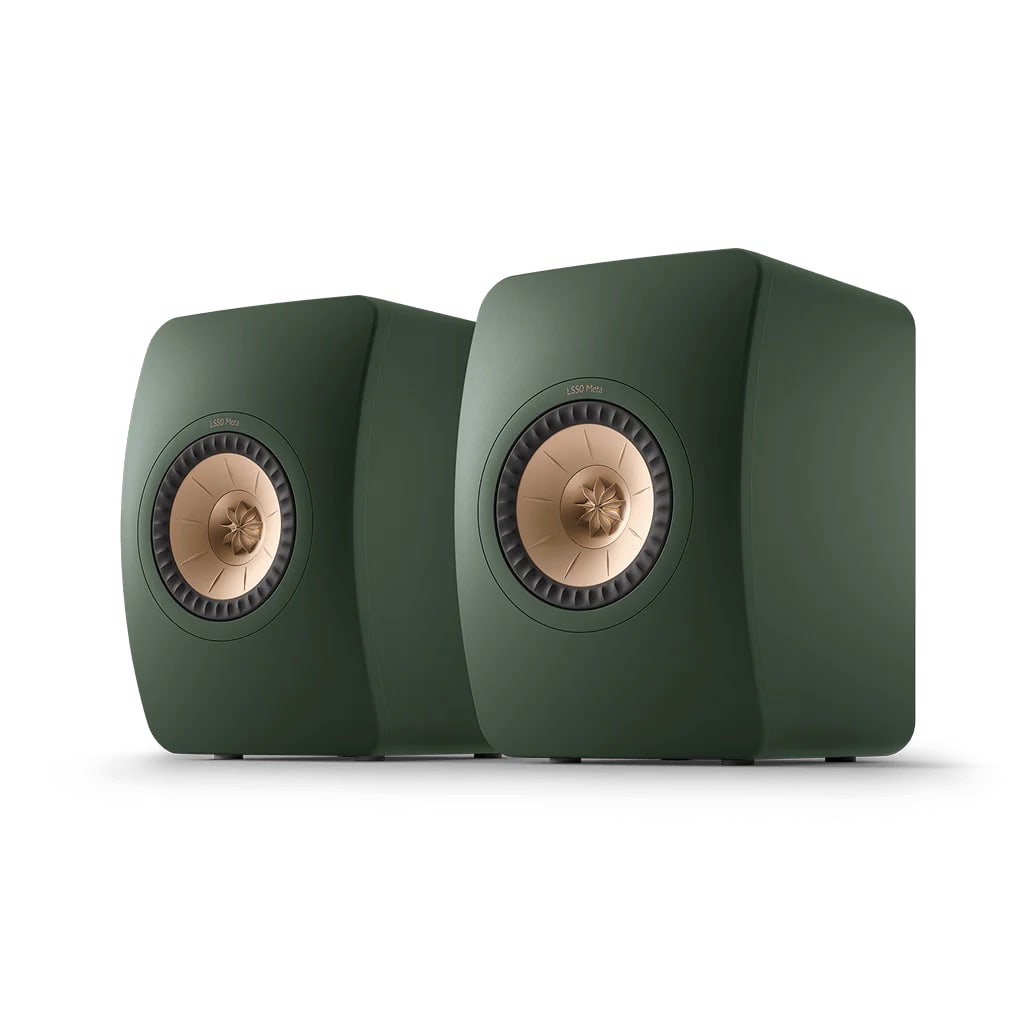
The KEF LS50 Meta is probably the best-known example of a speaker where this principle is taken to an extreme — the Uni-Q coaxial driver is, essentially, a point source, and the imaging precision it produces is genuinely uncanny. Our full review of the KEF LS50 Meta (check price) covers this in detail, and I'd recommend it as a reference for understanding what a standmount can achieve at a relatively attainable price before you start scaling up to statement territory. For those looking further up that KEF ladder, the KEF R3 Meta (check price) extends the same architecture with more bass authority and is worth a listen before deciding whether you need a floorstander at all.
When the floorstander genuinely wins
None of this is an argument against floorstanders. They win clearly in several situations and I want to be honest about that.
Large rooms — above 25–30 square metres — often genuinely benefit from a speaker that moves more air. A standmount in a 35-square-metre listening room may simply not have the dynamic headroom to pressurise the space convincingly at realistic listening levels. The laws of physics are not sentimental. If you need a speaker to fill a large, well-damped room with orchestral music at reasonable volume, a well-matched floorstander is doing you a genuine favour.
Similarly, if you are running a high-power solid-state amplifier — something north of 100 watts per channel into 8 ohms — and your speakers have the sensitivity and impedance curve to use that power gracefully, a full-range floorstander can reveal dynamic contrasts that a standmount simply cannot reproduce. The Focal Kanta No.2 is a good example of a floorstander that rewards this kind of matching; see our Focal Kanta No.2 review (check price) for the detail on how that plays out in practice.
The other clear floorstander argument is for listeners who categorically do not want a subwoofer in their system. If you find bass management, sub placement and integration too fiddly — and plenty of serious listeners do — then a full-range floorstander that handles the bass itself is a coherent, defensible choice, provided the room can take it.
Amplifier matching changes the calculation
One factor that tends to get lost in the format debate is how different amplifier topologies interact with each format. A standmount with a benign impedance curve and moderate sensitivity — something like 87–89dB at 1W/1m, 6–8 ohms — is often an easier load for a valve amplifier than a four-way floorstander with a complex crossover network that dips to 3 ohms at certain frequencies. If you are committed to valve amplification — and at statement budgets, many listeners are — this is worth taking seriously.
Our guide to the best standmount speakers for serious listening covers a range of options from different price points, and part of what that guide addresses is exactly this question of matching sensitivity and impedance to the amplifiers most commonly paired with standmounts at each level.
Conversely, a current-hungry floorstander with a low nominal impedance and real dips below 4 ohms will extract the best from a high-current solid-state design — something like the McIntosh MA352, which we reviewed separately and which has the iron-fisted bass control that kind of speaker demands. The matching matters as much as the format choice itself.
The subwoofer question at high-end price points
Here is where I will say something that some readers will push back on: at statement-system budgets, a high-quality standmount plus a genuinely excellent subwoofer is often a more revealing and more room-friendly solution than a comparably priced floorstander used full-range.
The snobbery around subwoofers in two-channel listening is, frankly, tiresome. It comes from a world where the available subs were either home-cinema boom boxes or crude add-ons with phase and crossover controls that made integration a dark art. That world still exists at the budget end. But at the level of a REL Reference or a Rel S series, or a JL Audio Fathom, the sub is a precision instrument that can be dialled in with real accuracy. You get the last octave when the music calls for it. You get the standmount's coherence everywhere else. And you get the bass decoupled from your main speaker placement, which is the one variable you have least control over with a full-range floorstander.
The counterargument — that the crossover point introduces a discontinuity — is legitimate but solvable. We've covered the fundamentals of integration in detail elsewhere on this site, and the tools available now (REL's High Level connection method, in particular) make the join genuinely transparent when done carefully.
Making the decision: a practical framework
Before you commit to either format at serious money, I'd suggest working through four questions in order.
First: what are your room's dimensions, and what is the fundamental bass mode? If your room is under 20 square metres, treat full-range floorstanders with real caution and model the bass loading before you buy.
Second: what is your amplifier, and what does it do well? Valve, low-power solid-state, and Class A designs tend to partner better with efficient, benign-impedance standmounts. High-current, high-power solid-state can unlock what a demanding floorstander offers.
Third: are you willing to integrate a subwoofer properly? If yes, the format decision opens up considerably and the standmount case becomes stronger. If not, factor that into your floorstander sizing — and be honest about whether your room can handle it.
Fourth: what music do you actually listen to? This sounds almost too obvious to state, but it matters. A collector who listens primarily to late-night jazz and small ensemble classical at moderate levels is not the same person as someone who needs to reproduce a Mahler symphony at convincing scale. The formats serve genuinely different priorities.
The most expensive system I've ever been asked to advise on was built around a pair of standmounts in a purpose-built listening room in a house in Woollahra — not a name I can share, but a room that had been acoustically treated with real money and real expertise. The owner had previously run a pair of flagship floorstanders in the same space and found them unlistenable. The standmounts, properly positioned, on serious stands, fed by a reference valve amplifier, were extraordinary. The bass was missing the last octave and they didn't care in the slightest, because everything they did hear was utterly right.
That is not a universal argument for standmounts. It is an argument for knowing what your room and your listening actually ask for, before you let floor space and price tags make the decision for you.
Common questions
- Can a standmount speaker really compete with a floorstander at the same price?
- At high-end price points, yes — and in some rooms it outperforms one. A statement standmount is not a budget-constrained design; it is a deliberate engineering choice that prioritises midrange coherence, cabinet control, and imaging precision. In smaller rooms where a floorstander would overload the bass, the standmount often sounds more convincing overall, particularly when partnered with a quality subwoofer for the bottom octave.
- What room size is generally too small for a full-range floorstander?
- There is no hard rule, but rooms under roughly 20 square metres — particularly those with parallel walls and limited acoustic treatment — often struggle with the bass energy from a full-range floorstander. The room's fundamental axial mode determines where bass will peak. A quick calculation (343 divided by twice your longest room dimension) gives you the frequency to watch. If your speaker has significant output at or near that frequency, you are likely to have problems that placement alone cannot solve.
- Does a valve amplifier change whether I should use a standmount or floorstander?
- Often, yes. Many floorstanders — especially multi-way designs with complex crossover networks — present difficult impedance loads that dip below 4 ohms, which can stress a valve amplifier and change its frequency response. A standmount with a simpler crossover, moderate sensitivity, and a relatively flat impedance curve is frequently a more natural match for valve amplification. That said, some floorstanders are specifically designed with high sensitivity and benign impedance for exactly this use — always check the impedance curve, not just the nominal rating.

I'm Sofia, and I get to play with the silly stuff — the statement amplifiers, the reference loudspeakers, the cost-no-object systems that most of us will only ever hear at a show. Someone has to, and I take it seriously: at this level the price stops mapping to performance and starts mapping to engineering, craft and ego, and part of my job is telling you which is which. I love the extreme end of this hobby, but I'm not dazzled by a big number on a price tag.
Covers flagship and cost-no-object reference systems
More from Sofia Laurent
 Negative feedback in amplifier design: the argument that never endsNegative feedback cuts amplifier distortion but divides designers. Here's what it does, why some statement amps avoid it, and what it means for you.
 The synergy tax: why mismatched gear costs more than cheap gearThe synergy tax explained: why pairing mismatched hi-fi components quietly costs more than buying modest, well-matched gear.
 Rear-port floorstanders near a glass wall: a risky pairingRear-ported floorstanders against glass walls cause boundary reinforcement and reflections. Here's how to place, measure and tune them properly.
- Infrasonic bass below 20Hz: chasing the octave you feel, not hearBelow 20Hz is infrasonic bass: felt more than heard. Here's what it takes to reproduce it properly, and whether a statement system should bother.
- Why statement systems still get beaten by the zone two speakerA $150,000 reference system is only as good as the worst-sounding zone it's networked to. Here's why multiroom integration is the statement system's real weak point.
- Why a statement floorstander can be the wrong speaker in the roomSix-figure floorstanders fail in rooms that were never built for them. Here's how to tell if your space can actually support one before you buy.