ISE 2026: LED luxury cinema steals the residential show
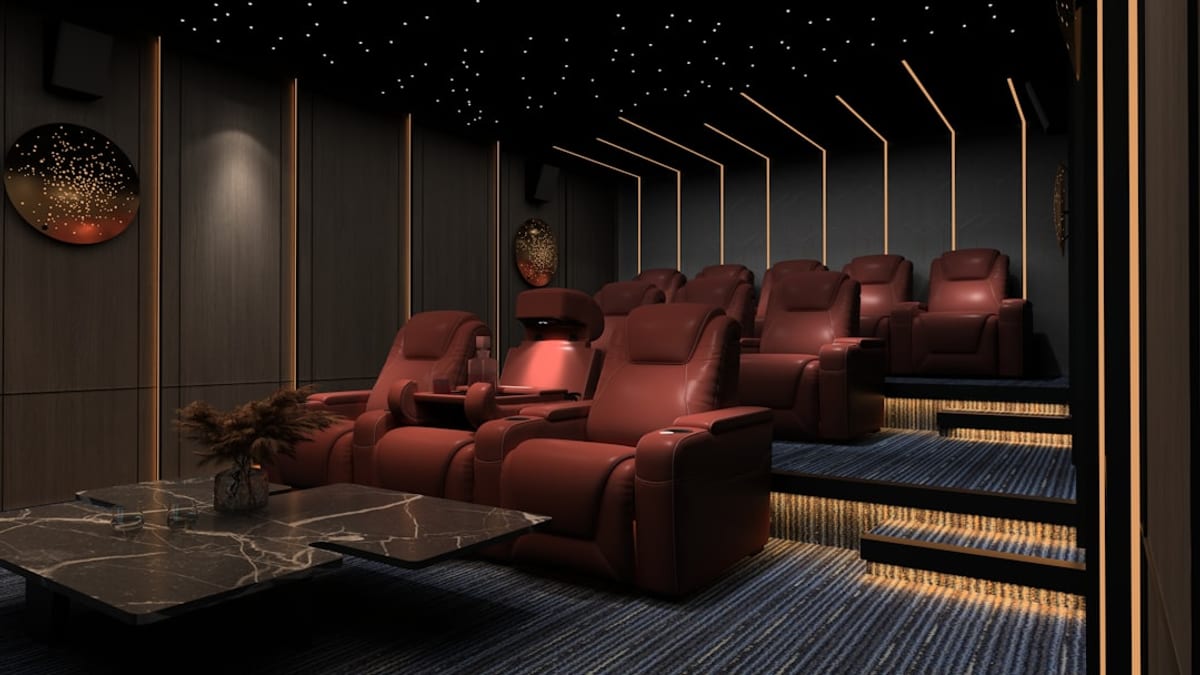
ISE 2026 in Barcelona: the residential cinema world shifted
Every February, the Integrated Systems Europe trade show descends on Barcelona's Fira Gran Via and resets the conversation about where professional and residential AV is heading. ISE 2026, which ran from 4–7 February, was no exception, and the residential halls told a different story from the usual one. The familiar parade of incremental projector updates and incremental screen improvements gave way to something more consequential: a near-consensus among the industry's most serious players that LED-based display technology, in both its large-format LED wall and emerging microLED forms, has arrived as a credible, even preferable, foundation for the highest-echelon home cinema installations.
There is a difference between marketing momentum and genuine technical inflection, and ISE 2026 read as the latter. The demos were not aspirational concept rooms; they were carefully engineered, reference-grade screening environments built around technologies that, while still commanding extraordinary price points, are increasingly within reach of the top tier of Australian custom-install projects. Here is what happened, why it matters, and what it signals for anyone seriously considering a statement cinema build in this country.
Barco Residential: three debuts that commanded attention
Barco Residential was, without question, the centrepiece of the residential LED conversation at ISE 2026. The Belgian display manufacturer, long revered in commercial cinema for its digital cinema projectors, brought three significant products to their European debut, and each one tells a slightly different part of the same story.
The Runar LED wall
The Runar is Barco's residential LED wall proposition, and it is a genuinely arresting idea. LED walls have been edging into high-end residential installations for several years now, but early iterations carried compromises: pixel pitch that demanded careful seating distance management, panel seams that became visible under direct inspection, and colour science that required significant calibration effort to reach the kind of accuracy that a serious cinephile expects. The Runar is clearly positioned to address those concerns head-on. As a display category, LED walls offer advantages that no projector-screen combination can fully replicate: true black levels through per-pixel illumination control, peak brightness headroom that makes HDR feel genuinely dynamic rather than tone-mapped into submission, and an immunity to the ambient light sensitivity that has always been the Achilles heel of projection-based rooms.
For Australian integrators working on trophy residential projects in Sydney, Melbourne or the Gold Coast, where clients often want cinema performance without the light-controlled bunker aesthetic, this matters enormously. Brighter, bigger screens are also moving down the price ladder in the consumer space, as Samsung's Micro RGB LED lineup shows.
TruePix Bifrost LED video wall
The TruePix Bifrost is a more explicitly commercial-derived product finding a home in residential applications, and it represents Barco's argument that the pixel pitch and colour performance achievable in their professional line can be repackaged for private cinema contexts. The Bifrost name nods to Norse mythology, consistent with the naming convention also visible in the Heimdall+ projector. What it signals technically is a display capable of the kind of colour volume and uniformity that professional post-production environments demand. In a residential cinema context, that translates to a screen that can serve as an honest reference: not flattering, not artificially vibrant, but accurate in the way that reveals the cinematographer's intent rather than the display manufacturer's house colour preference.
Heimdall+ Cinemascope RGB laser projector
Not everything at Barco's ISE 2026 showcase was LED-based. The Heimdall+ is a Cinemascope-format RGB laser projector, and its inclusion in the lineup is a reminder that laser projection remains a deeply relevant technology for residential cinema, particularly for rooms where the form factor of a projector-and-screen arrangement is preferred, or where the economics of an LED wall installation are prohibitive even at this level of the market.
RGB laser differs meaningfully from the laser-phosphor designs found in many high-performance consumer projectors, including well-regarded options like the Sony VPL-XW5000ES (check price). In an RGB laser system, three discrete laser light sources (red, green, and blue) are combined to produce the image, rather than using a blue laser to excite a yellow phosphor wheel. The result is a dramatically wider colour gamut, reaching deep into the Rec. 2020 colour space that native UHD content is mastered to, and a light source with greater long-term consistency. For Cinemascope 2.39:1 content specifically, the Heimdall+ format is purpose-built, avoiding the brightness and resolution compromises that come from anamorphic lens attachments or lens-shift-based cropping on standard 16:9 projectors. If projection stays your preference, JVC's D-ILA laser flagships are the other reference point worth studying.
The Luxury Immersion Cinema: microLED as a DCI-grade foundation
Separate from Barco's own suite, ISE 2026 hosted a Luxury Immersion Cinema demonstration that used microLED as its video foundation, and this is where the show's most forward-looking conversation was happening. The significance here is the framing: microLED was positioned not merely as a premium display option, but as a DCI-grade video base.
DCI, the Digital Cinema Initiatives standard, defines the colour gamut, peak luminance, contrast, and uniformity specifications that theatrical digital cinema projectors must meet. It is not a consumer standard; it is the benchmark against which films are graded and mastered for distribution to commercial cinemas worldwide. The ambition of deploying microLED technology capable of meeting or approaching DCI-grade performance in a private residential cinema represents a meaningful philosophical statement: the private cinema can now aspire to the reference conditions under which the content was actually created, rather than being a domesticated approximation of them.
MicroLED, for context, differs from conventional LED walls in its construction. Micro-scale LED elements are fabricated and integrated at a much finer pitch, enabling displays that can achieve television-like viewing distances without visible pixel structure, while retaining the per-pixel illumination control and raw brightness headroom that makes LED walls so compelling for HDR reproduction. It is, in many respects, the synthesis of OLED's black-level performance and LED's brightness capability, without either technology's most significant limitations. The technology is still maturing, and the cost per square metre at genuine high-performance specifications remains extraordinary, but the trajectory is clear.
Wisdom Audio, Screen Research and the 11.8.8 reference room
If the Barco and microLED demonstrations represented the video frontier at ISE 2026, the room assembled by Wisdom Audio and Screen Research represented the best of integrated audio-video system design, and it is the kind of installation that serious Australian cinema enthusiasts should study carefully.
The configuration was an 11.8.8 surround layout. For readers not deep in the object-based audio weeds: Dolby Atmos (see Dolby's official site) and its DTS:X counterpart support speaker arrays described by a three-number format: the number of ear-level speakers, the number of low-frequency subwoofer channels, and the number of overhead or height channels. An 11.8.8 system is an exceptionally ambitious implementation: eleven ear-level channels, eight subwoofer channels for bass management and envelopment, and eight height channels for the overhead layer that defines the immersive audio experience. This is not a system designed to meet a minimum Atmos certification threshold; it is designed to maximise the spatial resolution and envelopment that the format's object-based rendering engine can deliver.
The video component was Barco RGB laser, consistent with the Heimdall+ positioned elsewhere at the show, and the signal processing chain included two components that will be familiar to anyone who follows high-end AV closely: the madVR Envy Extreme video processor and the Trinnov audio processor.
The madVR Envy Extreme is the reference-grade video processing solution for residential cinema. Its HDR tone-mapping algorithms are regarded by calibrators and enthusiasts alike as the most sophisticated available outside of professional post-production environments, and its ability to extract and optimise content on a frame-by-frame, scene-by-scene basis rather than applying a static global transform makes a perceptible difference with challenging HDR material. Paired with an RGB laser projector capable of the colour volume to honour the tone-mapping decisions being made upstream, the combination is formidable.
Trinnov's role in the signal chain, specifically their Altitude processor series, addresses the audio domain with equivalent rigour. Trinnov's room correction and bass management capabilities are among the most sophisticated available to residential integrators. Their room correction methodology uses a proprietary 3D microphone array and mathematical modelling to address not just frequency response anomalies but spatial and timing errors introduced by room acoustics and speaker placement. In an 11.8.8 system, where the interaction between sixteen speaker channels and the room's acoustic properties is enormously complex, this level of processing intelligence is not optional. It is foundational.
The bass management implications of eight dedicated subwoofer channels are also worth dwelling on. Multiple-subwoofer arrays, when properly configured and time-aligned, can achieve a degree of bass uniformity across the listening area that a single or dual subwoofer simply cannot replicate. In a large cinema room, modal resonances (the frequency-specific bass peaks and nulls created by room dimensions) are the enemy of accurate low-frequency reproduction. Distributing bass reproduction across eight optimally placed subwoofers, and using processing to align their outputs, is the most effective known strategy for smoothing those modal problems without sacrificing the output capability that cinema soundtracks demand.
Omdia's read: AI and microLED-in-Package are shaping forces
The industry analyst firm Omdia used ISE 2026 as an occasion to articulate their view of the macro forces shaping professional AV over the coming years. Their flagging of AI and micro-LED, specifically including the MicroLED-in-Package (MiP) form factor, as the defining shaping forces of the sector is worth taking seriously, because Omdia's analysis tends to be grounded in supply chain and manufacturing economics rather than pure product excitement.
MicroLED-in-Package is a manufacturing approach that addresses one of the central production challenges of microLED displays: the difficulty of transferring millions of microscopic LED elements onto a backplane with sufficient yield and precision for commercial viability. MiP encapsulates groups of micro-LEDs into conventional surface-mount packages before assembly, building on existing LED manufacturing infrastructure. The practical implication is a pathway to more cost-effective production of fine-pitch LED displays that approach microLED's performance characteristics, which in turn accelerates the timeline for this technology to reach a price point accessible to a broader range of premium residential installations.
The AI component of Omdia's analysis relates primarily to processing, both in content upscaling and enhancement (where neural network-based algorithms are already demonstrably superior to traditional processing at interpolating detail and managing noise in real time) and in system management, where AI-driven calibration and adaptive performance optimisation are emerging capabilities. For residential cinema, the most immediately relevant manifestation of AI processing is in video upscaling: the ability to take 1080p or standard-dynamic-range content and produce an output that is meaningfully closer to native 4K HDR quality is an increasingly real capability, not a marketing claim.
How to judge an LED wall or microLED screen
Pixel pitch is the spacing between the centres of adjacent LED elements, and it is the first spec to understand. A coarser pitch needs a greater viewing distance before the individual pixels blend into a continuous image, while a finer pitch lets you sit closer. That is why microLED's finer integration matters so much in a domestic room, where the seating is rarely as far back as it would be in a commercial auditorium.
Beyond pitch, ask about panel seams, uniformity across the whole wall, and how the colour is calibrated and maintained over time. Ask, too, how the speakers will sit relative to the screen, because an LED wall is not acoustically transparent in the way a perforated projection screen is. Our piece on screen-wall speaker placement covers the principles, and while it is written around a UST projector, the questions about front-stage placement carry over.
What this means for Australian buyers and integrators
ISE 2026's residential highlights are not products you will walk into a retail showroom and purchase next Saturday. They are signals, and for anyone building a home cinema at the statement level, they are signals worth reading carefully before committing budget and construction to a technology direction.
The first practical implication is timing. If you are in the early planning stages of a dedicated cinema room and not yet committed to a display technology, the LED wall and microLED trajectory is moving fast enough that it warrants serious evaluation even if the price points feel remote. Custom install projects typically have long lead times, and a room designed and built today will be expected to perform for a decade or more. Designing the display wall with the physical and electrical infrastructure to accommodate a future LED or microLED installation, even if a laser projector serves as the initial display, is the kind of forward planning that distinguishes a well-considered statement room from one that feels compromised in five years.
The second implication relates to system integration philosophy. The Wisdom Audio and Screen Research room at ISE 2026 is an argument for the proposition that the audio and video chains in a reference cinema deserve equivalent investment and equivalent analytical rigour. Australian integrators who approach these projects holistically, treating the Trinnov processing, the subwoofer array, the acoustic treatment and the video processing chain as components of a unified system rather than independent purchasing decisions, will deliver better results than those who optimise each element in isolation. The madVR Envy Extreme and Trinnov combination is not the only path to that integrated excellence, but it represents a reference standard, and it sets a benchmark that competing solutions must be honestly evaluated against. For a broader look at where the money goes at this level, see where statement systems spend their budgets.
The third implication is about expectation calibration. MicroLED and high-end RGB laser cinema are technologies that deliver a qualitatively different experience from even very good mainstream home cinema equipment. The combination of genuine black levels, peak brightness that makes specular highlights feel physically real, and spatial audio reproduction from a well-implemented immersive array is not an incremental improvement over a good projector and a soundbar. It is a different category of experience. For clients who have the budget and the commitment, ISE 2026 confirmed that residential technology has closed the gap with commercial cinema to a degree that would have seemed implausible a decade ago, and in some respects, particularly in the audio domain, the best private cinemas now exceed what commercial exhibition can offer.
For those further along the entry-to-mid-cinema journey, perhaps evaluating their first dedicated room rather than a statement installation, the underlying principles demonstrated at ISE 2026 still apply at a different scale. Speaker placement, room acoustics, and processing quality matter at every price point. Understanding what the reference looks like is useful context even when you are not yet in a position to pursue it directly.
The trajectory is clear
ISE 2026 did not announce the death of projection for residential cinema; the Heimdall+ RGB laser demonstration alone was a reminder of how much performance this technology still offers. But the show did crystallise a trajectory that has been building for several years: LED-based display, in its evolving forms from large-format LED walls through to true microLED, is the direction that the residential cinema industry's most ambitious practitioners are moving toward. The combination of luminance headroom, contrast performance, and colour accuracy that these technologies offer is genuinely superior to what projection can achieve in absolute terms, and the gap will only widen as manufacturing economics improve and pixel pitches continue to shrink.
For Australian clients and integrators working at the statement end of the residential market, the message from Barcelona is unambiguous: design your next cinema room with the assumption that LED-based display is not a futuristic aspiration but an imminent reality. I'd argue that is the right call even for buyers who stay with a projector for now, since the cost of leaving room for the upgrade is small next to the cost of rebuilding a wall. The technology is here. The question is when your budget and timeline intersect with it.
Common questions
- What is the difference between a microLED display and a conventional LED video wall for home cinema?
- A conventional LED video wall uses individual LED modules at a relatively large pixel pitch, which limits how close you can sit before the pixel structure becomes visible. MicroLED uses microscopic LED elements fabricated at a much finer pitch, enabling television-like viewing distances while retaining the per-pixel illumination control and peak brightness headroom of LED technology. In practical home cinema terms, this means microLED can achieve the deep black levels associated with OLED and the high brightness associated with LED, without either technology's primary drawbacks — though the cost per square metre remains very high at current production volumes.
- Why is RGB laser projection considered superior to laser-phosphor designs for home cinema?
- In a laser-phosphor projector, a blue laser excites a yellow phosphor to produce white light, which is then filtered to create the image. This process limits the achievable colour gamut because the phosphor conversion step introduces constraints. An RGB laser system uses three discrete laser sources — red, green, and blue — producing a far wider colour gamut that can reach deep into the Rec. 2020 colour space that modern UHD content is mastered to. The result is more accurate, more saturated colour reproduction, particularly in highly saturated hues like deep reds and greens, along with more consistent colour output over the life of the light source.
- What does an 11.8.8 speaker configuration mean, and is it practical for a residential cinema?
- The three numbers describe the channel count in an immersive audio layout: eleven ear-level speakers, eight subwoofer channels, and eight height speakers. This kind of configuration is at the extreme end of residential implementation — it is designed to maximise the spatial resolution and envelopment achievable with object-based formats like Dolby Atmos. It is practical in a purpose-built, dedicated cinema room with proper acoustic design and a processor like the Trinnov Altitude capable of managing the complexity. It is not a living-room solution, but for a statement private cinema it represents the current reference standard in audio immersion.
- How long before microLED cinema becomes accessible to a broader range of high-end Australian residential projects?
- That is genuinely difficult to predict with precision, but the manufacturing trajectory suggested by developments like MicroLED-in-Package — which leverages existing production infrastructure to reduce cost — points toward meaningful price reduction over a three-to-five year horizon. The technology demonstrated at ISE 2026 is already being deployed in top-tier residential projects today. For anyone currently planning a statement cinema room in Australia, the practical advice is to design the physical and electrical infrastructure to accommodate LED-based display even if a projector serves as the initial solution — that way, the upgrade path remains open without requiring a rebuild.

I'm Sofia, and I get to play with the silly stuff — the statement amplifiers, the reference loudspeakers, the cost-no-object systems that most of us will only ever hear at a show. Someone has to, and I take it seriously: at this level the price stops mapping to performance and starts mapping to engineering, craft and ego, and part of my job is telling you which is which. I love the extreme end of this hobby, but I'm not dazzled by a big number on a price tag.
Covers flagship and cost-no-object reference systems
More from Sofia Laurent
 Negative feedback in amplifier design: the argument that never endsNegative feedback cuts amplifier distortion but divides designers. Here's what it does, why some statement amps avoid it, and what it means for you.
 The synergy tax: why mismatched gear costs more than cheap gearThe synergy tax explained: why pairing mismatched hi-fi components quietly costs more than buying modest, well-matched gear.
 Rear-port floorstanders near a glass wall: a risky pairingRear-ported floorstanders against glass walls cause boundary reinforcement and reflections. Here's how to place, measure and tune them properly.
- Infrasonic bass below 20Hz: chasing the octave you feel, not hearBelow 20Hz is infrasonic bass: felt more than heard. Here's what it takes to reproduce it properly, and whether a statement system should bother.
- Why statement systems still get beaten by the zone two speakerA $150,000 reference system is only as good as the worst-sounding zone it's networked to. Here's why multiroom integration is the statement system's real weak point.
- Why a statement floorstander can be the wrong speaker in the roomSix-figure floorstanders fail in rooms that were never built for them. Here's how to tell if your space can actually support one before you buy.