Marantz AV 30 and AMP 30: mid-tier Cinema separates
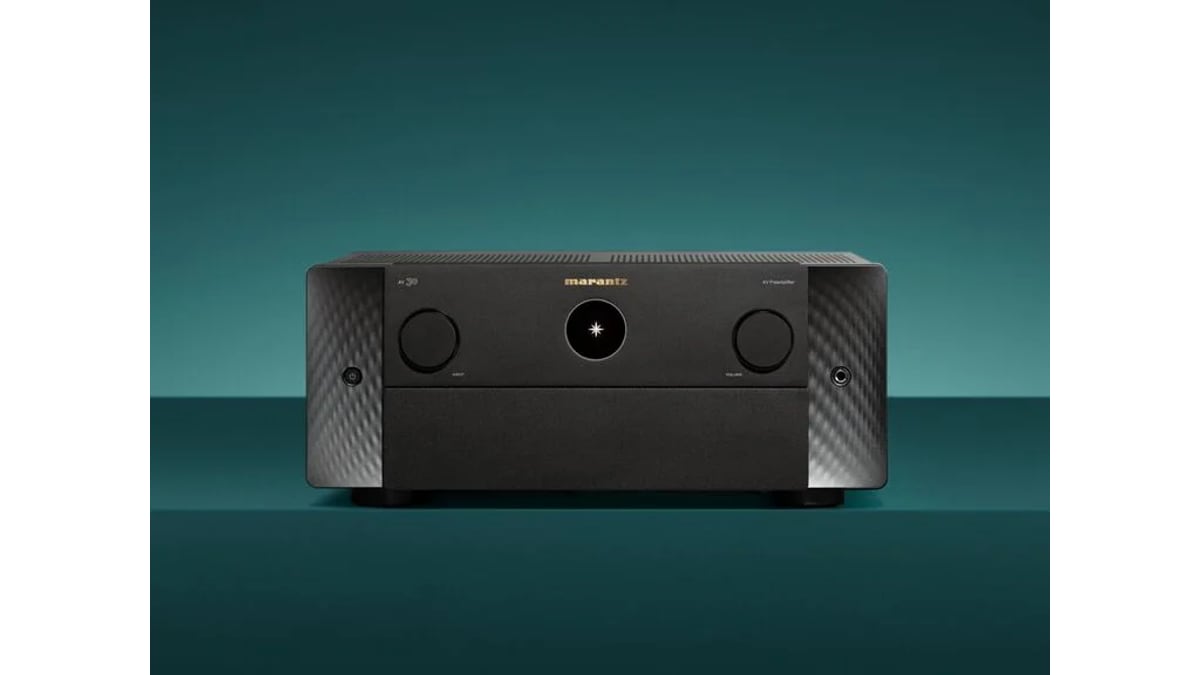
Where the Marantz AV 30 and AMP 30 fit in the range
There has long been an awkward void in the Marantz Cinema separates lineup. At the top sat the formidable AV 10 processor and AMP 10 amplifier, genuinely statement-tier gear built with the kind of fanatical attention to component quality that justifies their lofty pricing. Beneath that, the AV 20 offered a slightly more accessible entry point into the separates world without completely abandoning the brand's audiophile credibility. But for the serious enthusiast who wanted to step off the AVR merry-go-round without committing to full flagship expenditure? The gap was conspicuous. Marantz has now addressed it directly with the announcement of the Marantz AV 30 processor and AMP 30 amplifier, a mid-tier separates pairing scheduled for release in February 2026 and assembled, meaningfully, at Shirakawa Audio Works in Japan. The Marantz home page is the place to check official specifications.
Both units are priced at US$4,000 each, making a complete AV 30 and AMP 30 system an US$8,000 proposition before you account for additional amplification channels, subwoofers, and speakers. That is not inexpensive by any measure, but in the context of genuine separates-based home cinema, where the processor and power amplifier are discrete, purpose-built components rather than functions crammed into a single chassis, it represents a meaningful shift in what Marantz is asking for entry to that world. And for Australian buyers, who have historically watched high-end home cinema separates priced well into five figures before they could even consider them seriously, this announcement deserves careful attention.
What Shirakawa Audio Works actually means
It would be easy to gloss over the Shirakawa provenance as a marketing footnote, but it is worth dwelling on for a moment. Shirakawa Audio Works is the Marantz manufacturing facility in Japan where the brand's most significant products are assembled, and it carries genuine weight in enthusiast circles. When a product bears that lineage, it signals that the engineering philosophy applied is not the same as what governs the brand's more volume-driven receiver products. Component selection, build tolerance, and quality control at Shirakawa operate at a different register. The fact that Marantz has extended that facility to the AV 30 and AMP 30, rather than positioning them as straightforward cost-reduction exercises, tells you something about the intent here.
This matters particularly for the AMP 30, which employs Class D amplification paired with Marantz's own HDAM-SA2 (Hyper Dynamic Amplifier Module) circuit. Class D has travelled an interesting road in high-end audio. For years it was treated with suspicion in audiophile circles: efficient, certainly, but supposedly sterile or lacking in character compared to Class A or Class A/B designs. That reputation has been substantially revised as implementation quality has improved, and Marantz's use of their proprietary HDAM-SA2 topology in the signal path suggests they are not simply bolting a commodity switching amplifier module into a handsome chassis and calling it a day. The HDAM-SA2 is the same module family that has appeared in Marantz's more respected stereo and AV products, and its inclusion here is a deliberate quality signal. For the same design thinking at the single-box flagship level, see our piece on Class-D reaching the flagship tier with the Marantz Model 10.
The AV 30 processor: what 11.4 channels actually gives you
The AV 30 handles processing up to 11.4 channels, which in practical layout terms maps to a 7.4.4 Atmos configuration: seven main channels, four subwoofer outputs, and four height channels. That is a genuinely capable ceiling for a dedicated home cinema room, and for most Australian installations it will be more than sufficient to achieve what Dolby Atmos demands of a room in terms of both horizontal and vertical envelopment. Dolby publishes background on the format at Dolby's official site.
The four subwoofer outputs are worth singling out. Many processors at this price tier offer two, or occasionally four as a configuration option that requires menu-level gymnastics to enable properly. Having four discrete sub outputs natively is a meaningful practical advantage, because well-implemented bass management across multiple subwoofers, staggered around the room to smooth modal response, is one of the highest-impact and most frequently underutilised tools in home cinema system building. If you are running a pair of, say, SVS SB-3000 (check price) subwoofers and planning to expand to four, the AV 30 accommodates that without compromise.
Format support is comprehensive. Beyond Atmos, the AV 30 decodes DTS:X and Auro-3D, the latter being a format that still has a devoted following among enthusiasts who value its height-layer approach, and one that is increasingly appearing on physical media and streaming content. IMAX Enhanced certification rounds out the picture for those who prioritise the IMAX-optimised DTS:X Master Audio stream. The HDR pass-through story is similarly complete: HDR10, HDR10+, Dolby Vision, and HLG are all supported, meaning the AV 30 will not become a bottleneck in a modern display chain regardless of which HDR ecosystem your projector or display operates in.
Dirac Live ART (Advanced Room Treatment) compatibility is the room correction headline. Dirac Live has become the reference-standard correction system for serious home cinema in a way that was not true even three or four years ago. Its time-domain correction and frequency-domain filtering work together in a way that competitive systems struggle to match, and the ART extension takes that further by addressing bass-specific modal problems with a level of granularity that is genuinely useful. Room correction at this level is not a convenience feature. It is a fundamental system component, and having Dirac Live ART available rather than a proprietary system that locks you into the manufacturer's ecosystem is a meaningful advantage for serious buyers. Dirac explains its approach at Dirac's official site.
The AMP 30: six channels, bridgeable, and genuinely powerful
At 200 watts into 8 ohms per channel across six channels, the AMP 30 is well-specified for driving the demanding speaker loads that home cinema systems routinely present. The bridgeable option, taking two channels and combining them into a mono block delivering 400 watts, is particularly useful for front left and right in larger rooms, where main channel dynamics need genuine headroom to avoid compression at reference listening levels.
It is worth being precise about what those 200 watts mean in practice. Sensitivity and impedance interact with power ratings in ways that matter enormously when you are selecting speakers for a system like this. A 200-watt amplifier driving an 88dB/1W/1m speaker into an 8-ohm load in a moderately sized room will behave very differently from the same amplifier driving a 91dB speaker, because the power headroom available before clipping increases substantially. For buyers considering what to pair with the AMP 30, this is not an academic point. If you are building a system around large floorstanders with demanding impedance curves, and there are many compelling choices in the Australian market, the bridged mono option provides meaningful insurance against dynamic compression on the most critical channels. Our explainer on speaker sensitivity and amplifier power matching walks through the sums.
Six channels from a single AMP 30 is an interesting design choice. A typical 7.4.4 system obviously needs more than six amplified channels, which means most installations will require a second AMP 30, or supplementary amplification from within the Marantz Cinema range, to cover the full channel count. This is not a criticism, since it is architecturally consistent with the separates philosophy, where system configuration is modular and intentional rather than prescriptive. Australian buyers should still factor the cost of additional amplification into their planning from the outset.
Ecosystem flexibility: mixing and matching across tiers
One of the more interesting architectural decisions Marantz has made is the explicit allowance for mixing and matching across the 10, 20, and 30 tiers. An AV 30 processor can be paired with an AMP 10 power amplifier if the budget allows for a higher-tier amplification stage while starting with the more accessible processor, or vice versa. This is not a throwaway feature. It is the kind of upgrade path thinking that separates genuine audiophile product design from marketing segmentation.
For Australian buyers weighing up a market where price parity with US MSRP is rarely direct, this modularity has real practical value. It means the AV 30 and AMP 30 can serve as an entry point into a Marantz Cinema separates system with a credible roadmap for component upgrade over time, rather than requiring a wholesale system replacement to move upmarket. Building a home cinema around separates is always a longer game than buying an integrated receiver, and the cross-tier compatibility makes that journey considerably more sensible financially. I'd argue this flexibility matters more than the headline price.
Streaming and networking: HEOS, Roon, AirPlay 2
The AV 30's networking credentials are solid without being surprising. HEOS integration is expected at this tier within the Denon/Marantz ecosystem, and it functions well enough for whole-home audio routing if you are already embedded in that universe. Roon Ready certification is more significant for the audiophile purchaser. If your music playback infrastructure is built around Roon, the AV 30 participates in that network as a certified endpoint without requiring workarounds or third-party integration gymnastics. AirPlay 2 covers the Apple ecosystem with reasonable fidelity for casual listening.
None of this makes the AV 30 a replacement for a dedicated high-resolution audio streamer in a two-channel context, and buyers who also want a serious music playback system should look at the best DACs and network streamers alongside their cinema separates planning. It does mean the processor is not a dead end for streaming either.
Australian context and what to expect on pricing
US$4,000 per component at current exchange rates translates to somewhere in the vicinity of AU$6,200–$6,500 before Australian importer margins, warranty compliance costs, and GST are applied. In practice, Marantz's recent Cinema separates products have landed in Australia at prices that reflect those additional costs, and buyers should anticipate the complete AV 30 and AMP 30 pairing coming in somewhere around AU$13,000–$14,000 at retail, possibly a touch higher depending on how the local distribution arrangements play out closer to the February 2026 ship date.
That is real money, but it is contextually appropriate for what is on offer. Separates-based home cinema processing at this level of format support, room correction capability, and build provenance has historically cost significantly more than this. The AV 30 and AMP 30 do not replicate the full engineering ambition of the AV 10 flagship, but they bring the Shirakawa-built separates proposition into reach for buyers who previously would have been looking at integrated AVRs or compromised budgets.
What to check before moving to separates
Before committing, work through a few practical questions. Count the amplified channels your layout needs and compare that with six per amplifier. Check your speakers' sensitivity and impedance against the power on offer. Allow ventilation space around the amplifier, since power stages shed heat under load; our look at why a home cinema amp runs hotter on movies than music explains why. And if you are still undecided about the basic split, AVR vs AV processor lays out the trade-offs in plain terms.
The bigger picture: separates are making sense again
There is a broader trend worth acknowledging here. For much of the past decade, the relentless feature expansion of integrated AV receivers (more channels, more formats, better room correction, lower prices) made the traditional arguments for separates feel increasingly academic for all but the most committed enthusiasts. Why run a processor and power amplifier when a single unit from Denon or Yamaha could deliver 11 channels of processing, decent amplification, and Dirac Live for less than the cost of these components individually?
The answer, as it has always been, comes down to power supply architecture, thermal management, and what happens when you actually push a system hard. In an integrated receiver, the processing circuitry, switching supplies, and amplifier stages share a single chassis and often a single transformer. At moderate listening levels, this coexistence is largely benign. At reference levels, over extended listening periods, with demanding speaker loads, the compromises of that shared architecture become more audible. Separates sidestep the problem by design. The power amplifier's supply is entirely independent of the processor's, the heat generated by 200-watt-per-channel Class D stages is managed in its own enclosure, and the two units communicate at line level through a clean interface rather than through shared internal routing. For more on when the split pays off, see when a home cinema actually needs to split the amps out.
The AV 30 and AMP 30 are not going to replace a flagship statement system, and they do not try to. But they make the separates argument accessible to a wider audience, with Marantz's Japanese manufacturing pedigree behind them. For the Australian buyer who has been sitting on the fence between a premium integrated receiver and a genuine separates system, February 2026 has just become a date worth marking.
Common questions
- Can the Marantz AV 30 and AMP 30 be used with the AV 10 or AMP 10 flagship components?
- Yes. Marantz has confirmed that the Cinema separates range is designed for cross-tier mixing and matching. An AV 30 processor can be paired with an AMP 10 power amplifier, or the AMP 30 can be used alongside an AV 10 or AV 20 processor, giving buyers a genuine upgrade path without requiring full system replacement.
- Does the Marantz AV 30 support Dirac Live room correction?
- The AV 30 is compatible with Dirac Live ART (Advanced Room Treatment), which is the expanded version of Dirac Live that includes enhanced bass-specific modal correction. This is the same room correction platform used in many high-end separates processors and is widely regarded as the benchmark system in its class.
- How many subwoofer outputs does the Marantz AV 30 have?
- The AV 30 provides four discrete subwoofer outputs. This allows for multi-subwoofer configurations — typically used to smooth bass modal response across the listening room — without requiring any special workarounds or menu configuration beyond assigning the outputs.
- What is the expected Australian pricing for the AV 30 and AMP 30?
- Both components are priced at US$4,000 each in the US market. Australian retail pricing has not been officially confirmed, but based on current exchange rates and typical importer margins, buyers should anticipate prices in the range of approximately AU$6,200–$6,500 per unit, with the complete pairing likely landing around AU$13,000–$14,000 at retail.

I'm Sofia, and I get to play with the silly stuff — the statement amplifiers, the reference loudspeakers, the cost-no-object systems that most of us will only ever hear at a show. Someone has to, and I take it seriously: at this level the price stops mapping to performance and starts mapping to engineering, craft and ego, and part of my job is telling you which is which. I love the extreme end of this hobby, but I'm not dazzled by a big number on a price tag.
Covers flagship and cost-no-object reference systems
More from Sofia Laurent
 Negative feedback in amplifier design: the argument that never endsNegative feedback cuts amplifier distortion but divides designers. Here's what it does, why some statement amps avoid it, and what it means for you.
 The synergy tax: why mismatched gear costs more than cheap gearThe synergy tax explained: why pairing mismatched hi-fi components quietly costs more than buying modest, well-matched gear.
 Rear-port floorstanders near a glass wall: a risky pairingRear-ported floorstanders against glass walls cause boundary reinforcement and reflections. Here's how to place, measure and tune them properly.
- Infrasonic bass below 20Hz: chasing the octave you feel, not hearBelow 20Hz is infrasonic bass: felt more than heard. Here's what it takes to reproduce it properly, and whether a statement system should bother.
- Why statement systems still get beaten by the zone two speakerA $150,000 reference system is only as good as the worst-sounding zone it's networked to. Here's why multiroom integration is the statement system's real weak point.
- Why a statement floorstander can be the wrong speaker in the roomSix-figure floorstanders fail in rooms that were never built for them. Here's how to tell if your space can actually support one before you buy.