Pioneer SPHERA brings Dolby Atmos to any car via CarPlay
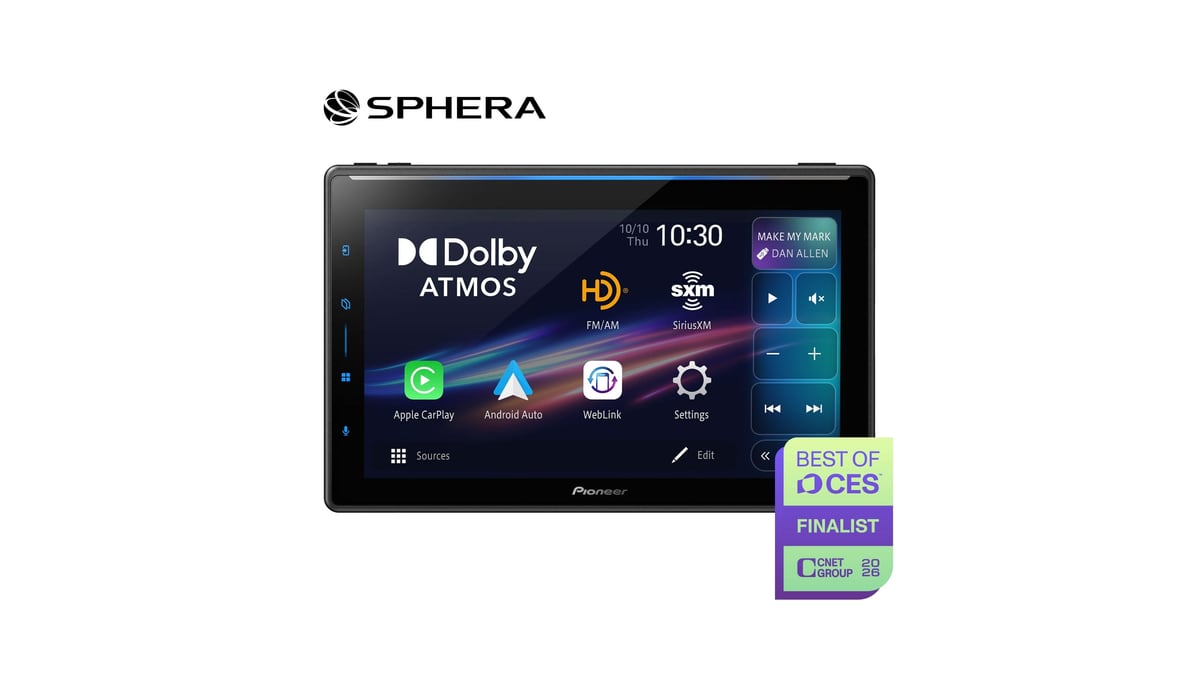
The wall just came down, and Pioneer swung the hammer
On April 22, 2026, Pioneer did something that a lot of car audio enthusiasts had quietly stopped believing would ever happen. The company announced the SPHERA DMH-WT8000NEX, a single-DIN aftermarket in-dash receiver that delivers Dolby Atmos spatial audio over Apple CarPlay. That's not a typo, and it's not marketing waffle dressed up in impressive-sounding language. Pioneer is calling it what it is: the world's first aftermarket in-dash receiver to pull off this trick, and on the surface at least, the claim looks solid.
Why does this matter so much? Because until now, in-vehicle Dolby Atmos has been the exclusive province of factory-installed systems: the kind of technology you either paid a premium to have baked into a new car at the point of sale, or you went without entirely. If you drove anything older than a few model years, or if you simply didn't buy the right brand with the right options package, immersive spatial audio in your car was simply not available to you. That's a lot of people locked out of a format that has, over the past few years, genuinely changed the way music sounds when it's done well.
Pioneer has now kicked open that door. At a list price of US$1,299.99, available through retailers including Crutchfield, the SPHERA sits in premium aftermarket territory, but it's not ludicrous money when you consider what it's delivering. Let's dig into why this is a bigger deal than it might first appear, what Australian buyers need to think about, and what the broader implications are for spatial audio as a format.
What Dolby Atmos actually means in a music context
Before we talk about the hardware, it's worth grounding ourselves in what Dolby Atmos for music actually is, because there's still a fair bit of confusion out there, even among enthusiasts who consider themselves reasonably well-informed. Dolby publishes its own overview of the format at dolby.com, and there's a neutral summary in the Wikipedia entry on Dolby Atmos.
Atmos began life as a cinema surround format, built around object-based audio where individual sounds are placed as three-dimensional objects in space rather than being assigned to fixed speaker channels. The genius of the object-based approach is that it's renderer-agnostic: the mix describes where a sound should be in space, and the playback system does its best to reproduce that placement given the speakers it has available. A 64-speaker cinema and a 7.1.4 home theatre and a pair of headphones all receive the same Atmos metadata; each does what it can with what it's got. Our explainer on how Dolby Atmos object audio works covers that idea in more depth.
When Atmos migrated into music, driven heavily by Apple Music's decision to make Spatial Audio a flagship feature of its streaming catalogue, the results were genuinely polarising at first. Early mixes were sometimes gimmicky, with instruments flying around the room in ways that served the novelty more than the music. But the format has matured considerably. A well-executed Atmos music mix today can have an openness, a sense of acoustic space and a clarity of separation between elements that stereo simply cannot match. When you hear a great Atmos mix through a capable system, the soundstage and imaging is genuinely revelatory. Not because things are spinning around your head, but because the depth and width of the presentation feels more like being in a room with musicians than listening through a window.
The car, it turns out, is a surprisingly good environment for spatial audio. You're already seated in a fixed listening position. The speakers are physically arrayed around you in ways that can approximate height and surround effects. Factory systems from brands like Mercedes-Benz (with Burmester), BMW (with Harman), and others have been exploiting this for a couple of years now, but again, only in new, expensive, correctly-optioned vehicles.
The aftermarket gap and why it's persisted
The reason in-vehicle Dolby Atmos has stayed locked to factory systems for so long isn't purely technical snobbery on the part of car manufacturers, though there's a bit of that. It's partly about the complexity of integrating spatial audio rendering with a car's existing speaker array, partly about licensing and certification, and partly about the fact that the major streaming platforms have historically delivered Atmos content through proprietary pipelines that don't easily hand off to third-party hardware.
Apple CarPlay, in particular, has long frustrated car audio enthusiasts because it essentially mirrors iPhone audio through the car's head unit without giving the head unit direct control over the stream. The result is that even premium aftermarket receivers have been stuck receiving a stereo or at best multi-channel downmix of what Apple Music knows is Atmos content. The spatial metadata has been there, sitting in the stream, but nothing in the aftermarket chain has been able to decode and render it, until now. If you want the background on the protocol itself, the Wikipedia article on CarPlay is a reasonable place to start.
What Pioneer has apparently achieved with the SPHERA is a genuine CarPlay-level integration that allows the Atmos metadata to pass through and be rendered by the head unit itself. The specifics of how that pipeline works, whether it's a new CarPlay API, a Pioneer-specific arrangement with Apple, or some clever processing on the receiver's end, aren't fully detailed in what's been released publicly. But the outcome is real: Dolby Atmos spatial audio, from Apple Music's catalogue, playing through an aftermarket unit in your car. That's new.
Who this is actually for
Let's be honest about the audience here, because I think there's a risk of the significance of this announcement getting lost if we frame it purely as a car audio story for the car audio crowd.
The people most immediately served by the Pioneer SPHERA are enthusiasts who already care deeply about audio quality, have an existing vehicle they love and don't want to replace just to get better in-car sound, and are already subscribed to Apple Music (and therefore already have access to a massive Atmos music catalogue without paying anything extra). That's a significant cohort, and it's one that has been frustrated for years by the factory-system exclusivity wall.
Think about what this looks like in practice. You drive a 2019 or 2020 vehicle. It sounds fine, maybe even good, but the head unit is dated and it certainly doesn't do Atmos. You're not in the market for a new car, because the economics don't make sense or you simply love what you drive. You subscribe to Apple Music and you've been listening to spatial audio through your AirPods Pro at home and going "why can't I have this in the car?" The SPHERA is the answer to that question.
For Australians specifically, this proposition is interesting. We don't have a particularly strong culture of chasing the newest model year just for infotainment features; we keep our cars longer than some other markets, and we have a healthy aftermarket installation industry. The challenge will be availability and pricing once the unit hits Australian retail. The US list price of $1,299.99 suggests that Australian RRP, once GST and distribution margins are applied, will land somewhere in the $1,800–$2,200 range if history is any guide. That's not entry-level, but it's not crazy for a flagship head unit with this feature set.
Professional installation is also a real cost to factor in. Fitting a double-DIN (or equivalent) aftermarket receiver isn't a simple job in most modern cars. Dash kits, wiring harnesses, and the labour to make everything look factory-clean can add several hundred dollars to the total outlay. That's before you think about whether your car's existing speaker array is up to the task of doing justice to Atmos content.
Speaker system considerations: where it gets interesting
Here's the thing that I don't think enough people are talking about in the initial wave of coverage: a Dolby Atmos head unit is only as good as the speaker system it's feeding. And most factory speaker installations, even in premium cars, are not optimised for spatial audio rendering. They're optimised for loud, impressive-sounding stereo with exaggerated bass response.
Getting the most from the SPHERA likely means thinking carefully about your car's speaker complement. Ideally you want front and rear channels at minimum, with tweeters positioned to handle the height cues that Atmos uses to create its vertical dimension. In a car environment, those height cues are often synthesised from front speakers angled at the windscreen or A-pillars rather than literal ceiling speakers, which is actually quite clever and tends to work better than you'd expect, because the reflections off the windscreen create a convincing upward-displaced image.
For those planning a more serious installation around the SPHERA, it's also worth thinking about bass management, making sure your subwoofer (if you run one) is crossed over correctly so it doesn't muddy the spatial presentation that Atmos is working to create. Poorly managed bass is one of the most common ways to undermine an otherwise capable system, and it's no different in a car than in a home listening room. Our piece on subwoofer placement and the crawl test explains the principle for rooms, and much of it carries over in spirit.
Setting up a cabin for spatial playback
A few general principles apply whether the room is a lounge or a cabin. Speaker position relative to your ears matters more than raw power, and any processing that delays or equalises individual channels is there to compensate for the fact that you sit closer to one door than the other. If the head unit offers time alignment or per-channel levels, use them, and set them from the driver's seat rather than by guesswork.
It also pays to keep expectations sensible. Height information in a car will always be an approximation, and a cabin full of glass and trim reflects sound in ways no living room does. Our guide to Atmos speaker placement sets out how each channel is meant to work at home, which is useful background for judging what a car can and can't imitate.
The streaming angle: Apple Music's Atmos catalogue is genuinely massive
One of the underappreciated advantages of tying this feature to Apple CarPlay is that Apple Music's spatial audio catalogue is enormous. Apple has been aggressively expanding Atmos content since it launched Spatial Audio in 2021, and by 2026 the number of tracks available in the format runs into the tens of millions. Unlike some spatial audio implementations that require a premium tier or separate subscription, Apple Music includes Atmos content in its standard subscription, so if you're already paying for Apple Music, you're already entitled to all of it.
This matters because it means the SPHERA isn't selling you on a feature that only works with a handful of tracks. Day one, you have access to a genuinely deep and diverse catalogue spanning virtually every genre. From orchestral classical where the spatial presentation is almost documentary-realistic, to pop and hip-hop where producers have had a field day building three-dimensional arrangements, to jazz recordings where the separation between instruments in the mix is extraordinary, it's all there, waiting.
For those interested in how streaming quality and digital audio fundamentals intersect, our glossary entry on bit depth and sample rate is worth revisiting, because Atmos for music operates with its own set of parameters around resolution that are distinct from simple PCM stereo streams, and understanding those fundamentals helps you appreciate what the format is actually doing.
The broader significance: spatial audio is escaping its premium ghetto
Zoom out for a moment and look at the trajectory here. Two years ago, in-vehicle Dolby Atmos was a selling point exclusive to six-figure luxury vehicles. A year ago, it had crept down into upper-middle premium territory. Now Pioneer has put it in a box you can install in virtually any car with a compatible dash opening, for under AU$2,000 fitted.
That's a democratisation story, and it's a genuinely meaningful one. It mirrors what happened with home cinema when Dolby Digital and DTS moved from dedicated processors costing thousands of dollars into mid-market AV receivers in the early 2000s. The format went from enthusiast novelty to mainstream expectation in the space of a few years, and quality increased dramatically as more content was produced for it. Spatial audio music is on a similar trajectory, and moves like the Pioneer SPHERA accelerate that process by getting the format into more ears.
For those of us who cover high-end audio, there's an interesting question about whether in-car Atmos starts influencing expectations for home listening. I'd argue it will. People who get used to the spatial openness of Atmos during their daily commute are going to start asking why their home stereo sounds comparatively flat and narrow. That's good news for the industry, and it's good news for the format. If you're curious about expanding your home listening into the spatial audio realm, our guide to the best DACs and network streamers is a solid starting point for understanding what hardware is capable of feeding a properly configured home Atmos system.
What to watch for: the open questions
The Pioneer SPHERA announcement raises some questions that the initial release doesn't fully answer, and I think Australian buyers in particular should be patient and wait for more detail before committing.
- Australian availability and final RRP: No confirmed local release date or pricing has been announced. The US launch through retailers like Crutchfield is confirmed, but Australian distribution timelines for Pioneer products can lag the US by three to six months.
- Android Auto: The announcement focuses specifically on Apple CarPlay. Whether Android Auto users get any form of spatial audio support isn't confirmed based on available information, which is a significant omission given Android's market share.
- Real-world sound quality: Pioneer's claims are compelling, but until independent reviewers have had extended time with the unit across a variety of vehicles and speaker configurations, we don't know how good the Atmos rendering actually sounds. Object-based audio is only as good as its renderer, and not all renderers are created equal.
- Integration with existing amplification: Many enthusiasts running serious car audio setups use external amplifiers rather than the head unit's built-in power. How the SPHERA's Atmos processing behaves when feeding a multi-channel external amp will be critical to its appeal for this segment.
- Firmware and feature updates: Head units live in your dash for years. Pioneer's track record with long-term software support will matter a lot here, especially as the Atmos for music spec continues to evolve.
The bottom line for Australian enthusiasts
The Pioneer SPHERA DMH-WT8000NEX is a genuinely significant product. If its implementation delivers on the promise, and the weight of Pioneer's engineering reputation and Dolby's certification process suggests it probably does, this is the unit that finally gives non-luxury car owners access to a properly immersive spatial audio experience during every commute, every road trip, every drive.
At US$1,299.99, it sits in serious aftermarket territory. It's not impulse-buy money. But compared to the cost of buying a new vehicle just to get factory Atmos, it's absurdly good value. Compare it to what you'd spend on a similarly ambitious home audio upgrade, a quality DAC, a capable streamer, and the cabling to tie it together, and the SPHERA's price point looks quite reasonable for what's promised.
My advice for Australian readers: monitor for local pricing and availability announcements, look for independent installation reviews that evaluate real-world sound quality in a variety of vehicles, and if you're already running a capable multi-speaker car audio setup, start thinking now about whether your existing configuration would do the SPHERA justice. Because if this thing sounds as good as it should, the queue is going to get long quickly.
This is one of those moments where a single product genuinely changes what's possible. Pioneer hasn't just launched a new head unit. They've opened up a whole category.
Common questions
- What is the Pioneer SPHERA DMH-WT8000NEX and what makes it different from other aftermarket head units?
- The Pioneer SPHERA DMH-WT8000NEX, announced on April 22, 2026, is described as the world's first aftermarket in-dash receiver capable of delivering Dolby Atmos spatial audio via Apple CarPlay. Prior to this unit, in-vehicle Dolby Atmos was restricted exclusively to factory-installed systems in new vehicles. The SPHERA removes that limitation, making immersive spatial audio music accessible to owners of older or non-luxury vehicles for the first time through an aftermarket installation.
- How much does the Pioneer SPHERA cost, and will it be available in Australia?
- The Pioneer SPHERA DMH-WT8000NEX carries a US list price of $1,299.99, and is available through US retailers including Crutchfield. As of the time of writing, confirmed Australian pricing and availability have not been announced. Australian buyers should factor in that local RRP typically reflects GST and distribution costs on top of the US price, plus the cost of professional installation, which varies by vehicle.
- Do I need a special Apple Music subscription to get Dolby Atmos content through the Pioneer SPHERA?
- No. Apple Music includes Dolby Atmos Spatial Audio content as part of its standard subscription — there is no separate premium tier required. If you already subscribe to Apple Music, you already have access to the full Atmos catalogue, which spans tens of millions of tracks across virtually every genre. The SPHERA simply enables your car to actually render that spatial audio content properly, which aftermarket head units have been unable to do until now.
- Does the Pioneer SPHERA also support Dolby Atmos via Android Auto?
- Based on the information available from Pioneer's announcement, the Dolby Atmos spatial audio feature is specifically tied to Apple CarPlay. Whether Android Auto users will receive any equivalent spatial audio support has not been confirmed in Pioneer's public release materials. This is an open question that potential buyers using Android devices should seek clarity on before purchasing.

I'm Dave, and I'm the cheapskate of the team — and proud of it. My whole thing is finding the gear that punches three times above its price, the so-called "giant-killers," because most people don't have forty grand for a system and shouldn't feel bad about it. I've heard the megabucks stuff, and a lot of it is gloriously good; I've also heard $800 setups that get you 85% of the way there. I'll always tell you where the law of diminishing returns kicks in.
Lifelong bargain-hunter; budget-to-midfi specialist
More from Dave Okafor
 Matching speaker and amp cost: ignore the price-parity mythForget the old rule of matching speaker and amp cost dollar-for-dollar. Here's what actually decides a good pairing, and why it isn't price.
 Turntable mats and platters: what actually changes the soundFelt, rubber, cork or acrylic — turntable mats and platter materials change the sound more than most upgrades. Here's what actually works.
- Buying a demo unit: the giant-killer move retailers hateEx-demo hi-fi gear can save 20-40% with near-zero risk. Here's how to actually negotiate it, what to check, and when to walk away.
- Flutter echo: the room fault that sounds like nothing's wrongFlutter echo blurs detail in parallel-wall rooms without obvious boom. Here's how to find it cheaply and kill it without over-treating.
 Amp power ratings into 8 vs 4 ohms: the spec sheet trapWhy an amp's 4-ohm wattage figure can mislead buyers, and how to actually match power output to real speaker loads on a budget.
 5.1.2 vs 7.1.4: the Atmos layout decision for real roomsChoosing between 5.1.2 and 7.1.4 Atmos layouts comes down to room shape and seating, not speaker count. Here's the giant-killer logic.