When to upgrade your amplifier versus your speakers: where the money actually goes
Roughly once a fortnight someone emails me a version of the same question: "I've got $3,000 to spend. Should I upgrade my amp or my speakers?" The honest answer is almost never the one they want to hear. But let's work through it properly, because the logic is actually pretty straightforward once you strip away the forum mythology.
Why this question is harder than it looks
The amp-versus-speakers debate has been running since at least the 1970s, and it generates more heat than light because both camps are partly right. Speakers make the biggest gross difference to the character of a system — the tonal balance, the dispersion pattern, the efficiency, the maximum output. Amplifiers, when they're working within their design envelope, make a smaller but still real difference: control, grip, headroom, noise floor, and how gracefully the system handles dynamic peaks.
The problem is that most of the audiophile discourse treats these as independent variables, when they're not. A speaker doesn't sound like anything without an amplifier. An amplifier only reveals what the speaker will let through. They're a chain, and a chain with one very weak link often leaves you chasing your tail.
There's also a third variable that both camps conveniently ignore: the room. I've measured enough lounges in Melbourne to know that a $15,000 speaker in an untreated room with a concrete slab and parallel brick walls will be routinely embarrassed by a $2,500 speaker in a properly treated space. But that's a longer argument I've made elsewhere — the short version is, fix the room first, then worry about boxes and electronics.
The case for speakers first (and why it's usually right)
Speakers are the component with the most audible variation between models. Two amplifiers measuring competently can sound very similar driving the same load. Two speakers of similar price can sound like completely different philosophies of what recorded music should feel like. The dispersion pattern alone — how the speaker radiates energy into the room — will alter the tonal balance you perceive far more than the choice between two solid-state amplifiers with similar distortion figures.
So if your current speakers are genuinely the weak link — if they're beamy, if the bass sounds lumpy and slow, if voices have that nasal honk that points to a crossover problem, if you're simply not getting enough dynamic range for your room size — then yes, upgrade the speakers. You'll hear the difference immediately and clearly.
The classic heuristic says to spend roughly 50–60% of your total system budget on speakers and stands combined, and most experienced builders would stand behind that. The speaker is doing the hardest physical work: turning electrical signal into air movement across an enormous range of frequencies, all while behaving politely under a wildly varying load. Getting that right is genuinely difficult, and the engineering shows in the price.
If you're considering something like the KEF R3 Meta (check price) or the Bowers & Wilkins 705 S3 (check price), those are speakers with real engineering behind the drivers and crossovers, and they'll resolve differences in the chain above them. That's important: a better speaker demands more from everything upstream, which brings us to the flip side.
When upgrading your amplifier actually makes sense
Here's where I'll push back against the conventional wisdom a little: the "speakers first" rule breaks down badly at the ends of the sensitivity and impedance spectrum.
Low-sensitivity speakers — anything under about 85 dB/1W/1m — will genuinely expose an amplifier's power reserves and current delivery. If you're running a pair of 82 dB standmounts off a 30-watt integrated and wondering why loud passages sound congested and flat, that's not the speakers failing. That's the amplifier running out of headroom. A bigger, more capable amp can genuinely transform what those speakers do under pressure.
Impedance tells a similar story. Speakers with difficult phase angles and low impedance dips — think electrostatics, some ribbon hybrids, and certain British standmounts that combine nominal 8-ohm ratings with 3-ohm dips in the bass — will genuinely stress an amplifier that's not built to handle reactive loads. I've measured speakers that looked benign on paper but turned out to be difficult in practice; if your amp isn't comfortable with that, the sound gets hard, thin, and compressed at moderate volumes.
The other scenario where amp-first makes clear sense: your speakers are already very good and the amp is visibly the constraint. If you inherited a pair of LS50 Metas and you're running them off a mid-fi receiver from 2018, upgrading the amplifier will absolutely be audible. The KEF LS50 Meta (check price) is a genuinely resolving speaker; it will reward a better amp clearly. Conversely, if you have a very capable amplifier and mediocre speakers, no amount of power and control will make the drivers perform beyond their engineering limits.
The sensitivity and matching question
I wrote previously about choosing standmount speakers for serious listening, and matching keeps coming up. The amplifier-speaker interface is worth spending real time on before any purchase. Specifically:
- Check the speaker's nominal impedance and the minimum impedance dip. A 4-ohm nominal with a 2.8-ohm minimum is a genuinely different load from an 8-ohm nominal with a 6-ohm minimum.
- Check the sensitivity specification — but know that manufacturer sensitivity ratings are measured under different conditions and aren't always directly comparable. A 3 dB difference in sensitivity is a factor of two in required amplifier power for the same loudness.
- Calculate the power you actually need for your room size and listening levels. This isn't guesswork; there's a formula, and it usually reveals that people dramatically over-specify or under-specify power depending on speaker efficiency.
If you want a fuller treatment of how sensitivity and impedance interact with amplifier choice, the existing piece on streaming amplifiers and all-in-ones covers some of the matching ground in the context of integrated solutions.
Diminishing returns and the system budget ceiling
Here's where I want to be genuinely useful rather than just theoretical. Diminishing returns in this hobby are real, but they don't occur at the same point across components.
In amplifiers, the engineering problems of building something quiet, powerful, stable, and accurate are largely solved at a fairly modest price. A well-designed integrated at $2,000–$3,000 Australian will measure very well and perform very close to amplifiers costing five times more. The Marantz Model 40n sits in that zone — it's a genuinely competent integrated (check price) that doesn't leave much on the table from a technical standpoint. Above that ceiling, you're paying for industrial design, brand story, and increasingly marginal performance gains. Some of those gains are real. None of them are transformative.
In speakers, diminishing returns kick in later. Driver quality, crossover components, cabinet resonance control, and motor system engineering all have meaningful effects on the final sound, and the cost curve is steeper. There's a clear performance jump going from $800 to $2,500 and another real one from $2,500 to $6,000. Above $10,000 the gains narrow sharply, though they don't disappear entirely — the very best speaker engineering does produce genuinely superior results, just for a lot more money.
The practical takeaway: for most people building a serious two-channel system on a $5,000–$8,000 total budget, allocating 55–60% to speakers and stands and the remainder to amplification is close to optimal. Don't starve the amplifier, but don't let it eat the speaker budget either.
Synergy is real — but don't overthink it
The word "synergy" gets thrown around in audio circles as though it explains everything and nothing simultaneously. I'll admit I'm a bit sceptical of the folklore version — the idea that brand X amplifier has some mystical affinity with brand Y speaker that transcends the measurements. But there's a real version of the concept worth taking seriously.
Some amplifiers are genuinely better suited to specific speaker types. High-output-impedance designs (most notably single-ended valve amplifiers) will alter the frequency response of any speaker with a non-flat impedance curve — which is essentially all of them. That interaction can be euphonic with the right pairing and ugly with the wrong one. Solid-state designs with very low output impedance are generally more load-agnostic, which is one reason they're the safer choice when you haven't thoroughly measured your speaker's impedance curve.
Beyond the electrical interface, there's the question of voicing. A speaker that's slightly lean in the upper bass might partner well with an amplifier that's slightly warm, and vice versa. This is real, but it's also worth saying clearly: you should be buying components that are each as accurate as possible for your budget, not buying deliberately flawed ones and hoping the flaws cancel. That approach almost never ends well long-term, because when you upgrade one component the whole balance shifts.
The room's veto power
I keep coming back to this because it keeps mattering. Before you spend $3,000 on anything, spend two hours measuring your room with a free tool like Room EQ Wizard and a calibrated USB microphone (available for under $150). The data is almost always surprising. I've sat in rooms in Brunswick and Paddington where the bass response between 60 Hz and 120 Hz varied by 18 dB across different seating positions — that's an enormous swing, and no amplifier upgrade and no speaker upgrade will fix it. Treatment and placement will.
If your system already sounds pretty good to you but something feels congested or unclear, check first reflections before you open your wallet. A $200 acoustic panel behind the listening seat and two flanking the speaker wall will sometimes do more than a $2,000 amplifier upgrade. I know that's not a romantic answer, but it is an accurate one.
For the full treatment of room-first system thinking, the piece on standmount speakers for serious listening addresses placement and treatment as part of the speaker choice process — worth reading before pulling the trigger on anything.
A practical framework for the actual decision
Rather than a rigid rule, here's the diagnostic I'd apply before any upgrade:
First, is the system meeting your minimum power and sensitivity requirements? If the answer is no — if it strains at moderate volumes, or sounds thin and hard during dynamic peaks — the amplifier is the problem, and fix that first.
Second, is the sonic character of the system mostly fine but lacking in resolution, detail, or tonal accuracy? That usually points to speakers. Amplifiers don't generally change the character of a system the way speakers do.
Third, is the bass a mess? Don't touch anything until you've measured the room. Bass problems in domestic spaces are almost always rooms, not equipment.
And honestly — if you're on a tight budget and genuinely unsure, buy the speakers last. Set up what you have in the best position in the room with the best treatment you can manage, and live with it for three months. You'll know exactly what's missing then, and you'll spend the money far more precisely.
The amplifier-versus-speakers debate doesn't have a universal answer because systems and rooms are individual. But the framework above will get you to the right answer for your situation more reliably than anything the forums will offer.
— Hannah Reid, Loudspeakers & Acoustics Editor
Common questions
- Should I always upgrade speakers before the amplifier?
- Usually, yes — speakers cause the largest audible differences in a system and have a steeper quality curve for your money. But if your current amplifier is genuinely underpowered for your speakers' sensitivity rating, or if it's struggling with a difficult impedance load, the amplifier is the right first fix. Measure and calculate before you spend.
- How much should I spend on an amplifier relative to my speakers?
- A useful starting point is spending roughly 40–50% of your speaker budget on amplification. So if you're spending $3,000 on speakers and stands, a $1,200–$1,500 integrated amplifier is a reasonable match. There's no hard rule, but starving either component tends to produce a system that's noticeably unbalanced.
- Does amplifier quality matter if my speakers aren't high-end?
- Less so, though a clean, quiet signal path still matters at any level. The bigger risk is mismatching power to speaker sensitivity — running an inefficient speaker off an underpowered amp hurts sound quality at any price point. Once the power requirement is met, amplifier differences become harder to detect with entry-level speakers.
- Can a better amplifier make bad speakers sound good?
- No. An amplifier can control speakers better and provide more headroom, but it cannot add driver resolution or fix crossover problems that are baked into the speaker's engineering. If the speakers are the limiting factor, no amount of amplifier quality will overcome their physical and acoustic limitations.

Hi, I'm Hannah. Speakers are my thing — specifically, the conversation between a speaker and the room it's in, which is where most systems are won or lost. I did acoustics at uni and never quite got it out of my system. I'll measure your room's bass response and then gently break the news that the $20,000 speakers aren't the problem, the untreated wall behind your sofa is. Stand-mounts on good stands are criminally underrated and I will die on that hill.
Acoustics background; loudspeaker and room-treatment specialist
More from Hannah Reid
 Open-back headphones on a desk: why the "room" still mattersOpen-back headphones don't seal you off from the room. Here's why your desk, walls and even your monitor are still part of the sound.
- Turntable isolation: why footfall and feedback matter more than the plinthSuspended floors, speaker vibration and footfall do more damage to vinyl playback than plinth material. Here's how to actually isolate a turntable.
 Why your streamer's output stage still shapes the sound at the speakerBits are bits, but the analogue stage after the DAC chip in your streamer still colours what your speakers do. Here's what actually matters.
- Subwoofer size versus number: why two small subs beat one big oneA 10-inch sub in two spots usually beats a 15-inch sub in one. Here's the room-mode maths behind why, and when a single big box still wins.
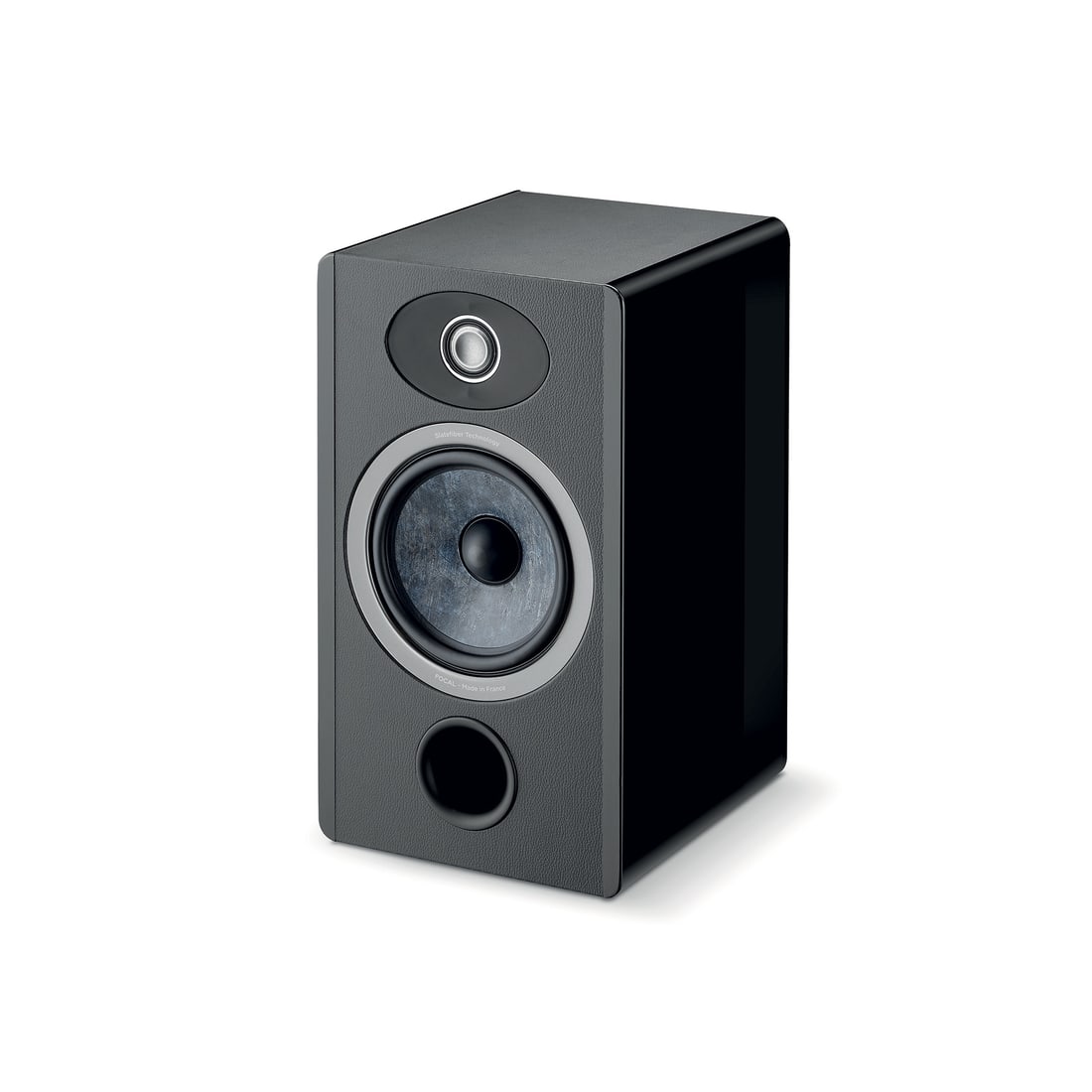 Toe-in angle: the free speaker upgrade nobody bothers measuringToe-in angle changes your speakers' tonal balance and imaging more than most upgrades. Here's how to actually find the right angle for your room.
- Speaker stands and boundary distance: the invisible spec on your spec sheetStand height, mass and distance from walls change a standmount's measured bass and imaging more than most upgrades. Here's how to get it right.