Dolby and LG launch the first Dolby Atmos FlexConnect soundbar at CES 2026
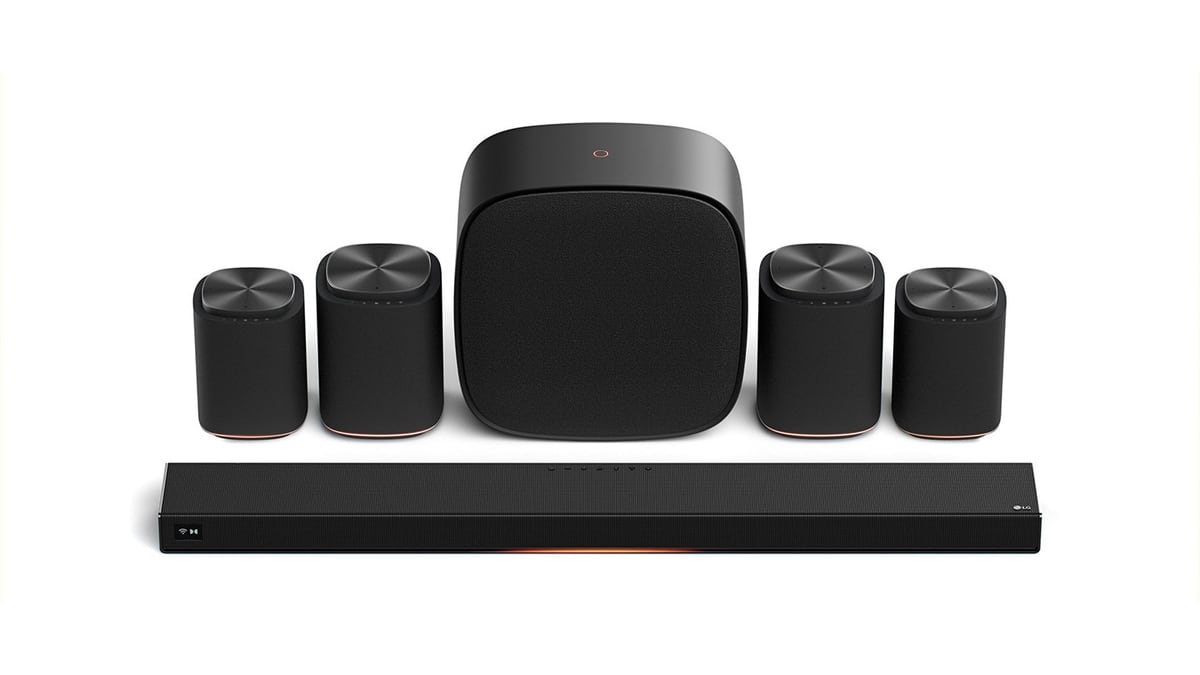
CES has a well-earned reputation for producing announcements that sound transformative on the show floor and then quietly disappear into the ether by March. So when Dolby and LG took the stage in Las Vegas in January 2026 to unveil the LG Sound Suite H7 — the world's first soundbar powered by Dolby Atmos FlexConnect — it was reasonable to apply a degree of scepticism. Having followed the FlexConnect story since its introduction on LG's OLED TV lineup, though, I think this one is genuinely worth paying attention to. Not because the H7 is a flawless product, and not because FlexConnect is a mature, fully-open ecosystem yet, but because the underlying idea addresses one of the most persistent and underappreciated problems in home cinema: the gap between what a spatial audio system is theoretically capable of and what it actually delivers once it's sitting in your living room.
Let me explain what I mean, and why Australian buyers in particular should be watching this closely.
What is Dolby Atmos FlexConnect, and why does it matter?
If you've been following LG's premium TV releases over the past couple of years, you'll already have some familiarity with FlexConnect. In its original incarnation, it was a feature embedded in select LG televisions that allowed the TV itself to detect, analyse and optimise the audio output from wireless speakers placed around the room. The key word there is optimise. FlexConnect doesn't just play audio — it adapts the sound profile to the physical layout of the room and the placement of the speakers within it.
Think of it as a form of intelligent room correction that operates at a system level rather than relying on a separate calibration microphone and a tedious setup wizard. The ambition is to remove one of the biggest variables in getting great Dolby Atmos playback at home: the fact that most people don't — and can't — place their speakers in the positions that a textbook Atmos layout would demand. Couches are against walls, ceilings are too high or too low, room dimensions are awkward, and the cat has claimed the optimal left-surround speaker position as its permanent napping spot. FlexConnect is designed to work with that reality rather than against it.
The H7 represents a meaningful expansion of that concept. Rather than FlexConnect living exclusively inside the television, it now powers an entire soundbar system, bringing adaptive spatial audio to a product category that — let's be honest — has historically leaned heavily on marketing language and relatively lightly on genuine acoustic intelligence.
The LG Sound Suite H7: what we know
The H7 is configured as a 9.1.6 wireless spatial-audio soundbar system. For those who haven't memorised Dolby's channel notation, that means nine primary channels, one subwoofer channel, and six overhead channels — a genuinely serious speaker count for a soundbar-based system. At US$999.99, it sits at the premium end of the soundbar market without quite crossing into the territory where a separates-based home cinema starts to make obvious financial sense.
The 9.1.6 configuration is noteworthy in itself. Most soundbars that claim Atmos support are doing so through upward-firing drivers and a lot of digital signal processing optimism. The H7 appears to take a more substantive approach to overhead audio, which is where the six-channel height layer becomes important. Whether the real-world overhead imaging matches the promise of that channel count is something we'll need to assess properly in a full review, but the architecture at least suggests LG and Dolby are taking the height dimension seriously.
The FlexConnect integration supports up to 27 distinct speaker configurations, which is a remarkable number. The practical implication is that the system should be able to accommodate a very wide range of room shapes, furniture arrangements and speaker placements while still delivering a coherent, optimised Atmos presentation. This is where FlexConnect distinguishes itself from conventional soundbar room correction: it's not just about equalising frequency response, it's about understanding the spatial geometry of the setup and adjusting the entire surround and height field accordingly.
If you're curious about how room acoustics interact with speaker placement more broadly, our Acoustic Treatment glossary entry is a solid starting point for understanding why room geometry matters so much, and why no amount of digital correction fully replaces getting the physical setup right.
FlexConnect comes to LG's 2025 TV lineup
Alongside the H7 announcement, LG confirmed that FlexConnect will be rolled out to select 2025 premium LG TVs via a future software update. This is smart product strategy: it expands the FlexConnect ecosystem without requiring existing LG TV owners to buy new hardware, and it gives the feature a much larger installed base almost immediately.
For Australian consumers who picked up one of LG's premium OLED or QNED models in 2025, this is genuinely welcome news — provided your model is on the supported list, which LG has yet to fully specify for the Australian market at the time of writing. Keep an eye on firmware update notes through the LG Australia support channels if you're in this camp.
The TV software update also reinforces that FlexConnect is being positioned as a platform, not just a product feature. Dolby wants this to become the standard adaptive-audio layer across the LG ecosystem, and LG's willingness to retrofit 2025 TVs suggests they're committed to building that platform out rather than treating it as a one-cycle marketing moment.
The critical limitation: it only works within the LG ecosystem
Here is where I have to be direct, because this limitation has real implications for Australian buyers and it's not getting nearly enough attention in the coverage I've read so far.
FlexConnect does not work across brands.
That means the intelligent spatial optimisation, the room-layout adaptation, the 27-configuration flexibility — none of it applies if you mix an LG soundbar with a Sony TV, or pair an LG television with a third-party speaker system. The entire FlexConnect stack requires LG hardware at both ends. For a technology that is being presented as a new standard in adaptive home cinema audio, that is a significant constraint, and it's one that Dolby and LG need to address if FlexConnect is to achieve genuine ecosystem traction.
To be fair, this is not an unusual situation in the consumer electronics industry. Apple's spatial audio features work best within the Apple ecosystem. Sony's 360 Reality Audio is optimised for Sony devices. Vertical integration is a legitimate engineering strategy, not just a commercial land-grab. But it does mean that the H7 is not a universal solution — it is an LG solution, and committing to it means committing to the LG ecosystem for the foreseeable future.
For Australian buyers who are building or upgrading a home cinema, this is a genuinely important consideration. If you already own a premium Samsung, Sony or Panasonic television, the H7's defining feature simply won't engage. You'd be paying for a soundbar that can play Dolby Atmos, certainly, but without the FlexConnect optimisation layer that is the entire point of the product. Our guide to building a home cinema goes into detail about why the relationship between your display and your audio system matters at a system level, and this is a textbook example of that principle at work.
Soundbars vs separates: where does the H7 fit?
The 9.1.6 configuration of the H7 raises an obvious question: at what point does a sophisticated soundbar system stop being the pragmatic choice and start being the more expensive, less acoustically capable one compared to a properly assembled separates rig?
It's a question worth sitting with. A discrete Atmos setup — a capable AV receiver, a matched set of speakers and dedicated height channels — remains the benchmark against which all soundbars are ultimately measured. The Denon AVR-X3800H (check price) paired with a well-chosen speaker package, for instance, offers a level of configurability and raw acoustic performance that no soundbar can fully replicate, and it doesn't tie you to a single brand ecosystem.
But the H7 is not trying to beat a separates system on pure acoustic merit. It's trying to beat the real-world performance of a separates system as most people actually set one up — which is to say, imperfectly, in rooms that aren't acoustically ideal, with speakers placed where practicality dictates rather than where the Dolby specification demands. If FlexConnect's room-adaptive processing is as effective as the demo footage suggests, the H7 could deliver a more consistently satisfying Atmos experience for the average lounge room than a separates system that's been installed without proper calibration or acoustic treatment.
That's a genuine value proposition, and it's one that deserves to be taken seriously rather than dismissed on snobbish grounds. The best system is the one that performs well in your actual room, not the one that looks most impressive on a spec sheet.
Pricing and Australian availability
The H7 carries a US$999.99 price tag, which at current exchange rates translates to somewhere in the AUD$1,500–$1,600 range before local taxes and margin. LG Australia has not yet confirmed local pricing or a release date at the time of publication, which is consistent with the typical CES-to-shelf timeline for premium audio products. Expect the H7 to appear in Australian retail in the second half of 2026, most likely through JB Hi-Fi and dedicated AV specialist retailers.
That price point puts the H7 in direct competition with serious soundbar alternatives from Sony, Samsung and Sonos, as well as the lower rungs of the separates market. It's not cheap, but it's not unreasonable for a 9.1.6 system with genuine spatial intelligence baked in — provided the FlexConnect processing works as advertised.
What to make of FlexConnect as a technology direction
Stepping back from the H7 specifically, the broader FlexConnect story is one of the more interesting audio technology narratives to emerge from CES 2026. Dolby has been extraordinarily successful at establishing Atmos as the dominant spatial audio format for home cinema — a feat that required years of careful licensing, content partnerships and hardware certification work. FlexConnect looks like the next phase of that strategy: making Atmos not just widely available, but adaptively intelligent.
The soundstage and imaging qualities of a well-implemented Atmos system are genuinely impressive, but they depend heavily on correct speaker placement and room treatment. If FlexConnect can meaningfully close the gap between textbook Atmos and real-world Atmos in typical Australian living rooms — with their open-plan layouts, hard floors, high ceilings and asymmetrical furniture arrangements — it would represent a real contribution to the home cinema experience, not just a feature on a marketing slide.
The brand-lock concern remains real, and I'd like to see Dolby push LG toward broader interoperability as the platform matures. But as a first generation product demonstrating a genuinely new approach to adaptive spatial audio, the LG Sound Suite H7 and the FlexConnect technology that powers it deserve a proper, rigorous listen. We'll be pursuing review samples as soon as they're available in Australia.
The bottom line for Australian buyers
The LG Sound Suite H7 is a legitimate technological step forward for the soundbar category, not just a spec-sheet upgrade. FlexConnect's room-adaptive approach to Dolby Atmos optimisation addresses a real problem — the disconnect between ideal speaker placement and what's actually achievable in a typical home — and the 9.1.6 configuration suggests LG is serious about delivering spatial audio with genuine height dimension rather than just processing tricks.
The brand-lock limitation is the elephant in the room, and it's the single most important factor Australian buyers need to assess before committing. If you're already in the LG TV ecosystem, or open to joining it, the H7 is a compelling proposition worth watching closely. If you're committed to another display brand, the H7's headline feature simply won't be available to you, and you'd be better served looking at a separates-based system.
We'll have hands-on impressions and a full review as soon as the H7 reaches Australian shores. In the meantime, if you're weighing up your home cinema options more broadly, our home cinema guide covers the full landscape of what to consider before making a significant investment in a spatial audio system.
Common questions
- What is Dolby Atmos FlexConnect?
- Dolby Atmos FlexConnect is an adaptive spatial audio technology that analyses a room's layout and speaker placement, then optimises the Dolby Atmos sound field accordingly. It supports up to 27 different speaker configurations and is designed to deliver a consistent, high-quality Atmos experience regardless of where speakers are physically positioned in a room.
- What is the LG Sound Suite H7 and how much does it cost?
- The LG Sound Suite H7 is a 9.1.6 wireless spatial-audio soundbar system and the first product to feature Dolby Atmos FlexConnect. It is priced at US$999.99. Australian pricing and availability had not been confirmed at the time of publication, but local retail pricing is expected in the AUD$1,500–$1,600 range.
- Does Dolby Atmos FlexConnect work with non-LG TVs or speakers?
- No. FlexConnect does not work across brands. The adaptive spatial audio optimisation requires LG hardware at both the display and speaker/soundbar end of the system. Mixing LG hardware with a different brand TV or speaker system will result in standard Dolby Atmos playback without FlexConnect's room-adaptive processing.
- Will FlexConnect be available on existing LG TVs?
- LG has confirmed that FlexConnect will be rolled out to select 2025 premium LG TVs via a future software update. The full list of supported Australian models had not been specified at the time of publication. LG Australia's support channels are the best place to check for firmware update announcements.
- Is the LG H7 a better choice than a separates-based Atmos system?
- It depends on your situation. A properly calibrated separates system — a capable AV receiver and matched speakers — will generally outperform any soundbar on pure acoustic merit. However, the H7's FlexConnect optimisation may deliver a more consistently satisfying result in real-world rooms where ideal speaker placement isn't achievable. If you already own a non-LG TV, a separates-based system offers far greater flexibility and no ecosystem lock-in.

Theo here. By day I write software, by night I argue with people on forums about whether bit-perfect playback is "solved" (it mostly is, and then it isn't). I cover the digital end — DACs, streamers, servers, the whole messy ecosystem of getting a file to sound its best. My promise to you: I'll separate the genuine engineering from the audiophile folklore, and I'll never tell you a $500 streaming bridge sounds "blacker" unless I can explain why.
Software engineer; network-audio and DAC specialist
More from Theo Mensah
 Where to spend on a digital front end: the diminishing-returns curve, mappedA software engineer's take on where DAC and streamer money actually buys sound quality, and where the curve goes flat.
 Cartridge alignment: why the last half-millimetre matters more than the cartridgeOverhang, zenith angle and azimuth decide more about vinyl sound quality than the cartridge you buy. Here's the engineering, explained by a digital guy.
- Streamer output stage vs speaker sensitivity: matching the digital front end to your pairYour streamer's output impedance and gain structure interact with speaker sensitivity more than most buying guides admit. Here's how to actually match them.
- Bass management over network audio: why your streamer's DSP matters for subsModern streamers now carry crossover and room EQ duties that used to live in an AVR. Here's what that shift actually changes for your subwoofer.
 Digital source, analogue speakers: why your streamer choice still shapes the pairA DAC engineer's take on why speaker matching starts upstream — how digital volume, output stage and streamer choice interact with standmounts and floorstanders.
- Phono preamp gain and loading, explained by someone who'd rather not own a turntableGain and loading settings on a phono stage aren't optional extras. Here's what they actually do to your cartridge's signal, explained without the mysticism.