Turntable in the theatre room: why vinyl and Atmos rarely mix well
A reader emailed me last month with a floor plan of his new theatre room in the Adelaide Hills, a lovely space with a raked ceiling for the height speakers, and a single question tucked at the bottom: "where do I put the Rega?" He'd spent eighteen months planning a seven-speaker Atmos layout with in-ceiling height channels and a pair of subs, and only at the very end remembered he also owns four hundred records and a turntable he genuinely loves. That email is the reason I'm writing this. It's not a rare problem. It's just a problem nobody plans for, because home cinema guides talk about speaker layouts and vinyl guides talk about plinths, and the two never sit in the same room together.
I ran a record shop in Fitzroy for the better part of a decade and I've spent the years since building modest valve-and-vinyl systems in spare rooms, lounge rooms, anywhere that would have me. I am not a home cinema person by trade. But I've been asked this question enough times now, by readers and by mates who've gone down the Atmos rabbit hole, that I want to put the honest answer on the record: a turntable and a dedicated theatre room can coexist, but they fight each other in ways that aren't obvious until you're standing in the room with a stylus in a groove and a subwoofer forty centimetres away doing its best impression of an earthquake.
The vibration problem nobody in the AV shop mentions
Every turntable is a mechanical device reading microscopic wiggles in a groove with a stylus that weighs a couple of grams. That's the whole vulnerability, and it's why I've banged on before about isolation, footfall and feedback mattering more than the plinth you paid for. In a dedicated cinema room, you've usually got one or two subwoofers pressurising the space with real energy, sometimes two subs working in tandem specifically to smooth out room modes, which is generally the right call for bass but it's also moving a lot of air at frequencies a turntable's suspension was never designed to reject.
Put a deck on a shared equipment rack near a sub, or worse, on the same wall as a sub firing along the floor, and you'll hear it as a low-level smear on quiet vinyl passages, sometimes as outright feedback howl if the gain's up and the bass is aggressive. It's not always audible as a discrete thump. More often it just softens the transients on the record, and you don't notice until you A/B it against the same record on an isolated stand somewhere else in the house. I did this exact test with a friend's system in Brunswick a few years back, moving his deck about two metres, and the difference in top-end clarity was not subtle.
AVR or processor, and where that leaves your phono stage
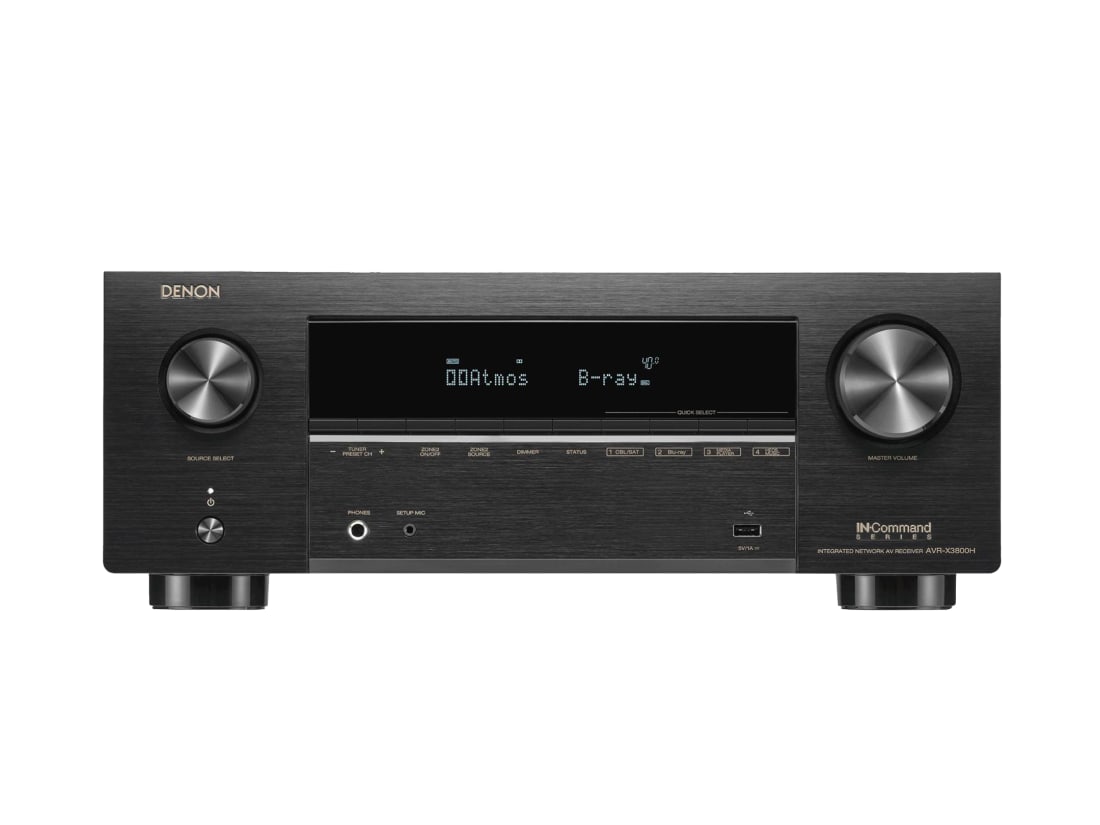
The other issue is signal path. Most home cinema systems are built around an AVR, or for the more serious builds a separate processor and power amps, and that whole ecosystem is designed for HDMI, multichannel decoding and the digital handshakes that come with a modern source. None of it particularly cares about turntables. Our guide on building a home cinema covers the core components well, but you'll notice a phono stage isn't one of them, because it genuinely isn't part of that world.
You've got two workable paths here. The first is running the turntable through a dedicated phono preamp into a stereo input on the AVR, using the AVR purely as a switcher for two-channel listening, which is fine but slightly wasteful if you've spent good money on a multichannel amp. The second, and the one I actually prefer for anyone serious about both hobbies, is keeping the vinyl system entirely separate, its own small integrated or phono-in amp driving a modest pair of standmounts, physically apart from the theatre gear. If you're weighing up AVR versus a separate processor and power amps for the cinema side of things, that's a genuinely useful decision on its own merits, separate from anything vinyl-related, and it's worth reading up on before you commit either way.
I'll say the contrarian bit here plainly: I think most people trying to run vinyl through their home cinema amp are optimising for convenience over sound, and that's a fair trade if you're mostly half-listening to records while watching sport with the mute on. But if you actually care about how the record sounds, a shared system is the compromise, not the solution.
The Atmos ceiling speakers change the room's acoustics too
Height channels, whether they're in-ceiling drivers or up-firing modules bouncing sound off a flat ceiling, change the reflective behaviour of a room in ways that matter for two-channel listening even when nothing is playing through them. In-ceiling speakers are usually flush-mounted with grilles, which is fine acoustically, but the raked or vaulted ceilings that suit Atmos height placement often make for a room that's acoustically live and reflective in exactly the frequency range where record surface noise and sibilance live. Add carpet-free floors for AV cable runs and a wall of glass for the projector screen's ambient light control, and you've got a room tuned for movie dialogue intelligibility that can be genuinely fatiguing for sustained vinyl listening.
This is where I'd push back gently on room design that treats the theatre room as the only room. If you've got the square footage, a separate listening space, even a converted study or a corner of a living area, gives your vinyl system a room built around its own acoustics rather than one optimised for a projector throw distance and height speaker angles.
Rumble, hum and the ground loop nobody diagnoses correctly
Turntables are notoriously sensitive to electrical noise, and a cinema rack is a genuinely hostile electrical environment: an AVR or processor, an amplifier stage, possibly a projector on a separate circuit, network switches, and a subwoofer amp all sharing power boards and often sharing a single wall outlet. Hum through a phono stage is usually a grounding issue, and it gets worse, not better, the more devices you daisy-chain into the same power run. I've traced more "the deck's faulty" complaints to a shared power board with a cinema amp than I care to count.
If you must share a rack, at minimum run the phono preamp and turntable off a separate circuit or a dedicated power board away from the AVR and subwoofer amps, and keep interconnect cable runs short and away from any HDMI or speaker cable bundles. It's not glamorous advice, but it fixes the majority of intermittent hum complaints I get asked about.
What I'd actually build, given the choice
If someone handed me the Adelaide Hills room and asked me to plan it from scratch, I'd keep the Atmos rig exactly as designed, on its own dedicated rack, subwoofers placed for the cinema experience without compromise. For the turntable, I'd want a separate, lightweight equipment stand against a different wall, ideally one not sharing floor joists directly with a subwoofer, running into a modest integrated amplifier with a built-in phono stage or a good outboard phono preamp, feeding a pair of standmounts on proper stands rather than the cinema's floorstanders. Something like the Rega Brio Mk7 (check price) or the Cambridge Audio CXA81 MkII (check price) handles phono duties respectably at a sensible price, and either would happily drive a pair of Wharfedale Diamond 12.1s (check price) or similarly modest standmounts without asking for a second mortgage.
That's two systems in one room, admittedly, which sounds indulgent until you remember it's exactly how mixed-use rooms have always worked. Nobody expects a home gym and a home office to share the same equipment, and a theatre rig and a vinyl rig are just as different in what they're optimised for.
If physical separation genuinely isn't possible, the fallback is to accept some compromise: turntable as far from the subs as the room allows, on an isolating platform, its own power circuit if you can manage it, and phono stage feeding a stereo input rather than trying to route it through the full multichannel processing chain. It won't be as good as a separate room. It'll be considerably better than a rack full of gear with a deck wedged on top.
A word on cable runs and clutter
One more practical thing that gets missed: cinema installs generate a lot of cable, HDMI runs to the projector, speaker cable to seven or more locations, subwoofer cable, network cable for streaming boxes. All of that in the same rack area as a turntable means more opportunity for the tonearm cable, which carries a genuinely tiny signal before the phono stage boosts it, to pick up interference from everything nearby. Keep that run as short and as isolated as you reasonably can. It's a small thing, but it's the kind of small thing that compounds with everything else in this list.
The honest version of my advice is this: build the Atmos room to be brilliant at being an Atmos room, and give the turntable somewhere else to be brilliant too. Trying to make one rack and one room do both jobs well is where most of the frustration in these emails comes from, and it's rarely fixed by better gear. It's fixed by better placement.
Common questions
- Can I run a turntable through my AVR without a separate phono stage?
- Only if the AVR has a phono input, and most modern AVRs don't. You'll need an outboard phono preamp or an integrated amp with phono built in, feeding a standard stereo input on the AVR.
- Will subwoofer bass actually damage a turntable?
- Damage is rare, but audible feedback and smeared transients are common when a deck sits close to a sub or shares a floor structure with one. Isolation and distance matter more than most people expect.
- Is it worth buying a second, smaller amplifier just for vinyl in a cinema room?
- If you listen to records seriously rather than as background noise, yes. A modest integrated amp with phono input, kept on its own rack away from the AV gear, will almost always sound and behave better than sharing the cinema system.
- Does the acoustic treatment for Atmos height channels hurt vinyl listening?
- It can. Rooms optimised for dialogue clarity and height-speaker reflection are often more live than a room suited to sustained two-channel listening, which can make vinyl's higher frequencies feel more fatiguing over time.

Hello — I'm Priya. I ran a second-hand record shop in Fitzroy for the better part of a decade, which is a polite way of saying I have three thousand records and nowhere to put them. I listen to vinyl through valve amplification because I like the ritual as much as the sound, and yes, I know the measurements aren't perfect — I don't care, and I'll explain why on the page. If you want someone to tell you a turntable is "just a motor and a bearing," I am not your person.
Record collector (3,000+); valve-amp enthusiast; ex record-shop owner
More from Priya Anand
 USB vs S/PDIF for DACs: does the digital input matter?USB, coaxial and optical into a DAC: which digital input actually changes the sound, and when the difference is real versus imagined.
- Qobuz vs Tidal for your record collection's digital halfQobuz vs Tidal compared for vinyl collectors who want a digital half that matches their records, not just a bigger catalogue.
 Why a subwoofer makes a valve system sound more honestAdding a subwoofer to a valve amp system can tighten bass, cut distortion and let low-power tubes sing. Here's how to do it properly.
- Tidal vs Qobuz vs Apple Music: which one actually suits a valve systemStreaming services aren't interchangeable once you're running valves. Here's how Tidal, Qobuz and Apple Music actually behave through a warm front end.
 Speaker matching to valve amps: sensitivity beats watts every timeWhy sensitivity, not power output, decides whether a valve amp and speaker pair actually works together — and how to read a spec sheet properly.
- Your phone's volume slider is quietly re-encoding your musicTurning your phone down before a Bluetooth speaker or DAC often re-processes the digital signal. Here's what's actually happening, and when it matters.