AVR vs AV processor: which should power your home cinema?
Every few months someone drops a question in my inbox that goes roughly like this: "I've got $5,000 to spend on processing and amplification for my cinema room. Should I buy one good AVR or split the money across a processor and separate amps?" The AVR vs AV processor question is a genuinely interesting engineering problem, and the answer isn't as obvious as either camp wants you to believe.
The marketing language surrounding each option tends to obscure the real tradeoffs. So let me put some specifics on the table.
AVR vs AV processor: what a receiver actually is, electrically
An AVR is a power amplifier section, a preamplifier section, a DSP board, an HDMI switching matrix, a DAC array, and sometimes a network streamer, all sharing a single chassis and a single power supply. That shared supply is where the compromise lives.
When you're running nine or eleven channels at moderate levels in a typical listening room, the shared supply is fine. Most modern receivers from Denon, Yamaha, Marantz and Onkyo are honest about their continuous power figures, and the specs hold up under measurement at moderate loads. The problem arrives when you ask the amplifier section to work hard across many channels simultaneously. The power supply sags, the voltage rails drop, and THD+N climbs. In a well-treated dedicated cinema room you'll likely never push an AVR hard enough to hear this. In an open-plan living space driving inefficient speakers at reference levels, you will.
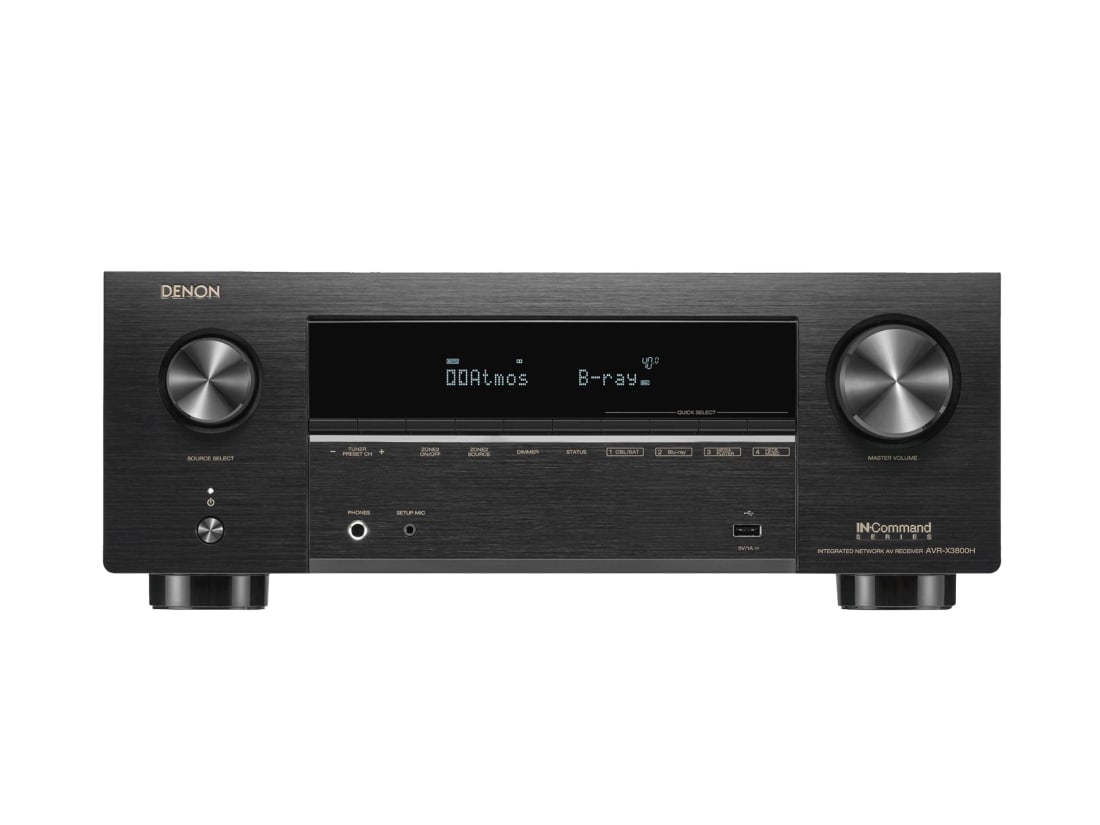
The second issue is physical proximity. The switching-mode power supplies inside most AVRs generate noise that has to be carefully isolated from the analogue stages. Manufacturers manage this with shielding and PCB layout, and the better ones do it well. But there is a hard limit to how much you can isolate when everything sits on the same board. Our Denon AVR-X3800H review (check price) showed excellent measured noise floors for the class, but you could still see the supply artefacts on a spectrum analyser if you looked at the right frequency range.
What a dedicated processor buys you (and what it doesn't)
A standalone AV processor, such as a Trinnov Altitude, StormAudio ISP, Datasat RS20i, or the Marantz AV 30 on the more accessible end, does everything up to and including the DAC output stage, then hands off to a separate power amplifier. The benefits are real and measurable: the processor's power supply doesn't have to feed output transistors under load, so the noise floor in the analogue domain is lower. You also get chassis isolation between the processing and amplification stages.
What a processor doesn't do is guarantee better sound all by itself. Expensive processors paired with mediocre multichannel amplifiers can produce results worse than a well-chosen AVR. The processor is only as good as the downstream amplification, and a budget stereo-ish multichannel amp will introduce its own distortion and noise. The separates path only beats the AVR path when the amplifier quality matches the processor quality, which typically means the total spend is meaningfully higher. Our piece on when to make the jump to a processor plus power amps goes deeper on that point.
There's also the calibration question. The best reason to consider a Trinnov-based processor today isn't the preamplifier section; it's the room correction. Trinnov's Optimizer uses a 3D microphone array and a genuinely sophisticated filter-design algorithm that goes well beyond what Audyssey MultEQ XT32 or even Dirac Live (in its base tier) can produce. If your room has significant acoustic problems, and most untreated rooms do, the correction engine may deliver more audible improvement than any analogue upgrade you could make. Room treatment still matters even when you have class-leading DSP, but the two work best together.
The power supply is the real argument for separates
If I had to name the single measurable advantage of the separates path, it's this: a dedicated monoblock or multichannel power amplifier can have a power supply scaled to its output stage without compromising anything else. A quality monoblock running a single channel has an effectively unlimited power-supply-to-output-power ratio compared to an AVR running eleven. That translates directly to lower dynamic compression and lower distortion on transients. If you want the engineering detail, see our look at power supply topology in high-end amplifiers.
For music listening this matters a lot. For cinema, it matters less than you might think. Film soundtracks are spectrally shaped and heavily compressed at the mix, so discrete channels rarely demand sustained high power simultaneously. The exception is large-format systems running subwoofers below 40 Hz at genuine reference levels, where you need real current delivery and a lot of it. That's a different conversation.
What I'd push back on is the idea, occasionally spruiked by high-end dealers, that a $15,000 processor paired with $8,000 worth of multichannel amplification will "blow away" a $6,000 AVR in a typical room. Sometimes it does. Sometimes you're paying for flexibility, upgradeability, and build quality rather than a measurable uplift in what reaches your ears. I'd rather someone spent a portion of that budget on room treatment before chasing the last 3 dB of noise floor improvement from a processor swap.
Where AVRs have genuinely closed the gap
The 2023-to-2026 generation of flagship AVRs is meaningfully better than what came before, partly because DSP silicon has got cheaper and more capable, and partly because Dirac Live licensing has pushed room correction into AVRs that would have had only basic Audyssey a few years ago. The miniDSP Tide16 and similar professional-grade solutions have also raised expectations for what correction can achieve at a given price point.
Pre-out sections on current flagships from Yamaha (the RX-A8A) and Marantz (the Cinema 40) are genuinely clean. If your plan is to run the AVR as a processor and bypass its internal amps on the main channels while running external amps for the front LCR, you're getting close to separates performance for a lot less money. This hybrid approach, with the AVR handling processing and surrounds and a separate stereo or multichannel amp on the fronts, is in my opinion underrated. It gives you the upgrade path of separates without the full cost.
Our guide to building a home cinema covers the component hierarchy in full, but the short version for this specific decision: if your front LCR speakers are high-sensitivity (92 dB+) and your room is under 40 square metres, a good AVR with pre-outs will serve you well and the measured difference versus separates will be hard to demonstrate. Below 88 dB sensitivity and above 50 square metres, the case for separate amplification on at least the front three channels gets much stronger.
Practicalities: HDMI, format support, and upgrade cycles
One area where AVRs have a structural advantage is HDMI integration. A modern AVR is a purpose-designed hub: HDMI switching, ARC/eARC, 4K/120Hz passthrough, VRR, ALLM, all handled in one box with a well-tested firmware stack. Standalone processors historically lagged on HDMI feature support because the HDMI licensing and silicon costs were easier for the volume manufacturers to absorb. That gap has narrowed, but if your cinema doubles as a gaming room and you need HDMI 2.1 features across multiple inputs right now, check the processor's spec sheet carefully before assuming separates are plug-and-play. The HDMI Forum and licensing body publishes the official specification background, and our explainer on HDMI handshakes and AVR signal dropouts covers why things go wrong in practice.
Format support is another one. HDMI 2.2 and the new Ultra96 cable spec are around the corner, and the AVR manufacturers will integrate that into their mid-cycle refreshes faster than the boutique processor brands. The premium separates market tends to address this via HDMI board upgrades (Trinnov, StormAudio both offer field-upgradeable HDMI cards), which is a sensible architectural choice but adds to the ownership cost.
Practical budget thresholds for the Australian market
I'll be direct about where I think the crossover points sit in the current AU market, acknowledging that prices shift and stock availability varies.
Below $3,000 total, buy a good AVR and spend whatever is left on acoustic treatment. There is no separates path that beats a well-calibrated current-generation AVR at this price in a real room with real acoustics. Between $3,000 and $7,000, a flagship AVR with decent pre-outs running external amplification on your front three channels is a genuinely strong option. Above $7,000 for the processing-and-amplification budget, a dedicated processor starts to make engineering sense, especially if you're in a purpose-built room. Above $15,000, you're in Trinnov/StormAudio territory and the room had better be treated or you're wasting the investment.
The best streaming amplifiers guide covers some of the crossover products that blur the line between these categories, and it's worth reading if you're building a dual-purpose music and cinema system rather than a dedicated theatre. And if you're sourcing the video side of things, our Sony VPL-XW5000ES review (check price) gives a sense of what the projection end of the equation demands from your signal chain in terms of latency and switching.
My actual recommendation on AVR vs AV processor
For most readers building or upgrading a home cinema in Australia, the AVR remains the right answer unless you have a specific, measurable reason to move to separates. "Separates sound better" is not a specific reason. "My front LCR speakers are 86 dB sensitive, my room is 60 square metres, and I want to run them at reference level" is a specific reason.
Start with the best AVR your budget allows, run Dirac Live if the firmware supports it (and do it properly, with multiple measurement positions), then evaluate whether the pre-out section is a bottleneck before you spend anything else. In most rooms, the next dollar after the AVR is better spent on bass trapping than on a processor upgrade. I know that's not what the separates evangelists want to hear, but it's what the measurements keep telling me.
The SVS SB-3000 (check price) illustrates the point well: a single well-placed, well-calibrated subwoofer can transform the low end more dramatically than swapping the processor would. Acoustic problems don't get solved in the equipment rack.
Common questions
- Can I use an AV receiver as just a processor by running its pre-outs to external amplifiers?
- Yes, and it's a popular approach. Most flagship AVRs have pre-outs for all channels, so you can use the AVR for decoding, DSP and room correction, and hand off to a separate power amplifier for the front LCR — or all channels if you prefer. The quality of the AVR's pre-out stage varies; check for a noise floor spec or look for independent measurements before assuming all pre-outs are equal. On current high-end AVRs from Yamaha, Marantz and Denon, the pre-out performance is generally very good.
- Does a standalone AV processor sound better than an AVR?
- In a properly treated room with matched-quality amplification, a dedicated processor typically measures better — lower noise floor, lower dynamic compression at high output levels. Whether you can hear that difference depends heavily on your room, your speakers, and the amplification you pair with the processor. In an acoustically poor room, the room correction quality of a high-end processor (Trinnov Optimizer, for example) is likely to produce a larger audible improvement than any analogue preamplifier advantage it holds over a good AVR.
- What Atmos object count do I actually need — 7.1.4 vs 9.1.6?
- For a room under roughly 50 square metres, 7.1.4 (seven bed channels, four height channels) is enough to render Atmos objects convincingly. The spatial resolution improvement from adding more overhead channels is real but diminishing. 9.1.6 layouts make more sense in larger, acoustically treated dedicated theatres where the extra channels can actually resolve in the room. Running more channels than your room can differentiate just spreads the amplifier budget thinner without audible gain.

I'm Marcus, and I'll be honest up front: I trust a measurement before I trust my own ears, because my ears lie to me daily. I spent fifteen years designing audio electronics before I started writing about them, so when a brand tells me a number, I want to see the graph. That doesn't make me cold about this hobby — I love a system that disappears as much as anyone — it just means I'll tell you when an expensive box is selling you confidence rather than performance.
Former audio electronics engineer; objectivist; runs the test bench
More from Marcus Vale
 Why your turntable's earth wire isn't optionalTurntable earthing fixes most phono hum problems. Here's how grounding actually works, why it fails, and how to track down a noisy connection.
 Why your AVR runs cool on music but throttles on AtmosAVR thermal throttling explained: why nine-channel Atmos mixes push receivers into protection mode that two-channel music never triggers.
- Subwoofer delay settings: why your AVR's number is a guessAVR auto-calibration estimates subwoofer delay from distance, not timing. Here's how to measure and correct it properly for tighter bass.
- AVR auto-calibration: what Audyssey, YPAO and Dirac actually measureAudyssey, YPAO and Dirac Live all run a mic sweep and spit out numbers, but they're not measuring the same things or fixing the same problems. Here's what's actually happening.
- Cartridge break-in: what actually changes in the first 40 hoursDoes a new cartridge really need 40 hours to "open up"? I measured one to find out what's mechanical fact and what's audiophile folklore.
- DAC output stages: what the chip doesn't tell youThe DAC chip gets all the marketing attention, but the analogue output stage after it does most of the work shaping what you actually hear.