AWOL Vision Aetherion Max and Pro: A UST Projector Challenge
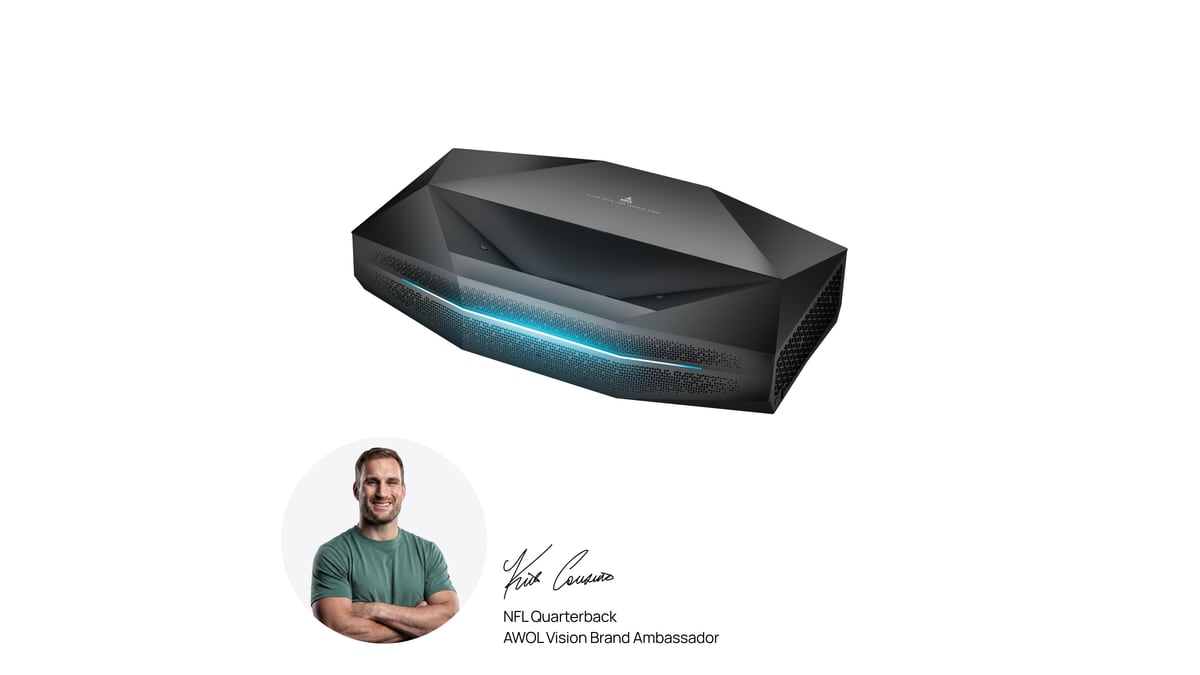
A new contender steps into the laser TV arena
The ultra-short-throw projector market has, for the past few years, been something of a two-horse race. On one side you have Hisense, whose PX series essentially created the consumer "Laser TV" category and remains the benchmark most Australians use when they walk into a retailer and ask about big-screen alternatives to OLED panels. On the other, you have a cluster of Chinese-born, internationally ambitious brands (Dangbei, Formovie, JMGO), all chasing the same UST dollar. AWOL Vision has been part of that chase, building a respectable reputation with its LTV series, but the company arrived at CES 2026 in January with something that feels more deliberate and more confident than anything it has shown before: the Aetherion series, led by the Aetherion Max and Aetherion Pro.
This is not a minor refresh. The Aetherion line represents AWOL Vision staking a claim in the upper-mid and near-premium UST tier, with specifications that are genuinely competitive on paper and a feature set, particularly around gaming, that goes beyond what most Laser TV incumbents have bothered to address. Whether it translates into a compelling real-world purchase for Australian buyers depends on a few things we'll work through below, but the arrival itself is worth paying close attention to.
What AWOL Vision announced for the Aetherion Max and Pro
The two projectors share a common platform. Both are 4K DLP designs using a tri-laser light engine. That means separate red, green and blue laser arrays rather than a single blue laser bounced through a phosphor wheel, which is the architecture behind most budget and mid-range laser projectors. Tri-laser matters because it gives you wider colour gamut coverage, better white balance stability and, in theory, a punchier, more saturated picture straight out of the box without aggressive post-processing. It's the same fundamental approach used in reference-class single-chip DLP projectors from the likes of Optoma and BenQ at much higher price points, and it's increasingly becoming the marker that separates serious UST designs from the value tier.
Aetherion Max
The flagship of the two sits at US$4,499 and delivers 3,300 ISO lumens. That's a meaningful headline number. ISO lumens, as opposed to manufacturer-claimed "ANSI lumens" or the frankly meaningless "equivalent lumens" figure you still see thrown around by some brands, is measured under a standardised test methodology that accounts for real-world light output across the full panel. Three thousand three hundred ISO lumens puts the Max in territory where you can genuinely consider ambient-light-tolerant viewing, which is the entire point of a Laser TV positioned against a conventional television.
Aetherion Pro
The step-down model is priced at US$3,499 and rates at 2,600 ISO lumens. Still a respectable figure (most competing USTs in the AU$4,000–$5,500 bracket are operating in roughly this zone), but the 700-lumen gap between the two models is meaningful if your room gets any daylight at all. In a properly light-controlled dedicated cinema room, the Pro is more than adequate. In a living room with east-facing windows, the Max starts to look like the more pragmatic choice even at the higher price.
Shared specifications: where it gets interesting
Here's where AWOL Vision has clearly made deliberate engineering choices rather than just competing on lumens and price. Both the Max and the Pro share the following specifications:
- Contrast: 6,000:1 native, 60,000:1 dynamic (EBL, short for Extreme Black Level)
- HDR support: Dolby Vision and HDR10+
- Gaming: 1ms-class input latency at 240Hz, VRR, ALLM, Dolby Vision Gaming
Let's take each of those in turn, because they each carry weight.
Contrast and the EBL system
A native 6,000:1 contrast ratio is solid for a single-chip DLP UST. It's not going to challenge a good LCOS projector like the Sony VPL-XW5000ES (check price) for absolute blacks, but it's competitive within the UST category where the short-throw optical path creates inherent contrast limitations. The 60,000:1 dynamic figure, achieved through what AWOL calls EBL (Extreme Black Level), is essentially a dynamic iris or laser dimming system that modulates light output scene by scene. Dynamic contrast systems are a double-edged sword. Done well, they add perceived depth in dark scenes without being distracting; done poorly, they cause visible pumping and crush shadow detail. We won't know which camp AWOL's implementation falls into until we get review samples in the room, but the 10:1 ratio between native and dynamic contrast suggests the EBL is doing significant work.
Dolby Vision and HDR10+: both, not one
This is quietly one of the more important details in the announcement. Most projectors in this price bracket support one or the other: typically HDR10+ from the Samsung ecosystem, or Dolby Vision, which requires a licence and a more complex processing pipeline. Supporting both means the Aetherion series can receive and correctly interpret dynamic metadata from virtually any streaming service or source device, whether you're running an Apple TV 4K (which outputs Dolby Vision), a Samsung device (which prefers HDR10+), or a Blu-ray player sending standard HDR10. For Australian streaming subscribers, where content libraries span Netflix, Disney+, Apple TV+ and Stan, all with different HDR format preferences, this universal compatibility is genuinely useful rather than a marketing footnote.
The gaming credentials
This is arguably the most strategically pointed part of the Aetherion announcement, and it's clearly aimed at a gap in the Hisense PX lineup. A 1ms-class input latency figure at 240Hz, combined with Variable Refresh Rate and Auto Low Latency Mode, puts the Aetherion series into territory that no Laser TV manufacturer has seriously addressed. Most UST projectors, including Hisense models, have input lag measurements in the 30–60ms range in their fastest modes. That's acceptable for casual gaming, but not serious console or PC gaming. If AWOL's 1ms claim holds up under independent measurement, and that's a significant if, these projectors become genuinely interesting for PlayStation 5 and Xbox Series X owners who want a large screen without sacrificing the responsiveness that modern gaming demands.
Dolby Vision Gaming is the cherry on top of the gaming story. This is the same certification you find on high-end OLED televisions and a small number of premium monitors. It delivers the dynamic metadata processing of Dolby Vision but tuned specifically for the low-latency, variable-brightness demands of game content. Xbox Series X supports Dolby Vision Gaming natively, and supported titles benefit from improved HDR tone mapping in real time. Seeing this on a UST projector is genuinely new territory.
For context on why all of this matters in a cinema room, it's worth reading through our building a home cinema guide, which covers the interplay between display technology, room design and source components in detail.
PixelLock: the feature that could define installation
Every UST projector launch involves a degree of hand-waving about image alignment and calibration, because the ultra-short-throw geometry creates real optical challenges. A projector sitting 15–20cm from a screen has almost no tolerance for placement variation. Shift the unit a centimetre sideways and you can introduce significant keystone distortion or pixel misalignment across the image.
AWOL Vision's answer here is PixelLock, described as a new alignment system introduced with the Aetherion series. The company hasn't published detailed technical documentation on exactly how PixelLock works (whether it's a hardware optical alignment mechanism, a software-driven auto-calibration routine using a built-in camera, or some combination), but the name and the context of its announcement suggest it's intended to address the real-world installation headaches that make UST projectors more finicky to set up than their Laser TV marketing implies.
This is an area I'll be paying close attention to when review units arrive in Australia. The installation experience is, for many buyers, the deciding factor between a UST projector and a conventional flat panel. If PixelLock genuinely simplifies alignment to the point where a confident DIY installer can achieve a consistently sharp image without professional calibration, it removes one of the category's most significant practical friction points.
Pricing, availability and the Australian context
Retail availability was projected for April 2026, with a crowdfunding campaign opening in February 2026. Australian pricing and local distribution arrangements have not been formally announced by AWOL Vision. The US pricing, US$4,499 for the Max and US$3,499 for the Pro, converts to roughly AU$6,900 and AU$5,400 at typical exchange rates before freight, GST and any distributor margin. Real-world Australian retail pricing will almost certainly land higher than the direct currency conversion suggests.
For comparison, Hisense's PX3-PRO, which is the top-tier laser TV available through Australian retail, sits in the AU$5,000–$6,000 range depending on the retailer and any bundled screen offers. If AWOL Vision's Australian pricing comes in around the AU$6,000–$7,500 mark, which seems the likely range, the Aetherion Max will need to justify a meaningful premium over the Hisense incumbent on image quality and the gaming feature set. The Pro, closer to AU$5,000–$6,000, would be a more direct head-to-head competitor to the PX3-PRO. Hisense's own push at the top of the category is covered in our piece on the Hisense tri-laser 4K flagship and pro-grade UST.
The crowdfunding route, with AWOL Vision opening pre-orders via crowdfunding in February 2026, is a familiar but somewhat double-edged path for premium AV hardware. Early backers typically receive discounted pricing, but they also accept the risk of delayed delivery, evolving firmware and limited warranty infrastructure if the local distribution footprint isn't yet established. Australian consumer law provides protections in these scenarios, but enforcing them against an overseas manufacturer without a local entity is never straightforward. Buyers who can wait for retail availability and local stock will be on firmer ground.
How does this stack up against the competition?
The UST projector market in Australia has expanded considerably over the past two years. Beyond Hisense, you now have Formovie, Dangbei and JMGO all with local or near-local distribution, and the Sony VPL-XW5000ES, while not a UST, represents the upper end of what serious enthusiasts spend on projection. For another tri-laser DLP option aimed at Australian buyers, our Valerion VisionMaster Max review is a useful yardstick. The Aetherion series targets a specific gap: buyers who want Laser TV convenience and placement flexibility but who are frustrated by the gaming compromises and HDR format limitations of existing options.
If the 1ms latency claim is validated by independent testing, AWOL Vision will have built something genuinely differentiated. If it isn't, and the real-world latency in a gaming-optimised mode is closer to 15–20ms, the Aetherion becomes a competent but unremarkable competitor in an already crowded field. Similarly, if PixelLock works as implied, it could shift the installation experience meaningfully. If it's marketing language for a standard digital keystone correction system, expect seasoned installers to be unimpressed.
One thing that will matter enormously for Australian buyers is screen compatibility. UST projectors are highly sensitive to the screen surface they're paired with. A standard gain screen designed for a throw-ratio projector will produce uneven brightness and hot-spotting with an ultra-short-throw light engine. Dedicated UST or ambient-light-rejection screens are essential, and they add AU$1,000–$3,000+ to the total system cost depending on size and brand. Any honest assessment of the Aetherion's value proposition needs to include that cost. If you plan to put speakers around the screen, our notes on screen-wall speaker placement for a UST projector cover how the projector's position shapes the whole front wall.
For a full picture of how display, screen, acoustics and processing fit together, our home cinema planning guide is a useful starting point, and pairing the projector with a capable AV receiver like the Denon AVR-X3800H (check price) will unlock its full Dolby Vision and immersive audio potential.
What to watch for before you buy
My honest take: the Aetherion Max and Pro are the most complete UST projector announcement I've seen from AWOL Vision, and the gaming specification sheet in particular represents a genuine step forward for the category. But specifications announced at CES and delivered products measured in a controlled review environment are two different things, and the UST market has a history of optimistic lumen and latency claims that don't survive independent testing.
Here's what I'd be watching before committing Australian dollars to either model:
- Independent input lag measurement in a low-latency gaming mode. The 1ms figure needs to be stress-tested by reviewers with a proper lag tester, not taken at face value.
- Real-world lumen output in calibrated modes versus the 3,300 and 2,600 ISO claims, since projectors often deliver peak brightness only in modes with elevated colour temperature and reduced accuracy.
- PixelLock in practice: does it genuinely simplify setup for a DIY installer, or is it a refined version of standard auto-keystone?
- Australian distribution confirmation. Warranty support and firmware updates are only meaningful if there's a local entity responsible for delivering them.
- Screen pairing recommendations. AWOL Vision should publish a list of validated ALR screen partners for Australian buyers.
The bottom line for Australian buyers
AWOL Vision has arrived at CES 2026 with its most credible challenge to Hisense's laser TV dominance yet. The Aetherion Max at US$4,499 and the Pro at US$3,499 bring tri-laser DLP image quality, universal HDR format support through Dolby Vision and HDR10+, and a gaming specification that, if it checks out, puts serious distance between these projectors and every other Laser TV on the market. The native contrast of 6,000:1 and the Dolby Vision Gaming certification are the features that stand out to me as genuinely meaningful rather than specmanship.
For Australian buyers, patience is the right posture. Wait for retail availability rather than the crowdfunding path, confirm local distribution arrangements, budget properly for an ALR screen, and hold the gaming claims to account when independent reviews start appearing. If the Aetherion Max delivers on even 80 per cent of what the CES announcement promises, it will be a serious contender in the AU$6,500–$8,000 total-system conversation for a 100-inch-class home cinema image.
We'll have a full review as soon as Australian units are available. In the meantime, if you're building the rest of the signal chain around a projector like this, our guidance on Dolby Atmos processing is worth a read, and pairing it with a capable subwoofer like the SVS SB-3000 (check price) will ensure the low-end keeps pace with that high-resolution picture.
Common questions
- What is the difference between the AWOL Vision Aetherion Max and Aetherion Pro?
- The Aetherion Max delivers 3,300 ISO lumens and is priced at US$4,499, while the Aetherion Pro outputs 2,600 ISO lumens at US$3,499. Both share the same tri-laser DLP platform, native 6,000:1 contrast ratio, Dolby Vision, HDR10+ and gaming specification including 1ms-class latency at 240Hz. The lumen difference is significant in rooms with ambient light — the Max offers more headroom for imperfect light control conditions.
- When will the AWOL Vision Aetherion series be available in Australia?
- Retail availability was projected for April 2026, with crowdfunding pre-orders opening in February 2026. Australian pricing and formal local distribution have not been announced at the time of writing. Buyers are advised to wait for confirmed local distribution rather than importing via the crowdfunding route, to ensure warranty support and firmware update coverage under Australian consumer law.
- Does the Aetherion series support both Dolby Vision and HDR10+?
- Yes — both the Aetherion Max and Aetherion Pro support Dolby Vision, HDR10+ and Dolby Vision Gaming. This dual-format HDR support means the projectors can correctly interpret dynamic metadata from virtually any streaming service or source device used in Australian homes, regardless of whether those devices favour the Dolby or Samsung HDR ecosystems.
- What screen do I need for an AWOL Vision Aetherion UST projector?
- Ultra-short-throw projectors require a dedicated UST-compatible screen, typically an ambient-light-rejection (ALR) design engineered for steep projection angles. Standard gain screens designed for long-throw projectors will produce uneven brightness and hot-spotting with a UST light engine. Budget AU$1,000–$3,000 or more for a quality ALR screen in the 100–120 inch range, in addition to the projector cost, to achieve the intended image quality.

G'day, Jonno here. I spent the better part of twelve years as a custom installer building theatres — everything from a media room squeezed into a Queenslander to a fully blacked-out, acoustically-treated cinema with a hundred grand of gear behind the screen. The thing nobody tells you is that the room matters more than the boxes, and I'll bang on about acoustics until you're sick of me. If you're planning a theatre, talk to me before you spend a cent on speakers.
Ex CEDIA-trained installer; dedicated-theatre and Atmos specialist
More from Jonno Fraser
 Guest Wi-Fi and audio: why visitor networks break multiroomGuest Wi-Fi networks isolate devices by design, which quietly breaks multiroom audio. Here's why it happens and how to fix it properly.
 Ceiling speakers vs upfiring Atmos modules: what actually worksCeiling speakers vs upfiring Atmos modules compared for real rooms: when in-ceiling wins, when upfiring is the better call, and why.
- Why your home cinema amp runs hotter on movies than musicFilm soundtracks push amplifier channels harder and longer than stereo music ever does. Here's why that matters for topology, power supplies and what actually fails.
- Screen-wall speaker placement: building around a UST projector properlyUltra short throw projectors sit right where your centre channel wants to be. Here's how I actually solve that in real theatre builds, not in theory.
 Headphone isolation vs room noise: why your desk setup fights youOpen-back headphones and a noisy home office don't mix. Here's how to actually diagnose room noise before you blame the gear.
 Toe-in and rake: the free speaker tuning most owners never touchToe-in angle and cabinet rake cost nothing but change tonal balance and imaging more than most upgrades. Here's how I set both on site.