Denon's 2026 X-Series adds the AVR-X2900H and AVC-X3900H with wireless rears
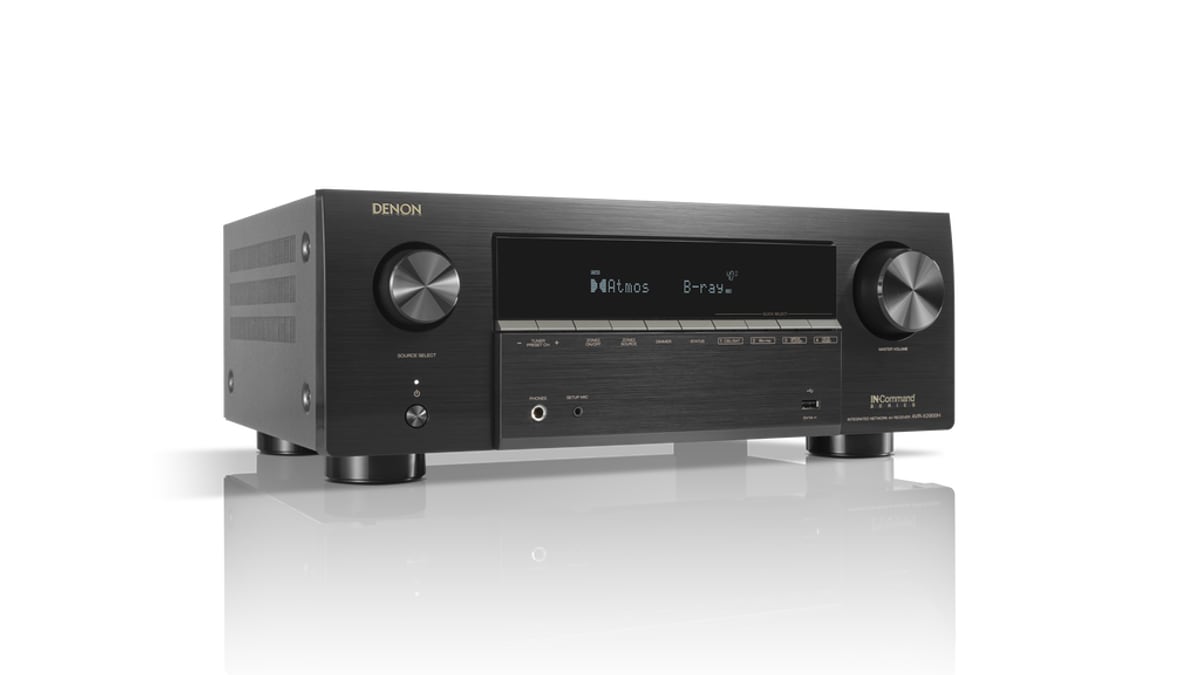
Denon dropped a pair of mid-tier receivers in May 2026 that deserve more attention than the typical spec-sheet refresh. The AVR-X2900H and the AVC-X3900H — the latter officially landing on 14 May — represent a meaningful step forward for the X-Series line, not just in raw numbers but in the kind of features that were, until recently, the exclusive territory of flagship gear. Dirac Live room correction at the X2900H's price point is the headline, but the wireless rear channel story is the one that could genuinely change how people build and live with a surround system. Let me unpack both products properly.
What Denon has actually announced
The AVR-X2900H is a 7.2-channel receiver rated at 95 watts per channel, priced at approximately US$1,349. The AVC-X3900H steps up to 9.4 amplified channels — with processing headroom for an 11.4-channel configuration — rated at 105 watts per channel, and carries a price of US$1,849, which works out to roughly AU$2,430 at current exchange. Both models sit firmly in what I'd call the serious enthusiast tier: not entry-level, not cost-no-object, but the range where most Australians building a genuine home cinema actually spend their money.
These are not simply iterative bumps. The X3900H specifically adds IMAX Enhanced, Auro-3D, 360 Reality Audio, and MPEG-H audio — a breadth of format support that makes it essentially future-proof for every immersive audio codec currently in active development or deployment. It also gains a third HDMI output dedicated to projector use, which is a quietly important addition I'll come back to. HDMI across the board supports VRR, ALLM, FreeSync, 8K@60Hz and 4K@120Hz. And then there's the firmware-enabled wireless rear channel capability via compatible Denon Home speakers — arguably the most practically significant feature either model carries.
Dirac Live at this price: why it matters
For context, room correction has been the single most impactful technology in home cinema over the past decade. Audyssey MultEQ XT32 has done solid work in Denon and Marantz receivers for years, and it remains a capable system. But Dirac Live operates differently — it corrects both the frequency domain and the time domain simultaneously, addressing phase and impulse response issues that frequency-only EQ simply cannot touch. The result, in well-documented listening tests and in my own experience across multiple rooms, is a more coherent soundstage, tighter bass articulation, and a mid-range that doesn't carry the slightly smeared quality that frequency-only correction can occasionally introduce.
The fact that Dirac Live now appears at the AVR-X2900H's price point — approximately AU$1,700-ish when it lands locally, depending on retailer and exchange at time of purchase — is genuinely significant. Until recently, Dirac Live in an AV receiver typically meant spending considerably more, often on separates or on the upper end of integrated receivers. Bringing it to a 7.2-channel receiver at this price democratises the technology in a way that benefits ordinary listening rooms everywhere. And ordinary listening rooms are where Dirac Live earns its keep most obviously: it was designed for imperfect acoustic environments, not treated studios.
If you're building out a system from scratch or upgrading an ageing receiver, I'd strongly recommend reading our guide to building a home cinema alongside these specifications. Room treatment and room correction work best together, not as substitutes for each other — Dirac Live will extract more from a room that has at least basic absorption and diffusion in place.
The AVC-X3900H's format support is genuinely comprehensive
Let's spend a moment on the X3900H's immersive audio roster, because it's worth appreciating how thorough it is. Dolby Atmos and DTS:X are table stakes in 2026. What's notable here is the simultaneous presence of Auro-3D, IMAX Enhanced, 360 Reality Audio, and MPEG-H.
Auro-3D uses a different height-channel philosophy to Atmos — a fixed layered approach rather than object-based rendering — and it has a devoted following among enthusiasts who find its naturalness with music and acoustic content compelling. Having it alongside Atmos rather than as an alternative is a genuine differentiator. IMAX Enhanced brings the DTS:X Pro codec together with IMAX-specific mastering guidelines, and is increasingly prevalent in streaming content from services like Disney+. 360 Reality Audio is Sony's spatial audio format, prominent in music streaming. MPEG-H, developed by Fraunhofer, is the broadcast-facing immersive audio standard making inroads in European and Asian broadcasting, and its inclusion suggests Denon is thinking about this receiver's longevity in a world where broadcast audio evolves.
The 9.4 amplified / 11.4 processing channel configuration also deserves a word. Running 9.4 amplified channels is already well beyond what many purpose-built home cinema rooms require — most domestic installs are 5.1.2 or 5.1.4 at best. But the 11.4 processing capability means you can run external amplification on the outermost channels and get to a full 7.2.4 configuration, which represents proper Atmos overhead in both the front and rear halves of the room. That's cinema-grade geometry in a domestic processor.
The third HDMI output for projector users
This one flew under the radar in most coverage, but for projector-based systems it's significant. In a traditional receiver setup, you have a primary HDMI monitor output and potentially a Zone 2 output. If you're running both a projector and a display — common in dedicated cinema rooms and increasingly in open-plan living spaces where a fold-down screen coexists with a wall-mounted panel — sharing a single output creates switching headaches and often forces compromise on signal routing.
The X3900H's dedicated projector HDMI output means you can have the projector and the panel connected simultaneously and switch between them cleanly, without unplugging anything. For integrators running custom install projects — the kind of work where cable runs are done once and done properly — this is a welcome addition that simplifies the signal path considerably. It also avoids the need for an external HDMI splitter or matrix switcher in straightforward dual-display setups, keeping the rack cleaner and the signal path shorter.
If you're in the market for a projector to pair with either of these receivers, our review of the Sony VPL-XW5000ES (check price) gives a good benchmark for what the upper end of the native 4K laser projector market looks like right now.
HDMI 2.1 compliance: VRR, ALLM, FreeSync, 8K@60Hz, 4K@120Hz
The HDMI specification across both models covers the features that gaming-focused buyers and future-proofers care about. Variable Refresh Rate (VRR) and Auto Low Latency Mode (ALLM) are essential for anyone routing a PlayStation 5 or Xbox Series X through the receiver — ALLM automatically kicks the display into its lowest-latency mode when gaming input is detected, and VRR eliminates screen tearing without the input-lag penalty of fixed-rate V-Sync. FreeSync extends VRR support to AMD-based gaming hardware and FreeSync-certified displays.
8K@60Hz and 4K@120Hz passthrough keeps the HDMI chain from becoming a bottleneck as display technology continues to push refresh rates and resolution. In practical terms, 4K@120Hz is the specification that matters most right now for high-frame-rate gaming and the growing catalogue of 120Hz-capable streaming content. 8K is mostly theoretical headroom at this point in the consumer market, but having it baked in means these receivers won't need to be bypassed when 8K content delivery eventually becomes mainstream.
Wireless rears via Denon Home speakers: the real world-changer
Here is where I think the X-Series 2026 refresh makes its most audacious claim. A future firmware update will allow compatible Denon Home speakers to function as wireless rear channels, effectively eliminating the cable run that has blocked more home cinema builds than any other single obstacle.
I cannot overstate how frequently the surround speaker cable problem kills or compromises a home cinema project. In rental properties, in open-plan rooms, in houses where the cable routing is behind finished plasterboard — running discrete cable to rear speakers is either impractical, expensive, or aesthetically unacceptable to a partner who has veto power over the living room. The traditional solutions have been either proprietary wireless surround kits (which add cost, introduce a separate transmitter/receiver chain, and vary in reliability) or soundbars with satellite rears (which come with their own sonic compromises). Using network speakers that are already in the Denon ecosystem — Denon Home speakers that people may already own for multi-room audio — as first-class rear channels is a genuinely elegant solution.
The important caveat is that this is firmware-dependent and the rollout timeline hasn't been firmly specified beyond "future firmware." I'd want to hear how the latency compensation is handled before drawing firm conclusions about sonic performance — synchronising a wireless network speaker with a discrete amplified channel is a non-trivial engineering problem, and the results will depend heavily on implementation quality. But the concept is right, and if Denon executes it well, it removes a real barrier to entry for Atmos builds in difficult domestic environments.
For anyone curious about the acoustic principles involved in rear channel placement and how surrounds interact with the room, our room correction explainer covers some of the relevant physics, and thinking carefully about bass management across a wider channel count like this becomes increasingly important as you add height and surround layers.
How these compare to the outgoing models
Regular readers will remember our review of the Denon AVR-X3800H (check price), the direct predecessor to the X3900H. The X3800H was already a strong performer at its price, with solid Audyssey XT32 implementation and comprehensive HDMI 2.1 support. The X3900H's key advances over it are the addition of Auro-3D (absent from the X3800H), the third HDMI output, the wireless rear channel capability, 360 Reality Audio and MPEG-H support, and — most importantly — the upgrade to Dirac Live. If you're running an X3800H and happy with it, the upgrade isn't urgent. If you're buying new, the X3900H's feature set makes the decision straightforward at this price.
The Australian market context
At approximately AU$2,430 for the X3900H, Denon is pricing this at a point where it will draw direct comparisons with Marantz's equivalent AV processor/receiver offerings and with the lower end of Anthem's lineup. The Dirac Live inclusion is a strong differentiator against most Marantz alternatives at this price, which typically ship with Audyssey. Anthem has its own proprietary ARC Genesis room correction system that competes seriously with Dirac, but Anthem's equivalent channel counts typically cost meaningfully more in the Australian market.
The X2900H at around US$1,349 — call it approximately AU$1,750-1,800 landed, depending on the retailer and timing — positions itself as the most affordable path to Dirac Live room correction in a multi-channel receiver, which is a compelling pitch for enthusiasts who are building a system incrementally and want the best acoustic foundation possible without going to separates.
Availability in Australia through authorised Denon dealers should follow within a few weeks of the US launch date. I'd encourage anyone considering either model to confirm local pricing carefully, as the AU dollar has been variable enough in 2025-2026 that the landed price can shift meaningfully between announcement and retail.
What to pair these with
The X3900H's 9.4 amplified channel count invites serious speaker system thinking. At this price tier, the front soundstage investment typically justifies standmount or floorstander speakers of real quality. If you're building the front left/right pair and want a reference point for standmount performance at a price that makes sense alongside a AU$2,430 receiver, our AVR-X3800H review (check price) discusses matching philosophy that applies equally here, and our broader home cinema build guide walks through the component hierarchy in practical terms.
For the subwoofer, the X3900H's 9.4 processing means dual subwoofer outputs, and this is one case where running two subs is genuinely worthwhile — dual subs placed asymmetrically in the room even out bass node distribution in a way that EQ alone cannot fully address. The SVS SB-3000 (check price) remains one of the strongest value propositions in sealed subwoofer design at a price that pairs sensibly with either of these receivers.
Verdict: a genuine step forward at an honest price
Denon's 2026 X-Series refresh is the kind of update the brand needed. The AVR-X2900H's inclusion of Dirac Live at its price point shifts the calculus for buyers who were previously looking at more expensive alternatives purely to access superior room correction. The AVC-X3900H's comprehensive format support — Auro-3D, IMAX Enhanced, 360 Reality Audio, MPEG-H — combined with the third projector HDMI output and the wireless rear channel firmware roadmap makes it one of the most practically capable mid-tier processors Denon has released.
The wireless rear channel feature, if it performs as well as the concept promises, could genuinely change how integrators and enthusiasts approach Atmos builds in difficult domestic environments. That's not a small thing. I'll be getting both models on the test bench as soon as Australian review units are confirmed — and the wireless rear implementation will be the first thing I stress-test.
Common questions
- What is the difference between the AVR-X2900H and the AVC-X3900H?
- The AVR-X2900H is a 7.2-channel receiver at 95W/ch, while the AVC-X3900H steps up to 9.4 amplified / 11.4 processing channels at 105W/ch. The X3900H also adds IMAX Enhanced, Auro-3D, 360 Reality Audio, MPEG-H, and a dedicated third HDMI output for projector use. Both include Dirac Live room correction.
- How do the wireless rear channels work on the new Denon X-Series receivers?
- A future firmware update will allow compatible Denon Home speakers to function as wireless rear surround channels, removing the need to run speaker cable to rear positions. The feature relies on the Denon Home speaker ecosystem and the timing compensation built into the firmware update.
- What is the expected Australian price for the AVC-X3900H?
- Denon has indicated a US price of US$1,849, which converts to approximately AU$2,430 at current exchange rates. Final Australian retail pricing should be confirmed with local authorised Denon dealers, as exchange rate fluctuations can affect the landed price.
- Does the AVR-X2900H support 4K@120Hz and VRR for gaming?
- Yes. Both the AVR-X2900H and AVC-X3900H feature HDMI with VRR, ALLM, FreeSync, 8K@60Hz, and 4K@120Hz support, making them suitable for routing PS5 or Xbox Series X through the receiver without introducing latency or bandwidth bottlenecks.
- Is Dirac Live better than Audyssey MultEQ XT32?
- Dirac Live corrects both frequency response and time-domain (impulse response and phase) issues simultaneously, which Audyssey's frequency-only approach cannot fully address. In typical domestic rooms, many listeners find Dirac Live produces a more coherent soundstage and tighter bass. Both are capable systems, but Dirac Live's dual-domain correction is generally considered the more thorough solution.

G'day, Jonno here. I spent the better part of twelve years as a custom installer building theatres — everything from a media room squeezed into a Queenslander to a fully blacked-out, acoustically-treated cinema with a hundred grand of gear behind the screen. The thing nobody tells you is that the room matters more than the boxes, and I'll bang on about acoustics until you're sick of me. If you're planning a theatre, talk to me before you spend a cent on speakers.
Ex CEDIA-trained installer; dedicated-theatre and Atmos specialist
More from Jonno Fraser
 Atmos speaker placement: how to position every channel correctlyJonno Fraser breaks down how to correctly position every Dolby Atmos speaker channel — from the LCR front stage to overhead heights — in a real home cinema room.
 AWOL Vision Aetherion Max and Pro: A Serious UST Challenge to Hisense and the Laser TV Status QuoAWOL Vision's new Aetherion Max and Pro UST projectors bring tri-laser DLP, Dolby Vision Gaming and 240Hz to the laser TV fight. Here's what AU buyers need to know.
 Hisense debuts a 6,000-lumen tri-laser 4K flagship and a pro-grade UST at CES 2026Hisense unveiled the XR10 long-throw and PX4-Pro UST at CES 2026, pushing its TriChroma RGB laser line further than ever. Here's what AU buyers need to know.
 BenQ W5850 Review: Laser Phosphor 4K for the Dedicated Cinema RoomBenQ's W5850 brings laser/phosphor to the W5800 formula at US$6,999. Is the step up worth it for serious Australian cinema rooms?
 XGIMI TITAN Noir Max headlines its CES 2026 lineup with a dual-iris contrast systemXGIMI's TITAN Noir Max debuts at CES 2026 with RGB triple-laser, a dual-iris contrast system and up to 100,000:1 dynamic contrast. Here's what AU buyers need to know.
 Epson QB1000 review: the sub-$12k laser cinema benchmark arrives in AustraliaEpson's Q-series flagship QB1000 is now established in Australia at AUD $11,900. We dig into whether it truly resets the benchmark below $12k.