Samsung's Micro RGB LED lineup cuts big-screen prices
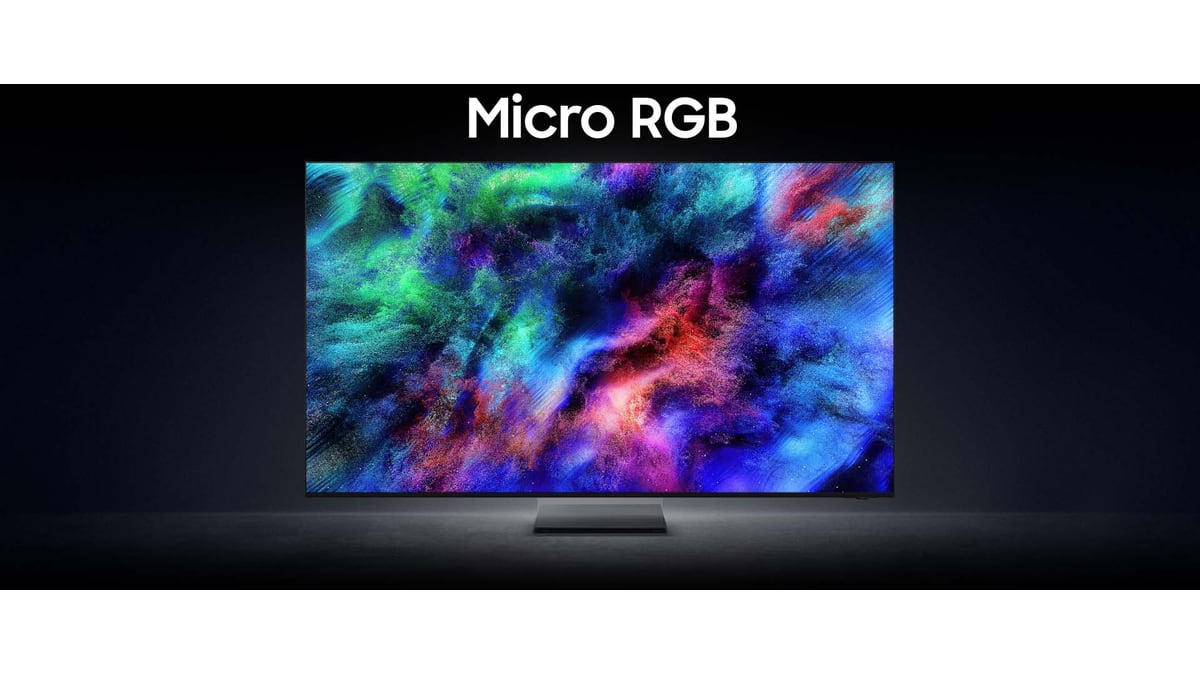
The price wall just got a lot lower
For years, the conversation around Samsung's Micro RGB LED range began and ended with a single, rather uncomfortable number: the kind of price that made even committed home cinema enthusiasts quietly close the browser tab. The 115-inch MR95F, carried over from 2025 at US$29,999.99, is the product that defined the category's reputation: extraordinary technology, extraordinary cost. CES 2026 changed the shape of that conversation in a meaningful way.
Samsung arrived in Las Vegas in January 2026 with two entirely new series, the R95H and the R85H, that extend the Micro RGB LED lineup downward in both screen size and, importantly, price. We are now looking at an 85-inch R95H at $6,499.99, a 75-inch for $4,499.99, and a 65-inch at $3,199.99. Step down to the R85H and the numbers become genuinely accessible by high-end display standards: 85-inch at $3,999.99, 75-inch at $2,799.99, 65-inch at $2,099.99, and a 55-inch entry point at $1,599.99. That last figure, in particular, represents a threshold that would have been unthinkable in this product family even eighteen months ago.
The 100-inch model and the Australian angle
Samsung has also confirmed that a 100-inch model is expected to arrive later in 2026, which will slot in between the current carryover 115-inch and the new R95H 85-inch, filling in the upper end of the size range with something slightly less financially terrifying than the flagship. The trajectory is clear: Micro RGB LED is moving from a trophy product to a considered purchase.
For Australian home cinema buyers, this matters. We have historically paid a significant premium over US retail for premium display technology, so the AU pricing will require careful watching when local availability is confirmed. But the directional shift in Samsung's strategy (broader sizing, lower entry points, more SKUs) signals genuine intent to grow the category rather than protect it as a luxury niche.
Micro RGB LED terminology: this is not The Wall
Before going further, the naming confusion that follows Samsung's display strategy like a persistent shadow needs addressing. The phrase "Micro LED" in the audio-visual industry technically refers to emissive microLED technology: individual microscopic LEDs that both produce and control light at the pixel level, with no separate backlight required. Samsung's The Wall is the canonical example of true emissive microLED, and it remains a commercial product aimed squarely at high-end installations at prices that make the MR95F look affordable.
The R95H and R85H are not that. These are RGB mini-LED-backlit LCD televisions, a refined and highly capable technology, but fundamentally a different architecture. The distinction matters: in a mini-LED-backlit LCD display, the LEDs form a dense backlight array behind an LCD panel. Local dimming zones, potentially very many of them, allow the backlight to be selectively brightened or darkened to improve contrast. The "RGB" component refers to the use of separate red, green and blue LED elements rather than white LEDs with a colour filter, which expands the colour gamut and allows more precise colour tuning at the backlight level.
This is genuinely impressive engineering. RGB mini-LED backlighting can push colour volume and peak brightness to levels that challenge the colour accuracy claims of OLED while substantially exceeding OLED's peak brightness ceiling. But it is still an LCD display, with the residual blooming and haloing artefacts that LCD's fundamental architecture produces around bright objects on dark backgrounds. Samsung's engineering has reduced these artefacts considerably at the high end, but they have not been eliminated, and buyers comparing these panels with OLED alternatives need to understand what trade-offs they are actually making.
The naming, however, will continue to cause confusion. "Micro RGB LED" sounds very close to "microLED," and Samsung has not gone out of its way to draw a bright line between them in consumer marketing. If you are guiding someone through a purchase decision, be clear: this is premium mini-LED LCD, and it is priced and positioned accordingly.
What the price spread means for home cinema builds
The practical impact of Samsung's expanded range depends heavily on what kind of home cinema build you are planning. If you are building a home cinema from scratch, the display is just one line item in a budget that also has to accommodate processing, amplification, speakers, subwoofer, acoustic treatment and cabling. Our piece on the system-building order of operations covers how to sequence those decisions. The fact that Samsung is now offering a credible 65-inch RGB mini-LED panel at $3,199.99 (R95H) or $2,099.99 (R85H) opens up allocation decisions that simply did not exist before.
Consider the maths at the lower end. A 55-inch R85H at $1,599.99 is entering the territory where premium OLED TVs from LG and Sony are competing hard. The question for a buyer at this price point is not simply which panel technology is "better" in the abstract. It is which one is better for their specific room, content mix and viewing habits. A bright, open-plan living room that doubles as a home cinema space will behave very differently from a dedicated, light-controlled room, and RGB mini-LED's higher peak brightness ceiling can be a genuine advantage in the former context.
Where the R95H sits against projection
At the upper end, the 85-inch R95H at $6,499.99 is competing with premium OLED and with high-gain short-throw laser projection. A very capable native 4K projector like the Sony VPL-XW5000ES (check price) sits in a broadly comparable price bracket and can put up a much larger image. But it requires a properly light-controlled room and a quality screen, adds complexity to the install, and does not match a direct-view panel's handling of fast motion or its resistance to ambient light. If you are weighing the projector route, our notes on screen-wall speaker placement around a UST projector show how much extra planning that path involves. The R95H 85-inch is targeting buyers who want the biggest direct-view panel they can afford without the compromises of a projector-based system.
The 100-inch R-series model expected later in 2026 will be particularly interesting at whatever price Samsung lands it. One hundred inches is a size that currently lives in the gap between credible consumer direct-view TVs and full-scale projection systems, and a well-priced Micro RGB LED option at that size could genuinely disrupt the home cinema projection market for buyers who are noise-sensitive or who cannot achieve proper light control.
The broader context: displays as screens, not appliances
Samsung's strategy here is part of a broader shift in how the premium display market positions itself. The concept of a display as a dedicated cinema screen, a panel chosen and installed with the same deliberate care as a projector and screen combination, has been gaining traction in enthusiast circles for several years. The proliferation of Dolby Atmos-capable content on streaming platforms, combined with the improving light output and colour performance of direct-view panels, has made it increasingly viable to build a genuinely satisfying home cinema without ever hanging a projection screen.
Samsung's Micro RGB LED positioning leans into this heavily. These are not products marketed on smart TV features or thin bezels. They are marketed on image performance, and specifically on the kind of image performance that was previously only available from commercial-grade hardware. The RGB backlight architecture, the expanded colour volume, the high peak brightness numbers: all of these speak to a buyer who is thinking about the display as a performance component rather than a household appliance.
For that buyer, display selection is the same kind of considered process as amplifier or speaker selection. You listen, or in this case look, carefully, you understand the technical architecture, and you think about how the product will behave in your specific environment over time. The same discipline that leads someone to spend hours comparing AV receiver specifications (check price) before committing to a purchase applies equally here.
AU pricing and availability: what to expect
The prices cited throughout this article are US retail figures from CES announcements. Australian retail pricing for Samsung display products has historically landed with a conversion premium over US MSRP, which is not unusual for the Australian market but is worth factoring in as you plan a budget. At the time of writing, confirmed Australian pricing and availability dates for the R95H and R85H series had not been published.
What I would suggest: treat the US prices as a directional indicator and budget conservatively for AU retail. The relative positioning between models should hold, with the R85H undercutting the R95H at each size and the 55-inch entry point remaining the most accessible, but the absolute numbers will be higher than a straight currency conversion implies. Watch for announcements from Samsung Australia in the months following CES, and resist the temptation to import unless you are fully across the warranty and compatibility implications.
Samsung's extended warranty and calibration support infrastructure in Australia is also more developed for its premium display lines than it was even three years ago, which matters for a product at this price point. A display costing several thousand dollars warrants professional calibration after installation, particularly in a dedicated home cinema environment where you are trying to extract the best possible performance from the hardware.
Who should be paying attention
The arrival of the R85H series in particular changes the conversation for a specific type of buyer: someone who has been sitting on the fence between a premium OLED in the 65-to-77-inch range and something larger, and who has been deterred from going bigger by the price cliff that previously existed in the Micro RGB LED range. At $2,099.99 USD for a 65-inch R85H, Samsung is asking you to compare directly with upper-mid-range OLED, and that is a comparison it is confident about making.
For the dedicated home cinema builder, the 85-inch and 75-inch R95H models represent the sweet spot: large enough to deliver genuine cinematic impact in a purpose-built room, capable enough technically to justify the premium over OLED, and now priced in a range where the rest of a high-performance system budget (processing, a quality AV receiver, a capable subwoofer like the SVS SB-3000 (check price), and appropriate acoustic treatment) can still be funded without heroics.
For the enthusiast who is primarily a music listener and uses the home cinema space secondarily, the calculus is different. Your display budget is competing directly with your audio budget, and the question of how much screen you actually need is worth asking honestly. But for those who are serious about both disciplines, and many of our readers are, the emergence of a credible $2,099 to $6,499 range within the Micro RGB LED family means that the display no longer has to consume the entire project budget.
The road ahead for Micro RGB LED
Samsung's expansion of the Micro RGB LED lineup at CES 2026 is not a surprise to anyone who has been tracking the company's display roadmap, but it is a meaningful milestone. The technology is maturing, the manufacturing costs are coming down, and the competitive pressure from OLED, particularly LG's continued refinement of its panel technology and Sony's processing expertise, is pushing Samsung to broaden its attack.
The pending 100-inch model is the one I am most curious about. If Samsung can price it sensibly relative to the R95H 85-inch, it will occupy a screen size that has no real direct-view competitor at anything like a consumer price point. Whether that materialises before the end of 2026 as indicated, and at what price, will tell us a great deal about how aggressively Samsung intends to push this technology into the mainstream.
The 115-inch MR95F carryover at US$29,999.99 remains in the range as the unreachable aspirational anchor. But the story of Samsung's Micro RGB LED range in 2026 is not about that product. It is about the R85H 55-inch at $1,599.99, and in my view that number is the one that changes what this technology means for Australian home cinema buyers.
Common questions
- What is the difference between Samsung's Micro RGB LED TVs and true microLED (The Wall)?
- Samsung's Micro RGB LED TVs — including the new R95H and R85H series — are RGB mini-LED-backlit LCD televisions. They use a dense array of small RGB LEDs behind an LCD panel to improve brightness and colour volume. True microLED, as used in Samsung's The Wall, is an emissive technology where individual microscopic LEDs produce light at the pixel level with no separate LCD layer or backlight required. The two are fundamentally different architectures, with true microLED being far more expensive and currently aimed at commercial and ultra-premium installations.
- Are the R95H and R85H prices quoted in Australian dollars?
- No — the prices cited in this article are US retail figures announced at CES 2026. Australian pricing and availability had not been confirmed at the time of publication. Australian retail prices for Samsung display products typically carry a premium over a direct currency conversion from US MSRP. Monitor Samsung Australia's official announcements for confirmed local pricing.
- How do Samsung's new Micro RGB LED TVs compare to OLED at similar price points?
- RGB mini-LED-backlit LCD panels like the R85H and R95H can offer significantly higher peak brightness and expanded colour volume compared to OLED, which can be advantageous in rooms with ambient light or for HDR content with very bright highlights. OLED retains advantages in absolute black levels and the absence of backlight blooming artefacts around bright objects on dark backgrounds. The right choice depends on your room environment, content preferences and viewing habits — neither technology is universally superior.
- What size Samsung Micro RGB LED TV is best suited to a dedicated home cinema room?
- For a dedicated, light-controlled home cinema space, the 85-inch or 75-inch R95H models offer the best balance of screen size, image performance and price within the new 2026 lineup. The 100-inch model expected later in 2026 would also be worth considering for larger rooms. Screen size selection should ultimately be driven by seating distance — as a rough guide, for 4K content, a viewing distance of roughly 1 to 1.5 times the screen height is typically recommended for full resolution benefit.

Theo here. By day I write software, by night I argue with people on forums about whether bit-perfect playback is "solved" (it mostly is, and then it isn't). I cover the digital end — DACs, streamers, servers, the whole messy ecosystem of getting a file to sound its best. My promise to you: I'll separate the genuine engineering from the audiophile folklore, and I'll never tell you a $500 streaming bridge sounds "blacker" unless I can explain why.
Software engineer; network-audio and DAC specialist
More from Theo Mensah
 Dongle DAC power limits: when a phone can't drive headphonesDongle DACs are brilliant until they aren't. Here's how to work out whether your phone-and-dongle rig actually has the current to drive your headphones.
 DNS and multiroom: why your streamer drops out at the worst timeMultiroom dropouts are rarely your Wi-Fi. Here's why DNS resolution quietly breaks streaming apps, and how to fix it for good.
- Parallel vs series IEM crossovers: why multi-driver in-ears sound so differentWhy do two IEMs with the same driver count sound nothing alike? The crossover topology is doing more work than the drivers themselves.
- Streaming a subwoofer's EQ filters: why your network player might be the bottleneckYour sub's miniDSP or app-based EQ can only act on a signal your streamer hasn't already mangled. Here's where network audio and bass management actually interact.
 Amplifier gain structure: the setting that decides your noise floorGain mismatches between DAC, preamp and power stage quietly wreck dynamic range. Here's how to actually set gain structure instead of guessing at the volume knob.
 Bass management by the numbers: what your AVR's crossover and slope actually doCrossover frequency gets all the attention, but slope, distance settings and speaker size flags quietly decide whether your bass management works or fights itself.