Headphone soundstage: why some pairs sound "wide" and others don't
A reader emailed me last month asking why his Sennheisers "sound like a room" and his IEMs "sound like they're inside his skull." He'd read three forum threads about soundstage, come away more confused than when he started, and wanted the acoustics answer rather than the marketing one. Fair question. I do rooms for a living, but the same physics that governs why your sofa wall kills bass also governs why a headphone can sound wide, narrow, forward or spacious — and almost none of it is folklore.
Soundstage on headphones is a slightly odd thing to chase, because strictly speaking there's no stage. There's no room. There are two drivers sitting a few centimetres from your eardrums, and everything you perceive as width, depth or "air" is your brain doing localisation work with incomplete information. That's not a criticism — it's just the starting point for understanding why some headphones do it convincingly and others don't, and why chasing a wider stage isn't as simple as buying a bigger driver.
Why loudspeakers get soundstage almost for free
With stereo speakers, soundstage is largely a product of the room and the setup. Sound from the left speaker reaches your right ear a fraction later and quieter than it reaches your left ear, and vice versa. Your brain uses that interaural time difference and interaural level difference to build a stereo image that sits out in front of you, between and beyond the speakers. Room reflections add depth and a sense of space around instruments. Get the toe-in and the rear-wall distance right — something I've written about at length — and a decent pair of standmounts on proper stands will throw a stage that extends well past the cabinets.
Headphones don't get any of that for free. Each ear only hears its own channel. There's no crosstalk between left and right, no time-of-arrival difference from a shared room, no reflections building depth cues. That's precisely why headphone imaging tends to collapse into your head rather than project outward — engineers call it "inside the head localisation," and it's the single biggest perceptual difference between headphone and speaker listening.
What open-back headphones are actually doing differently
Open-back designs don't fix the fundamental problem, but they help in a specific, measurable way. Because the rear of the driver isn't sealed against a closed cup, there's some interaction between the driver's rear wave and the space around your ear — a little bit of the room leaks back in, and a little bit of driver resonance that would otherwise reflect straight back at your eardrum in a closed cup gets to dissipate instead. The practical result is usually a flatter, less boxy midrange and a sense of the sound sitting slightly further from your head rather than pressed against it.
This is why open-backs like the Sennheiser HD 660S2 (check price) or the Focal Clear MG (check price) get described as spacious even though, strictly, there's still no real stereo crosstalk happening. It's not an illusion exactly, but it's also not the same mechanism that gives speakers their stage. I'd argue a lot of the "open-back soundstage" praise in forum threads conflates two different things — genuine driver behaviour, and the simple fact that open cups leak ambient room noise back in, which your brain interprets as spatial cues even when they're not musically meaningful. Worth knowing before you pay a premium purely chasing "airiness."
Closed-back designs like the Beyerdynamic DT 1990 PRO MK II (check price) (which actually ships with interchangeable pads specifically to manage this) trade some of that openness for isolation and usually more impactful bass, because a sealed cup reinforces low frequencies rather than letting them escape. Neither approach is "better" in the abstract — it depends whether you're at a desk in a quiet room or in an office where isolation matters more than air.
Driver geometry and angling change more than you'd expect
Planar magnetic headphones like the Audeze LCD-X (check price) often get described as having a different stage character to dynamic drivers — usually flatter and more forward, sometimes described as "walled" in a way some listeners love and others find claustrophobic. Part of this is driver behaviour: a large, flat planar diaphragm radiates differently to a small dynamic dome, with a more uniform dispersion pattern directly at the ear.
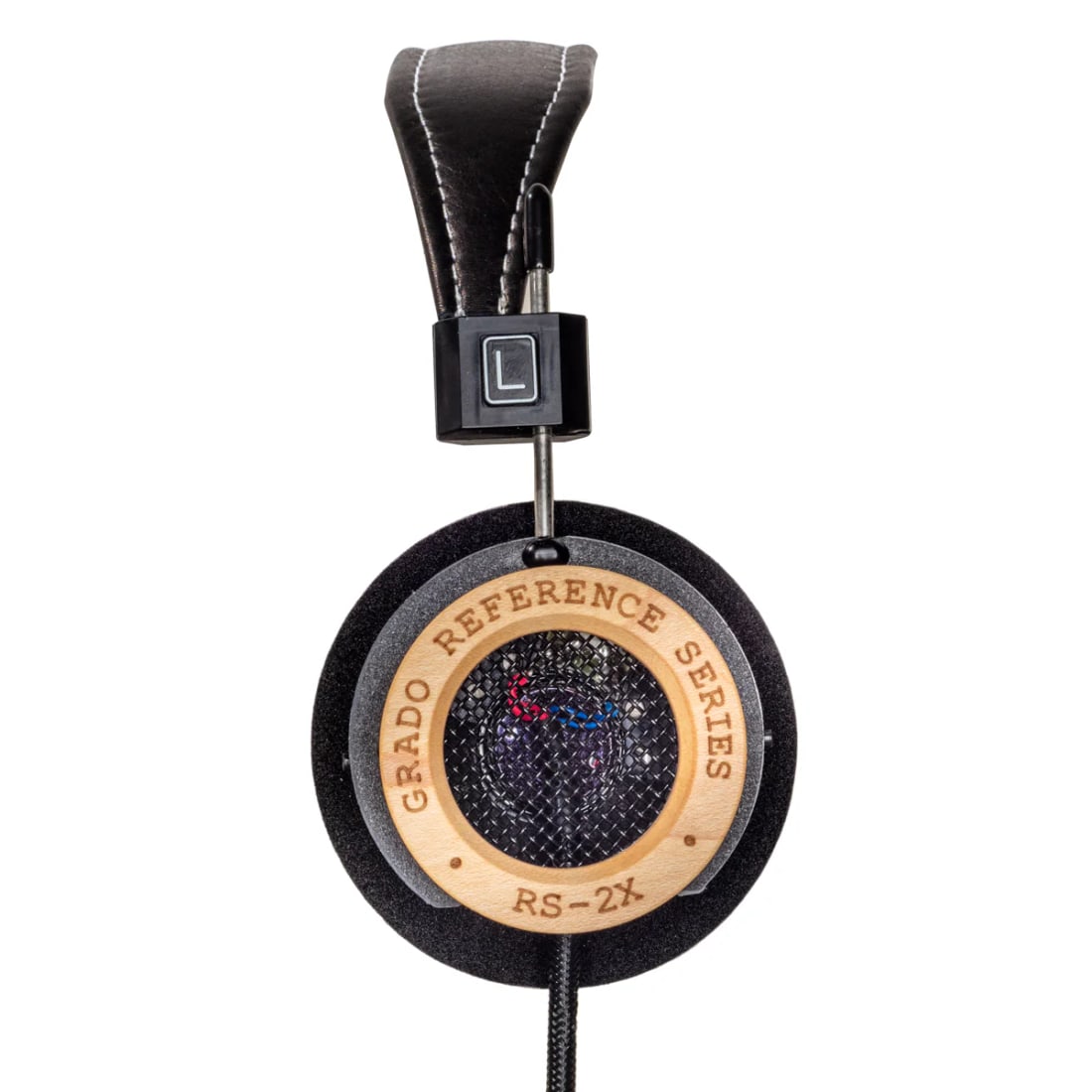
But a genuinely underrated factor is simply the angle of the driver relative to your ear canal. Some designs, including a few from Grado, mount the driver flat and close; others angle it slightly forward, which changes the arrival timing and reflection pattern inside the cup in a way that can genuinely shift perceived depth. It's a small mechanical decision that has an outsized effect on how "in-your-head" versus "in-front-of-you" a headphone sounds, and it's rarely mentioned in spec sheets because there's no clean number to put on a box for it.
Crossfeed: the one genuine soundstage fix that actually works
If you want the closest thing to a real engineering solution to inside-the-head localisation, it's crossfeed — and it's the one lever here I'd call unambiguously effective rather than a matter of taste. Crossfeed processing takes a small, delayed, filtered amount of the left channel and mixes it into the right (and vice versa), mimicking the acoustic crosstalk your ears would naturally get from a pair of speakers in a room. Done well, it genuinely pulls hard-panned mixes back toward a plausible front-of-you image instead of two separate mono sources either side of your skull.
Desktop DAC/amps with digital signal processing, and some standalone units like the RME ADI-2 DAC FS (check price), include crossfeed as a selectable filter. It's not always obvious in the menus, and a lot of owners never turn it on. My honest opinion: for headphone listening of anything mixed for speakers — which is most commercially released music — crossfeed should be on more often than it is. Purists resist it because it's "processing," but so is the mastering chain, the mic placement and the mix itself. If it makes hard-panned 1970s rock sound like a band rather than two bands standing either side of your head, that's a win, not a compromise.
Amping and the stage you're not hearing
Underpowered or poorly matched amping doesn't create width, but it absolutely can destroy it. Headphones with higher impedance or lower sensitivity — a lot of planars fall into this camp — need enough current and voltage swing to maintain control at the frequency extremes. Starved of that, the midrange can smear and low-level detail gets buried, which collapses the sense of separation between instruments even if the raw frequency response measures fine. This is a big part of why pairing genuinely matters and isn't just marketing from amp manufacturers — a unit like the Chord Electronics Mojo 2 (check price) or a proper desktop stack from our best desktop DAC/amps guide earns its keep here, not by adding "space" from nowhere, but by not subtracting the separation that was already recorded.
I'll admit I underestimated this for years, assuming impedance-matching mattered mostly for volume headroom. It doesn't. It's a control problem, not a loudness problem, and it shows up specifically as congestion in busy passages — exactly where stage width should be doing its job separating instruments.
IEMs and the tightest stage of all
In-ear monitors have the least physical space to work with of any headphone category, which is exactly why their stage tends to be the most compressed and cable and tip choices get discussed so intensely in that community. Tip selection changes the seal depth in your ear canal, which shifts the effective distance between driver and eardrum and can measurably change the high-frequency response — enough to affect the sense of air even before you touch the cable. Whether swapping cables changes anything meaningful is a separate and more contested question, and I'd point sceptical readers toward the deeper argument in our piece on IEM cable and tip rolling rather than relitigate it here. My honest take: tips do something real and repeatable; cables mostly don't, beyond build quality and connector reliability.
What actually moves the needle for you at your desk
If you're chasing stage width specifically, the order of operations I'd suggest is: get pads and seal right first (they change frequency response and thus perceived space more than almost anything else), try crossfeed if your DAC or amp offers it, and only then consider swapping headphones purely for "soundstage" reasons. A well-recorded acoustic album on the Meze Audio 109 Pro (check price) will out-stage a poorly recorded one on a headphone twice the price, every time. The recording matters more than most gear reviews admit.
And if headphone stage still frustrates you after all that, it might genuinely be a room problem in disguise — not your headphone room, but the fact that you've spent years training your ears on speakers in a treated space and expecting headphones to replicate an experience they're not built to deliver. That's not a flaw in the headphones. It's just a different instrument doing a different job.
Our full audiophile headphones guide covers specific models across open and closed designs if you want a shortlist to start auditioning against your own ears rather than a spec sheet.
Common questions
- Do open-back headphones always have a wider soundstage than closed-back?
- Usually, but not always. Open-back designs tend to sound less boxy and slightly more spacious because the rear wave isn't trapped, but driver design and pad geometry matter just as much. Some well-engineered closed designs, like the Beyerdynamic DT 1990 PRO MK II with its swappable pads, get surprisingly close.
- Does a headphone amplifier actually change soundstage width?
- Not directly, but a mismatched or underpowered amp can smear low-level detail and congest busy passages, which collapses the sense of separation between instruments. That reads as a narrower stage even though the amp isn't adding or removing spatial information.
- Is crossfeed processing worth using?
- For most commercially mixed music, yes. It reintroduces a small amount of the crosstalk your ears would naturally get from stereo speakers, which pulls hard-panned instruments toward a more natural front-of-you image instead of two separated mono sources.
- Why do my IEMs sound narrower than my over-ear headphones?
- Physical proximity to the eardrum and the shorter acoustic path give IEMs inherently less room to create a sense of space. Tip selection and seal depth can shift the high-frequency response enough to change the perceived air, though the effect is smaller than switching to an over-ear design.

Hi, I'm Hannah. Speakers are my thing — specifically, the conversation between a speaker and the room it's in, which is where most systems are won or lost. I did acoustics at uni and never quite got it out of my system. I'll measure your room's bass response and then gently break the news that the $20,000 speakers aren't the problem, the untreated wall behind your sofa is. Stand-mounts on good stands are criminally underrated and I will die on that hill.
Acoustics background; loudspeaker and room-treatment specialist
More from Hannah Reid
 First reflections: finding them, and what to actually do about themThe mirror trick still finds first reflection points better than any app. Here's how to locate them and what treatment actually earns its keep.
- Turntable wall shelves versus stands: what actually kills footfall bassFootfall bass in vinyl playback usually isn't the turntable's fault. It's the floor. Here's how to work out whether a wall shelf or a proper stand fixes it.
 Why your amplifier struggles below 4 ohms (and when to actually worry)Impedance dips scare buyers more than they should. Here's how to read a speaker's impedance curve and match it to an amp that won't run out of puff.
- Subwoofer placement: the crawl test still beats any appRoom-correction apps are handy, but the old carpet-crawl method still finds the seat-by-seat bass problems software glosses over.
- Plinth-to-wall distance: the turntable spec nobody checksWhere you put the turntable on the rack matters as much as the rack itself. Here's how boundary distance and shared surfaces feed feedback into the cartridge.
- Corner bass traps: how many you actually need before diminishing returns kick inTwo traps help, four help more, but the eighth one rarely does much. Here's how to work out where your room's bass treatment budget stops paying off.